三峡能源

Search documents
风电的另一场革命
Ge Long Hui· 2025-11-07 06:42
Core Viewpoint - The emergence of unmanned operation and maintenance (O&M) in the wind power sector represents not only a technological upgrade but also a revolutionary restructuring of industry logic [1] Group 1: Industry Challenges - The wind power industry in China faces significant challenges, including high labor costs, a shortage of skilled professionals, and harsh environmental conditions, particularly in remote areas [2][3] - Over 70% of wind farms are located in harsh environments, leading to low efficiency in manual inspections and increased safety risks [2] - The annual turnover rate for wind power maintenance personnel exceeds 20%, with high training costs and time requirements for skilled workers [2] Group 2: Unmanned O&M Solutions - Unmanned O&M effectively addresses the challenges faced by traditional wind power maintenance, utilizing drones, robotic dogs, and track-mounted robots for inspections and data collection [3][4] - The implementation of unmanned O&M has resulted in a reduction of over 3,000 hours of inspection work per year, an 80% improvement in fault response time, and a 3-5 times increase in safety [3][4] Group 3: Technological Framework - The unmanned O&M system is a complex integration of hardware, algorithms, and data, featuring a "cloud-edge-end" architecture that enhances operational efficiency [4][5] - The "cloud" serves as the central brain, optimizing fault recognition through machine learning and adapting to specific environmental conditions [5] - The "edge" acts as a bridge, processing local data and ensuring operations continue even in unstable network conditions [5] Group 4: Industry Standardization - The lack of standardized definitions and protocols in the unmanned O&M sector has hindered technology adoption, prompting industry leaders to establish a classification system for operational intelligence levels [6][7] - The introduction of standardized guidelines is expected to transition unmanned O&M from customized solutions to standardized products, facilitating broader implementation [7] Group 5: Cost and Talent Transformation - As technology advances and scales, the costs associated with unmanned O&M are expected to decrease significantly, with potential savings of 20 personnel per site in ideal conditions [7][8] - The workforce is undergoing a transformation, requiring traditional maintenance personnel to acquire new skills in system management and data analysis [8] Group 6: Future Prospects - The application of unmanned O&M systems is set to expand to offshore wind farms, which present greater operational challenges and costs [9] - The broader implications of unmanned O&M extend beyond the wind power sector, contributing to the overall efficiency and technological advancement of the energy industry [9]


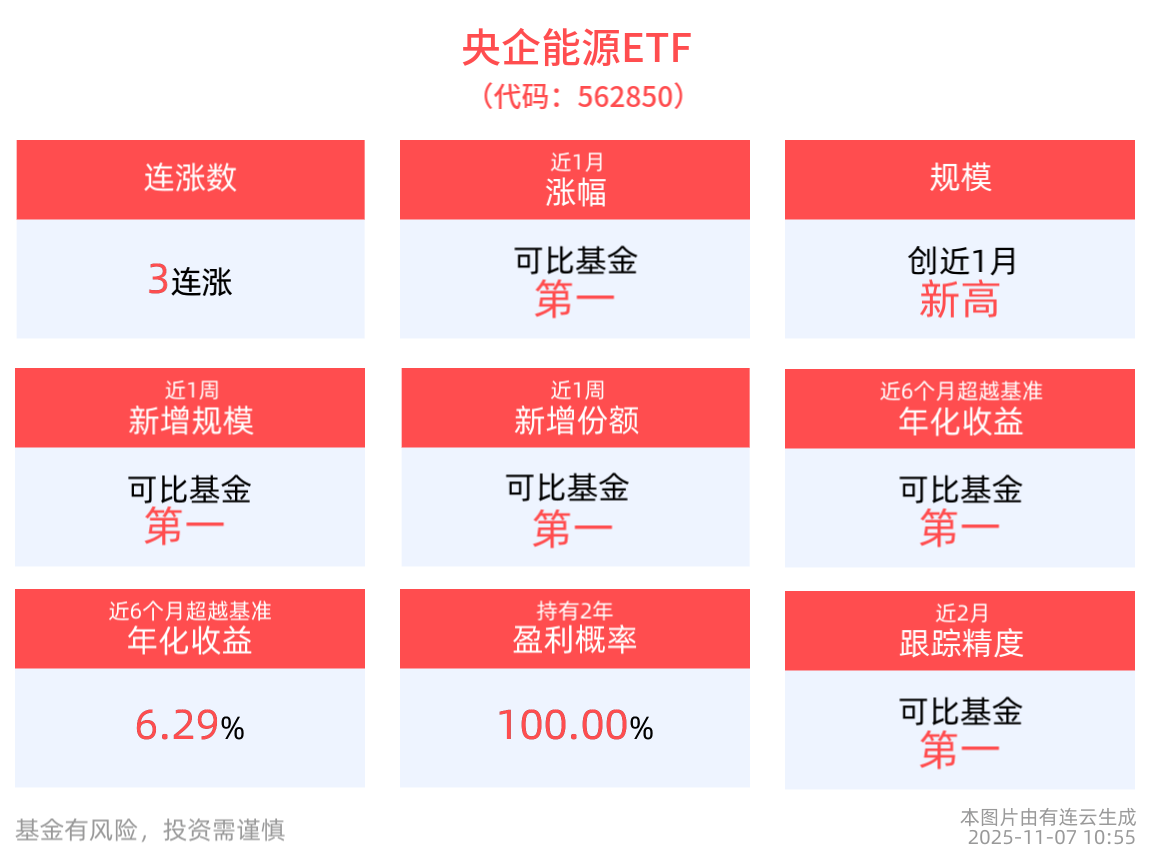
AI拉动电力需求背景下,央企能源ETF(562850)盘中上扬冲击3连涨,机构:中国将开启持续10年电力超级周期
Sou Hu Cai Jing· 2025-11-07 03:27
Group 1: ETF Performance - The Central State-Owned Enterprises Energy ETF has a turnover rate of 4.66% and a transaction volume of 3.57 million yuan as of November 6 [2] - Over the past two years, the net value of the Central State-Owned Enterprises Energy ETF has increased by 38.81%, ranking first among comparable funds [2] - The ETF's highest monthly return since inception is 10.15%, with the longest consecutive monthly gains being 7 months [2] - The ETF has outperformed its benchmark with an annualized excess return of 6.29% over the past six months, also ranking first among comparable funds [2] Group 2: Top Holdings - As of October 31, 2025, the top ten weighted stocks in the CSI National New Central State-Owned Enterprises Modern Energy Index include: - Changjiang Electric Power (8.43%) - Guodian NARI Technology (7.19%) - China Nuclear Power (5.60%) - China Aluminum (5.09%) - Three Gorges Energy (4.75%) - China Power Construction (3.75%) - Guodian Power (3.46%) - Yun Aluminum (3.35%) - China Rare Earth (2.99%) - Others [2][4] Group 3: Market Outlook - UBS predicts that China will enter a 10-year electricity supercycle, with annual electricity demand growth expected to surge to 8% between 2028 and 2030, doubling previous market estimates of 4% [5] - The driving force behind the electricity supercycle is attributed to structural changes in demand, driven by new productive forces, traditional industry upgrades, and rising consumer spending [5] - According to Changjiang Securities, the U.S. may face a total electricity shortfall of approximately 73.2 GW from 2025 to 2030, which could increase to 201 GW if data center growth exceeds expectations [5] - Huaxi Securities notes that the demand for electricity equipment is expected to remain high due to the need for upgrades and expansions in the electricity system, driven by AI-related electricity demand [5] Group 4: Investment Access - Investors without stock accounts can access high-quality energy central enterprises through the Central State-Owned Enterprises Energy ETF Connect (019593) [6]

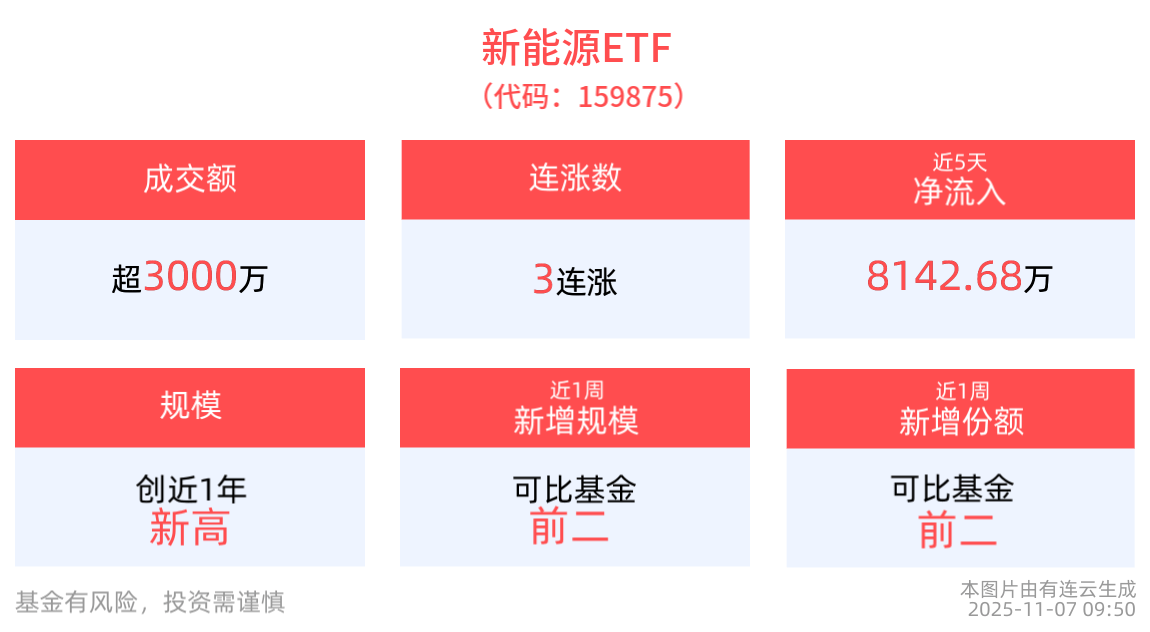
新能源ETF(159875)逆市上扬冲击3连涨,机构:持续看好储能全球共振
Sou Hu Cai Jing· 2025-11-07 02:20
Group 1: ETF Performance - The New Energy ETF has a turnover rate of 2.21% with a transaction volume of 33.46 million yuan [3] - The latest scale of the New Energy ETF reached 1.513 billion yuan, marking a new high since its establishment [3] - In the past week, the New Energy ETF saw a significant increase of 10.2 million shares [3] - Over the last five trading days, there were net inflows on three days, totaling 81.43 million yuan [3] - As of November 6, the net value of the New Energy ETF has increased by 69.97% over the past six months, ranking 151 out of 3850 in index equity funds, placing it in the top 3.92% [3] - The highest monthly return since inception was 25.07%, with the longest consecutive monthly increase being six months and a maximum increase of 67.53% [3] - The average return during the months of increase is 8.57% [3] Group 2: Market Trends and Opportunities - According to CITIC Securities research, the market is recovering, and there is a positive outlook on the global trend of energy storage [3] - The domestic energy storage sector is experiencing a significant economic turning point, driven by the marketization of new energy and capacity electricity prices [3] - The cumulative penetration rate of energy storage is still below 10%, with an upward adjustment of new domestic installations to 300 GWh for next year [3] - The largest overseas opportunity arises from the demand for energy storage in data centers, with leading companies already securing substantial orders [3] - Energy storage is expected to drive lithium battery demand growth exceeding 30% next year, presenting investment opportunities across materials, batteries, and integration [3] Group 3: Key Stocks in New Energy Index - As of October 31, 2025, the top ten weighted stocks in the CSI New Energy Index include: Sunshine Power, CATL, Longi Green Energy, EVE Energy, TBEA, Huayou Cobalt, Ganfeng Lithium, China Nuclear Power, Tongwei Co., and Lead Intelligent [5] - The combined weight of the top ten stocks accounts for 46.1% of the index [5]




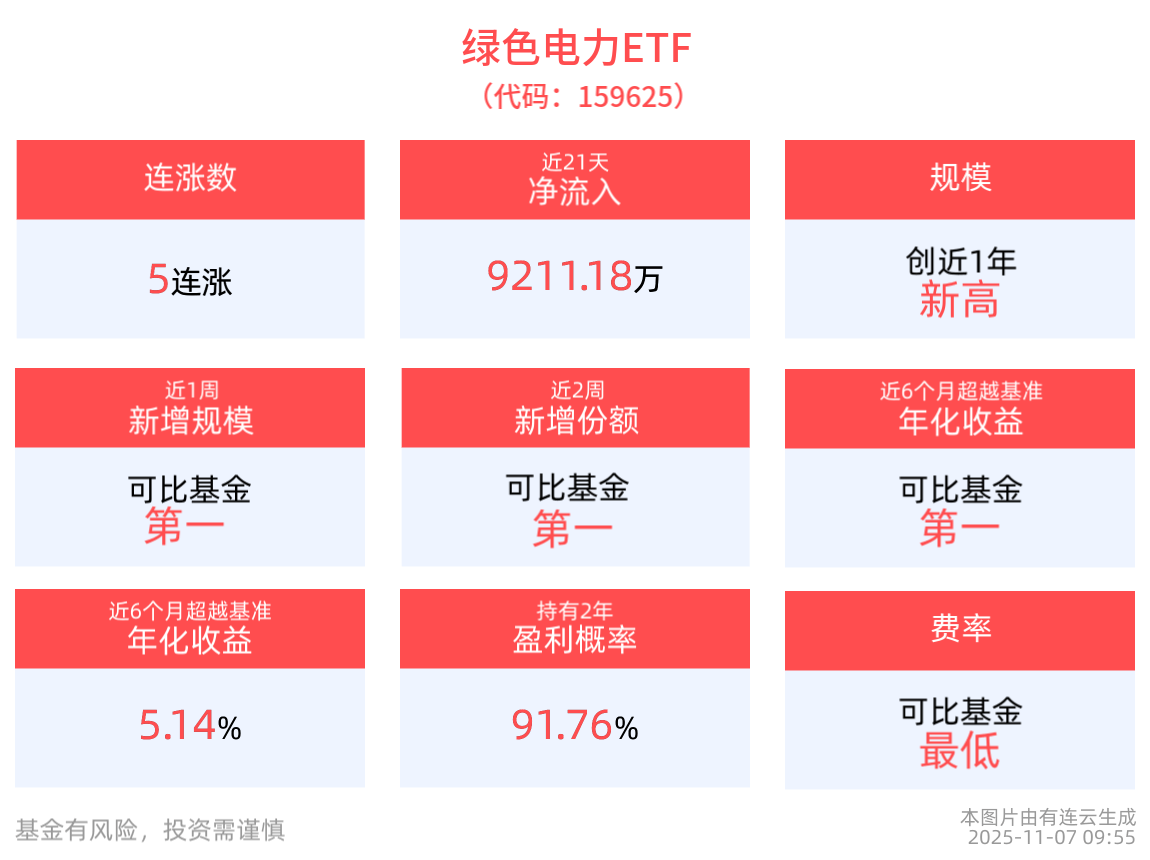
绿色电力ETF(159625)盘中涨近1%冲击5连涨,最新规模创近1年新高!
Sou Hu Cai Jing· 2025-11-07 02:20
Group 1: Green Power ETF Performance - The Green Power ETF has a turnover rate of 2.02% with a transaction volume of 9.0205 million yuan [2] - The latest scale of the Green Power ETF reached 444 million yuan, marking a one-year high and ranking first among comparable funds [2] - Over the past two weeks, the Green Power ETF's shares increased by 2 million shares [2] - In the last 21 trading days, there were net inflows on 11 days, totaling 92.1118 million yuan [2] - As of November 6, the net value of the Green Power ETF has risen by 24.10% over the past two years [2] - The highest monthly return since inception was 9.19%, with the longest consecutive monthly gains being 6 months and the highest cumulative gain being 14.85% [2] - The Green Power ETF outperformed its benchmark with an annualized excess return of 5.14% over the past 6 months, ranking first among comparable funds [2] Group 2: Electricity Consumption and Generation - From January to September, the total electricity consumption reached 77,675 billion kWh, a year-on-year increase of 4.6% [3] - The industrial electricity generation for the same period was 72,557 billion kWh, showing a year-on-year growth of 1.6% [3] - Breakdown of electricity generation from major sources shows thermal power and hydropower decreased by 1.2% and 1.1% respectively, while nuclear, solar, and wind power increased by 9.2%, 24.2%, and 10.1% respectively [3] - The total electricity consumption is expected to grow by around 5% for the entire year, with fourth-quarter growth anticipated to exceed that of the third quarter [3] - It is projected that by the end of 2025, the total installed power generation capacity will reach approximately 3.9 billion kW, a year-on-year increase of 16.5% [3] Group 3: Key Stocks in Green Power Sector - The top ten weighted stocks in the National Green Power Index account for 56.15% of the index, including companies like Three Gorges Energy, China Nuclear Power, and Yangtze Power [2] - The individual weightings of these stocks range from 9.60% for Three Gorges Energy to 2.82% for Huaneng International [5]





广东耕海牧渔:“粤字号”海鲜的全球大生意
2 1 Shi Ji Jing Ji Bao Dao· 2025-11-06 23:19
Core Insights - Guangdong is transforming traditional fisheries into a modern marine ranching industry cluster worth trillions, integrating high-end manufacturing and digital technology [1][2] - The province has launched 139 modern marine ranching projects with a total investment exceeding 20 billion, producing nearly half of the country's marine fish and leading in marine fish seed production for seven consecutive years [1][2] - The future demand for animal protein, if partially met by fisheries, could create a 60 trillion industry in modern marine ranching [1] Group 1: Industrial Development - Guangdong is addressing the challenges of traditional fisheries in deep-sea environments by developing industrialized deep-sea aquaculture equipment [2] - The province has established a complete industrial chain for marine engineering equipment, including design, manufacturing, and service, supported by leading companies [2] - The deployment of intelligent aquaculture platforms has led to significant value creation across different regions in Guangdong [2] Group 2: Technological Advancements - The introduction of AI, 5G, and big data is revolutionizing the operational efficiency of marine ranches in Guangdong [5] - Smart systems have reduced labor costs by 60% and increased harvest yields significantly through precise feeding [4][5] - The integration of 5G technology ensures high-speed data transmission between deep-sea platforms and onshore command centers, enhancing decision-making and management [5] Group 3: Comprehensive Industry System - Guangdong has developed a comprehensive marine ranching system that includes seedling production, feed, platforms, processing, logistics, and tourism [3] - The province is exporting "Yue" branded seafood to North America, the EU, and ASEAN, extending the global reach of its industry [3] Group 4: Innovative Business Models - The exploration of the "marine ranch +" model combines marine ranching with renewable energy and tourism, creating new growth opportunities [6] - The successful integration of wind power and aquaculture has been demonstrated with the launch of the "Mingyu No. 1" platform, showcasing commercial viability [6] - Coral reef restoration techniques are being employed to revitalize marine ecosystems, enhancing biodiversity and tourism potential [6] Group 5: Future Vision - Guangdong's modern marine ranching development reflects a broader vision of China's marine economy, emphasizing industrialization, intelligence, and integrated supply chains [7] - The provincial government aims to create a world-class blue economy by optimizing resource allocation across various sectors [7]
电力行业2025年三季报综述:火电业绩持续修复,水电平稳增长,把握绿电潜在政策催化预期
Huachuang Securities· 2025-11-06 05:15
Investment Rating - The report maintains a "Buy" recommendation for the electricity and public utilities sector, highlighting potential policy catalysts for green energy [1]. Core Insights - The report emphasizes the recovery of thermal power performance driven by declining coal prices, stable growth in hydropower, and the potential for green energy policy catalysts [1][4]. - It identifies key companies with significant profit growth in the thermal power sector, such as JianTou Energy (+231.79%) and JingNeng Power (+125.66%) [4][7]. - The report suggests that if coal prices stabilize and rebound, it may lead to improved electricity prices and profitability for thermal power companies [16][17]. Summary by Sections Thermal Power - **Performance**: The decline in coal prices has significantly improved profitability, with notable profit growth in companies like JianTou Energy (15.83 billion, +231.79%) and JingNeng Power (31.70 billion, +125.66%) [4][7]. - **Outlook**: A potential stabilization and rebound in coal prices could lead to improved electricity prices, enhancing profitability for thermal power companies [16][17]. Hydropower - **Performance**: Companies such as QianYuan Power (+85.74%) and MinDong Power (+32.38%) have shown strong profit growth due to improved water inflow [25][27]. - **Outlook**: The report suggests that a shift in market style could present allocation opportunities for hydropower assets, especially with declining long-term interest rates [33][34]. Nuclear Power - **Performance**: Short-term performance is under pressure, with China Nuclear Power reporting a 10.4% decline in net profit [38][39]. - **Outlook**: The long-term growth potential remains strong, with significant new nuclear projects expected to come online, enhancing future profitability [50][52]. Green Energy - **Performance**: Offshore wind energy companies like FuNeng Power (+12.17%) have shown growth, although traditional green energy faces challenges [55][62]. - **Outlook**: The report anticipates a new growth cycle for offshore wind energy, driven by favorable policies and market conditions [65].
抽水蓄能产业迈向全链协同新生态
Xin Lang Cai Jing· 2025-11-06 04:35
Core Insights - China is rapidly building a new power system under the "dual carbon" goals, with pumped storage hydropower entering a golden period of development as a stabilizer, regulator, and balancer of the power system [1][2] - The transition of pumped storage from a "regulator" to a "stabilizer" reflects the evolving demands of the energy structure transformation and the strategic elevation of pumped storage technology [2][3] - The industry faces challenges such as capacity and technology enhancement, pricing mechanism improvements, and insufficient industry chain collaboration [1][5] Group 1: Function Transformation - Pumped storage is evolving from primarily adjusting electricity supply to providing stability support for the entire system, addressing new challenges posed by high proportions of renewable energy [2][3] - The technology is now capable of providing critical services such as rotational inertia support, rapid reactive power regulation, and black start capabilities, making it essential for grid resilience [2][3] Group 2: Regional Practices - Different regions in China showcase the diverse roles of pumped storage, such as ensuring power supply safety during extreme weather in Northeast China and peak shaving during heating periods in North China [3] Group 3: Industry Chain Development - China has established a comprehensive industry chain for pumped storage, with significant advancements in design, equipment manufacturing, and construction, leading to a market-driven ecosystem [4][5] - Major state-owned enterprises are leading the construction of projects, contributing to substantial investments and job creation [4] Group 4: Structural Challenges - The industry faces structural bottlenecks, including mismatches between capacity and demand, challenges in design resources, and a shortage of qualified construction teams [5][6] - The industry also needs to address the "heavy construction, light operation" phenomenon and improve the pace of talent cultivation to match the growth in installed capacity [5][6] Group 5: Development Paradigm - The future of the pumped storage industry relies on the collaboration of policy, technology, and market forces, moving beyond single-point support to a more integrated approach [7][8] - A robust policy framework, particularly the "two-part electricity price" mechanism, is essential for providing stability and guiding the industry [7][8] Group 6: Technological Innovation - Technological advancements are crucial for meeting the higher demands of renewable energy systems, with innovations such as variable-speed units enhancing system flexibility [7][8] - The digital transformation of the industry is reshaping the entire value chain, enabling pumped storage plants to evolve into intelligent system nodes [8] Group 7: Market Development - The acceleration of a unified national electricity market is changing the operational landscape for pumped storage, creating multiple revenue channels through long-term contracts and market participation [8][9] - Future efforts should focus on refining market rules and establishing pricing mechanisms that reflect the system support value of pumped storage [8][9]
站在全省海洋生产总值破万亿新起点蓝色金融 护航向海图强
Xin Hua Ri Bao· 2025-11-05 23:20
Core Insights - Jiangsu aims to exceed a marine production value of 1 trillion yuan by 2024, with financial support being a key factor in achieving this goal [1] - The establishment of the Blue Finance Service Center and the launch of various financial initiatives indicate Jiangsu's commitment to supporting marine economic development [1][2] Group 1: Financial Innovations - The Guoxin Dafeng 850,000 kW offshore wind power project, with a total investment of approximately 10.6 billion yuan, utilizes an innovative development model combining offshore wind power, marine ranching, and seawater hydrogen production [2] - Jiangsu Bank has designed a "pre-loan + project loan" product to address the complex risk structures of marine projects, providing 8.4 billion yuan in credit [2] - Blue finance is tailored to the unique characteristics of the marine economy, requiring customized financial services [2] Group 2: Regional Financial Initiatives - Coastal cities like Yancheng, Nantong, and Lianyungang are focusing on blue finance, emphasizing support for marine green industries and low-carbon technology [3] - Yancheng has introduced a "carbon finance" series and allocated special credit quotas for marine economy projects, with financial institutions issuing loans totaling 27.3 billion yuan to significant marine projects this year [3] - Lianyungang has created the "Lianhai融" government-bank product to encourage preferential loans for marine industries [3] Group 3: Diverse Financial Tools - Blue finance is still in its early stages, with a limited supply of financial products to meet the diverse financing needs of the marine industry [4] - As of 2024, 30 blue bonds have been issued in China, totaling 30.99 billion yuan, primarily funding offshore wind and seawater desalination projects [4] - Financial institutions are encouraged to develop tailored services for various marine entities, including support for issuing short-term financing and medium-term notes [4] Group 4: Investment and Insurance - The Jiangsu Marine Economy Equity Investment Fund, established in May, has a scale of 2 billion yuan, focusing on the "ten major marine industry chains" and emerging strategic industries [5] - Insurance and financing leasing are being accelerated, with significant risk coverage provided for offshore wind projects [5] - Traditional insurance products are being upgraded to better serve the marine economy [5] Group 5: Collaborative Ecosystem - Jiangsu is building a multi-faceted support system for sustainable marine economic development, including the launch of the Jiangsu Marine Blue Finance Service Platform [6] - The platform has already met financing needs of 2.776 billion yuan for marine enterprises and has gathered 16,300 marine enterprises in its database [6] - The establishment of the Blue Finance Service Center aims to facilitate regular interactions between financial institutions and marine enterprises [6] Group 6: Project Signings - At the recent conference, 17 key projects were signed, covering marine fund investments, cooperation between financial institutions and enterprises, and regional equity market services [7]
向海图强驭风而行,聚链成势绿动未来
Qi Lu Wan Bao· 2025-11-05 11:52
Core Insights - Lushan City is accelerating the construction of a new energy industry system, focusing on offshore wind power and enhancing the entire wind power industry chain to support high-quality regional economic development [1][3] Group 1: Offshore Wind Power Development - Hai Li Wind Power has secured over 1 billion yuan in orders for offshore wind power projects, with production lines operating at full capacity and orders scheduled until 2026 [2] - Lushan has established a strong offshore wind power equipment manufacturing cluster, with over 40 projects and a complete supply chain including core components like main engines, towers, and cables [2][3] - The offshore wind power high-end equipment industrial cluster has been recognized as a strategic emerging industry cluster in Shandong Province, with an expected output value exceeding 15 billion yuan by 2025 [3] Group 2: Energy Storage Innovations - The first 100 MW flywheel energy storage station in China is being developed in Lushan, which will provide rapid response capabilities for grid stability [4] - Lushan has planned a dedicated energy storage area of approximately 600 acres to accommodate various new energy storage projects, including electrochemical and flywheel storage [5] - The city has successfully attracted key energy storage projects, including 500 MW electrochemical storage and 100 MW flywheel storage, indicating initial scale in the energy storage industry [5] Group 3: Project Facilitation and Infrastructure - Lushan has implemented a "project assistance team" mechanism to expedite project approvals, significantly improving efficiency by over 30% [6] - A dedicated road for transporting large equipment has been constructed, addressing transportation challenges for heavy machinery [7] - The city is investing in various support measures, including a new energy industry fund and partnerships with universities to train skilled workers, ensuring a stable production environment for companies [7]
突发!大面积涨停!重磅消息传来!
天天基金网· 2025-11-05 08:16
Core Viewpoint - The electric equipment sector has experienced a significant surge, driven by a UBS report predicting a 10-year super cycle in China's electricity demand, with annual growth rates expected to double from previous estimates [3][8]. Group 1: Market Performance - The electric equipment sector saw a notable increase, with nearly 30 stocks hitting the daily limit or rising over 10% [4]. - Key performers included Can Energy, which reached a 30% limit up, and other companies like Yinen Electric and Zhongzhi Technology, which saw gains exceeding 20% [4][5]. Group 2: Demand Forecast - UBS forecasts that from 2028 to 2030, China's electricity demand will grow at an annual rate of 8%, marking the beginning of a sustained super cycle in the domestic electricity industry [3][8]. - The report highlights that the demand surge is driven by structural changes in consumption, including the rise of new energy vehicles and data centers, which are expected to see an average annual growth rate of over 15% in electricity consumption over the next five years [8][9]. Group 3: Supply Dynamics - The supply side is undergoing significant restructuring under the dual carbon goals, with predictions that the share of renewable energy in domestic power generation will rise from 31% to over 50% in the next five years [10]. - Traditional coal power is transitioning to become a stabilizer in the power system, with integrated projects combining coal power and energy storage becoming mainstream [10]. Group 4: Policy Support - The strong policy attributes of the electricity sector provide a solid foundation for the super cycle, with national plans and funding mechanisms supporting renewable energy and grid upgrades [11]. - The State Grid plans to invest over 1.2 trillion yuan in the next three years to build ultra-high voltage and smart grid infrastructure to address the mismatch between supply and demand [11].