DeepSeek

Search documents
智谱涨近38%、MiniMax涨超25%!港股AI概念股集体走强,报告:2026年中国科技巨头指数将首超美股七巨头
Jin Rong Jie· 2026-01-12 06:13
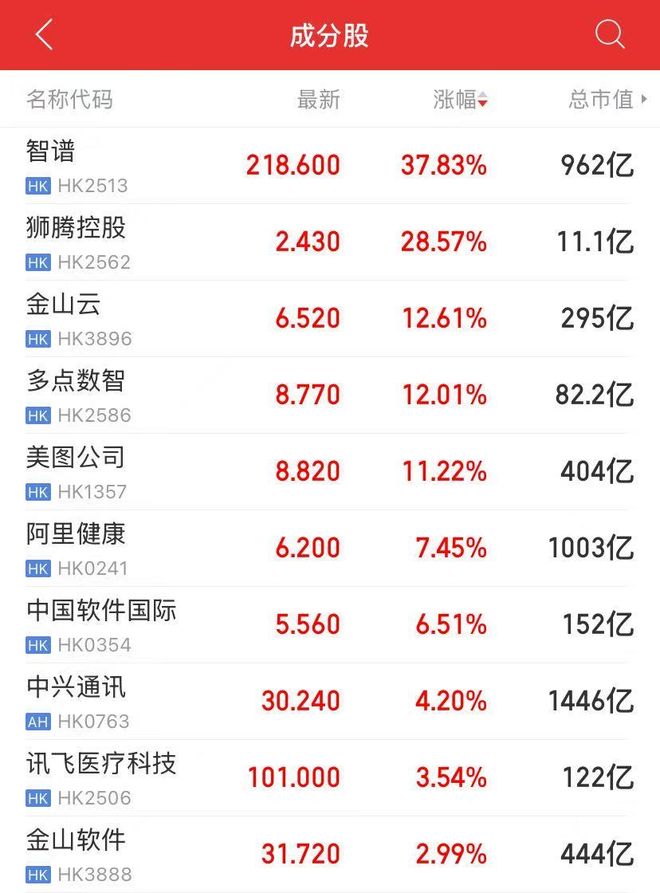
Group 1 - The Hong Kong stock market saw a strong performance on January 12, with significant gains in tech, media, and aerospace sectors, particularly AI concept stocks [1] - Notable performers included Zhihui, which surged nearly 38%, and MINIMAX, which rose over 25% [1] - Other companies that experienced substantial gains include Lion Group (up over 28%), Kingsoft Cloud (up 13%), Meitu (up 11%), and several others in the tech sector [1][2] Group 2 - Bloomberg industry research indicates that the earnings growth of Chinese tech giants is expected to surpass that of the "seven giants" in the US stock market for the first time since 2022, with a significant turning point anticipated in 2026 [3] - DeepSeek is set to release its next-generation V4 model in mid-February, which is expected to excel in programming tasks, long code prompt processing, and improved data pattern understanding [3] - The development of large models is accelerating the commercialization of AI applications, particularly in search & marketing, coding, multimodal applications, agents, and AI for science [3] - The evolution of large models is seen as a key tool for companies with deep industry know-how, particularly in AI healthcare, which is transitioning from a single auxiliary tool to comprehensive lifecycle management [3]

DeepSeek V4大模型被曝春节前后发布!科创人工智能ETF华夏(589010) 放量大涨4.33%,持仓股掀起涨停潮
Mei Ri Jing Ji Xin Wen· 2026-01-12 06:00
Group 1 - The core viewpoint of the news highlights the strong performance of the Sci-Tech Innovation Artificial Intelligence ETF (589010), which surged by 4.33%, indicating robust market sentiment towards AI investments [1][2] - The ETF's trading volume exceeded 252 million yuan, with a turnover rate of over 8%, reflecting high trading enthusiasm and recognition of long-term value in the AI sector [1] - Key constituent stocks such as New Point Software and Hai Tian Rui Sheng experienced significant gains, with New Point Software hitting a 20% limit up and several others rising over 15%, showcasing excellent profit potential [1] Group 2 - Open Source Securities noted that AI innovation is continuously evolving, with model capabilities improving and costs decreasing, particularly with the rise of Chinese open-source models like DeepSeek and Qwen [2] - The development of multi-modal large models is experiencing rapid breakthroughs, which is expected to further enhance application growth in the AI industry [2] - The Sci-Tech Innovation Artificial Intelligence ETF closely tracks the Shanghai Stock Exchange Sci-Tech Innovation Board AI Index, covering high-quality enterprises across the entire industry chain, benefiting from high R&D investment and policy support [2]



大模型能干的事很多,智能体赚钱的其实不多
3 6 Ke· 2026-01-12 05:19
Core Insights - The article discusses the financial struggles of large AI models and their inability to generate profits, with companies like OpenAI projected to lose $14 billion annually until 2029 [1]. - It highlights the reliance on venture capital (VC) funding for sustaining operations in the AI sector, particularly in China where VC support is lacking [5]. - The article contrasts the profitability of certain AI applications, noting that while some companies like Midjourney are profitable, many AI agents face significant challenges in achieving financial viability [8][24]. Financial Performance of AI Companies - OpenAI is expected to be unprofitable until 2029, with annual losses of $14 billion [1]. - Anthropic is projected to reach profitability by 2028 but is currently also incurring losses [2]. - Newly listed MiniMax is losing $500 million annually, similar to another company, Zhipu [3]. - DeepSeek is reportedly profitable, but the overall trend indicates that foundational models are generally unprofitable [4]. AI Agents and Profitability - Glean, an AI agent, has an annual recurring revenue (ARR) of $200 million, but the company is likely to continue seeking additional funding due to the high costs associated with AI operations [6]. - Many successful AI agents are heavily reliant on large-scale financing and acquisitions to sustain their operations [7]. - Companies like Midjourney have demonstrated profitability with a small workforce, generating $500 million annually with only 40 employees, indicating a different operational model [8]. Challenges in AI Implementation - The article identifies two main barriers to profitability for AI agents: precision and cost [9][20]. - Precision refers to the ability of AI to reliably perform tasks in specific business contexts, where high-stakes decisions require near-perfect accuracy [11][15]. - Cost considerations include model costs, which vary between international and domestic models, and the additional expenses associated with personnel and operational overhead [20][21]. The Concept of "Unmanned Companies" - The emergence of "unmanned companies" is presented as a necessary evolution for achieving profitability without relying on VC funding [24]. - These companies would utilize a system of AI agents to drive business operations, with human roles being supportive rather than central [24]. - The transition to unmanned companies is complex and requires a rethinking of production relationships, emphasizing the need for AI to take precedence in operational roles [24][26]. Future Outlook - The article suggests that the pace of AI development may be slower than that of the internet due to ongoing technological instability and the complexities of restructuring production relationships [26]. - Companies are encouraged to consider long-term strategies rather than short-term gains, as the journey towards profitable AI applications is likened to a marathon [26].
国泰海通晨报-20260112
国泰海通· 2026-01-12 05:02
Macro Research - December inflation shows a steady upward trend, driven by low food price base, rising gold prices, and soaring global industrial metal prices, while prices related to domestic demand remain stable [3][28][29] - Core CPI remains resilient, with a year-on-year increase of +1.2% and a month-on-month increase of +0.2%, indicating stable internal demand dynamics [2][28][29] Strategy Research - AI applications are entering a phase of rapid development, with top-level design improvements, technological breakthroughs, and product maturity driving acceleration across multiple fields [4][34] - The AI industry is expected to enter a stage of large-scale application, with a projected compound annual growth rate (CAGR) of over 35% for the AI market and over 63% for the large model market [8][34] Industry Research - The CES 2026 highlighted the trend of embodied intelligence, with significant advancements in humanoid robots and AI applications in various sectors [11][12] - The humanoid robot industry is expected to see substantial growth, particularly for companies that achieve technological breakthroughs and domestic replacements [11][12] Company Research: Beijia Clean (倍加洁) - Beijia Clean is building a health business platform through both organic growth and acquisitions, focusing on oral care and probiotics, with significant revenue growth expected from its probiotic segment [15][16] - The probiotic market in China is rapidly expanding, with a projected market size of over 1400 billion by 2025, driven by high-margin applications in food and dietary supplements [16][15]


特斯拉发包中,T链们周末再传重磅资讯!
Robot猎场备忘录· 2026-01-12 04:33
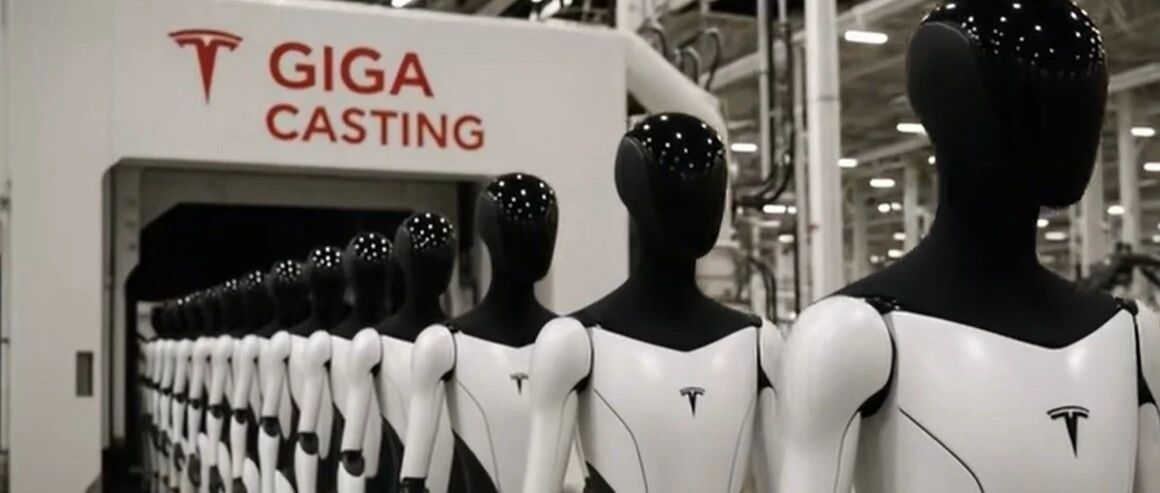
Core Viewpoint - The T-chain companies are expected to experience a shift from weak to strong performance due to recent positive developments, particularly the IPO guidance of key companies like XJ and SL, which are likely to attract more investor attention [3][4][7]. Group 1: T-chain Companies Performance - During the first trading week of January, T-chain companies did not continue the upward trend from December, showing weak performance despite a rising market [2]. - A notable increase in T-chain stocks was observed on the following Friday, indicating potential for a new upward trend [3]. Group 2: Key Developments - XJ, a core T-chain supplier for Tesla's Optimus, has initiated its IPO process with guidance from CITIC Securities, potentially leading to its listing on the Sci-Tech Innovation Board by late 2026 [4][7]. - SL, another key T-chain company, has successfully communicated with North American partners, maintaining strong performance despite overall weak market conditions [7][8]. Group 3: Market Sentiment and Future Expectations - The recent IPO news for XJ has generated positive sentiment in the robotics sector, particularly for T-chain companies, which are expected to gain more funding attention [7]. - SL's recent research indicates it may replace T1 suppliers like SH and TP, highlighting its growing significance in the market [13]. Group 4: North American Communication - T-chain companies are increasingly focusing on communication with North American partners, which is seen as a critical step towards securing contracts and production agreements [11][12]. - Companies like WX, FS, and KS have reported successful communications, leading to significant stock price increases [12]. Group 5: Upcoming Developments - The T-chain companies are expected to announce more positive developments regarding production milestones and contract signings in the near future, which will likely drive further market interest [10][13].

ETF盘中资讯|DeepSeek V4有哪些突破?科创人工智能ETF华宝(589520)跳空大涨,暴拉5%!AI应用端涨势猛烈!
Jin Rong Jie· 2026-01-12 03:50
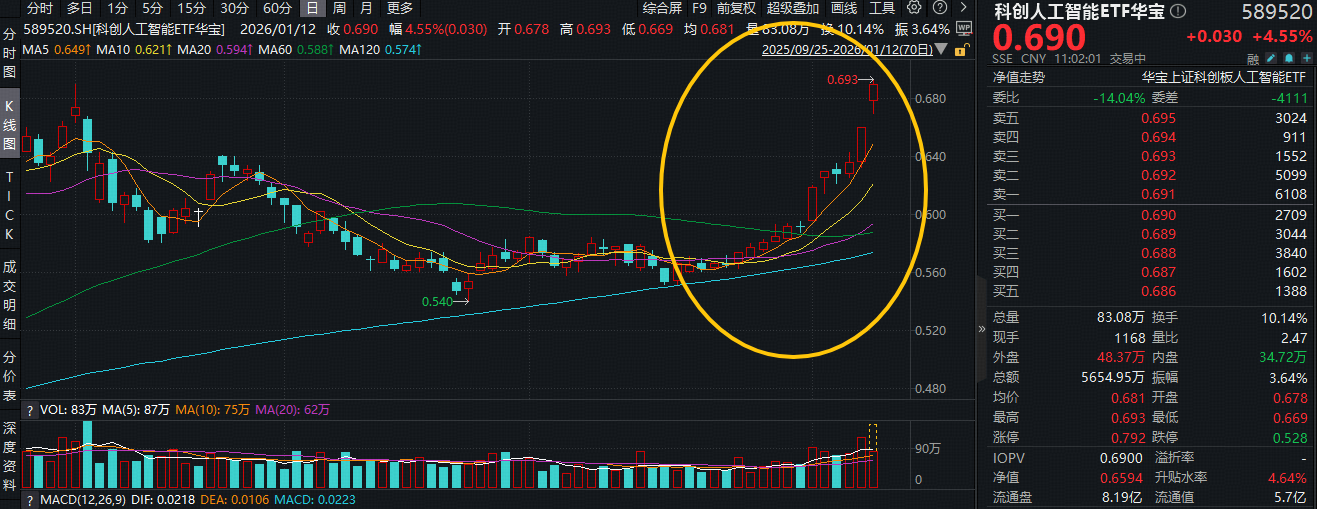
Core Viewpoint - The AI application sector continues to show strong momentum, with significant gains in the domestic AI industry chain, particularly highlighted by the performance of the Huabao AI ETF (589520) which surged by 4.55% [1][4]. Group 1: Market Performance - The Huabao AI ETF experienced a jump of 5% during intraday trading, marking its third consecutive day of gains [1]. - Key stocks in the AI sector saw substantial increases, with Zhongke Xingtou rising by 16.07%, Hehe Information by 15.32%, and others like Haitaian Ruisheng and Xinghuan Technology also showing strong performance [2][7]. Group 2: Industry Dynamics - The AI industry is witnessing a surge in activity, with significant financing rounds for overseas companies like xAI and Anthropic, and the introduction of domestic policies promoting "AI + manufacturing" [2][3]. - The upcoming release of DeepSeek's next-generation V4 model is anticipated to enhance programming capabilities and improve data pattern understanding, potentially reshaping the global AI competitive landscape [3]. Group 3: Future Outlook - Analysts predict that 2026 will be a "golden year" for AI applications, driven by technological maturity, supportive policies, and market demand [4]. - The domestic large model industry is transitioning from a phase of technological catch-up to systematic layout and ecosystem construction, with expectations of achieving leadership in certain areas by 2026 [4]. Group 4: Investment Opportunities - The Huabao AI ETF focuses on a balanced allocation across application software, terminal applications, terminal chips, and cloud chips, reflecting a shift from reliance on foreign technology to self-sufficiency [4][5]. - The ETF is positioned as an efficient tool for investing in domestic computing power, with a high concentration in semiconductor stocks [5].
创业板人工智能ETF南方(159382.SZ)涨4.48%,蓝色光标涨20.02%
Jin Rong Jie· 2026-01-12 03:50
Group 1 - The stock markets in Shanghai and Shenzhen continued to rise, with the media, computer, and defense sectors leading the gains. As of 11 AM, the Southern AI ETF (159382.SZ) rose by 4.48%, and BlueFocus increased by 20.02% [1] - The Ministry of Industry and Information Technology released the "Industrial Internet and Artificial Intelligence Integration Empowerment Action Plan" and the "Implementation Opinions on 'Artificial Intelligence + Manufacturing'" on January 7, marking a new phase in the systematic and large-scale promotion of industrial intelligence. The documents set quantitative goals for enterprise network transformation, industry data set construction, and model collaborative development, aiming to promote multiple general large model applications and create benchmark enterprises by 2027 [1] - The policy aligns with the "East Data West Computing" initiative and the positive performance of high-tech manufacturing, injecting growth momentum into the entire industrial chain of industrial internet, AI computing power, and intelligent equipment, accelerating the overall industrial intelligence [1] - The Ministry of Education is advancing AI in education, proposing a "Four Futures" concept and planning to introduce policies to deepen educational digitization by 2026, indicating significant potential in the education AI application sector [1] Group 2 - In the computer sector, DeepSeek is expected to officially release its next-generation V4 model in mid-February, which is anticipated to achieve breakthroughs in programming capabilities, long code understanding, data pattern learning, and reasoning reliability, potentially continuing its previous open-source influence [2] - Companies like Zhiyun and MiniMax recently listed on the Hong Kong Stock Exchange, with market capitalizations reaching nearly HKD 70 billion and over HKD 100 billion, respectively, both experiencing strong revenue growth in recent years [2] - Samsung Electronics is projected to see a significant increase in its Q4 2025 performance, with operating profit rising by 208.2% year-on-year, primarily driven by increased AI demand leading to higher storage chip prices [2] - Huawei recently forecasted that by 2035, the total computing power of society will increase by 100,000 times, with general artificial intelligence expected to drive the industry into an upward cycle [2] - The Southern AI ETF (159382.SZ) tracks the AI index on the Growth Enterprise Market, covering core areas of the AI application and hardware industry, benefiting directly from the AI capital expenditure wave, with high certainty in its growth and profitability [2]

蓝色光标涨幅20.02%!AI营销布局亮眼,多重利好加持市值攀升
Jin Rong Jie· 2026-01-12 03:34
Core Viewpoint - The market is focusing on BlueFocus's developments in the AI marketing sector, highlighted by its significant stock price increase and recognition as a leading AI marketing agency [1] Group 1: Stock Performance - As of 10:55 AM, BlueFocus's stock rose by 20.02%, reaching a price of 20.62 yuan, with a total market capitalization of 74.03 billion yuan [1] - The company experienced a trading volume of 17.00 billion yuan and a turnover rate of 25.93% [1] Group 2: Business Developments - BlueFocus has received multiple awards for being a top AI marketing agency, indicating strong industry recognition [1] - The company reported impressive revenue from overseas advertising placements, showcasing its successful international expansion [1] - BlueFocus is focusing on AI agents and GEO business directions, enhancing its service offerings [1] Group 3: Strategic Partnerships - The company has deepened its collaboration with Volcano Engine, integrating AI and cloud computing technologies to transform marketing content production and service models [1] - Volcano Engine will be the exclusive AI cloud partner for the 2026 Spring Festival Gala of China Central Television, indicating a significant partnership [1] Group 4: AI Innovations - BlueFocus's AI-driven revenue has seen substantial year-on-year growth, with its self-developed platform covering most marketing work scenarios [1] - The company has incubated over a hundred AI agents, contributing to improved business efficiency and cost reduction [1]
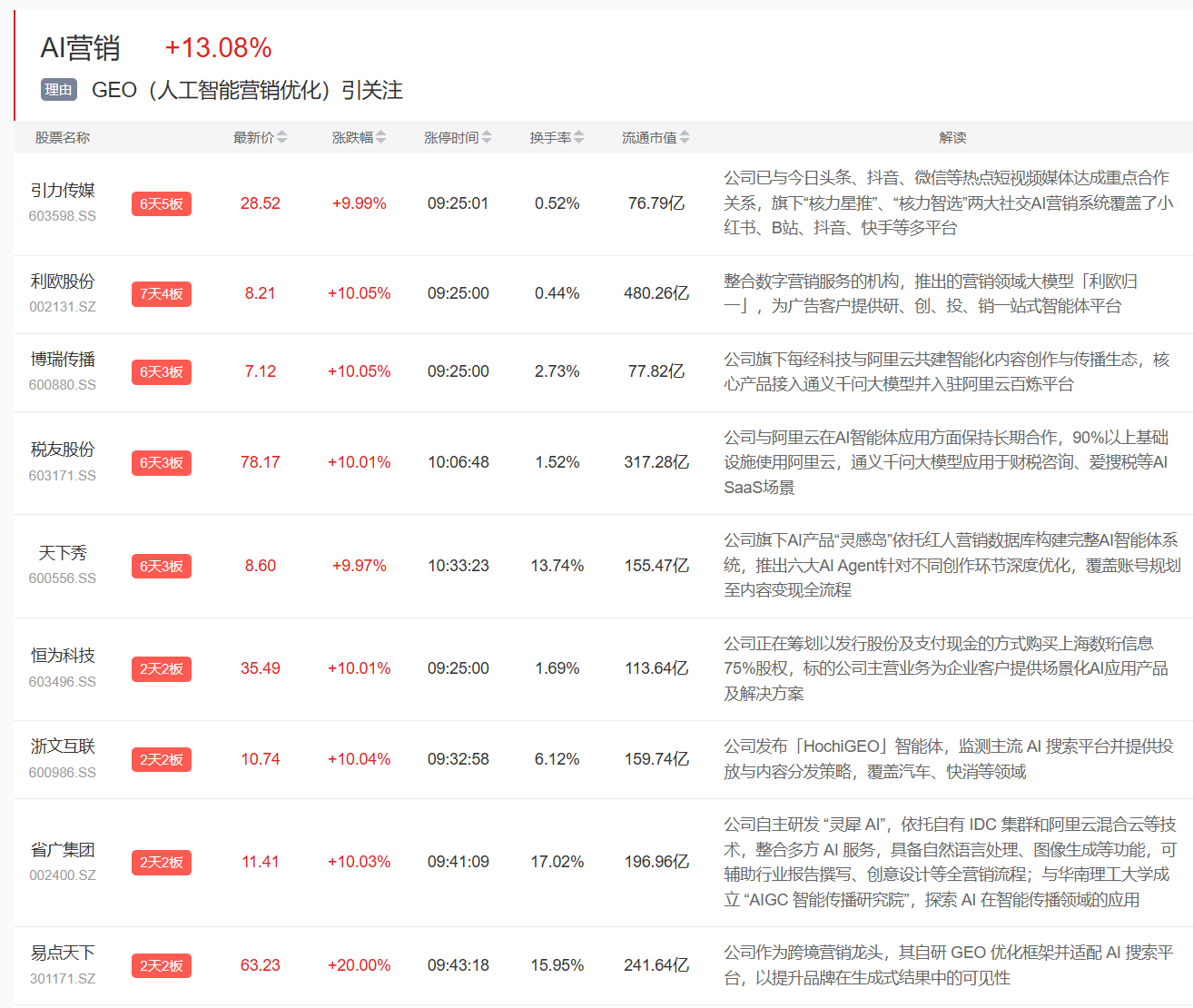
【大涨解读】AI应用:科技巨头新模型再度点燃AI应用上涨潮,GEO+AI编程成重点,AI重塑流量入口有望打开千亿市场
Xuan Gu Bao· 2026-01-12 03:19
Group 1: AI Application Stocks Performance - On January 12, AI application concept stocks experienced a collective surge, with companies like Liou Co., BoRui ChuanBo, and others achieving significant gains, including multiple stocks hitting the 20% limit up [1] - Notable performers included BlueFocus, Kunlun Wanwei, and others, all rising over 10% [1] Group 2: AI Marketing and Programming Developments - Elon Musk announced the open-sourcing of X platform's content recommendation algorithm, interpreted as a move into GEO (Generative AI Optimization) [3] - DeepSeek plans to release its next-generation V4 model in mid-February, focusing on enhanced programming capabilities, with initial tests showing superior performance compared to mainstream models [3] - AI programming is becoming a core application area, with leading model companies emphasizing code capabilities, as seen in the advancements of models like Claude and GPT [4][5] Group 3: Market Insights and Future Projections - The global GEO market is projected to reach $11.2 billion by 2025 and potentially $100 billion by 2030, indicating a significant growth trajectory [6] - The rise of GEO as a new paradigm in marketing, evolving from SEO, is expected to transform advertising agencies' business models towards subscription or performance-based payment structures, enhancing profitability [6]
AI应用持续爆发,科创创业人工智能ETF永赢(159141)强势涨超3%
Xin Lang Cai Jing· 2026-01-12 03:05
Core Viewpoint - The AI-focused ETF "Yongying" (159141) has seen significant gains, with its component stocks, including Zhongwen Online and Kunlun Wanwei, experiencing substantial increases in share prices, indicating a bullish trend in the AI sector [1][2]. Group 1: ETF Performance - The AI ETF "Yongying" (159141) rose by 3.50% on January 12, with notable performances from component stocks such as Zhongwen Online, which increased by over 18%, and Kunlun Wanwei, which rose by over 17% [1][2]. - The ETF comprises key players in the AI industry, covering the entire value chain from upstream computing chips and optical modules to midstream large models and cloud computing, with over 78% of its allocation in AI chips, optical modules, and cloud computing [4]. Group 2: Market Developments - The recent listings of AI companies Zhipu and Minimax on the Hong Kong stock market mark a significant milestone for global large model enterprises, with Zhipu's market capitalization reaching HKD 70 billion after a 36% increase and Minimax's market cap surpassing HKD 100 billion after a 109% surge on its debut [2][3]. - The upcoming release of DeepSeek's next-generation V4 model is expected to enhance programming capabilities and address key challenges in AI commercialization, such as stability and user value perception [3]. Group 3: Industry Trends - The trend towards generative AI products is becoming a core entry point for information acquisition, with the concept of Generative Engine Optimization (GEO) gaining traction as a new marketing paradigm in the AI era [3]. - According to industry insights, 2026 is anticipated to be a pivotal year for the commercialization of AI applications, shifting focus from cost savings to value creation, with increased attention on AI marketing strategies [3].