
中国国航

Search documents
中信建投:2026年A股资金面展望
Sou Hu Cai Jing· 2026-01-14 23:59
Group 1: Macro Liquidity and Economic Environment - The global interest rate cut cycle is entering its second half in 2026, characterized by "internal and external easing resonance" and a shift from "extraordinary to normal" conditions [2][5][61] - The Federal Reserve is expected to continue its rate cuts by 50 basis points, with a resumption of balance sheet expansion in December 2025 to alleviate dollar financing pressures [2][5][61] - Domestic monetary policy is transitioning from "extraordinary counter-cyclical adjustment" to "increased counter-cyclical and cross-cyclical adjustment efforts" [10][61] Group 2: Currency and Stock Market Dynamics - The weakening of the dollar due to continued Fed rate cuts and deteriorating U.S. fiscal conditions is expected to support the appreciation of the RMB, which may rise from 7.0 to 6.8 against the dollar [14][17][61] - The appreciation of the RMB is anticipated to enhance foreign investment in RMB-denominated assets, improve market risk appetite, and boost corporate profitability, thereby supporting the A-share market [17][61] Group 3: Investment Strategies and Asset Allocation - The long-term low interest rate environment is reshaping stock and bond allocation strategies, with a shift towards "fixed income plus" products and increased attractiveness of equity markets [20][21][62] - The "stock-bond seesaw" effect is expected to guide funds into equity markets, further supporting A-share performance despite potential long-term interest rate rebounds [25][62] Group 4: Capital Market Policy and Structural Changes - The capital market's status is significantly upgraded in the post-real estate era, becoming a core hub for economic development and resource allocation [4][32][63] - Policies are being implemented to enhance shareholder returns, with a focus on increasing dividend payouts and improving the quality of earnings, leading to a more balanced funding ecosystem [45][63] Group 5: Household Savings and Market Impact - The phenomenon of "deposit migration" is expected to become a significant marginal increment in the market as a large volume of fixed-term deposits matures in 2026 [3][29][62] - As of November 2025, household deposits in China exceeded 163 trillion yuan, with excess deposits potentially reaching 60 trillion yuan based on historical trends [28][29]


航油供应体系迎巨变 一体化整合能否稳定航司成本
Jin Rong Jie· 2026-01-14 10:48
Group 1 - The core point of the article is the restructuring of China Petroleum & Chemical Corporation and China Aviation Oil Group, which aims to create an integrated and centralized aviation fuel supply system in China, potentially consolidating the previously fragmented upstream refining, midstream trading, and downstream refueling structure into a closed industrial loop [1][3]. Group 2 - Aviation fuel is one of the main cost items for airlines, with its price fluctuations directly impacting airline profitability. According to China National Airlines' 2024 annual report, aviation fuel costs account for approximately one-third of total costs, and a 5% change in average aviation fuel prices could affect fuel cost fluctuations by about 2.686 billion yuan [3]. - Airlines express a preference for predictable fuel prices over simply low prices to stabilize cost management. The current pricing mechanism for aviation fuel purchases from China Aviation Oil is based on a weighted calculation centered around "comprehensive procurement costs," with international aviation fuel prices serving as a key reference benchmark [3]. - The initiation of this restructuring has raised market interest in the potential consolidation of other supportive state-owned enterprises in the civil aviation sector, with speculation that China Civil Aviation Information Network Co., Ltd. and China Aviation Supplies Holding Company may also be included in a higher-level industrial integration framework [3].


航空机场板块1月14日跌1.94%,中国东航领跌,主力资金净流出4.39亿元
Zheng Xing Xing Ye Ri Bao· 2026-01-14 08:58
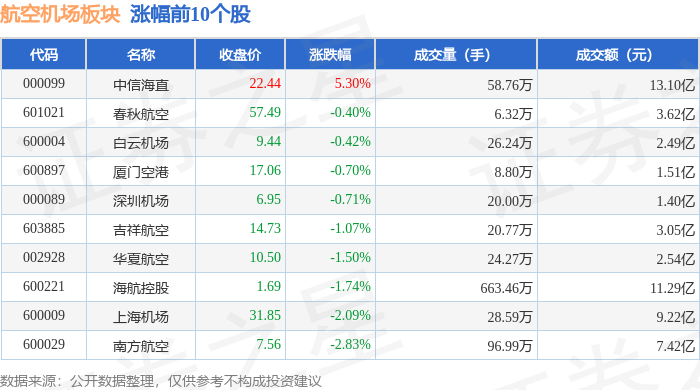
Core Viewpoint - The aviation and airport sector experienced a decline of 1.94% on January 14, with China Eastern Airlines leading the drop, while the Shanghai Composite Index fell by 0.31% and the Shenzhen Component Index rose by 0.56% [1] Group 1: Market Performance - The closing price of China Eastern Airlines was 5.85, down by 2.99%, with a trading volume of 1.27 million shares and a transaction value of 748 million yuan [2] - The aviation and airport sector saw a net outflow of 439 million yuan from major funds, while retail investors contributed a net inflow of 242 million yuan [2][3] Group 2: Individual Stock Performance - CITIC Hainan Airlines had the highest increase, closing at 22.44 with a rise of 5.30% and a transaction value of 1.31 billion yuan [1] - Major stocks like China Eastern Airlines, China Southern Airlines, and Air China saw declines of 2.99%, 2.83%, and 2.95% respectively, indicating a negative trend in the sector [2][3] Group 3: Fund Flow Analysis - Major funds showed a significant net outflow from several stocks, including China Eastern Airlines with a net outflow of 98.73 million yuan, and China Southern Airlines with 82.17 million yuan [3] - Retail investors showed a contrasting trend, with net inflows into stocks like China Eastern Airlines and Xiamen Airport, indicating differing investor sentiment [3]

香港 & 中国交通运输:2026 年展望-机遇大于风险-Hong KongChina Transportation-2026 Outlook More Opportunities than Risks
2026-01-14 05:05
Summary of Conference Call Notes Industry Overview - **Industry Focus**: Hong Kong/China Transportation and Infrastructure - **2026 Outlook**: More opportunities than risks, with a focus on supply-side opportunities in airlines, tanker shipping, and express delivery, while container shipping faces oversupply concerns [1][2][3] Airlines - **Pricing Trends**: Pricing inflation resumed since October 2025, supported by supply-side constraints and demand recovery from business travel, outbound travel growth, and inbound travel [2][11] - **Demand Drivers**: Business travel recovery positively correlated with capital expenditure, and inbound travel expected to grow, benefiting airlines [2][21] - **Airlines' Up-Cycle**: Chinese airlines are in a multi-year supply-driven up-cycle, with margin upside if pricing performance exceeds expectations [2][11] - **Key Stocks**: Overweight ratings on Air China (0753.HK), China Eastern Airlines (0670.HK), China Southern Airlines (1055.HK), and Spring Airlines (601021.SS) [9][10] Shipping - **Tanker Market**: Increasing demand for compliant tankers due to geopolitical tensions, with limited new supply additions due to low capital expenditure over the past decade [3] - **Container Shipping Risks**: Remains conservative on container shipping due to oversupply concerns [3] - **Key Stocks**: Overweight on COSCO Shipping (1138.HK) and China Merchants Energy Shipping (601872.SS), underweight on COSCO Shipping Holdings (1919.HK) and Orient Overseas (0316.HK) [3] Airports - **Bargaining Power**: Airports are regaining bargaining power through duty-free contract renewals, breaking monopoly dynamics, and increasing shareholdings in duty-free operators [4][54] - **Duty-Free Spending**: Expected upside in duty-free spending with expanded product categories and higher offline sales [4][58] - **Key Stocks**: Equal-weight ratings on Shanghai International Airport (600009.SS), Hainan Meilan Airport (0357.HK), and Guangzhou Baiyun International Airport (600004.SS), underweight on Beijing Capital International Airport (0694.HK) [53] Express Delivery - **Market Consolidation**: ZTO (ZTO.N) and YTO (600233.SS) are consolidating market share, leading to cost-efficiency gains and margin expansion [5] - **International Expansion**: J&T (1519.HK) expected to consolidate market share in overseas markets through e-commerce partnerships [5] Key Risks and Considerations - **Airlines**: Risks include faster-than-expected aircraft delivery, deterioration in travel demand, unfavorable RMB depreciation, and surging oil prices [52][51] - **Airports**: Continued underperformance in duty-free business due to weak consumption and competition from other channels [54][55] Conclusion - The transportation sector in Hong Kong/China is poised for growth in 2026, driven by supply-side opportunities in airlines and shipping, while airports are regaining power in duty-free operations. However, risks remain, particularly in container shipping and overall economic conditions.





港股三大航空股持续走低
Jin Rong Jie· 2026-01-14 02:11
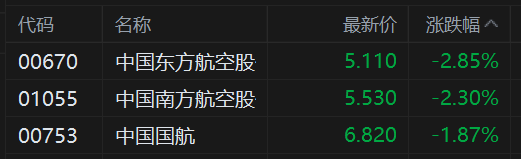
Group 1 - The Hong Kong aviation stocks are experiencing a continuous decline, with China Southern Airlines dropping over 3%, China Eastern Airlines falling by 2.3%, and Air China decreasing by 1.8% [1] - All three airlines have recorded a four-day losing streak [1]
港股异动丨三大航空股持续走低 国内机票跳水+地缘政治紧张
Ge Long Hui· 2026-01-14 02:00
Group 1 - The core viewpoint is that Hong Kong airline stocks are experiencing a decline, with China Southern Airlines dropping over 3%, China Eastern Airlines down 2.3%, and Air China falling 1.8%, marking four consecutive days of losses [1] - The winter travel market is expected to see a peak travel window for nearly a month after the New Year holiday, with online travel platforms indicating that current domestic flight and hotel prices are approximately 40% cheaper compared to the upcoming Spring Festival travel period [1] - Geopolitical tensions are causing oil prices to rise, which is a significant headwind for airline stocks and may lead to short-term volatility; however, the long-term stock price trends will be determined by fundamental factors such as industry supply and demand dynamics, oil price and exchange rate trends, and the companies' operational capabilities [1] Group 2 - The latest stock prices and changes for major Chinese airlines are as follows: China Eastern Airlines at 5.110 with a decrease of 2.85%, China Southern Airlines at 5.530 down 2.30%, and Air China at 6.820 down 1.87% [2]
听说基金又开始大卖了...
Xin Lang Cai Jing· 2026-01-13 10:07
Group 1 - The core news highlights the significant sales performance of Debon Fund's Debon Stable Growth Flexible Allocation Mixed Fund, which sold at least 120 billion yuan in a single day through Ant Financial channels [1][28]. - The article discusses the challenges faced by fund managers in deploying large sums of capital effectively, particularly in the context of existing investors' positions being diluted [3][30]. - It emphasizes the importance of timing and strategy in fund management, especially when dealing with substantial inflows, and the potential risks of market volatility [4][31]. Group 2 - The article notes that while larger fund sizes are often seen as beneficial, they do not guarantee long-term value creation for investors, as smaller funds can also perform well [5][32]. - It mentions the emergence of new fund products, such as the three-year fund launched by Ruiyuan, which features a multi-manager structure and is designed more as an experimental product rather than a scale-driven initiative [10][37][38]. - The performance of multi-manager products, like the Industrial Bank's three-year fund, is highlighted, showing a significant recovery and growth since its launch [12][40]. Group 3 - The article reflects on the historical performance of investments made during various market conditions, indicating that timing and market context are crucial for achieving favorable returns [46][49]. - It discusses the current valuation of the CSI 300 index, suggesting that understanding historical earnings and valuations can guide future investment decisions [18][51]. - The importance of buying at lower valuations is emphasized as a strategy for navigating market fluctuations and achieving long-term gains [26][53].
航空机场板块1月13日跌1.14%,中信海直领跌,主力资金净流出2.15亿元
Zheng Xing Xing Ye Ri Bao· 2026-01-13 09:00
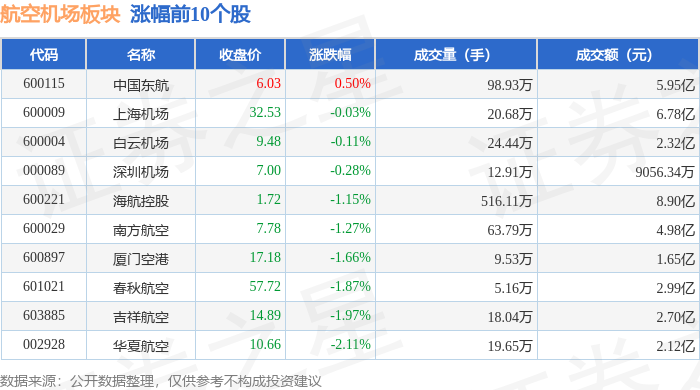
Market Overview - The aviation and airport sector experienced a decline of 1.14% on January 13, with CITIC Heli leading the drop [1] - The Shanghai Composite Index closed at 4138.76, down 0.64%, while the Shenzhen Component Index closed at 14169.4, down 1.37% [1] Stock Performance - China Eastern Airlines (600115) closed at 6.03, up 0.50% with a trading volume of 989,300 shares and a turnover of 5.95 million [1] - Shanghai Airport (600009) closed at 32.53, down 0.03% with a trading volume of 206,800 shares and a turnover of 678 million [1] - Hainan Airlines (600221) closed at 1.72, down 1.15% with a trading volume of 5,161,100 shares and a turnover of 890 million [1] - Xiamen Airport (600897) closed at 17.18, down 1.66% with a trading volume of 95,300 shares and a turnover of 165 million [1] Capital Flow - The aviation and airport sector saw a net outflow of 215 million in main funds, while retail investors had a net inflow of 117 million [2] - The sector's overall capital flow indicates a mixed sentiment among different investor types, with retail investors showing some confidence [2] Individual Stock Capital Flow - Shanghai Airport had a main fund net inflow of 52.92 million, but a retail net outflow of 89.22 million [3] - CITIC Heli experienced a significant main fund net outflow of 47.57 million, while retail investors had a net inflow of 45.51 million [3] - Hainan Airlines saw a main fund net outflow of 49.59 million, with retail investors showing a net inflow of 52.57 million [3]

中国航空传媒有限责任公司招聘出版部社媒编辑部主任
Bei Jing Ri Bao Ke Hu Duan· 2026-01-13 05:04
Group 1: Company Overview - China Aviation Media Co., Ltd. (referred to as "AVIC Media") is a wholly-owned subsidiary of China Aviation Group Co., Ltd. (referred to as "AVIC Group") and holds exclusive rights to operate media resources of AVIC Group and Air China [1] - AVIC Media serves as the "total service provider for brand building and cultural media business within the group" and operates as a "full media platform operator" [1] - The company is headquartered in Beijing, with branches in Chengdu, Chongqing, and Hangzhou, focusing on media publishing, marketing, brand planning, and value-added services for air travelers [1] Group 2: Recruitment Overview - The company is recruiting for the position of Social Media Editor-in-Chief, responsible for developing social media strategies and managing content creation and operations [5] - The recruitment aims to fill one position, requiring candidates to have a bachelor's degree or higher, with a preference for graduates from overseas institutions [5][6] - Candidates must possess over five years of experience in social media operations or digital marketing, including at least two years in team management [7] Group 3: Job Responsibilities and Requirements - Key responsibilities include tracking social media trends, establishing content management systems, and executing social media campaigns for significant events [5] - Candidates should have strong professional ethics, knowledge of media industry trends, and the ability to utilize social media management tools [8] - Successful candidates must provide evidence of managing social media accounts with over 1 million followers or impactful projects with significant engagement [9] Group 4: Compensation and Application Process - AVIC Media offers competitive compensation and benefits, which will be determined based on interview performance [10] - Applications are accepted online through the Air China official recruitment website, with a deadline of January 15, 2026 [11][12] - The selection process includes a combination of written and interview assessments to evaluate candidates' skills and qualifications [13][14]
部分机票退改签费用偏高 如何完善退改规则?专家解读
Yang Shi Xin Wen· 2026-01-13 03:28
央视新闻消息,近日,网友汤先生发帖称,他此前通过第三方购票平台花470元购买了一张北京飞往宜 昌的机票,后因行程变化办理了改签。待行程结束,开具发票时,他才发现,"退改费用"竟高达894 元,接近原机票价格的两倍。 第三方平台回应称,由于改签时间临近起飞,且机票价格实时浮动,新机票价格高于原价,因此产生了 780元票价差价及114元手续费,合计894元。机票退改签费用一般怎么计算?该如何进一步完善机票退 改规则? 2025年12月16日,汤先生在某购票平台购买了12月30日由国航执飞的北京大兴至湖北宜昌的航班,支付 总费用558元(含机票款470元、保险40元及一份价值48元的"全能保障服务")。12月26日,因行程变 动,他将机票改签至27日。事后第三方平台开具的行程发票信息显示,开票总价为1364元,其中470元 为"代订机票产品",894元为"退改费用"。汤先生表示,他没想到改签费用接近票价的两倍。 第三方平台回应称,由于改签时间临近起飞,且机票价格实时浮动,新机票价格高于原价,因此产生了 780元票价差价及114元改签手续费,合计894元。而平台页面所提示的"免收退票费",实指汤先生购买 的"全能保障 ...