
长江存储

Search documents
SK海力士全球DRAM市场蝉联第一,技术创新加速存储器市场高增长-股票-金融界
Jin Rong Jie· 2025-09-08 00:10
Group 1 - SK Hynix has maintained its position as the leading company in the global DRAM market for the second quarter of this year, following its first-quarter success, indicating a growing sales gap with Samsung Electronics due to its advantage in the high bandwidth memory (HBM) market [1] - Domestic policies in China are continuously promoting innovation and domestic substitution in the memory sector, with the "14th Five-Year Plan" emphasizing storage chips as a key technology focus [1] - The State Council's recent policies provide a 15% income tax reduction for memory companies, and the Ministry of Industry and Information Technology has allocated 12 billion yuan for 3D NAND research and development in 2024 [1] Group 2 - Omdia reports that the global DRAM industry sales reached $30.916 billion (approximately 220.604 billion yuan) in the second quarter, a 17.3% increase from the previous quarter, driven by rising DRAM contract prices and increased HBM shipments [1] - Looking ahead, Omdia forecasts that global HBM demand will reach 230 million GB by 2025, with a compound annual growth rate of 41%, and Chinese AI chip companies' procurement share is expected to rise to 35% [2] - The A-share market is anticipated to see continued price increases in the storage sector in the third and fourth quarters, driven by AI demand and the growth of high-value products, highlighting potential investment opportunities in leading companies benefiting from price hikes and domestic substitution [2]
中美金融暗战打响,美国不装了,要硬抢了,但中国却是另一景象
Sou Hu Cai Jing· 2025-09-06 08:30
Group 1 - The U.S. Treasury invested $8.9 billion to acquire nearly 10% of Intel's shares, marking a significant shift in government involvement in the tech sector [1][3] - Intel has invested $108 billion in capital expenditures and $79 billion in R&D over the past five years, yet its market value is only one-tenth of Nvidia's [3] - The U.S. government aims to enhance national security, recover finances through dividends, and gain influence over Intel's board by acquiring shares [3][9] Group 2 - China's response to the U.S. investment was notably calm, with significant advancements in domestic chip production, including a 92% yield rate for Yangtze Memory Technologies [5] - Chinese chip imports have decreased by 18% in the first seven months of the year, while domestic equipment exports have increased by 34% [5] - The U.S. technology blockade has proven ineffective, as Chinese companies have made significant progress in advanced manufacturing processes [7][9] Group 3 - A separate chip manufacturing corridor is emerging, with TSMC and Samsung expanding their operations in China, alongside local firms [9] - Intel's cost per 7nm wafer is approximately $9,000, while China's SMIC can produce the same at $6,000, indicating a potential pricing advantage for Chinese manufacturers [9] - The contrasting strategies of U.S. nationalization and China's market-driven approach highlight a broader shift in global economic roles [12]


搞垮日本芯片产业40年后,美国又盯上了韩国
芯世相· 2025-09-06 01:06
Core Viewpoint - The article discusses the historical and current challenges faced by the South Korean semiconductor industry, drawing parallels with Japan's past struggles and highlighting the impact of U.S. policies on technological independence and market dynamics [5][20]. Group 1: Historical Context - The U.S.-Japan Plaza Accord in 1985 marked the decline of Japan's semiconductor dominance, which is now mirrored by South Korea's current predicament [5][9]. - Japan's semiconductor industry, once a leader, saw its global market share plummet from over 48% in the 1980s to less than 10% by 1995 due to U.S. trade measures [12][13]. - South Korea's semiconductor industry, supported by U.S. technology, grew rapidly, capturing over 30% of the global DRAM market by the mid-1990s [13]. Group 2: Current Challenges - The U.S. has tightened regulations on South Korean companies, requiring individual licenses for importing American semiconductor equipment, which has created significant operational challenges [5][20]. - South Korea's semiconductor market holds approximately 14% of the global share, with over 50% in DRAM and NAND flash sectors, but faces risks of losing this position due to U.S. restrictions [24][27]. - The reliance on U.S. technology and equipment is critical, with over 70% of the technology used in South Korean semiconductor production coming from American firms [27]. Group 3: Future Outlook - The article suggests that South Korea's semiconductor industry must develop a stronger sense of independence and innovation to break free from historical cycles of dependency [23][32]. - Comparatively, while Japan has pivoted to become a major supplier of semiconductor materials, South Korea lacks similar advantages and must navigate its position carefully amid U.S.-China tensions [24][27]. - The rise of China's semiconductor capabilities poses a new challenge, as evidenced by advancements in domestic technology and production capabilities [31][32].

新凯来手握百亿订单!将IPO!
国芯网· 2025-09-05 12:48
Core Viewpoint - The article highlights the rapid growth and potential of the Chinese semiconductor industry, particularly focusing on the company New Kai Lai, which has secured significant orders and is on track for substantial revenue growth in the coming years [1][3]. Group 1: Company Overview - New Kai Lai has received orders exceeding 10 billion, with clients including major foundries like SMIC, Hua Hong Group, and Yangtze Memory Technologies [1]. - The company is projected to achieve revenues of 4.5 billion in 2023, 7.5 billion in 2026, and 16.9 billion by 2028, with a profit of 2 billion expected in 2027 and plans for an IPO [3]. - New Kai Lai is a wholly-owned subsidiary of Shenzhen State-owned Assets Supervision and Administration Commission, focusing on the research, manufacturing, sales, and service of semiconductor equipment and components [3][4]. Group 2: Industry Context - In response to overseas chip restrictions, Shenzhen's government invested hundreds of billions to support the local semiconductor industry, positioning New Kai Lai as a key player in the domestic semiconductor equipment sector [3]. - The company aims to produce 100% domestically manufactured semiconductor production equipment through its own research and partnerships [3]. Group 3: Team and Expertise - The core team of New Kai Lai has over 20 years of experience in electronic equipment technology development and collaborates with various domestic semiconductor manufacturing equipment and component partners [4]. - The company originated from Huawei's 2012 laboratory's Starlight Engineering Department, which was responsible for precision equipment design and development, and transitioned to independence in 2022 [3].
重磅!半导体产业迎来多重利好,百亿订单加速本土化进程,设备材料板块迎黄金发展期!-股票-金融界
Jin Rong Jie· 2025-09-05 07:26
Group 1 - The 13th Semiconductor Equipment and Core Components and Materials Exhibition (CSEAC 2025) is held in Wuxi, showcasing significant growth in the semiconductor industry with over 10 billion yuan in orders reported by Shenzhen semiconductor equipment company Xinkai [1] - Major clients include well-known wafer fabs such as SMIC, Hua Hong Group, and Yangtze Memory Technologies, indicating strong demand in the sector [1] - The Wuxi High-tech Zone has introduced unprecedented supportive policies for the integrated circuit industry, enhancing enterprise attraction, industry chain interaction, and R&D investment [1] Group 2 - The semiconductor equipment sector is experiencing rapid growth in domestic orders, accelerating the localization process and improving the industry supply chain [2] - Breakthroughs in key materials such as epoxy encapsulants are being achieved, with innovations in new material technologies speeding up and increasing the domestic production rate of high-end materials [2] - The semiconductor manufacturing sector is expanding wafer fab capacity and accelerating advanced process R&D, with evident effects of industrial clustering [2] Group 3 - Huahai Chengke (688276) is the second-largest global supplier of epoxy encapsulants, known for stable product quality [3] - Lianshi New Materials (688498) is a leader in ultra-pure high-purity wet electronic chemicals, entering the supply chain of international major manufacturers [3] - Zhaoshengwei (300782) is a leading enterprise in RF chips with a well-established supply chain layout [3] - Zhongxin Jingyuan (688517) is an important supplier of 12-inch silicon wafers, continuously increasing production capacity [3] - Yake Technology (002409) has entered the semiconductor materials field through acquisitions, showcasing strong technical capabilities [3]
新凯来获超百亿元半导体设备订单!客户包含中芯国际、华虹集团、长江存储
是说芯语· 2025-09-05 06:54
Core Viewpoint - The article highlights the rapid growth and strategic importance of Shenzhen-based semiconductor equipment company Xinkailai, which is positioned to significantly contribute to China's semiconductor supply chain security and independence amid international restrictions [1][4][8]. Group 1: Company Overview - Xinkailai has over 10 billion yuan in orders from major clients including Shenzhen Pengxin Micro, SMIC, Huahong Group, and Yangtze Memory Technologies [1]. - The company aims to achieve 100% domestic production of semiconductor manufacturing equipment, leveraging both state-owned and private sector resources [4][7]. - Xinkailai's revenue is projected to reach 4.5 billion yuan in 2023, 7.5 billion yuan in 2026, and 16.9 billion yuan in 2028, with profitability expected in 2027 [1][10]. Group 2: Market Context - The Chinese semiconductor equipment market is expected to reach $49.6 billion in 2024, growing by 35% year-on-year, with a significant gap in domestic production capabilities for advanced process equipment [10][11]. - The supply chain for EUV lithography machines is heavily reliant on Western technology, with China potentially lagging 10 to 15 years behind due to export restrictions [3][10]. - Xinkailai is strategically targeting the high-end market segment, particularly in advanced process equipment, to fill the existing gaps in domestic capabilities [10][11]. Group 3: Strategic Partnerships and Development - Xinkailai has established deep collaborations with leading wafer fabs, enabling rapid iteration from research and development to mass production [11]. - The company has set up a testing wafer fab in Shanghai to accelerate the testing of domestic devices and components [11]. - Shenzhen's state-owned assets are also backing the establishment of several specialized wafer fabs to ensure a stable supply of semiconductor products for various industries [11].
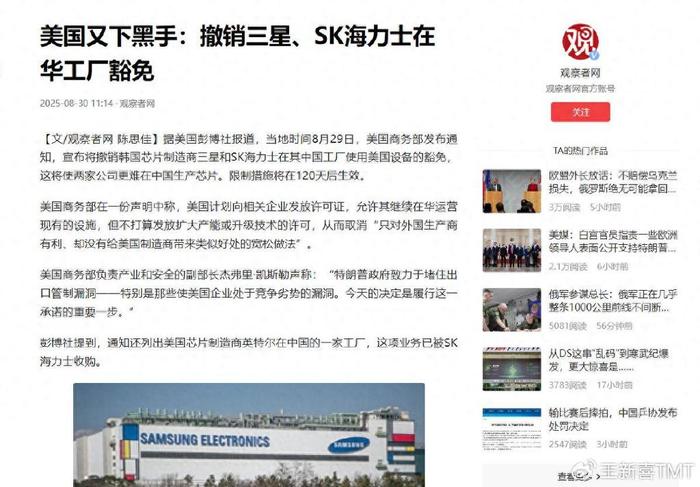
美国不准三星和SK升级扩建中国工厂,中国这个技术领域突破要抓紧
Xin Lang Cai Jing· 2025-09-05 06:25
Core Viewpoint - The U.S. government has revoked the "Verified End User (VEU)" status for Samsung Electronics and SK Hynix's factories in China, requiring them to obtain separate licenses for each batch of equipment shipped starting next year, which could lead to production delays and increased global memory prices [1][3][18]. Group 1: U.S. Regulatory Actions - The U.S. has closed exemptions for Samsung and SK Hynix, preventing them from using American machinery to produce high-end chips in China [3][18]. - The new regulations will require both companies to seek U.S. approval for each shipment to China, potentially causing significant delays and inefficiencies [3][18]. - The U.S. Department of Commerce stated that while the current situation can be maintained, no expansion of production or technological upgrades will be allowed, effectively blocking upgrades and expansions in China [20]. Group 2: Market Impact - The global semiconductor market is projected to grow by 18% in 2024, reaching $626 billion, with Samsung regaining the top position in sales due to a rebound in memory chip prices [9][12]. - Samsung's Xi'an factory produces 40% of its global NAND output, and SK Hynix is expected to surpass Samsung in sales by Q2 2025, indicating a competitive shift in the market [12][21]. - The price of SK Hynix's HBM3 memory has increased over five times since 2023, highlighting the growing demand for high-bandwidth memory in AI applications [16][21]. Group 3: Competitive Landscape - Samsung and SK Hynix dominate the HBM memory market, controlling 90% of global production, which is critical for AI chip performance [16][22]. - The U.S. is concerned that Samsung and SK Hynix could produce advanced AI memory components in China, prompting regulatory actions to slow down China's progress in this area [21][24]. - The restrictions on Samsung and SK Hynix may create opportunities for Chinese companies to develop their own high-end HBM memory, as they seek to fill the market gap left by these restrictions [24][25].
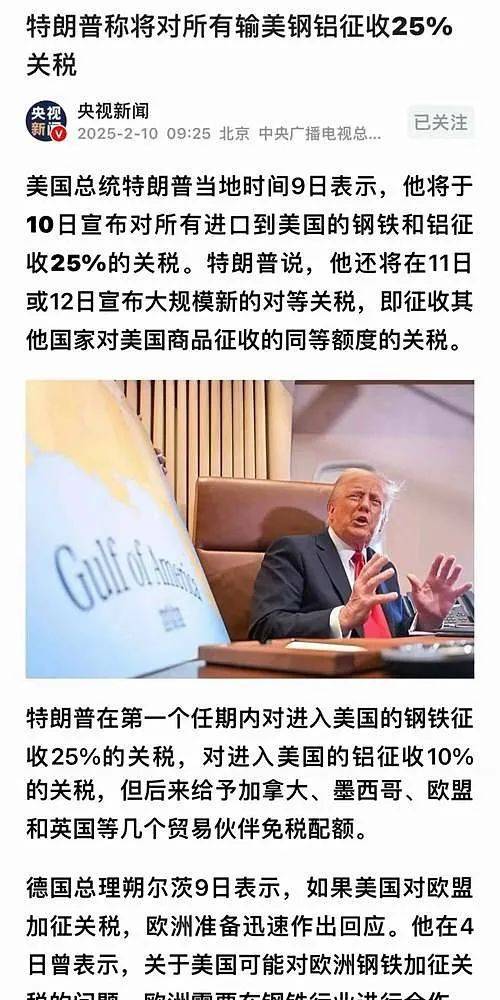
特朗普对进口芯片征税100%:一台美国制造iPhone,可能要卖2.5万人民币
Sou Hu Cai Jing· 2025-09-05 04:17
特朗普对进口芯片征税100%:一台美国制造iPhone,可能要卖2.5万人民币 特朗普说要对进口芯片征收100%的关税!你们知道这意味着什么吗?按照苹果现在的成本结构 一台美国制造的 iPhone可能要卖到2.5万人民币! 说实话 刚开始我还以为是假新闻呢。特朗普这家伙虽然爱放炮 但这次是真的要动真格的了。他的逻辑很简单: 你们都不在美国生产芯片 那我就用关税逼你们回来!可问题是 现在全球芯片产业链已经形成了 你说改就改? 为什么iPhone会涨价这么狠? 咱们算笔账就明白了。现在一台iPhone里面的核心芯片 主要来自台积电 海力士 还有一些其他的亚洲厂商。这些 芯片的成本大概占到整机成本的30-40%。如果真的征收100%关税 那这部分成本直接翻倍! 不过话说回来 特朗普这一招确实够狠的。现在台积电 三星这些大厂都在紧急评估美国建厂的可行性。台积电已 经在亚利桑那州投资了400多亿美元建厂 但是产能爬坡需要时间啊 而且成本比亚洲高出好几倍。 更要命的是 不光是处理器芯片 连存储芯片 射频芯片 电源管理芯片这些都要被征税。你想想 原本一台iPhone的 物料成本大概是售价的50% 现在这一下子就要增加20- ...

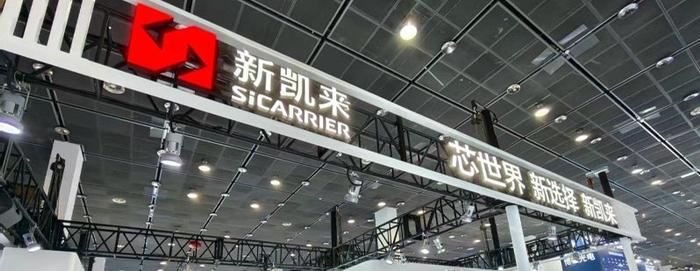
新凯来半导体设备订单超百亿,国产化进程加速
Guan Cha Zhe Wang· 2025-09-05 03:33
Core Insights - New Kai Lai, a Shenzhen-based semiconductor equipment company, has exceeded 10 billion in orders, with clients including major wafer fabs like SMIC and Changjiang Storage [1] - The company anticipates a significant increase in order volume for advanced semiconductor equipment in the coming year, projecting revenues of 4.5 billion this year, 7.5 billion by 2026, and 16.9 billion by 2028 [1] - New Kai Lai aims to produce 100% domestically manufactured semiconductor production equipment, responding to the Chinese government's push for self-sufficiency in the semiconductor industry [1] Group 1 - New Kai Lai's current order backlog has surpassed 10 billion, with key clients including Shenzhen Pengxin Micro, SMIC, Huahong Group, and Changjiang Storage [1] - The company is expected to achieve profitability of 2 billion by 2027 and is currently undergoing a second round of external financing, with a valuation of 65 billion [1] - The Shenzhen government has invested hundreds of billions to support the local semiconductor industry, positioning New Kai Lai as a critical player in this initiative [1] Group 2 - The anticipated mass production of New Kai Lai's orders is expected to create new business opportunities for upstream domestic semiconductor supply chain companies [2] - Companies like Li Hexing, which supplies precision components, project significant revenue growth due to New Kai Lai's orders, estimating potential income of 700-800 million, equivalent to their annual revenue [2] - Guoli Co., which supplies vacuum capacitors, is also preparing to replace foreign components in response to New Kai Lai's upcoming production ramp-up [2] Group 3 - New Kai Lai originated from Huawei's 2012 laboratory's Starlight Project, focusing on precision equipment design and development, and has since evolved into an independent entity with a team of top experts in the semiconductor equipment field [3]
深圳新凯来半导体设备订单额超百亿,利和兴、国力股份等公司加速准备产业链
Xin Lang Cai Jing· 2025-09-05 02:21
Core Insights - The core point of the article highlights that Shenzhen semiconductor equipment company Xinkailai has secured over 10 billion in orders, with clients including major wafer fabs such as Shenzhen Pengxinwei, SMIC, Huahong Group, and Yangtze Memory [1] Company Developments - Xinkailai is currently preparing for mass production, with a strong supply chain support from companies like Lihua Xing and Guoli Co., Ltd. to meet the upcoming demand [1]
