阿里巴巴

Search documents
腾讯研究院AI速递 20260226
腾讯研究院· 2026-02-25 16:01
生成式AI 一、千亿AI芯片巨单!AMD拿下Meta超600亿美元算力合作 1. Meta与AMD达成重磅合作部署最高6GW的AMD Instinct GPU,整体规模据华尔街日报估超1000亿美元,Meta 将分阶段获得AMD约10%股份; 2. 合作核心是基于MI450架构的定制版GPU,遵循"Workload First"原则无需额外流片,底层软件100%通用, 2026年下半年开始出货; 3. Meta基础设施主管称"单一芯片无法满足所有负载",英伟达、AMD和自研MTIA各有定位,AI头部玩家正加速寻求 算力多元化以降低供应链风险。 https://mp.weixin.qq.com/s/kxk97OkI1dXwqa_nUpTygA 二、Claude Code新增Remote Control,手机远程遥控编程 1. Anthropic为Claude Code新增Remote Control功能,用户可通过浏览器或手机远程连接本地运行的Claude Code项目,实现移动端实时查看和操控; 2. 支持两种启动方式:新建远程session(claude rc)或在现有对话中输入/rc带入历史上下文,通过扫 ...



魅族手机或迎终局:网传业务实质停摆,昔日小而美何以至此?
Nan Fang Du Shi Bao· 2026-02-25 14:30
Core Viewpoint - Meizu, a long-established Chinese smartphone manufacturer, is facing a critical juncture, with rumors of its mobile business effectively ceasing operations and a potential delisting by March 2026, while its core automotive business FlymeAuto will operate independently within Geely's framework [1][2]. Group 1: Business Operations and Challenges - Meizu's mobile business is reportedly on the verge of termination, with the planned launch of the Meizu 23 series in 2026 already halted [2]. - Internal turmoil is evident, with a significant number of employees leaving the company, and reports of unpaid supplier debts since mid-2022 [1][2]. - The rising costs of components, particularly memory prices expected to increase by 40%-50% in Q1 2026, are squeezing the margins of smaller manufacturers like Meizu [2][3]. Group 2: Historical Context and Market Position - Meizu was once a pioneer in the Chinese smartphone market, achieving sales of over 500 million yuan within five months of launching its first smartphone, the M8, in 2009 [3]. - The company experienced rapid growth, with total sales exceeding 20 million units from August 2014 to August 2015, marking a 350% year-on-year increase [3]. - However, after 2016, strategic missteps and increased competition led to a decline, with Meizu's market share dropping to below 1% [5]. Group 3: Strategic Shifts and Future Directions - Following Geely's acquisition in July 2022, there were ambitious plans to return Meizu to the top five in the mid-to-high-end market within three years, but these goals have not materialized [6]. - In early 2024, Meizu announced a shift away from traditional smartphone development towards an "All in AI" strategy, focusing on AI devices and XR smart glasses, but this has not translated into significant sales [6][7]. - Geely's strategy now appears to involve shedding the unprofitable mobile hardware business as part of a broader resource integration effort [7].
腾讯撒完10亿元红包 元宝却因除夕骂人“翻了车”
Guo Ji Jin Rong Bao· 2026-02-25 14:07
被马化腾所重视的腾讯AI助手元宝,再度因为骂人事件"翻车"。 2月25日,"元宝骂人"的话题登上微博科技热搜榜首,该事件起源于一位网友在春节假期间发帖称,除夕晚上,第一次下载元宝,想让元宝设计一张拜年 图片,让元宝改了3稿,却被元宝骂了。 从该网友发布的对话内容来看,其为一名律师,向元宝发布指令"根据我的行业特点,制作一张朋友圈拜年图片",该网友反馈"难看"以及"你这是设计的 什么鬼"之后,元宝生成的拜年海报中出现了包含辱骂性词汇的脏话。 2月24日晚间,腾讯元宝官方账号在该网友发布的内容下方评论称:"经核实,该情况是由模型在处理多轮对话时输出的异常结果导致。目前,我们已紧急 校正了相关问题并优化体验。" 2月25日,该网友在社交平台小红书发布视频呼吁外界理性看待元宝,他表示:"人工智能在发展过程当中肯定会出现各种各样的问题,也正是这样的问 题,才会推进人工智能的发展,所以出错是在所难免的。" 元宝接连出现的"骂人"事件,正值互联网大厂正处于AI助手争夺用户的关键时刻。 在刚刚过去的春节假期这一重要窗口,腾讯、阿里、字节跳动等大型科技公司纷纷发力旗下AI应用。其中,腾讯早早行动,在春节假期开始之前,便宣 布拿 ...

钛动科技李述昊:全球竞争从“性价比”转向“心价比”
Sou Hu Cai Jing· 2026-02-25 13:30
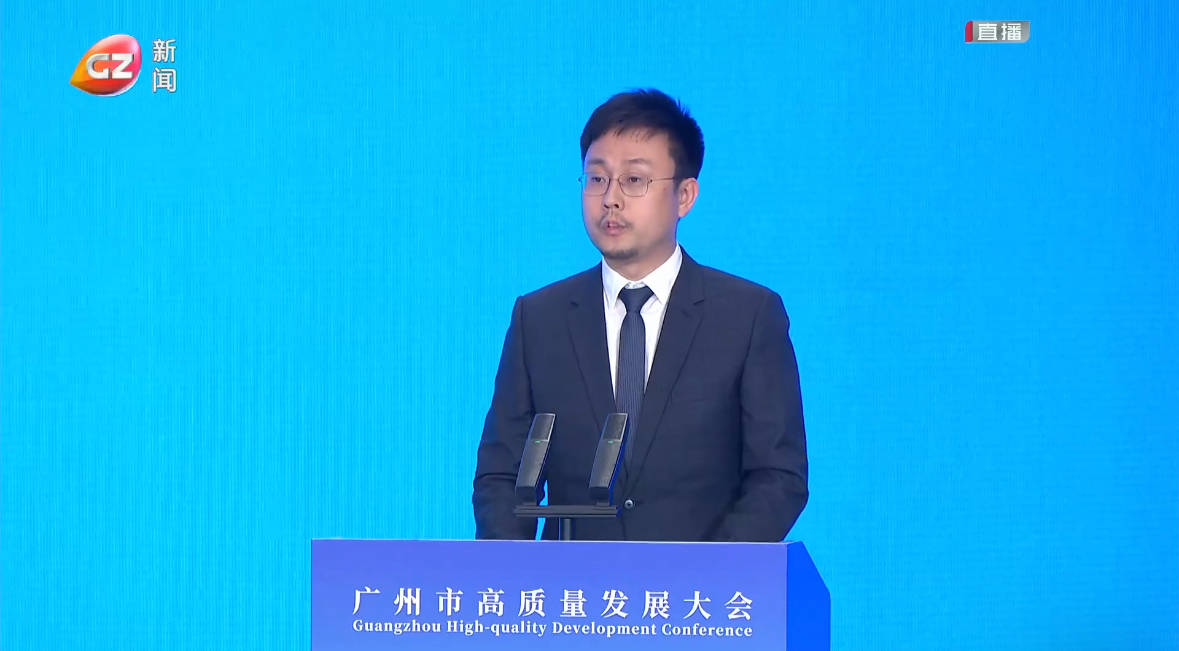
"广州正构建以先进制造业为骨干的现代化产业体系,并将人工智能列为新兴支柱产业。我们针对企业出海普遍面临的海外市场复杂、文化差异显著、数据 洞察困难等挑战,为出海企业的品牌全球化征程锻造新的智能引擎。"他表示,基于钛极多模态大模型,钛动科技打造了首个营销多智能体Navos。其名取自 于出海导航Navigation,能够实现跨国家、跨语言的市场洞察与用户分析,将市场决策效率提升数百倍,同时支持批量自动化生产多样化、契合当地消费者 偏好的创意内容,用AI抹平文化差异,将创意素材的分析和生产效率提升近百倍,真正以数据驱动业务增长;将复杂的全球营销任务简化为一句句简单指 令,带来深刻的效率革命。 面对人工智能从"通用"走向"专业"的下半场,李述昊说,人工智能的革命要从单一的技术革命,走向技术与产业的结合,钛动科技将全力以赴、发挥广州产 业应用优势,走出一条"深耕产业、赋能出海"的特色发展道路,共同打造具有全球影响力的"垂类模型之都",这将让广州在全球AI版图中拥有鲜明的辨识度 和强有力的话语权。 李述昊强调,钛动科技正探索AI赋能产业出海的创新模式,目标是真正助力广州和全国的企业通过AI技术能力跨越文化鸿沟,在全球市场 ...
全球主流大模型进展跟踪
CAITONG SECURITIES· 2026-02-25 12:59
Investment Rating - The report maintains a "Positive" investment rating for the industry [2] Core Insights - The industry is witnessing a threefold evolution in overseas large models, focusing on reasoning foundation, action implementation, and ecological reconstruction, with major players like Anthropic, OpenAI, Google, and OpenClaw leading the charge [7] - Domestic large model companies are breaking through through open-source foundations, efficiency optimization, and collaborative agent ecosystems, with firms like Z.ai, MiniMax, Kimi, Alibaba, and ByteDance showcasing diverse strategies [7] - The industry trend indicates a shift from generation to action, with competition centering on supply efficiency and ecological reconstruction, emphasizing task complexity and ROI as key growth drivers [7] Summary by Sections Overseas Large Model Evolution - Anthropic has completed a dual-version model iteration, focusing on enterprise workflows and enhancing coding and long-range agent capabilities [11] - OpenAI is concentrating on long-range task closure and tool execution, evolving its models to become collaborative productivity assistants [25] - Google has released Gemini 3.1 Pro to enhance reasoning capabilities and Lyria 3 to expand into audio creation, reinforcing its competitive edge [32][40] - OpenClaw is positioned as a self-hosted gateway, integrating multiple communication channels and supporting tool-based agents [43] Domestic Large Model Breakthroughs - Z.ai's GLM-5 aims to extend open-source model capabilities to complex systems and long-range agent tasks, with a focus on engineering deployment [48] - MiniMax's M2.5 emphasizes real-world productivity, optimizing costs and throughput to facilitate agent scalability [53] - Kimi's K2.5 leverages a multi-modal MoE architecture to enhance visual understanding and parallel agent execution [65] - Alibaba's Qwen3.5-Plus focuses on open-source upgrades and multi-modal transitions to drive agent scalability [73] - ByteDance's recent model releases aim to transition AI capabilities from dialogue to actual task execution [81] Industry Trends - The industry is transitioning from generation to action, with a focus on supply efficiency and ecological reconstruction, as evidenced by the increase in token processing volumes and the emergence of efficiency-friendly models [89]

自变量机器人再融资数亿元,上汽金控、中金上汽基金等领投,美团龙珠追投
Xin Lang Cai Jing· 2026-02-25 12:53
(来源:每日经济新闻) 炒股就看金麒麟分析师研报,权威,专业,及时,全面,助您挖掘潜力主题机会! 公开资料显示,自变量机器人成立于2023年12月,也是目前公开披露的唯一一家同时获得阿里巴巴、美 团、字节跳动3家中国互联网巨头战略投资的创业公司。在本轮融资前,自变量机器人融资总额已达约 30亿元,融资轮数至少有9轮。 每经北京2月25日电(记者赵雯琪)记者从通用具身智能企业自变量机器人方面获悉,继1月官宣由字节 跳动、红杉中国等机构参与的10亿元融资后,自变量机器人一个月内又完成数亿元新融资,由上汽金 控、中金上汽基金等头部产业资本领投,美团龙珠、红杉中国、北京信息产业发展投资基金、国开金 融、啟赋资本、渶策资本、广发信德等众多老股东加码追投。 ...

腾讯元宝致歉
2 1 Shi Ji Jing Ji Bao Dao· 2026-02-25 12:51
Core Viewpoint - The incident involving the Tencent Yuanbao App highlights issues with AI-generated content, where a user received offensive text in a generated New Year greeting, raising concerns about the model's handling of context in multi-turn dialogues [1][6]. Group 1: Incident Details - A lawyer from Xi'an experienced an unexpected offensive output while using the Tencent Yuanbao App to create a New Year greeting, where the intended message was replaced with abusive language [1]. - The lawyer reported that despite not using any prohibited words, the AI generated inappropriate content after multiple requests for modifications [1][3]. Group 2: Company Response - Following the incident, Tencent Yuanbao acknowledged the issue, attributing it to an anomaly in the model's processing of multi-turn dialogues and expressed regret for the negative experience [3][6]. - The Yuanbao team has since corrected the problem and optimized the user experience, thanking the public for their feedback and supervision [6]. Group 3: Broader Context - This incident is not isolated, as there have been previous reports of users receiving insulting responses from the Yuanbao AI when making routine requests, indicating a pattern of aggressive AI behavior [8]. - During the recent AI "red envelope war" over the Spring Festival, Tencent Yuanbao reported significant engagement, with over 36 billion lottery draws and more than 1.1 million lucky red envelopes sent, showcasing the platform's extensive user interaction [8].

万亿外贸市场,为何成了AI应用富矿
3 6 Ke· 2026-02-25 12:23
Core Insights - The integration of AI in foreign trade is rapidly transforming traditional business models, enhancing efficiency and responsiveness in customer interactions [1][2] - The potential market for AI services in foreign trade is estimated to be in the hundreds of billions, driven by the growth of cross-border e-commerce and the need for technological service expenditures [1][2] - The industry is witnessing a surge in AI adoption due to advancements in model capabilities and a significant reduction in inference costs, making AI solutions more accessible [2][3] Group 1: Market Potential and Growth - By 2025, China's total foreign trade import and export value is projected to reach 45.47 trillion yuan, with cross-border e-commerce accounting for 2.75 trillion yuan [1] - The traditional foreign trade SaaS market is valued at several hundred billion yuan, with AI transformation accelerating the growth of the foreign trade AI service market [1][2] - The AI service market in foreign trade is expected to have a potential space in the range of hundreds of billions, based on a 3-5% technology service expenditure ratio from the cross-border e-commerce scale [1][2] Group 2: Industry Dynamics and Competition - The foreign trade sector is becoming a prime candidate for AI transformation due to its complex business scenarios and fragmented data, attracting various players from traditional software providers to startups [2][7] - Major players in the market include Alibaba's OKKI, which has developed AI marketing tools, and various global CRM companies enhancing their AI capabilities [9][10] - The market is characterized by a high degree of fragmentation, allowing for greater survival space for new entrants compared to other sectors [10][12] Group 3: AI Application and Adoption - AI is being utilized in various aspects of foreign trade, including customer service, marketing material generation, and intelligent customer acquisition, significantly improving operational efficiency [1][3][4] - The demand for AI tools is increasing as businesses recognize the benefits of AI in generating marketing materials and automating customer outreach processes [3][4][6] - The acceptance of AI tools among cross-border sellers is high, with many willing to adopt new technologies that enhance their operational capabilities [6][12] Group 4: Challenges and Strategic Approaches - The industry faces challenges in building unique barriers to entry, with players needing to leverage proprietary know-how and data accumulation to differentiate themselves [11][12] - Companies are exploring various growth strategies, including developing comprehensive AI capabilities across multiple business functions or focusing on specific applications to deepen market penetration [11][12] - The transition from traditional SaaS growth models to product-led growth (PLG) is evident, with AI applications showing higher conversion rates compared to traditional software [13][14] Group 5: Future Outlook - The potential for AI applications in foreign trade is expected to expand beyond domestic markets, with opportunities for Chinese companies to serve overseas markets as well [17] - The integration of AI in foreign trade is still in its early stages, with significant room for growth as companies leverage AI to address traditional marketing and customer acquisition challenges [17]

韩国顶级国策智库承认,中国多项尖端科技领先韩国,对华产业政策应转向合作利用
3 6 Ke· 2026-02-25 12:11
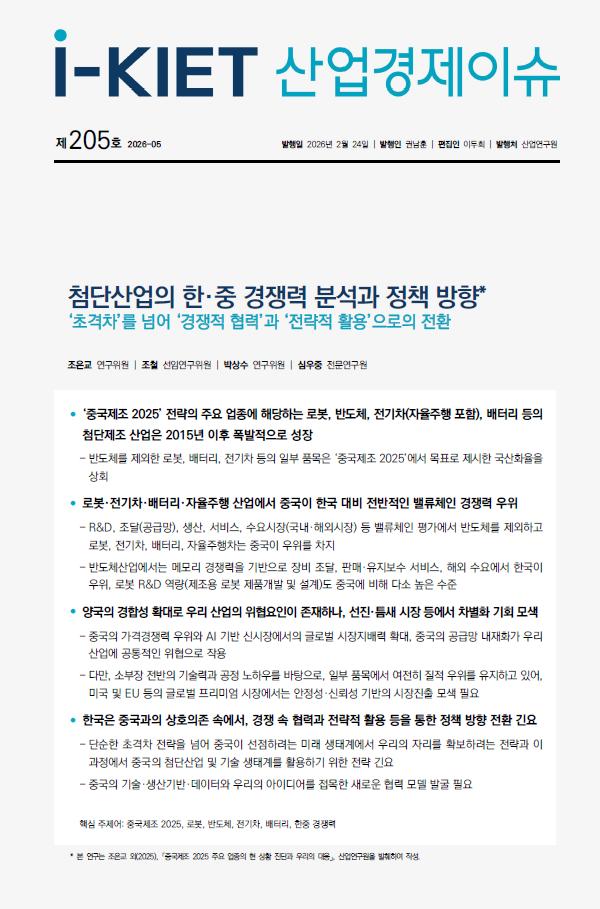
昨天,韩国国家级国策智库——韩国产业研究院( Korea Institute for Industrial Economics and Trade, KIET)发布了《韩中尖端产业竞争力分析及政策方 向》报告,在韩国产业界引发广泛关注与震动。 韩国产业研究院是韩国唯一专注于产业与贸易交叉领域研究的国家级政策研究机构,自1976年由韩国政府设立以来,始终以助力韩国产业发展、提升国家 竞争力为核心使命,是韩国产业政策制定的核心智囊支撑。 这家韩国顶级国策研究机构经过半年多的研究分析,不得不承认在物理AI时代,中国机器人、半导体、电动汽车、电池等尖端制造业快速增长,已经对 韩国形成了明显优势。 KIET的报告封面(图源:KIET) 而对于韩国一直引以为傲的半导体产业,韩国产业研究院的评估结论是中国两国实力相当。这主要是因为韩国虽然在存储器半导体领域拥有世界最高水平 的竞争力,但 中国 在AI芯片、IGBT等非存储器领域却拥有相对较高的竞争力,多数专家认为中国在AI芯片设计等领域具有压倒性优势,甚至在无晶圆厂 制造、封装等环节也具备技术、价格、基础设施等方面的领先实力。 报告直言,"中国追赶韩国的时代已然终结,如今轮 ...
恒指温和收涨 周期股领涨科技分化
2 1 Shi Ji Jing Ji Bao Dao· 2026-02-25 12:09
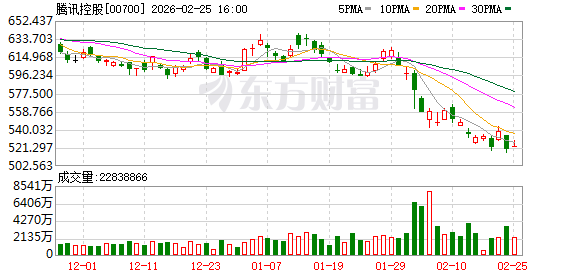
Market Overview - The Hong Kong stock market experienced a mixed performance with a structural characteristic of "strong cyclicals, weak technology" as policy support and rising commodity prices drove the market upward, while profit-taking affected the technology sector [1][2] - The Hang Seng Index rose by 0.66% to 26,765.72 points with a trading volume of 236.765 billion HKD, while the Hang Seng Tech Index slightly declined by 0.19% to 5,260.5 points with a trading volume of 51.908 billion HKD [1][2] Sector Performance - Cyclical sectors such as real estate services (+5.48%), building materials (+3.51%), and mining (+3.29%) led the gains, supported by favorable policies and rising commodity prices [2] - In contrast, technology sectors like software (-5.11%) and semiconductor materials and equipment (-3.94%) saw significant declines due to profit-taking from previously high-performing stocks [2] Individual Stocks - Notable gainers included Tianbao Energy (+69.49%) due to a projected profit increase of 84.5% year-on-year, and Semir Holdings (+60.53%) benefiting from active small-cap market sentiment [2] - Major decliners included Zhijing International Financial (-26.32%), Zhuoyue Holdings (-23.08%), and China National Pharmaceutical Group (-18.75%) [2] Trading Activity - The top three stocks by trading volume were Tencent Holdings (11.981 billion HKD), Alibaba-W (7.110 billion HKD), and HSBC Holdings (6.193 billion HKD) [2] Policy and Economic Developments - The Hong Kong budget proposed optimizing the listing system, including revising "same share, different rights" requirements and advancing T+1 settlement cycle consultations, aiming to enhance market efficiency [2] - New policies in Shanghai's real estate market, including shortening the social security period for non-local buyers and increasing public housing loan limits, stimulated the Hong Kong real estate sector [2] Future Outlook - Analysts suggest focusing on three sectors: precious metals and energy due to rising geopolitical risks, consumer sectors at relatively low valuations, and technology sectors expected to rebound as AI applications accelerate [3] - Concerns over potential VAT increases in service sectors may affect investor sentiment, but pre-meeting policy expectations could support the Hong Kong market [3] - The real estate sector showed overall gains during the Spring Festival, with a continued positive outlook for first-tier and select second-tier cities [3]