西部超导

Search documents
未知机构:华金电新核聚变系列深度三磁体材料迭代推动产业升级政策支持资本开支驱-20260210
未知机构· 2026-02-10 02:10
Summary of Key Points from the Conference Call Industry Overview - The fusion industry is entering an accelerated phase driven by policy support and capital expenditure, with major countries expected to introduce fusion policies by 2025, marking a shift from laboratory research to industrial layout and regulatory framework construction [1] Core Insights - Low-temperature superconductors (NbTi, Nb₃Sn) are relatively mature, while high-temperature superconductors (REBCO) are anticipated to become the mainstream in the future. The current landscape features a parallel development of low-temperature and high-temperature superconducting materials, with low-temperature superconductors supporting existing fusion device operations due to their industrial application advantages. High-temperature superconductors are expected to be key for breakthroughs in next-generation high-field fusion technology due to their superior adaptability to extreme environments [1][2] Market Projections - The magnet system is identified as a core cost component of fusion projects. Future tokamak devices are expected to trend towards compact designs and high-temperature superconductors, leading to a significant increase in industry demand. The market size for second-generation high-temperature superconducting tapes for controllable fusion devices is projected to be 300 million yuan in 2024, with an expected growth to 4.9 billion yuan by 2030, representing a compound annual growth rate (CAGR) of 59.3% from 2024 to 2030 [2] Investment Recommendations - It is suggested to focus on core supply chain manufacturers in the magnet segment: 1. Low-temperature superconductors: Western Superconductor 2. High-temperature superconductors: Shanghai Superconductor (not publicly listed, with Jingda Co. as the largest shareholder), Lianchuang Optoelectronics, Eastern Superconductor (not publicly listed, a subsidiary of Yongding Co.) 3. Core suppliers of tantalum and niobium: Dongfang Tantalum [2]
——金属新材料高频数据周报(20260202-20260208):铼粉价格连续2个月上涨-20260209
EBSCN· 2026-02-09 13:30
2026 年 2 月 9 日 有色金属 铼粉价格连续 2 个月上涨 ——金属新材料高频数据周报(20260202-20260208) 要点 军工新材料:电解钴价格下跌。(1)本周电解钴价格 42.00 万元/吨,环比 -5.2%。本周电解钴和钴粉价格比值 0.73 ,环比-5.2%;电解钴和硫酸钴价格 比值为 4.28 ,环比-5.2%。(2)碳纤维本周价格 83.8 元/千克,环比+0%。 毛利-9.19 元/千克。 新能源车新材料:氢氧化锂价格下跌。(1)本周碳酸锂和氢氧化锂价格分别 为 13.44 、13.25 万元/吨,环比-16.2%、-16.1%。(2)本周硫酸钴价格 9.53 万元/吨,环比+0%。(3)本周磷酸铁锂、523 型正极材料价格分别为 5.24 、18.00 万元/吨,环比+0%、-3.5%。(4)本周氧化镨钕价格 757.72 元/公斤,环比+1.2%。 光伏新材料:多晶硅价格下跌。(1)本周光伏级多晶硅价格 6.19 美元/千 克,环比 -6.5%。(2)本周 EVA 价格 9,650 元/吨,环比+0%,处于 2013 年 来较低位置。(3)本周 3.2mm 光伏玻璃镀膜价格 ...
航天军工:重视国际军贸投资机遇
HTSC· 2026-02-09 10:46
Investment Rating - The report maintains a "Buy" rating for the aerospace and military industry, with specific recommendations for several companies [8][42]. Core Viewpoints - The report emphasizes the increasing uncertainty in international security, highlighting opportunities in military trade as countries ramp up defense spending. For instance, the U.S. has approved military sales worth $6.67 billion to Israel and $9 billion to Saudi Arabia, indicating a vibrant military trade market [11][12]. - The report suggests that China's military equipment demand is expected to grow, particularly in new domains and advanced weaponry, aligning with the "14th Five-Year Plan" [13][17]. - The military trade market is anticipated to remain active, with China positioned as a key supplier capable of providing comprehensive solutions [11][12]. Summary by Sections Industry Investment Rating - The aerospace and military industry is rated as "Buy" with a focus on specific companies such as AVIC Shenyang Aircraft Corporation, Guorui Technology, and others [8][42]. Key Companies - Recommended companies include: - AVIC Shenyang Aircraft Corporation (600760 CH) - Guorui Technology (600562 CH) - Western Superconducting Technologies (688122 CH) - Guotai Group (603977 CH) - Ruichuang Micro-Nano (688002 CH) - Steel Research and Testing (300797 CH) - Northern Navigation (600435 CH) - Gaode Infrared (002414 CH) - Aerospace Rainbow (002389 CH) - Aerospace Intelligent Manufacturing (300446 CH) [3][42]. Market Trends - The report notes a structural shift in military equipment demand, with a focus on new technologies such as unmanned systems and advanced weaponry. The "14th Five-Year Plan" is expected to drive significant growth in these areas [13][15][16]. - The military trade market is projected to grow, with China's market share expected to increase from 5.87% to a more competitive position as global military spending rises [17][18]. Performance Metrics - As of February 6, 2026, the Shenyuan Defense and Military Index has a PE (TTM) of 95.29, indicating a high valuation relative to historical levels [39][40].


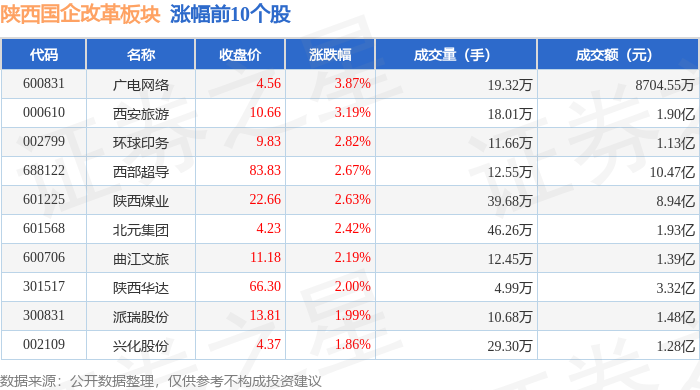
陕西国企改革板块2月9日涨1.5%,广电网络领涨,主力资金净流出1.65亿元

Sou Hu Cai Jing· 2026-02-09 09:39
Market Performance - The Shaanxi state-owned enterprise reform sector rose by 1.5% compared to the previous trading day, with Guangdian Network leading the gains [1] - The Shanghai Composite Index closed at 4123.09, up 1.41%, while the Shenzhen Component Index closed at 14208.44, up 2.17% [1] Individual Stock Performance - Guangdian Network (600831) closed at 4.56, with a gain of 3.87% and a trading volume of 193,200 shares, amounting to a transaction value of 87.05 million yuan [1] - Xi'an Tourism (000610) closed at 10.66, up 3.19%, with a trading volume of 180,100 shares and a transaction value of 190 million yuan [1] - Global Printing (002799) closed at 9.83, gaining 2.82%, with a trading volume of 116,600 shares and a transaction value of 113 million yuan [1] - Western Superconducting (688122) closed at 83.83, up 2.67%, with a trading volume of 125,500 shares and a transaction value of 1.047 billion yuan [1] - Shaanxi Coal and Chemical Industry (601225) closed at 22.66, gaining 2.63%, with a trading volume of 396,800 shares and a transaction value of 894 million yuan [1] Capital Flow Analysis - The Shaanxi state-owned enterprise reform sector experienced a net outflow of 165 million yuan from institutional investors, while retail investors saw a net inflow of 99.38 million yuan [2] - The main capital inflow was observed in Western Superconducting, with a net inflow of 1.23 billion yuan from institutional investors, despite a net outflow from retail investors [3] - North Yuan Group (601568) had a net inflow of 28.15 million yuan from institutional investors, while retail investors experienced a net outflow of 25.58 million yuan [3]

钢研高纳:首次覆盖报告高温合金龙头,军民共振驱动长期成长-20260209
GUOTAI HAITONG SECURITIES· 2026-02-09 02:45
Investment Rating - The report assigns a "Buy" rating to the company with a target price of 28.05 CNY [5][12][16]. Core Insights - The company is a leader in the high-temperature alloy sector in China, benefiting from strong demand in the aerospace industry and a focus on technological self-sufficiency, which is expected to drive steady growth in performance [2][12]. - The company has a comprehensive product range that includes casting high-temperature alloys, deformed high-temperature alloys, and new high-temperature alloys, with applications in key national sectors such as aerospace, nuclear power, and gas turbines [12][27]. - The growth in military and civilian markets, along with the increasing defense budget and the upgrade of aerospace equipment, provides a resilient demand backdrop for high-temperature alloys [12][27]. Financial Summary - The company is projected to achieve total revenue of 3.648 billion CNY in 2025, with a year-on-year growth of 3.5%, and net profit attributable to the parent company is expected to be 132 million CNY [11][12]. - The earnings per share (EPS) for 2025 is estimated at 0.17 CNY, with a projected net profit margin of 3.4% [11][12]. - The company’s financial metrics indicate a net asset return (ROE) of 3.4% for 2025, with a price-to-earnings (P/E) ratio of 165 times based on the 2025 estimates [11][12][24]. Market Position - The company is positioned as a core supplier of high-temperature alloys for aerospace applications, with a strong market presence and a stable customer base [12][27]. - The company has a robust R&D investment strategy, focusing on new high-temperature alloys and additive manufacturing, which helps maintain its technological edge [12][27]. Growth Catalysts - Key growth drivers include the ramp-up of aerospace equipment orders, the implementation of domestic high-temperature alloy policies, and unexpected growth in demand from the civil aviation and gas turbine sectors [12][27].

趋势研判!2026年全球时频测量行业产业链、市场规模、市场区域格局、竞争格局及发展趋势:需求持续释放,市场规模有望达到7.13亿美元[图]
Chan Ye Xin Xi Wang· 2026-02-09 01:27
二、时频测量行业发展现状 关键词:时频测量行业产业链、时频测量行业政策、时频测量市场规模、时频测量市场区域分布、时频 测量市场竞争格局、时频测量行业发展趋势 内容概要:时频测量是指利用量子态的高度稳定性和精确性,在多个重要领域实现高精度的时间同步。 随着现代信息化进程推进,时间码高精度测量需求升级及商业化加速,量子时频测量需求持续释放,市 场规模逐年增长。从区域分布来看,北美地区量子时钟发展发展较早,已经成为全球主要时频测量市 场。据统计,2024年全球量子时频测量领域市场规模达到6.4亿美元,其中,北美地区时频测量市场超 过全球40%的份额,欧洲占22%,中国占22%,亚太(除中国以外)约占9%。2025年全球量子时频测量领 域市场规模约6.77亿美元,预计2026年全球量子时频测量市场规模有望达到7.13亿美元。随着下游高端 领域需求扩张,时频测量设备的使用在关键国民经济领域不断得到推广,时频测量行业发展空间广阔。 一、时频测量行业定义及应用 上市企业:国盾量子(688027.SH)、天奥电子(002935.SZ)、西部超导(688122.SH)、光韵达(300227.SZ)、 国睿科技(600562.S ...

钢研高纳(300034):首次覆盖报告:高温合金龙头,军民共振驱动长期成长
GUOTAI HAITONG SECURITIES· 2026-02-09 01:09
Investment Rating - The report assigns a "Buy" rating to the company with a target price of 28.05 CNY [5][12][16]. Core Insights - The company is a leader in the high-temperature alloy sector in China, benefiting from strong demand in the aerospace industry and a focus on technological self-sufficiency, which is expected to drive steady growth in performance [2][12]. - The company has a comprehensive product range that includes casting high-temperature alloys, deformed high-temperature alloys, and new high-temperature alloys, with applications in key national sectors such as aerospace, nuclear power, and gas turbines [12][27]. - The military-civilian market synergy and resilient industry demand provide long-term support for growth, especially with increasing defense budgets and the upgrade of aerospace equipment [12][27]. Financial Summary - The company is projected to achieve total revenue of 3.648 billion CNY in 2025, with a year-on-year growth of 3.5%, and net profit attributable to the parent company is expected to be 132 million CNY [11][12]. - The earnings per share (EPS) for 2025 is estimated at 0.17 CNY, with a projected net profit margin of 3.4% [11][12]. - The company maintains a low net debt ratio of 6.39%, indicating a strong financial position [7]. Market Position - The company is positioned as a core supplier of high-temperature alloys for aerospace applications, with a stable customer base and strong capabilities across the entire industry chain [12][27]. - The company has a significant production capacity, including the ability to produce over 1,000 tons of aerospace-grade high-temperature alloy mother alloys annually [30][33]. Growth Drivers - Key growth catalysts include the ramp-up of aerospace equipment orders, the implementation of domestic high-temperature alloy policies, and unexpected growth in demand for civil aviation and gas turbines [12][27]. - The company is increasing its R&D investment to build technological barriers and ensure long-term stable growth [12][27]. Valuation Analysis - The target price of 28.05 CNY is based on a cautious assessment using a lower PE ratio of 165 times for 2025, reflecting the company's leading position and growth certainty in the high-temperature alloy sector [12][24]. - The report also considers comparable companies' average PE and PB ratios to establish a robust valuation framework [19][24].
磁体材料迭代推动产业升级
Zhong Guo Neng Yuan Wang· 2026-02-09 00:51
Core Insights - The fusion industry is entering an accelerated phase driven by policy support and capital expenditure, with major countries expected to introduce fusion policies by 2025, marking a shift from laboratory research to industrial layout and regulatory framework construction [2] - Low-temperature superconductors are relatively mature, while high-temperature superconductors are expected to become the mainstream in the future, with magnetic materials being the core foundation for stable magnetic field confinement in fusion devices [2] Industry Overview - The magnet system is a core cost component of fusion projects, with the ITER project using low-temperature superconductors having 86% of its component costs attributed to parts, of which magnets account for 28% [3] - In high-temperature superconductor projects, the cost of the magnet system increases further, with the ARC project showing that magnets account for 46% of the total cost [3] Market Potential - The market size for second-generation high-temperature superconducting tapes for global controllable fusion devices is projected to reach 300 million yuan in 2024, with an expected growth to 4.9 billion yuan by 2030, representing a compound annual growth rate of 59.3% from 2024 to 2030 [3] Investment Recommendations - The magnet segment, being the highest value component in the fusion system, is currently transitioning from low-temperature to high-temperature technology validation and evolution, indicating a positive outlook for demand driven by the capital expenditure cycle in fusion [3] - Key suppliers in the magnet segment include: 1) Low-temperature superconductors: Western Superconductor 2) High-temperature superconductors: Shanghai Superconductor (not listed, controlled by Jingda Co., Ltd. (600577)), Lianchuang Optoelectronics (600363), Eastern Superconductor (not listed, a subsidiary of Yongding Co., Ltd. (600105)) 3) Core suppliers of tantalum and niobium: Dongfang Tantalum Industry (000962) [3]
核聚变深度:磁体材料迭代推动产业升级(附34页PPT)
材料汇· 2026-02-08 15:24
Group 1 - The fusion industry is entering an accelerated phase driven by policy support and capital expenditure, with major countries expected to introduce fusion policies by 2025, marking a shift from laboratory research to industrial layout and regulatory framework construction [2][9] - Domestic policy support for controllable nuclear fusion is forming a clear advancement logic, with a national framework being established to optimize regulatory processes and provide clear guidance for technological research and development [6][8] - The superconducting materials landscape is characterized by a parallel development of low-temperature superconductors (NbTi, Nb₃Sn) and high-temperature superconductors (REBCO), with low-temperature superconductors currently supporting existing fusion operations and high-temperature superconductors poised to become key for next-generation high-field fusion technology breakthroughs [2][3][27] Group 2 - The magnet system is a core cost component of fusion projects, with the ITER project showing that component costs account for 86%, of which magnets represent 28%, primarily due to the reliance on high-cost low-temperature liquid helium for cooling [3][55] - In high-temperature superconducting projects, the cost of the magnet system is expected to increase further, as seen in the ARC project where the magnet system accounts for 46% of the total cost [57] - The global market for second-generation high-temperature superconducting tapes used in controllable nuclear fusion devices is projected to grow from 300 million yuan in 2024 to 4.9 billion yuan by 2030, with a compound annual growth rate (CAGR) of 59.3% from 2024 to 2030 [3][65] Group 3 - Investment recommendations focus on the magnet segment of the fusion system, which is currently transitioning from low-temperature to high-temperature technology, indicating a significant demand increase driven by the capital expenditure cycle in nuclear fusion [3][8] - The BEST project, aimed at bridging the gap between experimental and demonstration reactors, is expected to accelerate capital expenditure, with significant procurement activities already underway [59][63] - The global market for superconducting materials is expected to see substantial growth, driven by the increasing demand for high-temperature superconductors in fusion applications, with REBCO materials showing significant potential for enhancing magnetic field strength and reducing magnet size [27][31]


未来产业:核聚变关键部件与材料投资机会(附投资逻辑与标的)
材料汇· 2026-02-07 15:18
Group 1 - The article discusses the current advancements in nuclear fusion technology and key future milestones [1] - It highlights the operational status and financing situation of global nuclear fusion devices [2][6] - The article analyzes the value of key components such as magnet systems, divertors, and blanket systems, along with a breakdown of essential materials [7][8] Group 2 - ITER (International Thermonuclear Experimental Reactor) is set to begin plasma experiments with deuterium-tritium in 2036, with China responsible for 18 key component procurement packages [2][51] - The HL-3 (Chinese Circulation No. 3) aims to achieve a fusion triple product of 10^20 by May 2025, marking a significant advancement in fusion research [3] - EAST (Experimental Advanced Superconducting Tokamak) achieved a world record of 1 billion degrees Celsius for 1066 seconds in January 2025 [4] Group 3 - The BEST (Compact Fusion Energy Experimental Device) project is scheduled to be completed by 2027, with plans to demonstrate power generation by 2030 [5][71] - The global nuclear fusion industry is projected to attract over $7.1 billion in investment in 2024, with a compound annual growth rate of 5.1% expected until 2037 [6] - Key components in ITER, such as the magnet system, in-vessel components, and vacuum chamber, account for 28%, 17%, and 8% of the total construction cost, respectively [7][50] Group 4 - The article emphasizes the advantages of nuclear fusion energy, including high energy density, environmental friendliness, and safety [15][19] - It outlines the necessary conditions for achieving controlled nuclear fusion, which include sufficient temperature, density, and energy confinement time [19][20] - The article details the operational status of various fusion devices globally, with a focus on the number of devices in operation, under construction, and planned [36][44]