
中国移动

Search documents
特朗普称希望与伊朗“能够达成协议”;深圳水贝“杰我睿”进展:有消费者收到兑付方案;国投白银LOF复牌;何小鹏回应机器人摔倒 | 每经早参
Mei Ri Jing Ji Xin Wen· 2026-02-01 21:47
Taxation and Regulatory Changes - The State Taxation Administration has announced an increase in the threshold for value-added tax (VAT) from 500 yuan to 1000 yuan per transaction starting this year, with specific exemptions for certain activities [5] - New regulations for export tax rebates have been introduced to streamline the process, leveraging big data and new technologies to enhance efficiency for taxpayers [5] Shipbuilding Industry - China's shipbuilding industry is set to maintain its global leadership for the 16th consecutive year, with projections indicating that by 2025, six Chinese companies will rank among the top ten in terms of shipbuilding completion, new orders, and orders on hand [5] Energy Consumption - Shanghai's electricity consumption is expected to exceed 200 billion kilowatt-hours for the first time in 2025, reaching 208.88 billion kilowatt-hours, marking a year-on-year growth of 5.28% [6] Automotive Industry - In January 2026, several major automotive brands reported year-on-year sales growth, with Hongmeng Zhixing achieving a 65.6% increase in deliveries, while other brands like Xiaomi and Xpeng saw declines compared to the previous month [18] Telecommunications Sector - China Mobile, China Unicom, and China Telecom have announced that from January 1, 2026, the VAT rate for certain telecommunications services will increase from 6% to 9%, which will impact their revenue and profit [19]







中国移动有限公司关于电信服务增值税税目适用范围调整的公告
Shang Hai Zheng Quan Bao· 2026-02-01 18:52
Core Viewpoint - The announcement from the Ministry of Finance and the State Taxation Administration of the People's Republic of China indicates a change in the tax classification for certain telecommunication services, which will affect the revenue and profit of China Mobile starting January 1, 2026 [1]. Group 1: Tax Changes - The tax category for services such as mobile data, SMS, multimedia messaging, and internet broadband access will change from value-added telecommunications services to basic telecommunications services [1]. - The applicable VAT rate for these services will increase from 6% to 9% [1]. Group 2: Company Response - China Mobile emphasizes its commitment to its core business and aims to strengthen and enhance its telecommunications, computing power, and intelligent services [1]. - The company plans to focus on foundational network improvements, promote comprehensive innovation, and enhance management efficiency to build a world-class technology service enterprise [1].
电信服务增值税税目适用范围调整 三大运营商聚焦算力等新兴业务布局
Shang Hai Zheng Quan Bao· 2026-02-01 18:15
Core Viewpoint - The three major telecom operators in China are adjusting their business strategies in response to changes in tax regulations, focusing on innovation and the development of computing power services to drive high-quality growth [1][2]. Group 1: Tax Regulation Impact - The Ministry of Finance and the State Taxation Administration announced that starting January 1, 2026, the tax category for certain telecom services will change from value-added telecom services to basic telecom services, with the VAT rate increasing from 6% to 9% [2]. Group 2: Strategic Focus and Performance - China Telecom is implementing a comprehensive strategy to enhance its cloud and AI services, aiming to create an integrated intelligent cloud service platform [3]. - China Mobile is focusing on strengthening its communication services and expanding its capabilities in computing and intelligent services [3]. - China Unicom is concentrating on core areas such as connectivity, computing, services, and security to build differentiated advantages [3]. - The three operators are transitioning to a strategic "gear-shifting" phase, placing artificial intelligence at the core of their strategies, with significant achievements already noted [3]. Group 3: Financial Performance - China Unicom reported a revenue of 293 billion yuan for the first three quarters of 2025, a year-on-year increase of 1.0%, with a net profit of 8.8 billion yuan, up 5.2% [4]. - China Telecom's IDC revenue reached 27.5 billion yuan, a 9.1% increase year-on-year, contributing to a total revenue of 394.3 billion yuan, up 0.6% [4]. - China Mobile achieved a revenue of 794.7 billion yuan, a 0.4% increase, with a net profit of 115.4 billion yuan, up 4.0% [4].

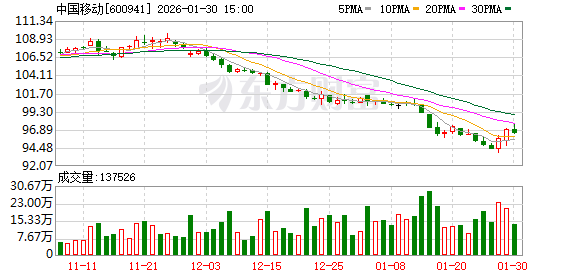
股市必读:中国移动(600941)1月30日主力资金净流入4465.49万元,占总成交额3.36%
Sou Hu Cai Jing· 2026-02-01 17:20
Group 1 - The stock price of China Mobile (600941) closed at 96.38 yuan on January 30, 2026, down by 0.62%, with a turnover rate of 1.52% and a trading volume of 137,500 shares, amounting to a total transaction value of 1.33 billion yuan [1] - On January 30, the net inflow of main funds was 44.65 million yuan, accounting for 3.36% of the total transaction value, while retail investors experienced a net outflow of 33.14 million yuan, representing 2.49% of the total transaction value [2][1] Group 2 - Starting from January 1, 2026, the VAT rate for mobile data services, SMS, MMS, and broadband access services will be adjusted from 6% to 9%, with the applicable tax category changing from value-added telecommunications services to basic telecommunications services [1][2] - This adjustment is expected to impact the company's revenue and profit, prompting the company to continue focusing on its core business, enhancing service capabilities, and promoting innovation and management optimization [1]
周末重要消息:顶层集体学习未来产业,去年证券印花税增长58%,黄金白银现史诗级暴跌,商业航天传来大消息,锋龙股份等妖股复牌
Jin Rong Jie· 2026-02-01 16:32
一、财经重要消息 财政部:2025年证券交易印花税增长57.8% 1月30日,财政部举行新闻发布会,介绍2025年财政收支情况。会上,财政部国库司副司长郑涌介绍, 2025年,证券交易印花税达到2035亿元,增长57.8%。 两部门:鼓励供需双方在中长期合同中签订随市场供需、发电成本变化的灵活价格机制 国家发展改革委、国家能源局发布《关于完善发电侧容量电价机制的通知》。其中提到,完善电力市场 交易和价格机制。煤电容量电价机制完善后,各地可根据电力市场供需、参与市场的所有机组变动成本 等情况,适当调整省内煤电中长期市场交易价格下限,在确保电力电量平衡的情况下适当放宽煤电中长 期合同签约比例要求。鼓励供需双方在中长期合同中签订随市场供需、发电成本变化的灵活价格机制。 省内市场供需双方签订中长期合同时,各地不得强制要求签订固定价,可根据电力供需、市场结构等情 况,要求年度中长期合同中约定一定比例电量实行反映实时供需的灵活价格。 财政部:2025年全国一般公共预算收入21.6万亿元,较2024年下降1.7% 政治局集体学习:前瞻布局和发展未来产业 中共中央政治局1月30日下午就前瞻布局和发展未来产业进行第二十四次集体 ...

港股周观点 | 科技+周期耗材主线回撤而非反转
Xin Lang Cai Jing· 2026-02-01 15:00
Market Overview - The Hang Seng Index reached a four-year high last week, but experienced a technical pullback due to a hawkish Federal Reserve chair nomination, indicating a risk-off sentiment in global equity markets [1] - The market sentiment index moved from panic to optimism within 16 days, suggesting a shift in investor sentiment [1] - Current market volatility is expected to persist, but it is more likely to be a correction rather than a reversal of market performance [1] Earnings and Revenue Expectations - Non-financial earnings expectations have been revised upward by 0.4% over the past four weeks, while revenue expectations have been slightly downgraded by 0.1% [2] - The sectors with the most significant upward revisions in earnings expectations include non-ferrous metals (7.7%), military industry (4.0%), and electric new energy (1.8%) [2] Capital Flow - Foreign capital continues to flow into Hong Kong stocks, with net inflows reaching $2.8 billion, up from $1.95 billion the previous week [3] - Active foreign capital has seen a continuous inflow for three weeks, with a record weekly inflow of $640 million [3] - The nomination of Kevin Warsh as the next Federal Reserve chair has led to short-term volatility, but the medium-term liquidity outlook remains accommodative [3] Market Sentiment - The market sentiment index has risen to 62.1, indicating an optimistic outlook [4] - Factors contributing to this optimism include strong net inflows from southbound capital and high buying intensity [4] Investment Recommendations - Companies with earnings certainty should be considered as core holdings, while opportunities to increase allocations in technology and cyclical materials should be explored during market corrections [5] - Focus on sectors showing upward trends, such as AI-related industries, semiconductor manufacturing, and innovative pharmaceuticals [5]
金山银山变绿水青山——A股一周走势研判及事件提醒
Datayes· 2026-02-01 14:12
Core Viewpoint - The article discusses the significant market fluctuations in precious metals, particularly due to the nomination of Kevin Warsh as the next Federal Reserve Chairman, which has led to a sharp decline in gold and silver prices, indicating a shift towards a more hawkish monetary policy [3][8]. Market Reactions - Gold futures fell by 11%, marking the most severe correction since 1980, while silver futures dropped by 31%, the largest single-day decline in over 40 years [3]. - The market is experiencing extreme sentiment, with a potential for recovery in precious metals as the fundamentals remain unchanged [8]. Economic Indicators - China's general public budget revenue saw a significant decline of 25% year-on-year in December, with tax revenue down by 11.5% and non-tax revenue down by 47.9%, leading to an overall contraction of 1.7% for the year [9]. - Government bond issuance in January reached approximately 1.1 trillion yuan, exceeding last year's 930 billion yuan, indicating a proactive fiscal approach to support economic growth [9]. Sector Performance - The semiconductor sector is witnessing a surge, with South Korea's semiconductor exports increasing by 103% year-on-year, contributing significantly to the overall export growth [14]. - Domestic chip manufacturers are raising prices by up to 80%, indicating strong demand and potential for continued price increases in 2026 [14]. AI Applications - Tencent's AI assistant launched a successful promotional campaign, indicating strong consumer engagement and interest in AI applications [15]. - The emergence of platforms like Moltbook, which hosts numerous AI agents, suggests a growing trend in AI integration into social and productive tools [16]. Investment Strategies - Analysts suggest that despite recent market volatility, sectors such as AI hardware, semiconductors, and resource commodities may present strong investment opportunities as the market stabilizes [13]. - The focus remains on sectors with robust fundamentals and growth potential, particularly in technology and renewable energy [13].

中国移动:电信服务增值税税率6%调至9%,影响公司收入利润
Mei Ri Jing Ji Xin Wen· 2026-02-01 14:01
Core Viewpoint - The adjustment of the VAT tax category for telecommunications services in China will impact the revenue and profit of China Mobile, as the VAT rate changes from 6% to 9% starting January 1, 2026 [1][4]. Group 1 - The Ministry of Finance and the State Taxation Administration of China announced that from January 1, 2026, the tax category for services such as mobile data, SMS, MMS, and internet broadband access will change from value-added telecommunications services to basic telecommunications services [1][4]. - The corresponding VAT rate for these services will increase from 6% to 9% [1][4]. - The company aims to strengthen its core telecommunications services, computing power services, and intelligent services while focusing on network enhancement and innovation [1][4].

中国三大电信运营商宣布调整电信服务增值税税率
Zhong Guo Xin Wen Wang· 2026-02-01 13:43
Group 1 - The core point of the news is the adjustment of the value-added tax (VAT) rate for telecommunications services in China, increasing from 6% to 9%, which will impact the revenue and profits of major telecom operators [2][3] - The adjustment is set to take effect on January 1, 2026, and applies to services such as mobile data, SMS, multimedia messaging, and internet broadband access [2] - The change is characterized as a "repositioning" of the tax category rather than an additional tax burden, aiming to clarify the public nature of basic communication services and enhance operational efficiency in the industry [4] Group 2 - The announcement from the Ministry of Finance and the State Taxation Administration specifies the applicable VAT rates and the scope of services, with the current VAT rates in China being 13% for the basic rate, and 9% and 6% for preferential rates [4] - The repositioning is expected to encourage telecom operators to focus more on core activities such as network construction and service assurance, reducing homogeneous marketing competition [4]


宽带、短信等增值税税率由6%提高至9%,会涨价吗?
Di Yi Cai Jing· 2026-02-01 13:42
Core Viewpoint - The adjustment of the VAT tax rate applicable to telecommunications services in China will impact the revenue and profits of the three major telecom operators, China Mobile, China Unicom, and China Telecom, starting from January 1, 2026 [1][2]. Group 1: Tax Rate Changes - The new regulation changes the applicable tax category for mobile data services, SMS, MMS, and internet broadband access from value-added telecommunications services (6% VAT) to basic telecommunications services (9% VAT) [1][2]. - The definition of basic telecommunications services has been expanded to include mobile data services, SMS, MMS, and internet broadband access, which were previously classified under value-added telecommunications services [2]. Group 2: Financial Implications - The increase in VAT from 6% to 9% for certain services may lead to higher costs for consumers, although the extent of this price increase will depend on consumer demand elasticity [2][3]. - The adjustment is expected to increase the tax burden on telecom companies, but given their state-owned status and market position, the impact is considered manageable [2]. - The adjustment in tax rates is anticipated to contribute to increased fiscal revenue, addressing the growing fiscal pressure faced by the government [3]. Group 3: Broader Economic Context - In 2025, the national general public budget revenue is projected to be 21,604.5 billion yuan, a decrease of 1.7% from the previous year, while government fund budget revenue is expected to decline by 7% [3].