三生制药

Search documents
深度 | 蔓迪港股递表,引爆防脱“新战局”
FBeauty未来迹· 2025-11-25 14:18
Core Insights - The core viewpoint of the article is that the power dynamics in China's anti-hair loss market have shifted from traditional daily chemical brands to pharmaceutical companies, driven by a growing consumer base and evolving market demands [4][5]. Market Dynamics - The anti-hair loss market in China has seen a significant transformation, with over 300 million people affected by hair loss, particularly among the 26-35 age group, indicating a shift from a minor issue to a widespread concern [4]. - Pharmaceutical companies, particularly those with OTC pipelines and dermatological resources, have emerged as the primary players in the market, leading to a dual oligopoly dominated by Sanofi's Mandi and Zhendong Pharmaceutical's Dafeixin [4][8]. - The market for anti-hair loss products has reached 5.247 billion yuan in sales within the first ten months of 2025, reflecting a year-on-year growth of over 47% [10][13]. Brand Strategies - Pharmaceutical companies are creating a new narrative of "anti-hair loss = medicine + consumer," leveraging high margins and professional barriers while extending their product lines into daily care categories [5][19]. - Brands like Mandi and Dafeixin are combining pharmaceutical and cosmetic products, promoting them through "scientific anti-hair loss salons" to capture consumer interest [6][9]. Competitive Landscape - Traditional daily chemical brands are struggling, with companies like Bawang reporting a significant decline in profits despite a slight revenue increase, highlighting a structural challenge in the market [8]. - The consumer focus has shifted from "shampoo for hair loss" to "medical treatment and scalp management," indicating a demand for more scientifically-backed solutions [9][10]. Emerging Trends - The average price of anti-hair loss products has risen to over 113 yuan, suggesting consumers are willing to invest more in effective scalp care solutions [13]. - New brands such as EHD and Off&Relax are gaining traction, with EHD leading in sales at 371 million yuan, showcasing a trend towards professional and functional care [16][18]. Future Directions - To compete effectively, beauty brands must transition from traditional narratives to scientific and medical language, focusing on the mechanisms behind hair loss and scalp health [19][23]. - The integration of devices with hair care products is emerging as a trend, with brands like Kérastase introducing scalp care devices that enhance treatment efficacy [25][27]. Conclusion - The anti-hair loss market is evolving into a sector characterized by scientific, medical, and long-term management approaches, with pharmaceutical companies redefining the rules and traditional brands being compelled to adapt [19].



脱发90后撑起一个IPO,公司年赚近4亿,毛利率超82%
2 1 Shi Ji Jing Ji Bao Dao· 2025-11-25 12:07
Core Viewpoint - The IPO application of Mandi Inc., a subsidiary of Sihuan Pharmaceutical, aims to become the first listed company in China's hair health sector, capitalizing on a market with over 339 million people suffering from hair loss and a projected market growth rate of 11.3% annually [1][3][5]. Market Demand and Growth - The hair health management market in China is expected to exceed 80 billion yuan in 2024, with a compound annual growth rate (CAGR) of 11.3% projected from 2024 to 2035, potentially reaching 171.4 billion yuan by 2035 [3][5]. - The demographic of hair loss sufferers is predominantly under 35 years old, accounting for over 60% of the total, indicating a shift from optional to essential consumption in this market [3][5]. Company Performance and Product Portfolio - Mandi Inc. has established a strong market presence, with its core product series, the Mandi® series, holding over 71% market share in the minoxidil drug market as of 2024 [5][6]. - The company reported revenue growth from 982 million yuan in 2022 to 1.455 billion yuan in 2024, with a net profit increase from 202 million yuan to 390 million yuan during the same period, reflecting a CAGR of 21.7% [6][8]. Challenges and Risks - Mandi Inc. faces significant risks due to its high dependency on core products, with 92.4% of its revenue in the first half of 2025 coming from the Mandi series [8][9]. - The company has low R&D investment, with only 2.62% of revenue allocated to R&D in the first half of 2025, raising concerns about its long-term competitiveness [9]. - Supply chain concentration is a risk, with the top five suppliers accounting for 75.6% of procurement, making the company vulnerable to supply disruptions [9]. Strategic Plans and Future Outlook - The IPO proceeds will be used to enhance R&D, expand product lines, and optimize the supply chain, focusing on women's hair loss treatments and new topical formulations [10][11]. - The company aims to balance short-term sales with long-term R&D investments to build sustainable growth and reduce reliance on the Mandi series [11]. - The competitive landscape is evolving, with traditional and emerging brands entering the market, necessitating Mandi Inc. to innovate and adapt to maintain its market position [9][11].

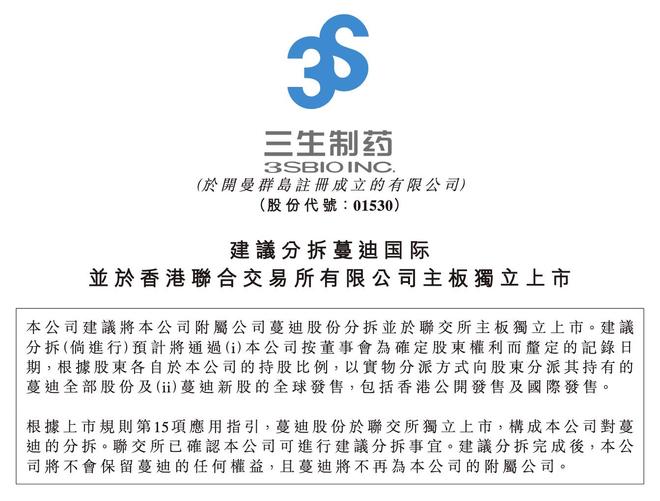
三生制药拟分拆脱发治疗领域附属公司蔓迪国际赴港上市
Xin Jing Bao· 2025-11-25 12:05
Core Viewpoint - Recently, 3SBio announced the proposal to spin off its subsidiary Mandi International for independent listing on the Hong Kong Stock Exchange, with 3SBio holding 87.16% of Mandi's shares, and after the spin-off, 3SBio will not retain any interests in Mandi [1][5] Group 1: Company Overview - Mandi International was established in 1997 as Zhejiang Wansheng Pharmaceutical Co., Ltd., and launched China's first 5% minoxidil product in 2001, filling a gap in the domestic hair loss treatment market [1][2] - Mandi International's revenue is primarily dependent on the Mandi product series, which includes 5% minoxidil solutions and shampoos, contributing over 90% of its revenue [3][4] Group 2: Market Potential - The hair health management market in China has expanded from 19.8 billion yuan in 2018 to an estimated 52.7 billion yuan in 2024, with a projected compound annual growth rate (CAGR) of 11.3% from 2024 to 2035 [2] - Over 339 million people in China are affected by hair loss, with more than 60% of them under the age of 35 [2] Group 3: Financial Performance - Mandi International's revenue from 2022 to 2024 is projected to grow from 982 million yuan to 1.455 billion yuan, with a CAGR of 21.7%, and net profits are expected to rise from 202 million yuan to 390 million yuan [3] - In the first half of 2025, Mandi International achieved revenue of 743 million yuan, a year-on-year increase of approximately 20.2% [3] Group 4: Product Development - Mandi International launched the second-generation minoxidil product, Mandi 5% minoxidil foam, which saw rapid sales growth, generating 307 million yuan in 2024 and 283 million yuan in the first half of 2025 [4] - The company has a pipeline of products under development, including treatments for acne, obesity, and vitiligo, although these contribute less to current revenue [4] Group 5: Strategic Rationale for Spin-off - The spin-off is expected to provide multiple commercial benefits, including enhanced value transparency, independent financing platforms, and optimized management responsibilities, which will improve decision-making and market responsiveness [5]
港股创新药ETF(159567)涨0.60%,成交额13.91亿元
Xin Lang Cai Jing· 2025-11-25 10:55
来源:新浪基金∞工作室 港股创新药ETF(159567)现任基金经理为马君。马君自2024年1月3日管理(或拟管理)该基金,任职 期内收益68.04%。 最新定期报告显示,港股创新药ETF(159567)重仓股包括百济神州、康方生物、信达生物、中国生物 制药、中国生物制药、石药集团、三生制药、翰森制药、科伦博泰生物-B、再鼎医药,持仓占比如下。 股票代码股票名称持仓占比持仓股数(股)持仓市值(元)06160百济神州10.62%436.35万8.17亿09926 康方生物10.55%630.20万8.12亿01801信达生物10.21%893.55万7.86亿01177中国生物制药9.62%9966.80万 7.41亿08027中国生物制药9.62%9966.80万7.41亿01093石药集团7.56%6809.40万5.83亿01530三生制药 7.25%2038.75万5.58亿03692翰森制药5.39%1260.00万4.15亿06990科伦博泰生物-B3.48%57.08万2.68亿 09688再鼎医药2.73%862.34万2.10亿 港股创新药ETF(159567)成立于2024年1月3日,基金全 ...
脱发90后撑起一个IPO,公司年赚近4亿,毛利率超82%
21世纪经济报道· 2025-11-25 10:26
Core Viewpoint - The article highlights the upcoming IPO of Mandi Inc., a subsidiary of Sanofi Pharmaceutical, which aims to become the first listed company in China's hair health sector, capitalizing on the growing demand from over 339 million people suffering from hair loss in China [1][3]. Market Opportunity - The hair health management market in China is projected to exceed 80 billion yuan in 2024, with a compound annual growth rate (CAGR) of 11.3% expected from 2024 to 2035, potentially reaching 171.4 billion yuan by 2035 [6]. - The demographic trend shows that over 60% of the hair loss population is under 35 years old, indicating a shift from optional to essential consumption in hair loss treatments [5]. Company Performance - Mandi Inc. has established a strong market presence, with its core product series, Mandi®, holding over 71% market share in the minoxidil drug market as of 2024 [7]. - The company's revenue grew from 982 million yuan in 2022 to 1.455 billion yuan in 2024, with a net profit increase from 202 million yuan to 390 million yuan during the same period, reflecting a CAGR of 21.7% [7]. Challenges and Risks - Mandi Inc. faces significant risks due to its high dependency on its core product series, which accounted for 92.4% of total revenue in the first half of 2025 [9]. - The company has low R&D investment, with only 2.62% of revenue allocated to R&D in the first half of 2025, raising concerns about its long-term competitiveness [10]. - Supply chain concentration is another risk, with the top five suppliers accounting for 75.6% of procurement, making the company vulnerable to supply disruptions [11]. Strategic Plans - The IPO proceeds will be primarily used for increasing R&D investment, expanding product lines, and optimizing the supply chain [12]. - The company aims to balance sales and R&D spending, accelerate new product development, and maintain market share amid increasing competition from traditional pharmaceutical companies and emerging brands [12]. Conclusion - Mandi Inc.'s IPO represents not only a financial leap but also a critical opportunity for transformation and growth in the competitive hair health market [13].

资讯日报:中美元首进行上月会晤以来的首次通话-20251125
Guoxin Securities Hongkong· 2025-11-25 09:13
Market Overview - The Hong Kong stock market showed a significant recovery on November 24, with all three major indices ending a streak of declines[9] - Large tech stocks performed strongly, with Kuaishou rising over 7%, and NetEase and Bilibili increasing over 5%[9] - The Hang Seng Tech Index closed at 5,546, up 2.78% for the day and 24.11% year-to-date[3] Sector Performance - Innovative pharmaceuticals and outsourcing concepts saw notable gains, with companies like Innovent Biologics rising over 6%[9] - Military stocks also performed well, with China Shipbuilding Defense up over 13%[9] - Oil stocks were weak, with China National Offshore Oil Corporation and China Oilfield Services both declining over 1%[9] U.S. Market Insights - On the same day, U.S. markets saw all three major indices close higher, driven by increased bets on a Federal Reserve rate cut[9] - The "Magnificent Seven" tech stocks, including Google and Nvidia, all rose, with Google gaining over 6%[9] - The S&P 500 index is projected to achieve double-digit annual growth according to HSBC strategists[14] Economic Indicators - The Federal Reserve is expected to cut rates in December, with market predictions showing a 70% probability[14] - The U.S. economy's third-quarter GDP report has been delayed due to a government shutdown, affecting economic analysis[14] Investment Trends - The Nasdaq Golden Dragon China Index rose by 2.82%, indicating a positive trend for Chinese concept stocks[13] - Significant inflows into semiconductor stocks were noted, with companies like Broadcom surging 11%[13]



“防脱药水”生意单飞,蔓迪国际自立门户闯港股
Guan Cha Zhe Wang· 2025-11-25 08:57
Core Viewpoint - The announcement of the spin-off of the consumer pharmaceutical business, Mandi International, from Sangfor Pharmaceutical marks a significant move towards independent listing on the Hong Kong Stock Exchange, highlighting the company's strategy to unlock value and navigate market challenges [1][3][9]. Company Overview - Mandi International, a subsidiary of Sangfor Pharmaceutical, has dominated the Chinese hair loss treatment market for over a decade with its Minoxidil products, holding approximately 57% market share in 2024 [4][6]. - The company was founded by Lou Dan in 1993, with Lou Jing taking over management in 1995, and has since expanded through acquisitions, including the full acquisition of Zhejiang Wansheng Pharmaceutical in 2015 [3]. Financial Performance - Mandi International's revenue is heavily reliant on its Minoxidil product line, contributing over 90% of total revenue from 2022 to 2024, with projected revenues of 982 million yuan in 2022, 1.228 billion yuan in 2023, and 1.455 billion yuan in 2024, reflecting a compound annual growth rate of approximately 21.7% [6][7]. - The company experienced a revenue growth of 25.05% in 2023, but this is expected to slow to 18.49% in 2024, with net profit growth also declining from 68.81% in 2023 to 14.37% in 2024 [6][8]. Market Challenges - The company faces significant challenges due to policy changes, with a reported 52% price drop for its core Minoxidil liquid products following collective procurement initiatives, impacting its high-margin business model [8]. - Increased competition from brands like Zhendong Pharmaceutical and new entrants in the hair loss treatment market adds pressure on Mandi International to diversify its product offerings and maintain growth [8][11]. Spin-off Implications - The spin-off is seen as a strategic asset restructuring for Sangfor Pharmaceutical, allowing it to focus on its core biopharmaceutical business while Mandi International seeks to establish its own market identity [9][10]. - Post-spin-off, Mandi International will not retain any equity in Sangfor, indicating a complete separation that may pose risks as it loses the backing of its parent company [10]. Future Growth Prospects - Mandi International is exploring new growth avenues beyond hair loss treatments, including dermatology and weight management, with potential new products expected to enter the market by 2026 [11]. - The company’s ability to navigate the challenges of high customer and supplier concentration, alongside rising sales expenses, will be critical for its success as an independent entity [10][11].
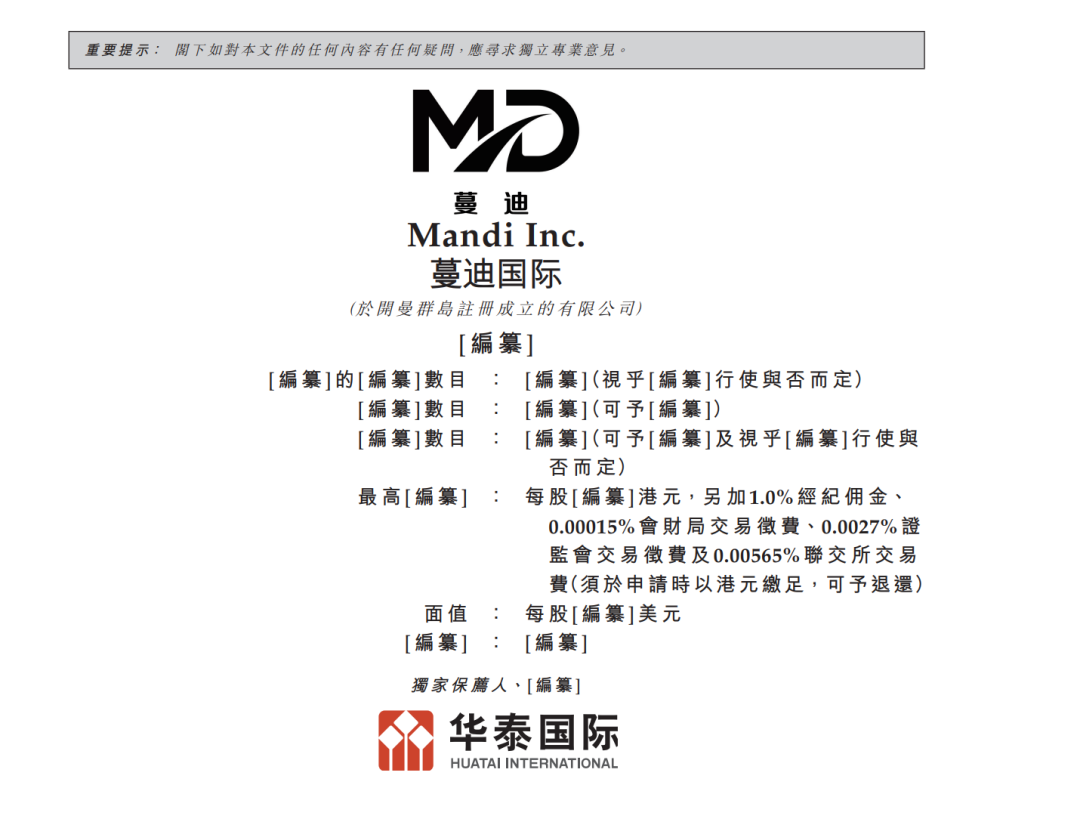
脱发“90后”,撑起一个IPO:蔓迪国际正式向港交所主板递交上市申请
Zhong Guo Ji Jin Bao· 2025-11-25 07:58
Core Insights - A hair loss treatment product from Mandi International, a subsidiary of Sangfor Pharmaceutical, is set to go public on the Hong Kong Stock Exchange, potentially marking the third IPO for the Liu family [1] - Mandi International holds a significant 57% market share in China's hair loss medication market, driven by its flagship product, Mandi® Minoxidil [1][4] - Despite strong financial performance, Mandi International faces challenges such as product concentration, reduced R&D investment, and increasing competition [1][7] Financial Performance - Mandi International's revenue projections for 2022 to 2024 are 982 million RMB, 1.228 billion RMB, and 1.455 billion RMB, with net profits of 202 million RMB, 441 million RMB, and 309 million RMB respectively [2] - In the first half of 2025, the company reported revenue of 743 million RMB, a 20.2% increase year-on-year, and a net profit of 174 million RMB, up 64.1% [2] - The gross margin for the company has remained high, with figures of 80.3%, 82.0%, 82.7%, and 81.1% from 2022 to 2025 [3] Product Structure - Over 90% of Mandi International's revenue comes from the Mandi® product line, with the core product Mandi® 5% Minoxidil accounting for 91.3% and 91.6% of revenue in 2022 and 2023 respectively [4] - The company is expanding its product line to include other skin care products and is developing a long-acting GLP-1 receptor agonist for weight management, currently in Phase III clinical trials [6] R&D and Marketing - Mandi International's R&D expenses saw a significant drop from 92.2 million RMB in 2024 to 19.5 million RMB in the first half of 2025, raising concerns about its innovation capabilities [7] - In contrast, sales expenses have increased, reaching 374 million RMB in the first half of 2025, which is over 50% of total revenue [9] Market Competition - The hair loss treatment market is becoming increasingly competitive, with major players like Merck and Johnson & Johnson entering the space [12] - Mandi International's core patents are set to expire in 2028, which could lead to a surge in generic products and price competition [12] - The number of registered hair loss shampoos in China has exceeded 400, indicating a crowded market [12] Industry Trends - The global hair loss medication market is projected to reach $2.11 billion in 2024 and $3.175 billion by 2031, with a CAGR of 6.1% [12] - The rising interest in consumer healthcare and the potential for high-margin, self-purchased products are attracting capital market attention [13]
创新药千亿BD交易背后的繁荣和挑战
投中网· 2025-11-25 07:41
Core Insights - The Chinese innovative drug industry has reached a new watershed in 2025, characterized by significant transactions and a shift towards quality over quantity in drug development [5][7][8]. Group 1: Industry Evolution - The year 2025 marks the tenth anniversary of the Chinese innovative drug industry, described as a year of "frenzy" due to major transactions such as 60.5 billion USD partnership between 3SBio and Pfizer, 12.5 billion USD collaboration between Hengrui Medicine and GSK, and 11.4 billion USD deal between Innovent Biologics and Takeda [6][8]. - License-out upfront payments reached 4.55 billion USD in the first three quarters of 2025, surpassing the total financing amount of 3.19 billion USD in the primary market, indicating that BD transactions have become a crucial cash flow pillar during a capital winter [6][22]. - The approval speed of new drugs has accelerated, with 43 new drugs approved in the first half of 2025, a 59% increase year-on-year, and 26 innovative drugs approved by October [14][20]. Group 2: Market Dynamics - The total amount of BD transactions in the Chinese pharmaceutical sector exceeded 100 billion USD, with 103 license-out transactions totaling 92.03 billion USD in the first three quarters, a 77% year-on-year increase [16][20]. - The oncology field remains the core battlefield, with 63 projects going overseas in the first three quarters, while the endocrine and metabolic fields have also seen significant growth [16][22]. - The U.S. is the primary acquirer in license-out transactions, accounting for 49% of the total, followed by Germany, South Korea, and Switzerland [22]. Group 3: Financial Performance - The innovative drug sector achieved a revenue of 48.83 billion CNY in the first three quarters of 2025, a 22.1% year-on-year increase, with a notable profit turnaround for leading companies [41][43]. - Leading companies like BeiGene and Innovent Biologics reported significant profits, with BeiGene achieving a net profit of 1.139 billion CNY in the first three quarters [41][43]. - The financial performance of small biotech firms contrasts sharply, with many facing severe funding challenges and some, like NuoHui Health, being forced to delist due to financial misconduct [40][43]. Group 4: Challenges and Opportunities - Despite the industry's growth, deep-seated challenges remain, including insufficient late-stage clinical development capabilities and the phenomenon of "selling early-stage pipelines at a discount" [25][36]. - The gap in clinical trial capabilities between domestic companies and multinational corporations (MNCs) is evident, with MNCs leveraging their resources to dominate core clinical resources in China [30][33]. - The proportion of license-out transactions for late-stage projects has only slightly increased, indicating a continued reliance on early-stage assets [26][36].



脱发“90后”,撑起一个IPO!
中国基金报· 2025-11-25 07:28
Core Viewpoint - A hair loss treatment product from Mandi International, a subsidiary of 3SBio, is expected to lead to a third IPO for the Liu family, amidst a growing hair loss crisis in China, where over 330 million people are affected, with more than 60% under the age of 35 [2][4]. Financial Performance - Mandi International reported impressive financial data, with revenues projected to reach RMB 9.82 billion, RMB 12.28 billion, and RMB 14.55 billion from 2022 to 2024, and net profits of RMB 2.02 billion, RMB 4.41 billion, and RMB 3.09 billion respectively [6]. - In the first half of 2025, the company achieved revenue of RMB 7.43 billion, a year-on-year increase of 20.2%, and a net profit of RMB 1.74 billion, up 64.1% [6]. Product Concentration - Over 90% of Mandi International's revenue comes from the Mandi® product series, with the core product, Mandi® 5% Minoxidil solution, accounting for 91.3% and 91.6% of revenue in 2022 and 2023 respectively [7][8]. R&D and Marketing Expenditure - Despite strong performance, Mandi International's R&D spending saw a significant drop from RMB 9.22 million in 2024 to RMB 1.95 million in the first half of 2025, raising concerns about its innovation capabilities [11]. - Sales expenses have increased significantly, with over 50% of revenue in the first half of 2025 allocated to sales costs, indicating rising customer acquisition costs in a competitive market [13][14]. Market Competition - The hair loss treatment market is becoming increasingly competitive, with major players like Merck and Johnson & Johnson entering the space. The global market for hair loss treatment is projected to reach USD 2.11 billion in 2024, growing at a CAGR of 6.1% [18]. - Mandi International faces potential risks as some of its core patents are set to expire in 2028, which could lead to a flood of generic products and price wars [18]. Industry Trends - The rising incidence of hair loss among younger demographics is transforming "hair health" into a significant consumer pharmaceutical category, attracting capital market interest [19]. - The company's ability to innovate and diversify its product pipeline will be crucial for its future growth potential, especially in a market that has shown clear demand [19].