
天合光能

Search documents
白银占成本从3%飙升至29%!光伏巨头“血亏”求生:涨价能救命吗?
Zhi Tong Cai Jing· 2026-01-16 02:56
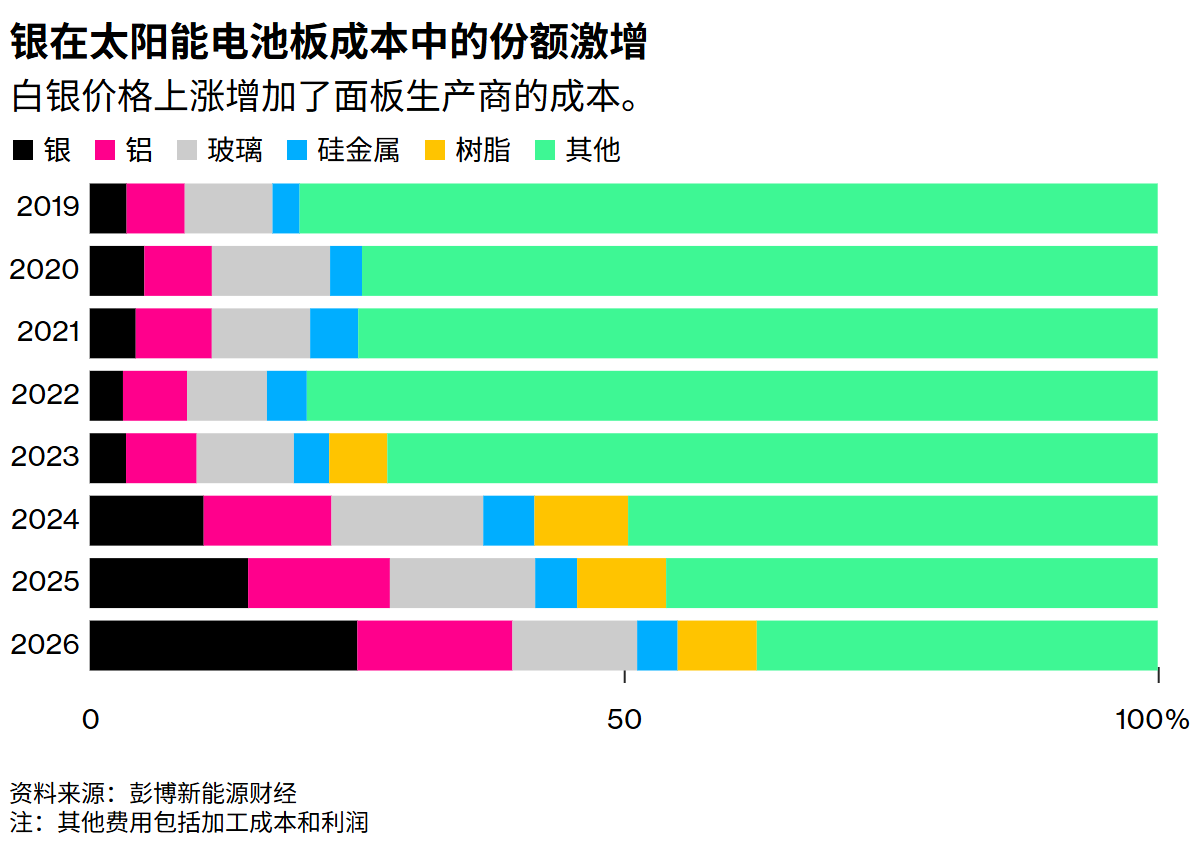
Core Viewpoint - The surge in silver prices is exacerbating the financial struggles of solar panel manufacturers, who are facing intensified competition and ongoing losses. The industry is implementing a dual strategy to cope with rising costs: increasing product prices and accelerating the transition to cheaper materials like copper to replace silver [1][4]. Group 1: Industry Challenges - Solar panel manufacturers are experiencing significant cost pressures due to soaring silver prices, which have tripled over the past year, reaching over $93 per ounce [1][4]. - The use of silver in solar cells now accounts for 29% of the total component cost, a sharp increase from 3.4% in 2023 and 14% last year [1]. - Major solar companies, including Trina Solar, have warned of expected net losses through 2025, indicating that the industry downturn has not yet reached its lowest point despite efforts to curb overcapacity and price wars [4]. Group 2: Price Adjustments and Market Response - In response to rising silver prices, Chinese component manufacturers have raised prices to over 0.8 yuan per watt, reflecting a 1.4% to 3.8% increase from the previous week, resulting in typical 500-watt component prices around 400 yuan ($57) [4]. - The silver market is experiencing a record streak, with prices around $91 per ounce, potentially marking the longest consecutive monthly increase since records began in 1950 [4]. Group 3: Material Substitution Efforts - Manufacturers are actively working to reduce silver paste usage in solar cells to lower costs, with projections indicating an average usage of 8.96 milligrams per watt by 2025, down from 11.2 milligrams in 2024 [5]. - Longi Green Energy has announced plans to begin replacing silver with cheaper metals in their solar cells [5]. - The solar industry accounted for approximately 17% of total silver demand last year, a significant increase from a decade ago, but a slowdown in consumption could threaten the long-term price increase of silver [5][6].



光伏企业,正经历一场“白银劫”
财联社· 2026-01-16 02:29
Core Viewpoint - The surge in global silver prices is exerting additional pressure on solar panel manufacturers, who have already faced two years of losses, compounded by intense industry competition [1] Group 1: Silver Price Impact - Spot silver prices have soared to over $93 per ounce, a historical high, with prices more than tripling in the past year [1] - The cost of silver in solar panels now accounts for 29% of total panel costs, significantly up from 3.4% in 2023 and 14% last year [1] Group 2: Industry Response - Manufacturers are responding by raising prices and accelerating plans to replace silver with cheaper materials like copper [4] - In China, some component manufacturers have increased prices to over 0.8 yuan per watt, reflecting a price increase of 1.4%-3.8% from the previous week due to rising silver costs [4] - The typical price for a 500-watt solar panel is now at least 400 RMB (approximately $57) [4] Group 3: Future Outlook - Major solar companies, including Trina Solar and JinkoSolar, have warned of expected net losses again in 2025, indicating that the industry's downturn has not improved significantly despite previous self-regulatory measures [5] - The average silver paste usage in solar panels is projected to drop to 8.96 mg per watt by 2025, down from 11.2 mg in 2024, as manufacturers seek to reduce costs [6] Group 4: Risks of Material Substitution - Engineers can use various methods to replace silver with cheaper copper, but rushing this process may pose risks for manufacturers [7] - Increasing the proportion of substitutes could lead to shorter lifespans for solar panels, potentially resulting in significant liabilities for manufacturers if panels fail before the warranty period [8] Group 5: Silver Demand and Future Consumption - The solar industry accounted for about 17% of total silver demand last year, more than double its share a decade ago, which is comparable to jewelry manufacturing [8] - A slowdown in consumption could threaten the sustainability of rising silver prices, which are currently driven by speculative interest and commodity rotation effects [8] - The current high silver prices may lead to more substitutions, but strong investment demand is expected to keep prices stable in the short term [8]
白银占成本从3%飙升至29%!光伏巨头“血亏”求生:涨价能救命吗?
智通财经网· 2026-01-16 02:24
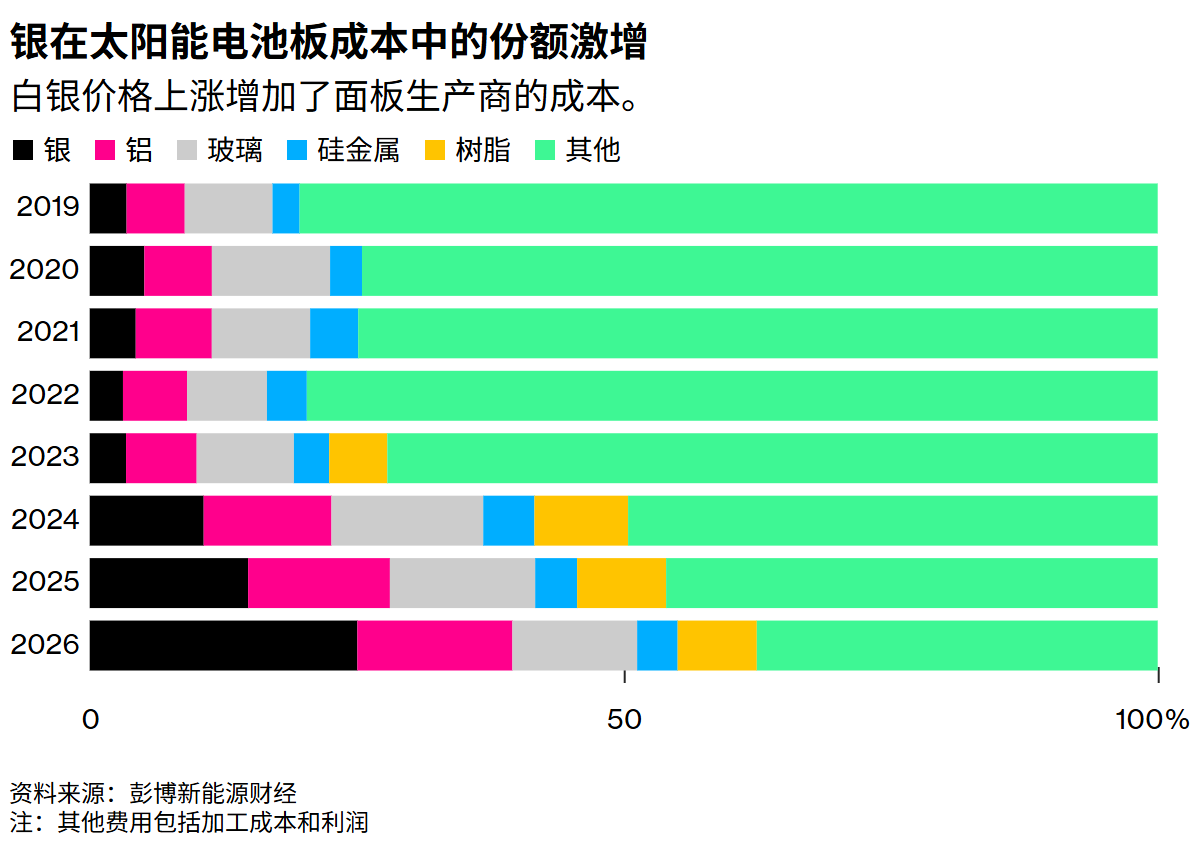
Core Viewpoint - The surge in silver prices is exacerbating the financial struggles of solar panel manufacturers, who are facing intensified competition and ongoing losses despite efforts to adjust pricing and reduce costs through material substitution. Group 1: Industry Challenges - Solar panel manufacturers are implementing a dual strategy to cope with rising costs: increasing product prices and accelerating the transition to cheaper materials like copper to replace silver [1][4] - The industry is experiencing severe overcapacity following a period of rapid expansion since the early 2020s, leading to escalating losses [1] - Current spot silver prices have exceeded $93 per ounce, marking a historical high and tripling in value over the past year [1] Group 2: Pricing and Market Dynamics - In the largest market, China, component manufacturers have raised prices to over 0.8 yuan per watt, reflecting a 1.4% to 3.8% increase due to rising silver costs [4] - Leading solar companies, including Trina Solar, have warned of expected net losses continuing into 2025, indicating that the industry downturn has not yet reached its lowest point [4] Group 3: Material Usage and Future Projections - Silver paste, a critical material for solar panels, currently accounts for 29% of total component costs, up from 3.4% in 2023 and 14% last year [1] - Efforts to reduce silver paste usage are accelerating, with projections indicating an average usage of 8.96 milligrams per watt by 2025, down from 11.2 milligrams in 2024 [5] - The solar industry accounted for approximately 17% of total silver demand last year, a significant increase from a decade ago, but a slowdown in consumption could threaten the long-term price momentum of silver [5][6]
光大证券晨会速递-20260116
EBSCN· 2026-01-16 02:17
2026 年 1 月 16 日 晨会速递 分析师点评 市场数据 总量研究 【宏观】结构性降息影响几何?——2025 年 12 月金融数据&国新办会议点评 12 月金融数据平稳收官:企业信贷增长加快是一大亮点,但考虑春节错位因素,持 续性值得关注;人民币升值推动居民结汇,居民存款大幅增长;股市持续活跃仍将提 振 M2 增速。货币政策结构性降息以及扩大并优化结构性工具的使用,更有利于提振 风险偏好,短期内股强债弱的格局将持续。风险提示:财政刺激政策落地不及预期; 流动性投放有缺口导致资金面出现波动。 【宏观】消费反弹,美国一季度经济继续偏强——2025 年 11 月美国零售数据点评 考虑到关税政策与政府停摆扰动影响收敛,叠加 11 月是传统消费旺季,美国消费数 据回升在"意料之中",11 月零售环比增速录得+0.6%,高于预期。展望看,基数效 应下,如果 2026 年一季度政府可以顺利完成运转,则在政府预算集中支出和税收返 还的影响下,2026 年一季度美国各项经济数据或显著上行,短期内进一步降息必要 性不强,待新一届美联储主席上任后,降息节奏或有所加快。 行业研究 【电新】渠道与场景加持,光伏组件企业大举进入储 ...
1.16犀牛财经早报:国内首只千亿级黄金ETF诞生
Xi Niu Cai Jing· 2026-01-16 01:40
Group 1 - The first domestic gold ETF in China has surpassed 100 billion yuan in scale, driven by rising gold prices and continuous investor buying, indicating significant asset allocation value in the current low-interest-rate environment [1] - Domestic power grid investment is expected to exceed 1 trillion yuan per year during the 14th Five-Year Plan, with a projected 40% increase in fixed asset investment by the State Grid Company compared to the previous plan [1] Group 2 - The space photovoltaic concept has gained significant attention in 2026, with multiple companies like JinkoSolar and Trina Solar actively disclosing their development plans, indicating a potential trillion-yuan market [2] - The low-altitude economy is viewed as a long-term endeavor, requiring patience and collaboration across the industry to achieve its full potential [2] Group 3 - China's commercial aerospace industry is growing at over 20% annually, with projections of reaching 7 to 10 trillion yuan by 2030, as various regions compete to establish their presence in this sector [3] - Nickel prices have surged nearly 30% in a month due to supply contraction expectations, with significant implications for the nickel market and its downstream industries [3] Group 4 - The automatic driving industry in China is advancing, with the first L3-level conditional autonomous driving models receiving approval for road testing in designated areas [5] - In 2026, traditional car manufacturers are targeting stable growth rates of 10% to 30%, while new entrants aim for aggressive growth rates of 34% to 67% [5] Group 5 - The electric vehicle sector is witnessing a reshuffle, with companies like Jidu Auto entering restructuring processes, reflecting the competitive landscape of the industry [6] - Star River Power has successfully launched 89 satellites into orbit, marking a significant achievement in the private aerospace sector [6] Group 6 - WuXi Biologics' major shareholder has agreed to sell 150 million shares at a price of 38.52 HKD per share, which will reduce their stake from approximately 12.12% to 8.49% [10] - Kuaishou has issued a total of 6 billion USD in senior notes, with proceeds intended for general corporate purposes [11] Group 7 - Cloud Intelligence plans to place 780,000 new H-shares at a price of 252 HKD per share, indicating ongoing capital-raising efforts [12] - E-Tech's IPO is set to face scrutiny from regulators, highlighting the challenges faced by companies in the automotive electronics sector [13] Group 8 - Luoyang Molybdenum expects a net profit increase of 48% to 54% for 2025, driven by rising product prices and effective cost management [14] - Lio's stock has been suspended for trading due to significant price fluctuations, reflecting the need for regulatory oversight in volatile markets [14] Group 9 - U.S. stock indices rebounded, with significant gains in technology and financial sectors, driven by strong earnings reports from major companies [16] - Commodity prices, including metals and oil, experienced declines after reaching record highs, indicating market volatility [16]
太空光伏概念热度飙升,企业抢滩布局正酣!钙钛矿成潜力方向
Shang Hai Zheng Quan Bao· 2026-01-16 00:46
Core Insights - The space photovoltaic concept has gained significant attention in 2026, with brokerages predicting a "trillion-level market" and companies like JinkoSolar, Trina Solar, and Junda Co. actively disclosing their plans and progress in this field [1][2] - Industry experts highlight the potential of space photovoltaics amid the maturation of commercial space technology and the growing energy demands of AI computing centers, while also acknowledging the challenges of commercialization [1][4] Company Developments - Elon Musk discussed the future of space photovoltaics, emphasizing solar energy as the key to human energy freedom, with plans for 8,000 launches per year to deploy AI satellites that maximize sunlight utilization [2] - JinkoSolar signed a strategic cooperation agreement with Jingtai Technology to establish a joint venture focused on AI-based high-throughput perovskite tandem solar cells [2] - Junda Co. announced an investment of 30 million yuan to acquire a stake in Xingyi Chip Energy, aiming to expand into the space photovoltaic sector [2] Technological Advancements - GCL-Poly's chairman stated plans to collaborate with aerospace research institutions to test perovskite components in thin atmosphere regions, exploring commercial applications [3] - Lightyear Technology has been conducting ground simulations and space environment tests, having already sent perovskite components into orbit for testing [3] - Mingyang Smart Energy, a wind power leader, plans to acquire Dehua Chip, which focuses on space solar cells, indicating a cross-industry move into space photovoltaics [3] Market Potential - The interest in space photovoltaics is driven by the maturation of commercial space technology and the increasing value of the "space economy," which provides a solid foundation for development [4] - The main battery technologies for space photovoltaics include gallium arsenide, crystalline silicon, and perovskite, with perovskite being favored for its high efficiency and potential for lightweight and flexible applications [5][6] Commercialization Challenges - Despite the promising future, the commercialization of space photovoltaics faces significant challenges, including high launch costs and the stability of equipment in extreme space environments [7] - Analysts predict that large-scale commercial power supply from space photovoltaics may not be realized until after 2040, emphasizing the need for phased development and testing [8]


太空光伏,企业抢滩布局正酣
3 6 Ke· 2026-01-16 00:21
2026年开年以来,太空光伏概念热度飙升,券商密集发布太空光伏相关研究报告并给出"万亿级市场"的 研判,晶科能源、天合光能、钧达股份等相关企业动作频频,相继披露布局进展与未来发展规划,形 成"抢滩"之势。多位业内人士表示,在商业航天技术日趋成熟叠加AI算力中心能源缺口持续扩大的背景 下,太空光伏承载着巨大想象空间与发展潜力。但"仰望星空"的同时更要"脚踏实地",须正视太空光伏 商业化仍面临的多重挑战,包括发射与部署成本居高不下、极端太空环境下的设备稳定性难以保障等。 (上证报) ...
太空光伏概念热度飙升,企业抢滩布局正酣
Xin Lang Cai Jing· 2026-01-16 00:15
2026年开年以来,太空光伏概念热度飙升,券商密集发布太空光伏相关研究报告并给出"万亿级市场"的 研判,晶科能源、天合光能、钧达股份等相关企业动作频频,相继披露布局进展与未来发展规划,形 成"抢滩"之势。多位业内人士在接受记者采访时表示,在商业航天技术日趋成熟叠加AI算力中心能源缺 口持续扩大的背景下,太空光伏承载着巨大想象空间与发展潜力。但"仰望星空"的同时更要"脚踏实 地",须正视太空光伏商业化仍面临的多重挑战,包括发射与部署成本居高不下、极端太空环境下的设 备稳定性难以保障等。(上证报) ...
储能行业跟踪报告:渠道与场景加持,光伏组件企业大举进入储能领域
EBSCN· 2026-01-16 00:12
Investment Rating - The report indicates a positive outlook for the solar component companies entering the energy storage sector, suggesting a new growth space for these companies [4]. Core Insights - Leading solar component companies are accelerating their entry into the energy storage market, with notable players like Canadian Solar, Trina Solar, Jinko Solar, JA Solar, and LONGi Green Energy making significant moves [3][9]. - The entry of these companies into the energy storage sector is supported by two main advantages: strong customer channels and the ability to leverage existing global networks [3][13]. - The energy storage market is characterized by a strong binding trend between solar and storage projects, particularly in regions with rapidly growing electricity demand [21]. Summary by Sections 1. Accelerated Layout of Leading Component Companies in Energy Storage - Major solar component companies are focusing on large-scale energy storage, with significant market potential and a trend towards joint development of solar-storage projects [9][11]. 2. Competitive Advantages: Reusing Global Networks in Customer and Channel - Solar and energy storage customers overlap significantly, providing solar companies with inherent customer acquisition advantages [13][17]. - Leading solar companies have established global sales and service systems, enhancing their ability to develop energy storage businesses [17][20]. 3. Competitive Advantages: Strong Binding of Scenarios and Applications - The trend of integrating solar and energy storage projects is becoming mainstream, especially in countries with less developed electricity markets [21]. 4. Investment Recommendations - The report emphasizes that the entry of solar component companies into the energy storage sector is expected to open new growth opportunities, with a focus on three key indicators for assessing growth potential: commitment to energy storage, overseas market expansion in the next 1-2 years, and profitability contributions [4][24]. - Specific companies to watch include Canadian Solar, which has already seen significant profit contributions from its energy storage business, and Trina Solar, which is rapidly expanding its overseas energy storage operations [24].


太空光伏概念热度飙升 企业抢滩布局正酣
Xin Lang Cai Jing· 2026-01-16 00:08
Core Viewpoint - The space photovoltaic concept has gained significant momentum since the beginning of 2026, with brokerages intensively releasing research reports predicting a "trillion-level market" [1] Industry Developments - Companies such as JinkoSolar, Trina Solar, and Junda Co., Ltd. are actively disclosing their layout progress and future development plans, creating a competitive "land grab" atmosphere [1] - Industry experts indicate that the maturity of commercial space technology, combined with the growing energy gap in AI computing centers, presents substantial potential for the development of space photovoltaics [1] Challenges - Despite the promising outlook, the commercialization of space photovoltaics faces multiple challenges, including high launch and deployment costs and the difficulty of ensuring equipment stability in extreme space environments [1]