陕西煤业

Search documents
煤炭行业成本趋势深度研究报告:刚性成本筑底,煤价中枢上行
Shenwan Hongyuan Securities· 2025-11-21 09:43
Investment Rating - The report maintains a positive outlook on the coal industry, indicating a favorable investment rating due to the rising cost structure and expected increase in coal prices [2][6]. Core Insights - The coal industry is experiencing a structural change with a systematic increase in the cost base, driven by factors such as increased mining depth, stricter environmental compliance, and rising safety investments. This has led to a higher price floor for coal, making it unlikely to return to the low levels seen in 2015 [8][7]. - The report emphasizes that the rising costs are not a temporary phenomenon but are supported by rigid factors such as labor costs, safety investments, and environmental governance, which are expected to persist in the long term [7][8]. - The anticipated tightening of supply due to production constraints and limited new capacity is expected to support a steady increase in coal prices [6][7]. Summary by Sections 1. Industry Cost Research Framework - The report outlines the components of coal production costs, including direct and indirect costs, with a focus on production costs as the most significant element [16][17]. 2. Thermal Coal: Cost Support and Price Floor - From 2015 to 2024, the average complete cost of thermal coal for sample enterprises increased from 216 CNY/ton to 306 CNY/ton, with a CAGR of 4%. The production cost rose from 161 CNY/ton to 231 CNY/ton [29][30]. - In 2024, benchmark companies like China Shenhua, Shaanxi Coal, and China Coal Energy have complete costs of 251, 294, and 310 CNY/ton respectively [29][30]. 3. Coking Coal: Rising Cost Support - The complete cost of coking coal for sample companies increased from 546 CNY/ton to 1051 CNY/ton from 2015 to 2024, with a CAGR of 7.6%. The production cost rose from 432 CNY/ton to 814 CNY/ton [5][6]. - The report indicates that the cost structure for coking coal is also expected to rise due to increased mining difficulty and regulatory pressures [5][6]. 4. Supply Tightening and Market Dynamics - The report notes that domestic coal production has been in negative growth since July, influenced by loss pressures and capacity checks, which are expected to tighten supply further [6][7]. - Import volumes have been declining for eight consecutive months, limiting the ability to supplement domestic supply [6][7]. 5. Key Conclusions and Investment Recommendations - The report recommends stable, high-dividend stocks such as China Shenhua, Shaanxi Coal, and China Coal Energy, while also suggesting attention to more elastic stocks like Jinko Coal and Huayang Co. [6][7].



自由现金流ETF中证全指(561080)跌1.70%,半日成交额416.72万元
Xin Lang Cai Jing· 2025-11-21 03:46
Core Viewpoint - The Freedom Cash Flow ETF CSI All Share (561080) experienced a decline of 1.70% as of the midday close on November 21, with a trading volume of 4.1672 million yuan [1] Group 1: ETF Performance - The Freedom Cash Flow ETF CSI All Share (561080) closed at 1.211 yuan [1] - The fund has a performance benchmark of the CSI All Share Free Cash Flow Index return rate [1] - Since its establishment on April 23, 2025, the fund has achieved a return of 23.00%, with a one-month return of 4.57% [1] Group 2: Major Holdings - Major stocks in the Freedom Cash Flow ETF include: - China National Offshore Oil Corporation (CNOOC) down 1.44% - Midea Group down 0.05% - Gree Electric Appliances down 0.74% - Wuliangye Yibin down 0.36% - China COSCO Shipping down 0.46% - Luoyang Molybdenum down 3.48% - TCL Technology down 1.92% - China Aluminum down 4.08% - SF Express down 1.34% - Shaanxi Coal and Chemical Industry down 0.43% [1]





2025年1-9月中国原煤产量为35.7亿吨 累计增长2%
Chan Ye Xin Xi Wang· 2025-11-21 03:41
Group 1 - The core viewpoint of the article highlights the trends in China's coal industry, particularly focusing on the production statistics and future development forecasts [1] - In September 2025, China's raw coal production was reported at 410 million tons, reflecting a year-on-year decrease of 1.8% [1] - From January to September 2025, the cumulative raw coal production in China reached 3.57 billion tons, showing a cumulative growth of 2% [1] Group 2 - The article lists key listed companies in the coal sector, including China Shenhua (601088), Zhongmei Energy (601898), Shanxi Coking Coal (000983), and others [1] - The report referenced is the "China Coal Industry Panorama Research and Future Development Trend Assessment Report (2026 Edition)" published by Zhiyan Consulting [1] - Zhiyan Consulting is recognized as a leading industry consulting firm in China, providing comprehensive industry research reports and customized services [1]


符合预期,港口基准价维持不变 | 投研报告
Zhong Guo Neng Yuan Wang· 2025-11-21 03:04
Core Viewpoint - The 2026 coal supply long-term contract plan released by the National Development and Reform Commission provides comprehensive guidance on contract signing, including targets, methods, quantities, pricing mechanisms, and regulatory measures for compliance [1][2]. Summary by Sections Contract Signing and Compliance - The 2026 plan continues the mechanism established in the 2022 long-term contract plan, which was a significant adjustment from the previous five-year mechanism since 2017. The compliance requirements for long-term contracts have been slightly relaxed from 2022 to 2026, but the foundation for compliance remains intact [3]. - For electric companies, the principle is that the signed contracts should not be less than 80% of the signing demand, with 80% of these contracts being subject to key regulatory oversight. The wording has been modified from "should not be less than" to "principally should not be less than" [3]. - For coal companies, the requirement remains that the task volume should not be less than 75% of their own resource volume [3]. Pricing Mechanism - The pricing mechanism for coal from production areas will include a new monthly adjustment mechanism, while the benchmark price for port contracts remains unchanged. The production area pricing will be based on a "benchmark price + floating price" model, with the benchmark price being the median of reasonable price ranges from key coal-producing regions [4]. - The adjustment in the pricing mechanism for production area contracts allows for closer alignment with market changes, while the port pricing mechanism remains stable despite previous long-term contract price discrepancies [4]. Compliance Supervision - The compliance requirements have been relaxed, emphasizing seasonal adjustments. The monthly compliance rate should not be less than 80%, with quarterly and annual compliance rates ideally not less than 90%. There is a new emphasis on increasing compliance during peak demand periods [4]. Investment Recommendations - With the implementation of "anti-involution" policies, the expected increase in domestic coal supply is limited. Following the recovery of coal prices, compliance with long-term contracts is expected to improve significantly. If prices remain high, there is considerable potential for performance recovery in coal companies. Key companies to watch include Jin控煤业, 华阳股份, 山煤国际, 兖矿能源, 陕西煤业, 中煤能源, and 中国神华 [4].
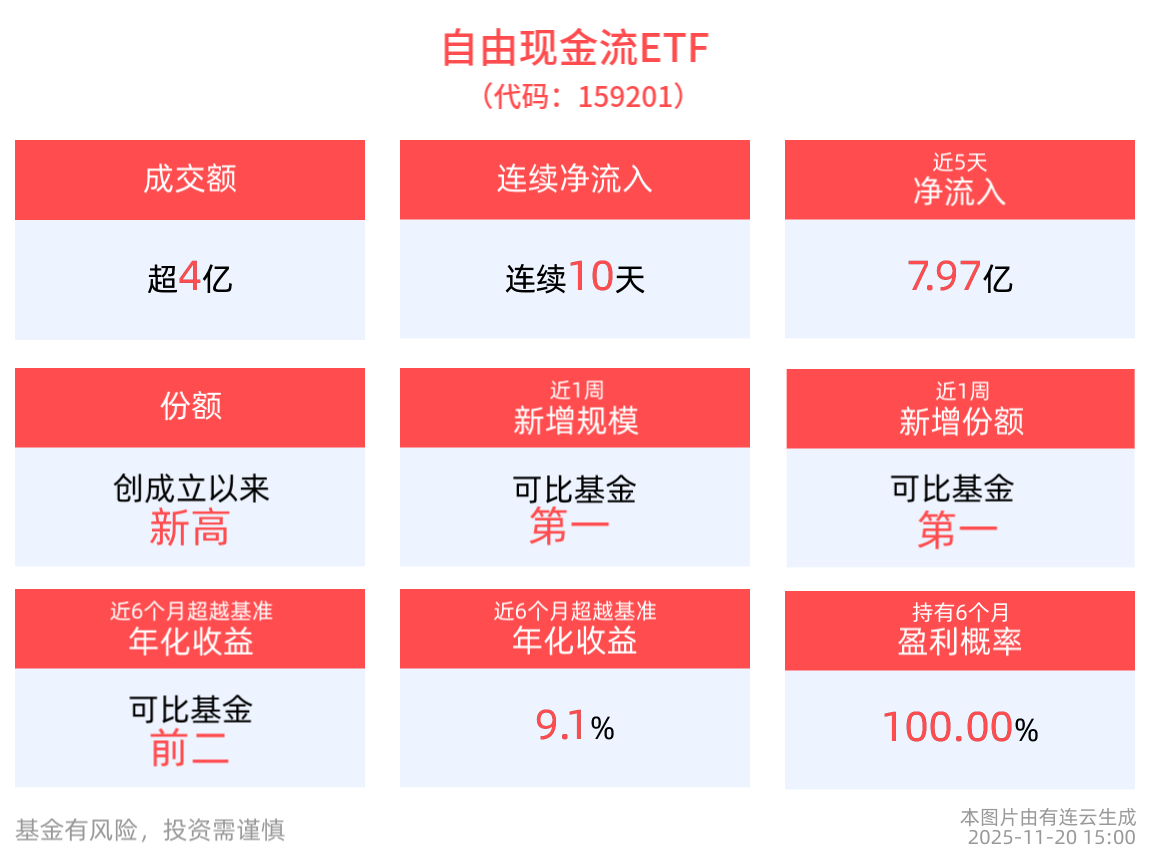
盘前速递 | 自由现金流ETF(159201)连续10天净流入,合计“吸金”15.42亿元
Sou Hu Cai Jing· 2025-11-21 01:36
Core Insights - The Guozheng Free Cash Flow Index decreased by 0.76% as of November 20, 2025, with mixed performance among constituent stocks [1] - The Free Cash Flow ETF (159201) saw a decline of 0.84%, with a latest price of 1.18 yuan [1] - The Free Cash Flow ETF has experienced significant net inflows, totaling 15.42 billion yuan over the past 10 days, with a daily average net inflow of 1.54 billion yuan [1] Performance Summary - The Free Cash Flow ETF's net value increased by 19.19% over the past six months [2] - Historical performance indicates a maximum monthly return of 7% and a longest winning streak of six months, with an average monthly return of 3.2% [2] - The probability of profitability for holding the ETF for six months is 100% [2] Fee Structure - The management fee for the Free Cash Flow ETF is 0.15%, and the custody fee is 0.05% [4] Top Holdings - As of October 31, 2025, the top ten weighted stocks in the Guozheng Free Cash Flow Index account for 54.79% of the index, including China National Offshore Oil Corporation, SAIC Motor, Wuliangye, and Gree Electric Appliances [4]
陕西煤业11月20日获融资买入5596.29万元,融资余额6.16亿元
Xin Lang Cai Jing· 2025-11-21 01:27
Core Viewpoint - Shaanxi Coal Industry experienced a decline of 2.48% in stock price on November 20, with a trading volume of 600 million yuan, indicating a challenging market environment for the company [1]. Financing Summary - On November 20, Shaanxi Coal Industry had a financing buy-in amount of 55.96 million yuan, with a net financing buy of 36.23 million yuan after repayments [1]. - The total financing and securities balance reached 623 million yuan, with the financing balance at 616 million yuan, representing 0.27% of the circulating market value, which is below the 10% percentile level over the past year [1]. - In terms of securities lending, 97,000 shares were repaid, while 21,900 shares were sold, amounting to 507,400 yuan in sales [1]. Business Performance - As of September 30, the number of shareholders for Shaanxi Coal Industry increased by 2.07% to 105,000, while the average circulating shares per person decreased by 2.02% to 92,312 shares [2]. - For the period from January to September 2025, the company reported operating revenue of 118.08 billion yuan, a year-on-year decrease of 5.86%, and a net profit attributable to shareholders of 12.71 billion yuan, down 20.26% year-on-year [2]. Dividend Information - Since its A-share listing, Shaanxi Coal Industry has distributed a total of 81.645 billion yuan in dividends, with 47.331 billion yuan distributed over the past three years [3]. Shareholding Structure - As of September 30, 2025, China Securities Finance Corporation is the second-largest circulating shareholder with 195 million shares, unchanged from the previous period [3]. - Hong Kong Central Clearing Limited is the third-largest shareholder with 133 million shares, a decrease of 10.7 million shares compared to the previous period [3]. - The eighth-largest shareholder, Huaxia SSE 50 ETF, holds 74.05 million shares, down by 2.0086 million shares, while the tenth-largest shareholder, Huatai-PB CSI 300 ETF, holds 66.06 million shares, a decrease of 2.8122 million shares [3].
山西证券研究早观点-20251121
Shanxi Securities· 2025-11-21 01:18
Group 1: Coal Industry Insights - The 2026 coal supply contract plan aligns with expectations, with the port benchmark price remaining unchanged at 675 RMB/ton, slightly exceeding expectations [5][6] - The contract signing quantity remains consistent, with a flexible expression for compliance; coal enterprises are required to fulfill at least 75% of their own resource quantity [5] - The pricing mechanism for coal contracts has been adjusted to include a monthly price adjustment mechanism for production area contracts, making it more responsive to market changes [5] Group 2: Company Analysis - Zhejiang Natural - Zhejiang Natural reported a revenue of 818 million RMB for the first three quarters of 2025, a year-on-year increase of 3.48%, but Q3 revenue declined by 30.38% [7] - The company’s gross profit margin decreased by 1.30 percentage points to 34.00% for the first three quarters of 2025, with Q3 gross profit margin at 28.23% [7] - Despite challenges, the company expects a recovery in Q4 2025, driven by the release of capacity from overseas subsidiaries and strong customer relationships [7] Group 3: Company Analysis - Zhongheng Electric - Zhongheng Electric launched two 800VDC solutions aimed at enhancing efficiency in new and existing data centers, potentially increasing system efficiency to 98.5% [9][13] - The company achieved a revenue of 1.42 billion RMB in the first three quarters of 2025, a year-on-year increase of 20.3%, although net profit decreased by 15.6% [13] - Future growth is anticipated as the company expands its high-voltage direct current (HVDC) solutions in both domestic and international markets [13]
日「赚」8000,好多人想摆摊了
Sou Hu Cai Jing· 2025-11-20 18:41
Core Insights - The article emphasizes the importance of understanding cash flow, profit, and income in business operations, highlighting that cash flow is a critical indicator of financial health [4][5][15]. Group 1: Cash Flow Understanding - Cash flow thinking differentiates between "how much is earned" and "how much is retained," which is crucial for business sustainability [5][12]. - The example of a street vendor illustrates that while the vendor may have a monthly income of 50,000 yuan, the actual cash flow after expenses is only 8,000 yuan, which is the true free cash flow available for discretionary spending [6][8][12]. Group 2: Free Cash Flow Index - The article introduces the concept of free cash flow indices, which are designed to identify companies with strong cash flow generation capabilities [16][18]. - Two main indices in China are highlighted: the Guozheng Free Cash Flow Index and the Zhongzheng Free Cash Flow Series, both of which exclude financial and real estate sectors to focus on cash flow quality [18][21]. Group 3: Historical Performance - Historical data shows that the Guozheng Free Cash Flow Index has an annualized return of approximately 18% from 2013 to 2025, with a maximum drawdown of about 21% [19][23]. - The performance of these indices is attributed to their selection of high cash flow generating companies and their avoidance of sectors that faced significant downturns, such as finance and real estate [23][24]. Group 4: Investment Considerations - The article notes a growing interest in cash flow indices due to declining interest rates and the reduced liquidity of real estate investments, prompting investors to seek more stable returns [27][28]. - It suggests that investors should clarify their preferences between the two indices, as they have different sector focuses, and consider factors like tracking error, fees, and fund management experience when selecting funds [30][34].

2026&2025年电煤中长协政策对比点评:向市场化方向微调
Guohai Securities· 2025-11-20 11:15
Investment Rating - The industry investment rating is "Recommended" (maintained) [1] Core Viewpoints - The report indicates a slight adjustment towards market-oriented policies in the long-term coal supply contracts for 2026 compared to 2025, with both quantity and price aspects moving closer to market mechanisms [2][7] - The signing volume for coal enterprises is set to be no less than 75% of their own resource volume, while for power generation enterprises, the minimum signing volume should be at least 80% of the demand [2] - The fulfillment rates have been relaxed slightly, with monthly fulfillment remaining at no less than 80%, quarterly fulfillment now being generally no less than 90%, and annual fulfillment also generally no less than 90% [2] - The pricing mechanism for long-term contracts may begin to reference indices, with a monthly adjustment mechanism established for the pricing of coal from production areas [3][4] - The report emphasizes that the coal mining industry continues to show a long-term upward price trend driven by factors such as rising labor costs, increased safety and environmental investments, and higher taxation by local governments [8] Summary by Sections Policy Changes - The 2026 policy document indicates that contracts for coal from production areas must align with reasonable price ranges and establish a monthly adjustment mechanism through negotiation between supply and demand enterprises [3] - The pricing for long-term contracts for coal remains unchanged, with a base price set at current levels [4] Market Performance - As of November 19, 2025, the coal mining sector has shown a performance of 2.3% over one month, 11.3% over three months, and 0.2% over twelve months, compared to the Shanghai and Shenzhen 300 index which recorded 1.6%, 8.6%, and 15.4% respectively [5] Investment Recommendations - The report suggests focusing on robust companies such as China Shenhua, Shaanxi Coal, and others, highlighting their strong cash flow and high asset quality [8] - Specific recommendations include: - Steady stocks: China Shenhua, Shaanxi Coal, and others - Stocks with greater elasticity in thermal coal: Yanzhou Coal, Jinko Energy, and others - Stocks with greater elasticity in coking coal: Huaibei Mining, Pingdingshan Coal, and others [8] Earnings Forecasts - The report provides earnings per share (EPS) and price-to-earnings (PE) ratios for key companies, indicating a positive outlook for several coal enterprises [10]


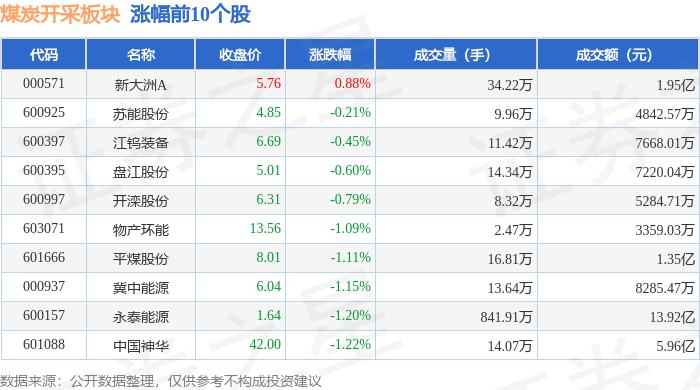
煤炭开采板块11月20日跌2.08%,大有能源领跌,主力资金净流出5.64亿元
Zheng Xing Xing Ye Ri Bao· 2025-11-20 09:16
Market Overview - The coal mining sector experienced a decline of 2.08% on November 20, with Dayou Energy leading the drop [1] - The Shanghai Composite Index closed at 3931.05, down 0.4%, while the Shenzhen Component Index closed at 12980.82, down 0.76% [1] Individual Stock Performance - Notable stock performances include: - Xindazhou A (000571) increased by 0.88% to close at 5.76, with a trading volume of 342,200 shares and a turnover of 195 million yuan [1] - Dayou Energy (600403) fell by 9.97% to 8.31, with a trading volume of 1,108,400 shares and a turnover of 95.26 million yuan [2] - China Shenhua (601088) decreased by 1.22% to 42.00, with a trading volume of 140,700 shares and a turnover of 596 million yuan [1] Capital Flow Analysis - The coal mining sector saw a net outflow of 564 million yuan from major funds, while retail investors contributed a net inflow of 580 million yuan [2] - The capital flow for individual stocks indicates: - Huai Bei Mining (600985) had a net outflow of 35.39 million yuan from major funds [3] - Electric Power Investment Energy (002128) recorded a net inflow of 22.42 million yuan from major funds [3] - New Dazhou A (000571) experienced a net inflow of 18.34 million yuan from major funds [3]