
恒瑞医药

Search documents
21健讯Daily | 恒瑞医药:收到药物临床试验批准通知书;英矽智能:与衡泰生物达成超5亿港元合作
2 1 Shi Ji Jing Ji Bao Dao· 2026-01-21 04:10
Policy Developments - The National Healthcare Security Administration has issued a guideline for the pricing of surgical and treatment auxiliary operations, focusing on medical technology innovations such as robotic surgery and 3D printing, establishing 37 pricing items and guiding the transition from traditional to precision medicine [2] Drug and Device Approvals - Bailitianheng's drug application for iza-bren, a first-in-class EGFR×HER3 dual antibody ADC for treating recurrent or metastatic esophageal squamous cell carcinoma, has been accepted and prioritized for review by the National Medical Products Administration [4] - Heng Rui Medicine has received clinical trial approval for SHR-9839, a humanized antibody for advanced solid tumors, and HRS-4642, a KRAS G12D inhibitor [5] - Fosun Pharma's subsidiary has been approved to conduct clinical trials for HLX701 in combination with chemotherapy for advanced colorectal cancer [6] Capital Market Activities - InnoCare Pharma has entered a collaboration agreement with Shenzhen Hengtai Biotechnology for the ISM8969 project, a new NLRP3 inhibitor for CNS diseases, with a potential total payment of up to $66 million [8][9] - Zhejiang Dejin Bio completed a multi-million A round financing to advance its core product, a recombinant botulinum toxin, and for international expansion [10] Industry Developments - Ant Group's Antifor has launched a DeepSearch feature on its PC platform to assist medical professionals with literature searches and clinical diagnosis [12] - Guangzhou's political advisor has proposed a plan to develop the brain-computer interface industry, aligning with national strategies and leveraging local resources [13] Shareholder Actions - Meihua Medical announced that shareholders plan to reduce their holdings by up to 2.51% of total shares due to personal financial needs [15] - Kain Technology has voluntarily withdrawn its drug registration application for a new hepatitis B indication, which will impact its 2025 profits [16]

医疗创新ETF(516820)红盘向上,医保局首次明确机器人手术收费指引
Xin Lang Cai Jing· 2026-01-21 02:53
Group 1 - The core viewpoint of the news highlights the positive performance of the medical innovation sector, with the CSI Medical and Medical Device Innovation Index rising by 0.55% and several constituent stocks showing significant gains [1] - The Medical Innovation ETF has seen continuous net inflows over the past three days, with a maximum single-day net inflow of 6.0262 million and a total of 11.2443 million, averaging 3.7481 million per day [1] - The National Healthcare Security Administration issued a guideline aimed at standardizing pricing for surgical and treatment auxiliary services, promoting a shift from traditional treatment to precision medicine [1] Group 2 - The CSI Medical and Medical Device Innovation Index consists of 30 publicly listed companies with strong profitability, growth potential, and research innovation capabilities, reflecting the overall performance of the sector [2] - As of December 31, 2025, the top ten weighted stocks in the index include WuXi AppTec, Hengrui Medicine, Mindray Medical, and others, accounting for 63.75% of the total index weight [2]

平安证券(香港)港股晨报-20260121
Ping An Securities Hongkong· 2026-01-21 02:19
Market Overview - The Hong Kong stock market experienced a downward trend, with the Hang Seng Index closing at 23,831 points, down 145 points or 0.61% [1][5] - The market turnover decreased to 82.799 billion, with net inflows of 484 million from the Stock Connect [1][5] - The technology sector led the decline, with notable drops in stocks like SMIC and Sunny Optical, while real estate stocks showed resilience [1][5] US Market Performance - The US stock market saw significant declines, with the Dow Jones falling 1.8% and the S&P 500 down 2.1%, marking the worst single-day performance since October of the previous year [2] - The technology sector was particularly affected, with Nvidia and Tesla experiencing drops of 4.4% and 4.2% respectively [2] Market Outlook - The report highlights that both Hong Kong and A-shares achieved a positive start in 2026, with net inflows of 45.1 billion HKD from southbound funds [3] - Key investment themes include "technological self-reliance" and AI applications, with leading companies in these sectors expected to benefit in the medium to long term [3] - Recommendations for investment focus on sectors supported by policies for "expanding domestic demand," including sports apparel and non-essential services [3] Company Spotlight: Li Ning - Li Ning, a leading sports brand in China, reported a revenue of 14.817 billion for the first half of 2025, reflecting a year-on-year growth of 3.3% [10] - The company's gross margin was 50%, a slight decrease of 0.4 percentage points, attributed to increased promotional competition [10] - Li Ning's net profit was 1.737 billion, down 11% year-on-year, with a net profit margin of 11.7% [10] - The company is expected to enhance its brand presence in professional sports through a partnership with the Chinese Olympic Committee [10]
上证180指数上涨0.08%,上证180ETF指数基金(530280)实现4连涨
Sou Hu Cai Jing· 2026-01-21 01:55
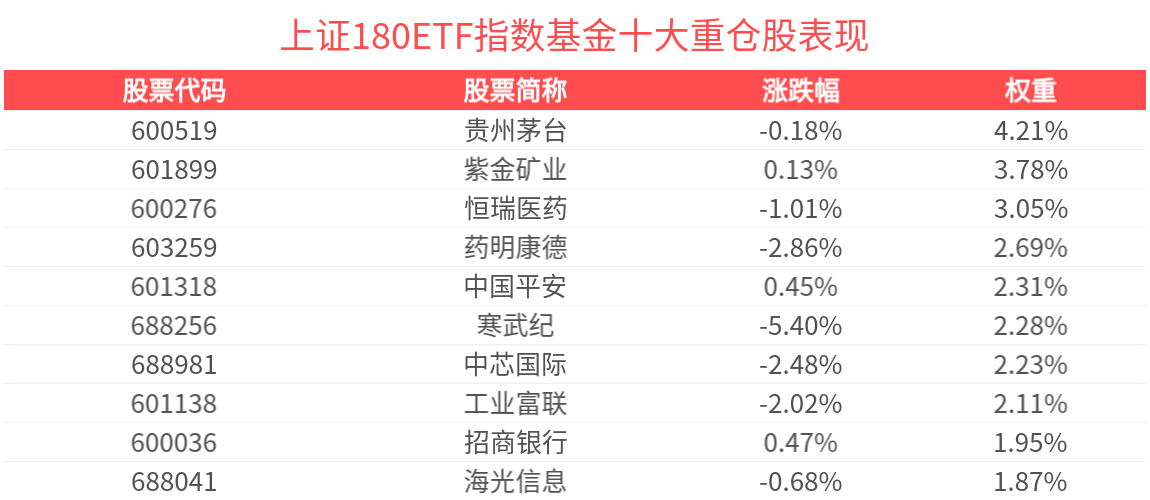
Core Viewpoint - The Shanghai 180 ETF Index Fund closely tracks the Shanghai 180 Index, which reflects the overall performance of 180 large-cap and liquid stocks in the Shanghai securities market [2] Group 1: Index Performance - As of January 20, 2026, the Shanghai 180 Index rose by 0.08%, with notable increases in constituent stocks such as China Chemical (+10.01%), China Power Construction (+7.02%), and Hengli Petrochemical (+6.62%) [1] - The Shanghai 180 ETF Index Fund achieved a four-day consecutive increase, with the latest price reported at 1.26 yuan [1] - The fund's average daily trading volume over the past year was 256.26 million yuan, with a turnover rate of 0.11% on January 20, 2026 [1] Group 2: Fund Metrics - The fund's Sharpe ratio since inception is 2.13, indicating a favorable risk-adjusted return [1] - The maximum drawdown for the fund year-to-date is 1.30%, with a relative benchmark drawdown of 0.06% [1] - The management fee for the fund is 0.15%, and the custody fee is 0.05% [1] Group 3: Top Holdings - As of December 31, 2025, the top ten weighted stocks in the Shanghai 180 Index account for 25.29% of the index, including Kweichow Moutai, Zijin Mining, and China Ping An [2] - The top ten stocks by weight are Kweichow Moutai (4.21%), Zijin Mining (3.78%), and China Ping An (2.31%), among others [3]





盘前公告淘金:奕帆传动拟购北京和利时87%股权,预计构成重大资产重组,同花顺净利预增50%-80%
Jin Rong Jie· 2026-01-21 01:27
【重要事项】 纳指科技ETF:将于1月21日开市起至当日10:30停牌 国投白银LOF:二级市场交易价格波动较大,1月21日开市起至当日10:30停牌 凯龙高科:筹划购买金旺达控制权21日起停牌,后者主要产品包括精密行星滚柱丝杆等 【资本运作】 震裕科技:2025年第四季度来自机器人行业订单有较明显增长 百利天恒:iza-bren用于治疗复发性或转移性食管鳞癌的上市申请获受理并被纳入优先审评品种名单, 为全球首个EGFR×HER3双抗ADC上市申请获受理 上海医药:B023细胞注射液获得临床试验批准通知书 全球未有同品种同适应症的药品上市 奕帆传动:拟购买北京和利时87.07%股权,预计构成重大资产重组 康欣新材:拟3.92亿元收购宇邦半导体51%股权,实现向半导体产业的战略转型与升级 明德生物:拟共同投资设立私募基金,投向光互联、半导体等人工智能基础设施/终端产业链 中钨高新:柿竹园公司增储9.17万吨钨金属量等资源 恒瑞医药:HRS-2141片获准开展2型糖尿病适应症的临床试验 【业绩】 海康威视:2025年净利润141.88亿元,同比增长18% 建投能源:2025年净利同比预增253.38% 通富微电: ...

多空激战!指数巨震背后,资金正疯狂抢筹这些方向?
Sou Hu Cai Jing· 2026-01-21 00:45
来源:中信建投证券 摘要:A股呈现延续震荡走势,资金重新从权重蓝筹向中小盘成长股迁移。板块上,资源、消费升级板 块强势,部分前期热门成长赛道回调,资金聚焦基本面支撑的结构性机会。财政部、发改委昨日出台多 项政策,覆盖消费、投资等领域,划定高端制造、科创长期主线。当前震荡是政策调控后的正常反应, 慢牛逻辑未变,短期板块轮动成常态,投资者应聚焦政策与业绩双优赛道。 昨日市场三大指数集体收跌,创业板指一度跌超2%。沪深两市成交额2.78万亿,较上一个交易日放量 694亿。盘面上,全市场超3100只个股下跌。从板块来看,化工板块逆势爆发,十余只成分股涨停。贵 金属概念延续强势。房地产板块表现活跃。AI应用端局部走高。下跌方面,算力硬件、商业航天等板 块跌幅居前。其中商业航天概念股集体大跌。截至收盘,沪指跌0.01%,深成指跌0.97%,创业板指 1.79%。 习近平:努力提高国民经济循环质量和效率,让内需成为经济发展的主动力。 省部级主要领导干部学习贯彻党的二十届四中全会精神专题研讨班20日上午开班。习近平指出,我国人 口多、市场大、产业全、发展动能强,有条件加快构建新发展格局。要坚持以国内大循环为主体,正确 处理消 ...
生物医药行业:JPM大会中国市场有6款顶级候选药物值得关注
Ping An Securities· 2026-01-21 00:27
Investment Rating - The industry investment rating is "Outperform the Market," indicating that the industry index is expected to perform better than the market by more than 5% over the next six months [31]. Core Insights - The JPMorgan Healthcare Conference highlighted six top candidate drugs in the Chinese market for 2026, with four originating from local innovative companies, showcasing their R&D capabilities that can compete with multinational brands [4]. - The report anticipates continued active merger and acquisition (M&A) transactions in the biopharmaceutical sector, with a projected global M&A transaction volume reaching $5.1 trillion in 2025, led by a 44% increase in the healthcare sector [4]. - Investment strategies suggest focusing on innovative Chinese pharmaceutical companies that are enhancing their global competitiveness, particularly in therapeutic areas like metabolism, chronic diseases, and central nervous system disorders, as well as potential technology platforms such as small nucleic acid drugs and CAR-T therapies [5]. Summary by Sections Industry Overview - The JPMorgan Healthcare Conference showcased 24 Chinese innovative pharmaceutical companies, including BeiGene and Legend Biotech, presenting their latest R&D and commercialization achievements [4]. - The report emphasizes the importance of the Chinese market, identifying six candidate drugs that are expected to make significant impacts in 2026 [4]. Investment Strategy - The report recommends focusing on innovative therapeutic areas beyond traditional oncology and immunology, such as metabolic disorders and chronic diseases [5]. - It also highlights the potential of emerging technology platforms, suggesting investment in companies that are advancing in areas like peptide drugs and small nucleic acids [5]. Market Performance - The pharmaceutical sector experienced a decline of 0.68% last week, while the Shanghai and Shenzhen 300 Index fell by 0.57%, ranking the pharmaceutical industry 17th among 27 sectors [20]. - In contrast, the Hong Kong pharmaceutical sector saw an increase of 2.38%, outperforming the Hang Seng Index, which rose by 2.56%, ranking 6th among 11 sectors [30].
江苏恒瑞医药股份有限公司 关于获得药物临床试验批准通知书的公 告
Zhong Guo Zheng Quan Bao - Zhong Zheng Wang· 2026-01-20 23:33
Core Viewpoint - Jiangsu Hengrui Medicine Co., Ltd. has received clinical trial approval from the National Medical Products Administration for two drugs, SHR-9839 and HRS-4642, indicating progress in its oncology pipeline [1][2]. Group 1: Drug Information - SHR-9839 is a humanized antibody drug developed by the company, intended for the treatment of advanced solid tumors by blocking two key signaling pathways related to tumor development. The total R&D investment for SHR-9839 has reached approximately 93.9 million yuan (about 13.5 million USD) [1]. - HRS-4642 is a KRAS G12D inhibitor in a liposome formulation, specifically designed to bind to KRAS G12D and inhibit the phosphorylation of MEK and ERK proteins, with no similar drugs approved in the market. The cumulative R&D investment for HRS-4642 is approximately 254.2 million yuan (about 36.5 million USD) [2]. - HRS-2141 tablets (I) and (II) have also received clinical trial approval for type 2 diabetes treatment, with a cumulative R&D investment of about 5.4 million yuan (about 0.8 million USD) [6]. Group 2: Regulatory Approval - The company has received the clinical trial approval notice for SHR-9839 and HRS-4642, allowing it to proceed with clinical trials [1][2]. - The approval for HRS-2141 tablets was granted based on compliance with the relevant drug registration requirements, allowing the company to initiate clinical trials for the diabetes indication [6].
自免ADC走到爆发前夜
3 6 Ke· 2026-01-20 13:44
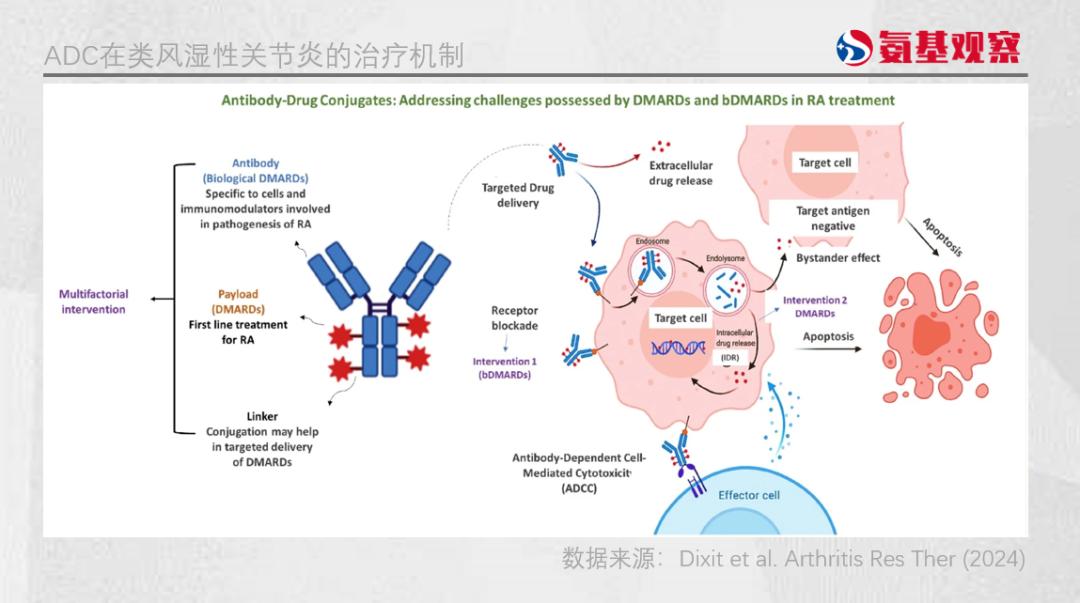
Core Insights - Antibody-drug conjugates (ADCs) have emerged as a highly certain therapeutic strategy in the innovative drug field, with major multinational corporations (MNCs) incorporating ADCs into their core technology platforms for both monotherapy and combination treatments [1][2] - The potential of ADCs extends beyond oncology, as their characteristics of "precise targeting and strong efficacy" align well with the needs of autoimmune diseases for "precise intervention and long-term control" [1][2] - Despite early-stage exploration in autoimmune ADCs, Chinese biopharmaceutical companies have transitioned from followers to core participants, with several firms advancing multiple autoimmune ADC pipelines into clinical stages [1][2] Industry Developments - The last two decades have seen significant advancements in the treatment of autoimmune diseases, moving from traditional immunosuppressants to more targeted therapies, yet unmet needs remain for more precise and sustainable immune modulation [2][4] - ADCs are positioned to address these unmet needs by targeting specific immune cell phenotypes, allowing for effective delivery of therapeutic payloads while minimizing systemic toxicity [2][4][5] - The transition of ADCs from oncology to autoimmune diseases is facilitated by their targeting, delivery efficiency, and safety advantages, addressing long-standing issues in traditional autoimmune therapies [5] Clinical Trials and Challenges - AbbVie has been a pioneer in exploring ADCs for autoimmune diseases, with two key projects, ABBV-3373 and ABBV-154, demonstrating promising early clinical efficacy but ultimately facing challenges that led to their discontinuation [8][10] - ABBV-3373 showed significant efficacy in a Phase 2 study for rheumatoid arthritis, but concerns over long-term steroid exposure and adverse events arose [10] - ABBV-154 also faced challenges, including potential tumor events, leading to its termination despite achieving statistical improvements in key efficacy endpoints [10] Competitive Landscape - The field of autoimmune ADCs is becoming increasingly competitive, with differentiation in target selection, dosage forms, and indications already underway [11] - Various targets such as B cells, T cells, and related activation pathways are being explored, with ADCs targeting BCMA, CD19, and CD20 showing potential [11][13] - Domestic biopharmaceutical companies in China are leading the charge, with innovative ADCs like DB-2304 and SHR4597 entering clinical trials, showcasing advancements in dosage forms and delivery methods [13][14] Future Outlook - While autoimmune ADCs have not yet reached commercialization, early clinical efficacy suggests the potential for long-term treatment solutions, with the industry awaiting significant breakthroughs [14]

GSK acquires RAPT Therapeutics for $2.2bn
Yahoo Finance· 2026-01-20 12:43
Core Viewpoint - GSK is acquiring RAPT Therapeutics for up to $2.2 billion to enhance its immunology portfolio, focusing on food allergy treatments [1][2]. Group 1: Acquisition Details - GSK will pay $58.00 per share for RAPT, resulting in an aggregate equity value of approximately $2.2 billion, significantly higher than RAPT's closing stock value of $35.10 on January 16 [1]. - The acquisition includes global commercial rights to ozureprubart, a long-acting anti-immunoglobulin E (IgE) prophylactic food allergy candidate, outside of specific Asian markets [2]. Group 2: Product Potential - Ozureprubart is currently in Phase IIb clinical trials and could become a "best-in-class" medication if approved, due to its once-quarterly dosing schedule, unlike other therapies that require more frequent dosing [3]. Group 3: Strategic Focus - GSK is emphasizing immunology as a key growth area, having previously engaged in a $12 billion deal with Hengrui Pharma for immunology and oncology assets [4]. - The company also established a five-year £50 million ($54.3 million) R&D agreement with the University of Cambridge to develop new treatments for immune dysfunction [5]. Group 4: Industry Context - The pharmaceutical industry is facing a significant patent cliff, with potential losses of $230 billion in the US market from 2025 to 2030, prompting companies to seek new growth avenues [6]. - GSK's Chief Scientific Officer highlighted the use of AI-driven early-stage R&D to strengthen its pipeline and mitigate losses from drug patent expirations [7].

