阿特斯

Search documents
全球最大镰刀也盯上能源了
Hu Xiu· 2025-11-13 14:39
Core Insights - The increasing demand for AI computing power is leading to a significant electricity shortage, with major tech companies like Microsoft and OpenAI highlighting the risks to their operations due to insufficient power supply [2][3][8] - The investment landscape is shifting towards energy solutions, particularly in the context of AI's growing electricity needs, with companies exploring advanced nuclear technologies [4][40] Group 1: Electricity Demand and Supply Dynamics - AI server clusters are consuming electricity at a rate that outpaces the expansion of the power grid, potentially creating a bottleneck for the AI era [3] - The power consumption of AI training has escalated dramatically, with data centers projected to consume 945 TWh by 2030, which would account for approximately 63.42% of China's residential electricity consumption in 2024 [4][7] - The U.S. is currently the largest consumer of data center electricity, accounting for 45% of global consumption, with significant growth expected in both the U.S. and China by 2030 [7][8] Group 2: U.S. Electricity Challenges - The U.S. electricity system is unprepared for the surge in demand driven by AI, with a disconnect between economic growth and electricity demand [8][11] - The aging infrastructure and the retirement of coal-fired power plants have exacerbated the electricity supply issues, leading to a projected shortfall of approximately 100 GW over the next five years [12][14] - Major data centers in the U.S. are already facing delays in new projects due to transmission capacity limitations [14][15] Group 3: China's Energy Landscape - China has a robust energy supply, with total electricity generation exceeding consumption, and is expected to see significant growth in renewable energy sources [20][22] - The country is focusing on integrating computing power with renewable energy, with policies aimed at achieving a synergy between energy supply and demand [26][30] - By 2030, China's data center electricity demand is projected to reach between 3000-7000 billion kWh, while renewable energy generation is expected to exceed this demand [34][35] Group 4: Nuclear Energy as a Solution - Both the U.S. and China are increasingly looking towards nuclear energy, particularly small modular reactors (SMRs) and controlled nuclear fusion, to meet future energy demands [49][50] - The commercial viability of SMRs is still in its early stages, with significant investments being made but no substantial revenue expected until the late 2020s [51][52] - Controlled nuclear fusion is gaining traction as a long-term solution, with various countries setting ambitious timelines for its commercialization and significant funding being directed towards this technology [54][55]

中芯国际:前三季净利同比增长41.1%;康达新材:终止筹划收购北一半导体股权丨公告精选
2 1 Shi Ji Jing Ji Bao Dao· 2025-11-13 14:22
Group 1: Company Performance - SMIC reported a revenue of 17.162 billion yuan in Q3 2025, a year-on-year increase of 9.9%, with a net profit of 1.51 billion yuan, up 43.1% year-on-year. For the first three quarters, revenue reached 49.51 billion yuan, growing 18.2%, and net profit was 3.81 billion yuan, an increase of 41.1% year-on-year [1] - BoRui Pharma's BGM1812 injection has received clinical trial approval for weight loss indications, with no similar targeted formulations approved globally [2] - Li Zhong Group's subsidiaries received project confirmations for aluminum alloy wheels from major international automotive manufacturers, with expected total sales of approximately 1.135 billion yuan [4] Group 2: Corporate Actions - Kanda New Materials announced the termination of the acquisition of equity in North One Semiconductor due to unmet progress expectations and lack of consensus among parties [3] - Lide Man plans to acquire 70% of Xiansheng Xiangrui for 1.733 billion yuan, aiming to enter the bioproducts industry [9] - Arctech's controlling shareholder CSIQ expects total revenue of 1.3 to 1.5 billion USD in Q4 2025, with a gross margin of 14% to 16% [6] Group 3: Market Activity - Taihe Technology's VC project phase two construction will be adjusted based on phase one market expansion, indicating some uncertainty [5] - Hezhong China has experienced significant stock price fluctuations, with a cumulative increase of 230.84% over 12 out of 13 trading days, leading to potential application for trading suspension if abnormal price increases continue [7][8]



美股异动 | Q3收入超预期 阿特斯太阳能(CSIQ.US)盘前涨超7%
Zhi Tong Cai Jing· 2025-11-13 14:21
Core Viewpoint - Canadian Solar (CSIQ.US) reported Q3 2025 revenue of $1.5 billion, exceeding market expectations of $1.37 billion, leading to a pre-market stock increase of over 7% [1] Financial Performance - Q3 revenue reached $1.5 billion, surpassing the anticipated $1.37 billion [1] - Gross margin for Q3 was 17.2% [1] - Q4 revenue is projected to be between $1.3 billion and $1.5 billion [1] - Expected gross margin for Q4 is between 14% and 16% [1] Shipment Data - Q3 component shipment volume was 5.1 gigawatts [1] - Q4 component shipment volume is expected to be between 4.6 and 4.8 gigawatts [1] - Anticipated energy storage system shipment volume for Q4 is between 2.1 and 2.3 gigawatt-hours [1]


Q3收入超预期 阿特斯太阳能(CSIQ.US)盘前涨超7%
Zhi Tong Cai Jing· 2025-11-13 14:19
Core Viewpoint - Canadian Solar (CSIQ.US) shares rose over 7% pre-market on Thursday, with a month-to-date increase of 37%, closing at $30.61 [1] Financial Performance - In Q3 2025, Canadian Solar reported revenue of $1.5 billion, exceeding market expectations of $1.37 billion, with a gross margin of 17.2% [1] - The company shipped 5.1 gigawatts of solar modules in Q3 [1] Future Guidance - For Q4, Canadian Solar expects total revenue to be between $1.3 billion and $1.5 billion, with a projected gross margin between 14% and 16% [1] - The anticipated module shipment for Q4 is between 4.6 and 4.8 gigawatts, along with expected energy storage system shipments of 2.1 to 2.3 gigawatt-hours [1]
阿特斯控股股东CSIQ2025年第四季度预计总收入13亿—15亿美元
Bei Jing Shang Bao· 2025-11-13 13:13
Core Insights - CSIQ reported a third-quarter revenue of $1.5 billion (approximately ¥10.68 billion) for 2025, with a gross margin of 17.2% [1] - The company expects fourth-quarter revenue to range between $1.3 billion and $1.5 billion (approximately ¥9.24 billion to ¥10.67 billion), with a gross margin forecast of 14% to 16% [1] - For the full year of 2026, CSIQ anticipates total module shipments of 25 to 30 GW and energy storage system shipments of 14 to 17 GWh [1] Financial Performance - In Q3 2025, CSIQ achieved module shipments of 5.1 GW [1] - The projected module shipments for Q4 2025 are between 4.6 GW and 4.8 GW, with energy storage system shipments expected to be between 2.1 GWh and 2.3 GWh [1] Shareholding Structure - As of the end of Q3 2025, CSIQ directly holds 62.24% of the shares in the company [2]
锂电股爆发,宁德时代、阿特斯双双签大单,国内外储能需求迎来共振时刻!
Hua Er Jie Jian Wen· 2025-11-13 12:38
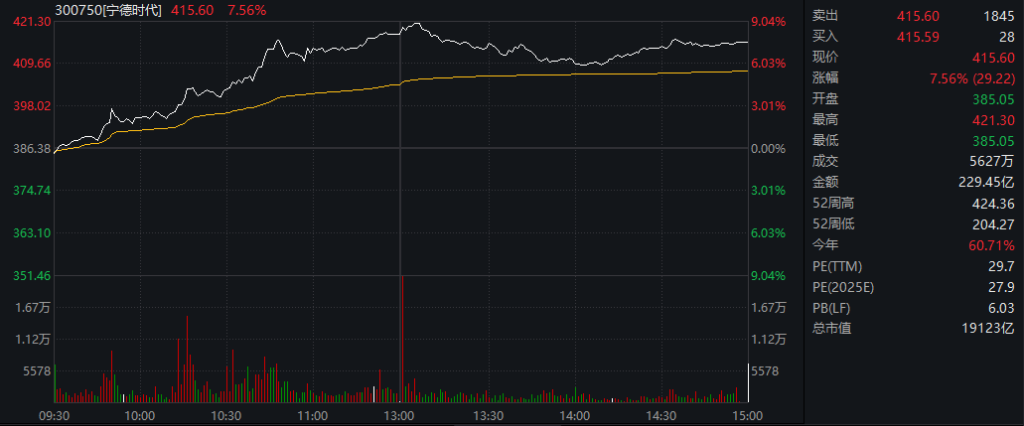
Core Viewpoint - The lithium battery sector in A-shares has experienced a strong surge, driven by significant collaborations and demand in the energy storage market, particularly involving CATL and its strategic agreements with major players [1][5][6]. Group 1: Market Performance - CATL's stock rose by 7.56%, reaching a price of 415.6 yuan per share, with a total market capitalization of 1.9 trillion yuan and a trading volume of 22.9 billion yuan, leading the A-share market [1]. - The entire lithium battery supply chain saw a collective increase, with over 20 stocks, including Huasheng Lithium and Kangpeng Technology, hitting the daily limit [3]. Group 2: Strategic Collaborations - A significant ten-year strategic agreement was signed between Haibo Sichuang and CATL, with a commitment to procure no less than 200 GWh of battery cells over the next three years [6]. - Canadian company Arctech secured a major contract for a 1.86 GWh energy storage project, further highlighting the growing demand for energy storage solutions [5][6]. Group 3: Industry Insights - Analysts from Morgan Stanley noted that the recent orders confirm strong global demand for energy storage systems and highlight CATL's leading position in the value chain, suggesting potential price or margin premiums due to supply-demand tightness [5][7]. - UBS projected that energy storage systems will become the "second growth engine" for the lithium market, estimating that by 2030, they will account for 22%-26% of total battery demand, equivalent to half of electric vehicle demand [5]. Group 4: Policy and Market Trends - Recent domestic policies have been favorable for the energy storage industry, with the inclusion of new energy storage in the capacity pricing mechanism, which could enhance economic viability and drive growth [9]. - The independent energy storage policy in Inner Mongolia is expected to stimulate local demand significantly, with projected growth rates of 50% in energy storage demand by 2026 [10].

阿特斯集团(CSIQ)发布2025年第三季度业绩报告
Xin Lang Cai Jing· 2025-11-13 12:20
Financial Performance Highlights - For Q3 2025, the company reported revenue of $1.5 billion (approximately RMB 10.68 billion) with a gross margin of 17.2% [5] - The e-STORAGE business achieved a quarterly shipment volume of 2.7 GWh [5] Q4 2025 Outlook - The company expects revenue to be between $1.3 billion and $1.5 billion (approximately RMB 9.24 billion to RMB 10.67 billion) [6] - Gross margin is projected to be between 14% and 16% [6] - Module shipment volume is anticipated to be between 4.6 GW and 4.8 GW [6] - Energy storage system shipment volume is expected to be between 2.1 GWh and 2.3 GWh, with approximately 600 MWh allocated for self-owned projects [6] Company Overview - Canadian Solar Inc. was founded in 2001 by Dr. Shawn Qu and went public on NASDAQ in 2006 [9] - The company is a leading provider of solar modules and energy storage systems, with core business activities including manufacturing and sales of solar photovoltaic modules and energy storage systems, as well as the development, construction, and operation of solar power plants and energy storage projects globally [9] - As of September 30, 2025, the company has delivered nearly 170 GW of solar modules to customers in over 160 countries and regions [9] - The cumulative shipment volume of the e-STORAGE subsidiary has surpassed 16 GWh, with a backlog of orders amounting to $3.1 billion (approximately RMB 22 billion) as of October 31, 2025 [9] Recent Business Developments - In November 2025, the company secured a 411 MW/1,560 MWh order for the "Skyview 2" energy storage project in Ontario, Canada [10] - A supply agreement for a 33 MW/66 MWh energy storage project in Texas was signed in November 2025 [10] - The "Mannum" energy storage project in Australia, with a capacity of 220 MWh, commenced commercial operations in October 2025 [10] - The company has over 1.8 GWh of energy storage projects under construction in Australia [10] - In October 2025, a contract was signed with Aypa Power for two energy storage projects in Ontario, totaling 420 MW/2,122 MWh [10] - In September 2025, the company was included in S&P Global Commodity Insights' "2025 Tier 1 Clean Energy Technology Companies" list and recognized as a Tier 1 supplier for both photovoltaic modules and energy storage systems [10] - A new generation of low-carbon photovoltaic modules and modular energy storage products, FlexBank 1.0, was launched in September 2025 [10]

美股异动丨阿特斯太阳能盘前大涨近13% Q3收入超出预期
Ge Long Hui A P P· 2025-11-13 11:48
格隆汇11月13日|阿特斯太阳能美股盘前大涨近13%。消息面上,公司2025年Q3收入15亿美元,超出 市场预期;Q4预计总收入在13亿至15亿美元。 ...
国泰海通 · 晨报1114|宏观、汽车、投资银行业与经纪业
国泰海通证券研究· 2025-11-13 11:03
Macroeconomic Overview - The current economic backdrop for Japan under Prime Minister Kishi is characterized by moderate recovery amidst ongoing re-inflation, contrasting with the deflationary stagnation faced by former Prime Minister Abe [3] - Kishi's economic strategy emphasizes demand-side management to combat external inflation while also pursuing structural supply-side reforms to stimulate new growth sectors [3] Fiscal Policy - Kishi plans to implement an "expansionary but responsible fiscal policy," with expectations of an increase in Japan's fiscal deficit ratio by 2026, although the overall expansion may be limited due to debt risks [3] Monetary Policy - Despite a dovish stance, the Bank of Japan is expected to continue raising interest rates in 2026, with a potential increase of 30 to 50 basis points, while also slowing the pace of balance sheet reduction [3] Industrial Policy - Kishi aims to enhance strategic investments in 17 key industries over the next five years, focusing on sectors such as AI, semiconductors, shipbuilding, quantum technology, biotechnology, aerospace, and cybersecurity [3] Market Impact - The "Kishi trade" observed in October indicates a strengthening of Japanese stocks, while the yen and Japanese bonds weaken, with expectations of a bullish stock market and continued upward pressure on bond yields [4] - The yen is projected to remain under pressure in the short term, with a potential for slight appreciation if U.S. dollar credit declines [4] Automotive Industry - The wholesale prices of passenger vehicles have stabilized in October, with an average discount rate of 18.5%, reflecting a shift from price competition to refined operations in the domestic market [7] - Traditional fuel vehicles maintain a high average discount rate of 26.3%, while new energy vehicles show a more stable discount rate of 12.8%, indicating a dual advantage in cost control and market demand for new energy products [7][8] Investment Fund Trends - As of October 2025, the total net asset value of public funds in China is 36.02 trillion yuan, with a net outflow observed in stock and bond funds, while money market funds saw an increase [12] - Individual investors' risk appetite has been affected by market volatility, leading to a decline in shares of ordinary stock and mixed funds, while QDII and FOF funds have gained traction as safe-haven investments [13] - Mixed FOF products have performed well, with a 63.10% increase in new issuance, as they provide a balance of risk and return for retail investors [14]