
华菱钢铁

Search documents
险资入市全拆解:连续五个季度大幅增配股票,二季度整体增配红利,整体仍增配科技
Xin Lang Cai Jing· 2025-09-06 07:29
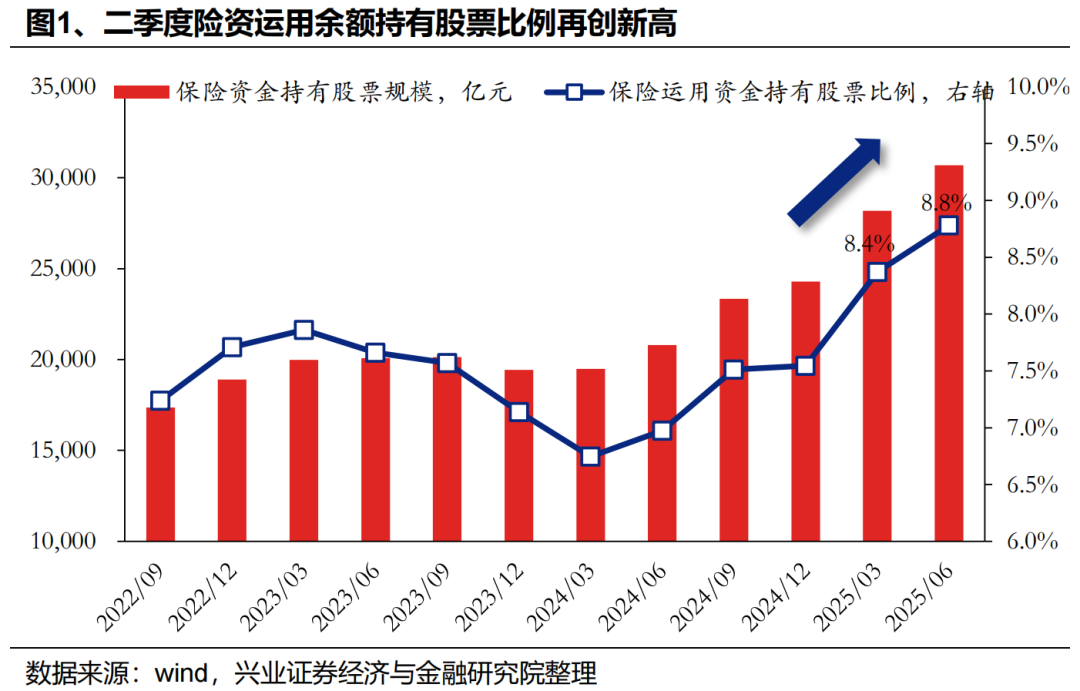
Group 1 - The performance evaluation methods for state-owned insurance companies have been continuously optimized since the beginning of the year, leading to an improved policy environment for insurance fund equity investments, which has accelerated the entry of insurance capital into the market [1] - In the second quarter, insurance companies further increased their stock allocations by approximately 200 billion yuan, with the proportion of stocks held rising by 0.4 percentage points to 8.8% compared to Q1 [1] - It is estimated that insurance capital will continue to increase allocations to A+H stocks by 300 to 400 billion yuan in the second half of the year, based on a 30% investment of new premium income [5] Group 2 - Insurance capital's participation in equity assets is gradually shifting from external management to direct investment, with a notable increase in stock holdings since Q4 2024, while fund holdings have decreased [8] - In the second quarter, insurance capital increased allocations to dividend-paying stocks while reducing holdings in energy sectors, with a focus on technology and high-end manufacturing [11] - The average dividend yield of the top 20 stocks increased to 3.80%, indicating a preference for high-dividend assets [13] Group 3 - Insurance capital has accelerated its stake acquisitions in listed companies, particularly in Hong Kong stocks, with 28 stake acquisitions recorded by August 31, surpassing the total for the previous year [16] - The preference for Hong Kong assets has made insurance capital a core driver of the rise in Hong Kong dividend assets [19] Group 4 - In the first half of 2025, insurance capital's holdings in ETFs saw a slowdown, with a total of 214.9 billion yuan held, reflecting a shift towards direct investments [23] - Despite the slowdown in total ETF allocations, there has been a significant internal structural adjustment, with increased allocations to TMT, manufacturing, and financial real estate sector ETFs [29] Group 5 - The five listed insurance companies in A-shares increased their stock holdings by 411.9 billion yuan in the first half of the year, representing a 28.7% increase [33] - The proportion of FVOCI stocks held by listed insurance companies has significantly increased, with a 62.2% rise in holdings [36]




普钢板块9月5日涨0.55%,本钢板材领涨,主力资金净流出8348.82万元
Zheng Xing Xing Ye Ri Bao· 2025-09-05 08:56
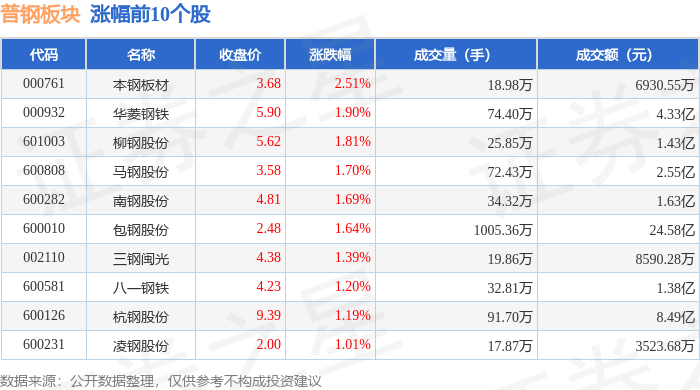
Market Performance - On September 5, the general steel sector rose by 0.55% compared to the previous trading day, with Benxi Steel leading the gains [1] - The Shanghai Composite Index closed at 3812.51, up 1.24%, while the Shenzhen Component Index closed at 12590.56, up 3.89% [1] Individual Stock Performance - Benxi Steel (000761) closed at 3.68, up 2.51% with a trading volume of 189,800 shares and a transaction value of 69.31 million yuan [1] - Other notable performers include: - Hualing Steel (000932) at 5.90, up 1.90% with a trading volume of 744,000 shares [1] - Liugang (601003) at 5.62, up 1.81% with a trading volume of 258,500 shares [1] - Sijiang Steel (600808) at 3.58, up 1.70% with a trading volume of 724,300 shares [1] Capital Flow Analysis - The steel sector experienced a net outflow of 83.49 million yuan from institutional investors, while retail investors saw a net inflow of 191 million yuan [2] - The capital flow for individual stocks shows: - New Steel (600782) had a net inflow of 23.35 million yuan from institutional investors [3] - Hebei Steel (000709) had a net inflow of 22.33 million yuan from institutional investors [3] - Chongqing Steel (601005) had a net inflow of 22.06 million yuan from institutional investors [3]


中金:看好下半年钢铁行业多重周期向上共振 底部反转可期
Zhi Tong Cai Jing· 2025-09-05 06:27
Core Viewpoint - The steel industry is expected to see supply-demand improvement in the second half of 2025, driven by production regulation and a recovering inventory cycle, amidst a backdrop of anti-involution [1][3]. Group 1: Industry Cycle and Valuation - The steel sector has been gradually recovering from historical lows since Q3 2024, with current profitability at 50% of the complete cycle since 2015 and a low P/B valuation of 1.09X, indicating significant room for improvement [2]. - The industry is currently at the left side of a major cycle bottom reversal, with the bottom becoming increasingly clear, suggesting a potential upward resonance in the industry cycle [3]. Group 2: Supply-Side Reform - The path for the current supply-side reform in the steel industry is becoming clearer, focusing on differentiated production control based on efficiency and environmental standards, accelerating the elimination of outdated capacities, and promoting industry consolidation to improve competition [4]. - The central government's increasing emphasis on anti-involution is expected to accelerate supply-side reforms, leading to improved industry profitability and return on equity (ROE) [4]. Group 3: Investment Recommendations - The company recommends focusing on the upward resonance of multiple cycles in the steel industry in the second half of 2025, with core assets currently undervalued and expected to undergo valuation recovery as the profitability cycle bottoms out [5]. - Two main investment lines are suggested: long-term focus on high-quality core assets like Huazhong Steel (000932.SZ), and short-term focus on efficient rebar companies with a higher proportion of rebar production [5].
二季度末险资对交通运输板块大幅加仓,交通运输ETF(159666)连续四日净流入1299万元
Mei Ri Jing Ji Xin Wen· 2025-09-05 05:58
Group 1 - The A-share market showed mixed performance on September 5, with over 3,000 stocks declining, while sectors such as electric equipment, non-ferrous metals, and basic chemicals led the gains, and retail, comprehensive, and beauty care sectors lagged [1] - As of the end of Q2, insurance capital significantly increased holdings in industries such as transportation, communication, and public utilities, with notable increases in shares of CITIC Bank, Beijing-Shanghai High-Speed Railway, and China Telecom, each exceeding 200 million shares [1] - According to招商证券, by the end of Q2 2025, the top five industries by insurance capital holdings in A-shares will be banking, transportation, communication, real estate, and electric and public utilities, indicating a stable growth outlook for highway enterprises and their low volatility dividend attributes [1] Group 2 - The Transportation ETF (159666) and its linked funds are the only ETFs tracking the CSI All-Transportation Index, which includes logistics, railways, highways, shipping ports, and airports, reflecting the overall performance of A-share transportation industry listed companies [2]
险资最新重仓股出炉!这一行业受青睐
Zhong Guo Zheng Quan Bao· 2025-09-05 03:18
Group 1 - The core viewpoint of the articles indicates that insurance capital is increasingly favoring bank stocks, with a significant presence in the top ten shareholders of over 700 stocks as of the end of Q2 2025 [1][3] - As of the end of Q2 2025, insurance capital held a total of 730 stocks, with a total shareholding of 61.919 billion shares and a market value of 628.985 billion yuan, both of which increased compared to the end of Q1 2025 [3] - Among the top ten heavy holdings of insurance capital, six are bank stocks, including Minsheng Bank, SPDB, Zhejiang Bank, Huaxia Bank, Industrial Bank, and China Merchants Bank [3] Group 2 - Insurance capital has shown a preference for high-dividend stocks and sectors such as transportation, telecommunications, and public utilities, with significant increases in holdings in these areas [4][5] - In Q2, insurance capital increased its holdings in CITIC Bank, Beijing-Shanghai High-Speed Railway, and China Telecom, with each seeing an increase of over 200 million shares [4] - The insurance sector is focusing on optimizing equity investment structures, particularly in high-dividend and new productive capacity stocks, with an emphasis on technology innovation, advanced manufacturing, and new consumption sectors [5]
2025年1-7月黑色金属矿采选业企业有1532个,同比增长0.52%
Chan Ye Xin Xi Wang· 2025-09-05 01:37
Group 1 - The core viewpoint of the article highlights the growth in the number of enterprises in the black metal mining and selection industry in China, with a total of 1,532 enterprises reported from January to July 2025, reflecting an increase of 8 enterprises compared to the same period last year, representing a year-on-year growth of 0.52% [1][1][1] - The black metal mining and selection industry enterprises accounted for 0.29% of the total industrial enterprises in China during the same period [1][1][1] - The report referenced is the "2025-2031 China Black Metal Mining and Selection Industry Market Panorama Survey and Investment Prospect Forecast Report" published by Zhiyan Consulting, a leading industry consulting firm in China [1][1][1] Group 2 - The article provides statistical data from the National Bureau of Statistics and Zhiyan Consulting, indicating a change in the threshold for large-scale industrial enterprises from an annual main business income of 5 million yuan to 20 million yuan since 2011 [1][1][1] - The report emphasizes the importance of industry research and consulting services in supporting investment decisions, showcasing Zhiyan Consulting's expertise in providing comprehensive industry solutions [1][1][1]

普钢板块9月4日跌1.63%,包钢股份领跌,主力资金净流出6.28亿元
Zheng Xing Xing Ye Ri Bao· 2025-09-04 08:50
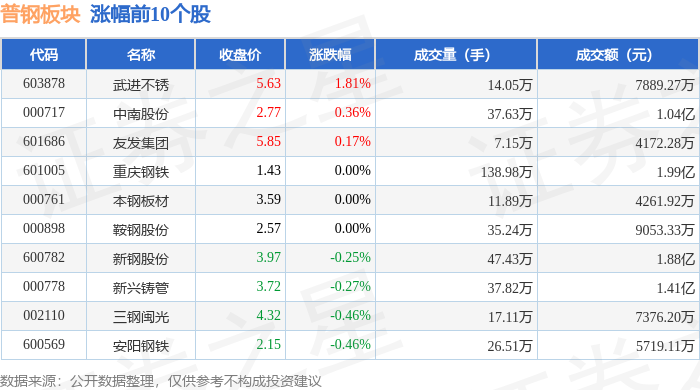
Market Overview - On September 4, the steel sector experienced a decline of 1.63% compared to the previous trading day, with Baogang Co. leading the drop [1] - The Shanghai Composite Index closed at 3765.88, down 1.25%, while the Shenzhen Component Index closed at 12118.7, down 2.83% [1] Individual Stock Performance - Notable performers included: - Wujin Stainless Steel (603878) with a closing price of 5.63, up 1.81% on a trading volume of 140,500 shares and a transaction value of 78.89 million yuan [1] - Zhongnan Co. (000717) closed at 2.77, up 0.36% with a trading volume of 376,300 shares and a transaction value of 104 million yuan [1] - Baogang Co. (600010) saw a significant decline of 4.69%, closing at 2.44 with a trading volume of 13,013,100 shares and a transaction value of 322.9 million yuan [2] Capital Flow Analysis - The steel sector experienced a net outflow of 628 million yuan from main funds, while retail investors saw a net inflow of 601 million yuan [2] - The capital flow for individual stocks showed: - Ma Steel (600808) had a net inflow of 18.89 million yuan from main funds, while retail investors had a net outflow of 28.27 million yuan [3] - Baogang Co. (600019) had a net inflow of 8.08 million yuan from main funds, but a net outflow of 23.39 million yuan from retail investors [3]


国泰海通:钢铁需求有望逐步边际回升 盈利中枢有望逐步修复
智通财经网· 2025-09-04 08:49
Group 1 - The steel industry demand is expected to gradually bottom out, with signs of market clearing on the supply side, leading to a potential recovery in the industry's fundamentals [1][3] - Last week, the apparent consumption of five major steel products was 8.5777 million tons, an increase of 47,800 tons week-on-week, while total inventory reached 14.6788 million tons, up 268,400 tons [1] - The operating rate of blast furnaces among 247 steel mills was 83.2%, a decrease of 0.16 percentage points week-on-week, indicating a slight reduction in production activity [1][2] Group 2 - The average gross profit for rebar was 231.5 CNY/ton, down 12.2 CNY/ton week-on-week, reflecting a decline in profitability across the sector [2] - The steel industry has been experiencing losses since Q3 2022, with over 30% of steel companies still in the red, but market-driven supply adjustments are beginning to take effect [3] - The Ministry of Industry and Information Technology is expected to introduce policies aimed at structural adjustments and the elimination of outdated production capacity, which could accelerate supply contraction [3] Group 3 - Long-term trends indicate an increase in industry concentration and a shift towards high-quality development, benefiting companies with product and cost advantages [4] - Recommended companies include Baosteel, Hualing Steel, and Shougang, which are noted for their technological and product structure leadership [4] - The report highlights the potential for upstream resource companies to benefit from demand recovery, recommending firms such as Hebei Resources and Erdos [4]

康波萧条期的资源繁荣
2025-10-13 01:00
Summary of Key Points from Conference Call Records Industry Overview - The records discuss the dynamics of the commodities market, particularly focusing on industrial metals and their pricing attributes influenced by both China and the United States [1][2][3][5]. Core Insights and Arguments 1. **Commodity Pricing Attributes**: Commodities are categorized into three types: - Financially driven gold - Physically driven base metals like steel - Copper, which has both attributes [5][2]. 2. **Impact of U.S. Monetary Policy**: Gold prices are primarily influenced by U.S. fiscal and monetary policies, while base metals are driven by supply and demand dynamics [5][2]. 3. **China's Role in Industrial Metals**: China dominates the demand for industrial metals, accounting for approximately half of global consumption, which significantly influences pricing [3][5]. 4. **U.S. Trade Deficit Challenges**: The U.S. faces a persistent trade deficit, which could be addressed by increasing total supply or reducing total demand, both of which are challenging [7][14]. 5. **Reindustrialization Difficulties in the U.S.**: The U.S. manufacturing sector has been declining, with its share of the economy dropping from nearly 30% in 1965 to about 10.2% in 2020, indicating significant challenges in reindustrialization [13][14]. 6. **China's Industrialization Stage**: China is in a mature industrialization phase, similar to Japan in 1976 and the U.S. in 1938, focusing on upgrading its manufacturing capabilities and shifting towards high-end exports [9][10]. 7. **Global Trade Dynamics**: The U.S.-China trade friction has led to a redistribution of global trade flows without altering overall supply and demand [6][7]. 8. **Debt Pressure Comparison**: There is a stark contrast in debt pressures between China and the U.S., with China experiencing lower debt pressure due to its industrial maturity, while the U.S. faces significant fiscal sustainability issues [15][21]. 9. **Fiscal Policy Implications**: The U.S. fiscal deficit is closely tied to its trade deficit, with high spending leading to increased imports. The fiscal deficit for 2025 is projected to be around $1.36 trillion [14][21]. 10. **Economic Transition in China**: China is transitioning from an investment-driven economy to a consumption-driven one, with significant implications for its economic structure and growth [40][41]. Other Important but Potentially Overlooked Content 1. **Historical Context of Industrialization**: The records draw parallels between current industrialization trends and historical examples from East Asia, emphasizing that merely absorbing low-end industries does not equate to full industrialization [12][9]. 2. **Service Sector Development**: The need for China to develop its service sector is highlighted as a crucial step in enhancing economic stability and consumer spending [3][34]. 3. **Copper Market Dynamics**: The copper market is characterized by limited new supply due to reduced capital expenditures by mining companies, leading to a significant supply-demand gap [46]. 4. **Long-term Economic Trends**: The records suggest that the current economic environment is influenced by long-term cycles, such as the Kondratiev wave, indicating that the global economy is still in a downturn phase [23][49]. 5. **Potential for AI and Technology**: While AI has the potential to drive economic recovery, its impact will depend on its application and the pace of technological diffusion [48]. 6. **Fiscal Tightening Effects**: The tightening of fiscal policies in China has led to reduced government spending, impacting various sectors and necessitating a careful balance to avoid stifling growth [38][39]. 7. **Consumer Behavior Insights**: Despite perceptions of weak consumer spending in China, household savings have significantly increased, indicating a potential for future consumption growth if income distribution issues are addressed [30][31]. This summary encapsulates the critical insights and arguments presented in the conference call records, providing a comprehensive overview of the current state and future outlook of the commodities market and the broader economic landscape.
华菱钢铁:累计回购0.6088%股份
Ge Long Hui· 2025-09-03 10:59
Core Viewpoint - Hualing Steel announced a share buyback program, repurchasing a total of 42,061,479 shares, which represents 0.6088% of the company's total share capital of 6,908,632,499 shares [1] Summary by Relevant Sections - **Share Buyback Details** - The company has repurchased shares through a dedicated securities account via centralized bidding [1] - The highest transaction price was 5.27 CNY per share, while the lowest was 4.41 CNY per share [1] - The total amount spent on the buyback was 201,216,217.75 CNY, excluding transaction fees [1] - **Funding Sources** - The funds for the share buyback came from the company's own funds and self-raised funds [1] - The buyback price did not exceed the upper limit of 5.80 CNY per share as outlined in the buyback plan [1]