南方电网

Search documents
京东出席2025 能源产业生态论坛,以数智供应链筑牢能源产业生态基石
Sou Hu Wang· 2025-06-30 07:39
Core Viewpoint - The forum focused on accelerating the construction of a new energy system and promoting the green and low-carbon transformation of the energy industry, with participation from over 400 representatives from government, energy companies, and related sectors [1] Group 1: Company Initiatives - JD.com is promoting energy conservation and emission reduction in its supply chain through initiatives such as green data centers, green warehousing, green logistics, and green packaging [2] - The company has installed photovoltaic equipment in 17 smart industrial parks, aiming for a self-generated photovoltaic power output exceeding 38 million kilowatt-hours by 2024, which is expected to reduce carbon emissions by over 30,000 tons [2] - JD.com has optimized operations in high-energy-consuming data centers by incorporating renewable energy and developing its own Alpha intelligent computing module, maintaining a Power Usage Effectiveness (PUE) below 1.15 [2] Group 2: Industry Collaboration - JD.com utilizes digital technology to connect and optimize various aspects of social production, consumption, and services, driving the transformation of the green supply chain [2] - Since 2022, JD.com has launched the "Green Plan" in collaboration with over 100 Fortune 500 brands to encourage consumers to choose green products [2] - The company has introduced dual carbon accounts for brands and consumers, establishing a carbon-inclusive mechanism and an environmentally friendly product system [2] Group 3: Support for the Energy Sector - JD.com extends its services across the entire energy industry chain, including generation, grid, load, and storage, serving major energy companies such as China National Energy Group, PetroChina, Sinopec, and Southern Power Grid [3] - The company has served over 8 million government and enterprise clients, including more than 30,000 large clients [3] - As the national "dual carbon" strategy deepens, the digitalization and greening of the energy industry are becoming essential, with JD.com committed to supporting energy companies in cost reduction and efficiency improvement [3]

新股探寻 (屹唐股份、信通电子)
2025-06-30 01:02
新股探寻 (屹唐股份、信通电子)20250627 屹唐股份本次募集资金的投向及预期效益是什么? 屹唐股份计划募集资金约 25 亿元,主要投入两个项目。第一个是集成电路装 备研发制造服务中心项目,该项目已于 2021 年开始投建,并于 2023 年实现 管理层预计 2025 年上半年营收同比增长 10%-19.6%,归母净利润同 比增长 24%-37%,备品备件业务基于 4,800 台设备存量,预计将成为 持续稳定的收入来源。 公司面临的风险包括半导体扩张速度、部分零部件依赖进口、技术升级 迭代验证和进度,以及电力行业智能化改造政策波动等因素。 投产,旨在提升公司现有干法去胶设备、快速热处理设备和干法刻蚀设备的生 产能力。第二个项目主要用于高端产品的研发,包括现有设备的升级迭代和新 产品的研发,例如新一代超高产能去除设备和刻蚀设备的研发,以及新型等离 子体刻蚀设备的开发。 屹唐股份在集成电路前道制造设备领域的主要产品线有哪些? 屹唐股份主要提供晶圆加工设备,特别是集成电路前道制造过程中的关键设备, 包括干法去胶设备、快速热处理设备和干法刻蚀设备。 屹唐股份的全球客户覆盖情况如何? 截至 2024 年末,屹唐股份 ...
浙商银行广州分行:发挥场景金融优势,精准灌溉广东产业沃土
Nan Fang Du Shi Bao· 2025-06-26 13:17
Core Viewpoint - The article emphasizes the importance of developing new productive forces and modern industrial systems in Guangdong, with a focus on integrating financial services into the manufacturing industry to support small and medium-sized enterprises [2][5]. Group 1: Financial Services Innovation - Zhejiang Commercial Bank's Guangzhou branch is innovating financial services by creating scenario-based financial models that integrate deeply into the core of the industrial chain, specifically targeting small and medium-sized enterprises [2][5]. - The bank has developed differentiated financing solutions for key industries in Guangdong, including energy, construction, automotive, telecommunications, and home appliances, to enhance the industrial ecosystem [5][6]. Group 2: Support for Technological Innovation - The bank offers specialized financial products such as "Specialized and Innovative Loans" and "Co-Investment Loans" to support technology enterprises at various stages of development, ensuring comprehensive financial services throughout their lifecycle [6][7]. - By May 2025, the bank had served over 1,800 technology finance enterprises and more than 700 specialized and innovative enterprises, providing substantial financial support for technological innovation in Guangdong [6]. Group 3: Financing for Industrial Parks - The bank has implemented a comprehensive financial service model for industrial parks, addressing the financial needs of enterprises within these parks, with over 257 small and micro parks served and a total loan amount exceeding 29.5 billion [7]. - The introduction of a digital service system has improved access to financing for small and micro enterprises, with nearly 190 million in digital loans disbursed in 2024 [7]. Group 4: Globalization Support - The bank is addressing challenges faced by Guangdong enterprises in their global expansion, such as difficulties in overseas account opening and payment efficiency, by providing innovative cross-border services [8]. - By the end of 2024, the bank's international settlement and foreign exchange transaction volumes exceeded 35.3 billion and 23.3 billion, respectively, supporting the international development of Guangdong enterprises [8].



华能/三峡/国电投/中能建/中电建/中交三航/龙源振华/中海油/海油工程/明阳智能/国家电网/南方电网...
DT新材料· 2025-06-26 00:50
Core Viewpoint - The article discusses the evolving landscape of marine clean energy development in China, highlighting the shift from state-owned electric enterprises to marine engineering leaders in deep-sea projects, particularly in offshore wind energy [2]. Group 1: Industry Dynamics - State-owned electric enterprises have traditionally dominated marine clean energy development in China, but this barrier is being challenged as deep-sea projects become more prevalent [2]. - Marine engineering companies with extensive experience in FPSO, deep-water platforms, and floating oil and gas systems are increasingly entering the offshore wind energy sector, reshaping the industry dynamics [2]. - Companies like CNOOC, Zhenhua Heavy Industries, and CIMC Raffles are leveraging their deep-sea oil and gas engineering expertise to become key players in the EPC (Engineering, Procurement, and Construction) segment of offshore wind energy [2]. Group 2: Future Collaboration - The future of marine clean energy development in China will depend on collaboration between electric state-owned enterprises and marine engineering companies, focusing on technology standards, resource sharing, and policy coordination [2]. - Electric state-owned enterprises are enhancing their operations through three main strategies: intelligent operation and maintenance, flexible power grids, and ecological integration [2]. Group 3: Upcoming Events - The 2025 Marine Clean Energy Technology and Equipment Summit Forum will be held from July 23-25 in Nantong, featuring various activities including a youth scientist forum, industry development discussions, and technology exhibitions [3][12]. - The forum aims to address trends in marine clean energy development, the "14th Five-Year Plan" policy outlook, and the integration and collaboration within the industry [12].

南方电网打造粤港澳大湾区最大算力集群
Zhong Guo Dian Li Bao· 2025-06-25 03:19
Group 1 - The Guangdong-Hong Kong-Macao Greater Bay Area has officially launched a public computing power service platform, with significant projects signed and launched, including over 30 projects in AI applications [1] - The Shaoguan data center cluster has successfully attracted 22 data center projects with a total investment exceeding 60 billion yuan, and the average monthly electricity consumption of data centers has increased by 84.27% year-on-year from January to May [1][2] - The Shaoguan power supply bureau is enhancing the power grid structure and modern power supply service system to support the real-time computing power capabilities of the data centers [1][2] Group 2 - The construction of modern data centers in Shaoguan is progressing rapidly, with 120,000 standard racks built and over 30,000 computing power cards expected to form the largest intelligent computing pool in South China [2] - The Shaoguan power supply bureau is implementing five collaborative concepts to guide the planning and construction of power infrastructure, including the establishment of five 220 kV substations and 14 110 kV substations [2][3] - The integration of electricity and computing power is being enhanced through intelligent collaboration, with improvements in power communication networks and power dispatch systems to increase the efficiency of computing resource allocation [3] Group 3 - Shaoguan's renewable energy sources, including wind, solar, and hydropower, account for 56.7% of installed capacity, with an annual surplus of over 10 billion kWh, which helps reduce electricity costs for data centers [4] - The Shaoguan power supply bureau is proactively engaging with enterprises to track electricity needs and shorten electricity connection times, providing tailored services to support the growth of the data industry [4][5] - The power supply bureau is committed to ensuring reliable power supply for data centers, implementing customized power solutions to support the national strategy of "East Data West Computing" [5]
中东战火未冷,全球资本抢滩“人造太阳”
财富FORTUNE· 2025-06-24 12:42
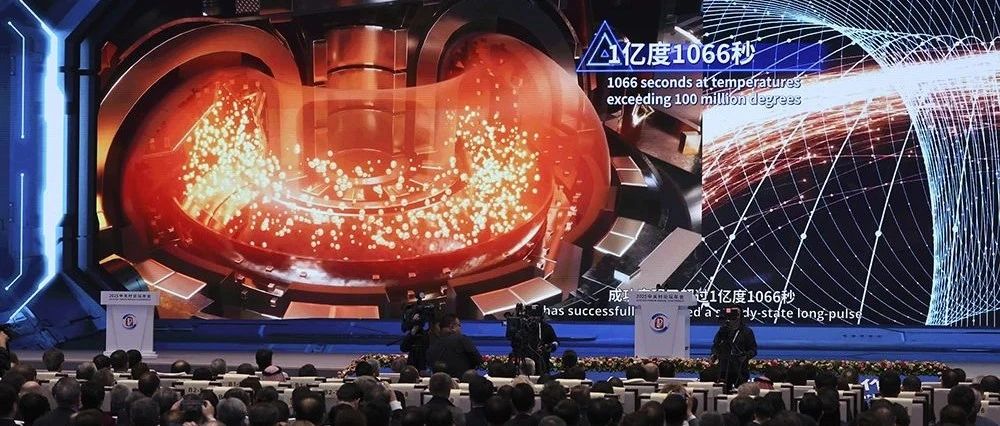
Core Viewpoint - The article emphasizes the accelerating development and investment in controllable nuclear fusion technology, which is seen as a "ultimate energy" solution amid geopolitical tensions and energy security concerns in China [1][7]. Group 1: Energy Security and Nuclear Fusion - China's energy import dependency is at 20%, with oil strategic reserves only sufficient for 24 days, highlighting severe energy security issues [1]. - Controllable nuclear fusion offers significant advantages, such as the energy released from 1 gram of deuterium-tritium fuel being equivalent to 8 tons of oil, and the cost of generating electricity can be controlled below 0.005 yuan per kilowatt-hour [1][6]. - The Chinese government has included nuclear fusion in its "Top Ten Future Industries" initiative, planning over 300 billion yuan investment by 2030 [1]. Group 2: Investment and Commercialization - Social capital is actively investing in nuclear fusion projects, with notable investments like the 3.275 billion yuan increase in Kunlun Capital aimed at controllable nuclear fusion [2]. - The establishment of Fusion New Energy, a core platform for commercializing nuclear fusion technology, has attracted significant investment, with registered capital reaching 14.5 billion yuan [2]. Group 3: Technological Advancements - The CRAFT project, a key system for fusion reactors, achieved full domestic production of its low-noise current drive system, marking a significant technological milestone [3]. - The HL-3, China's largest and most advanced nuclear fusion experimental device, achieved new operational records, indicating rapid progress in fusion technology [3]. Group 4: Market Potential and Future Outlook - The global controllable nuclear fusion market is projected to reach $496.5 billion by 2030 and may exceed $1 trillion by 2050 [6]. - The article notes a decline in China's crude oil imports for the first time in 20 years, reflecting a strategic shift towards reducing oil dependency and increasing focus on nuclear fusion as a viable energy solution [6][7].
2025高考志愿填报——储能科学与工程专业解析
中关村储能产业技术联盟· 2025-06-23 09:31
Core Viewpoint - The article discusses the emerging field of Energy Storage Science and Engineering, highlighting its significance in response to national energy strategies and the growing demand for skilled professionals in this sector [1][3]. Group 1: Background and Strategic Importance - The establishment of the Energy Storage Science and Engineering major aligns with national energy security and industrial transformation needs, directly addressing the "dual carbon" goals and renewable energy integration [5]. - The global energy transition and "dual carbon" targets necessitate the cultivation of talent in energy storage, which is crucial for the development of new storage technologies [3]. - According to the "Energy Storage Industry Research White Paper 2025," China is expected to maintain its position as the global leader in new energy storage installations, with a projected capacity of 43.7 GW in 2024, accounting for approximately 60% of global new installations [3]. Group 2: Professional Characteristics - The Energy Storage Science and Engineering major is characterized by its alignment with national strategic needs, multi-disciplinary integration, and collaborative innovation between academia and industry [5][6][7]. - The program integrates knowledge from electrical engineering, chemical engineering, materials science, and energy dynamics, fostering the ability to solve complex engineering problems [6]. - The dual mentorship system and industry collaboration enhance the connection between educational institutions and industry demands, promoting effective talent development [7]. Group 3: Employment Prospects and Development Potential - Graduates of the Energy Storage Science and Engineering major possess a broad knowledge base and adaptability, making them suitable for various sectors including energy, environment, automotive, and new materials [8]. - Key employment sectors include energy power companies, grid enterprises, battery and system integration firms, with notable companies such as CATL, BYD, and Huawei [10]. - The major has seen a significant increase in the number of institutions offering it, with 103 universities across 27 provinces in China now providing this program [11]. Group 4: Key Universities and Their Specialties - Major universities offering the Energy Storage Science and Engineering program include Xi'an Jiaotong University, Xiamen University, and Harbin Institute of Technology, each with unique educational and research strengths [11][26]. - Beijing University of Science and Technology has established a dedicated department for this major, focusing on interdisciplinary collaboration and innovative research [19]. - Fuzhou University collaborates with German institutions to provide international exposure and dual degree opportunities for students [21]. Group 5: Career Development Paths - Career paths for graduates include roles in battery and energy storage system development, project management in energy systems, and research positions in academia [13][14]. - The program offers various development pathways, including technical expertise in research centers, project management roles, and opportunities for interdisciplinary transitions into energy investment analysis [14].
上海超导科技IPO:技术光环下的财务隐忧与领导人迷雾
Sou Hu Cai Jing· 2025-06-20 13:58
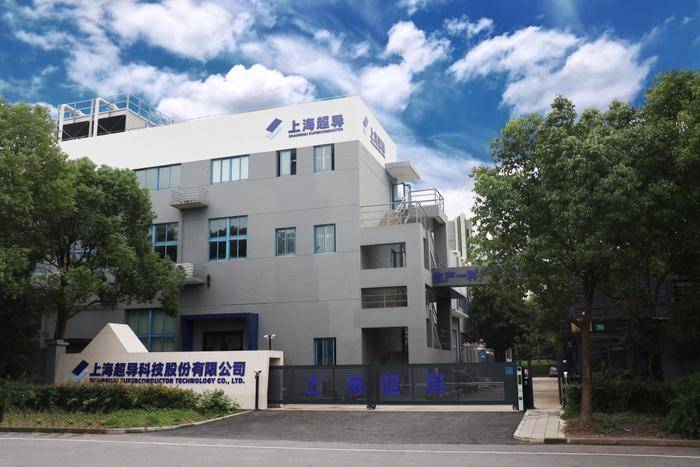
Core Viewpoint - Shanghai Superconductor Technology Co., Ltd. has initiated its IPO process on the Sci-Tech Innovation Board, aiming to raise 1.2 billion yuan, with China International Capital Corporation (CICC) as the sponsor [1][3]. Group 1: IPO Journey - The company was established on October 18, 2011, with a registered capital of 520 million yuan, focusing on high-temperature superconducting materials [3]. - Key milestones include the start of IPO counseling on November 28, 2024, and the acceptance of the IPO application on June 18, 2025 [3]. Group 2: Business and Governance Risks - The company faces high customer concentration, with the top five clients contributing over 70% of revenue. A 30% decline in the State Grid's procurement volume in 2024 has led to an increase in inventory turnover days to 287 days, compared to 180 days in 2022 [5][6]. - The commercial viability of its technology is questioned, as claims of entering fields like controlled nuclear fusion and medical devices remain unproven, with large-scale applications expected to take 5-10 years to develop [7]. - The chairman, Ma Tao, has limited public information available, and his past associations raise concerns about governance and transparency [8][10]. Group 3: Financial Data Analysis - The company reported revenues of 0.35 billion yuan in 2022, increasing to 0.83 billion yuan in 2023, and projected to reach 2.39 billion yuan in 2024. However, it also faced net losses of 0.28 billion yuan in 2022 and 0.04 billion yuan in 2023, with a projected profit of 0.72 billion yuan in 2024 [12]. - The high accounts receivable, which accounted for 52% of revenue, raises concerns about the quality of earnings, especially given that some major clients are relatively new companies [12]. - The company plans to expand its production capacity significantly, aiming for an annual output of 6,000 kilometers, while the global market for high-temperature superconducting materials is only about 50 kilometers in 2024, indicating a severe supply-demand mismatch [12]. Group 4: Regulatory Inquiry Anticipation - The company may face inquiries regarding its technology commercialization capabilities, governance structure without a controlling shareholder, and high accounts receivable potentially indicating bad debt risks [13]. - Investors are advised to monitor three critical signals: the ability to diversify the customer base, the potential for positive cash flow, and the feasibility of capacity utilization [13].
国网“小伙伴”今日申购,另有两只新股上市丨打新早知道
2 1 Shi Ji Jing Ji Bao Dao· 2025-06-19 23:10
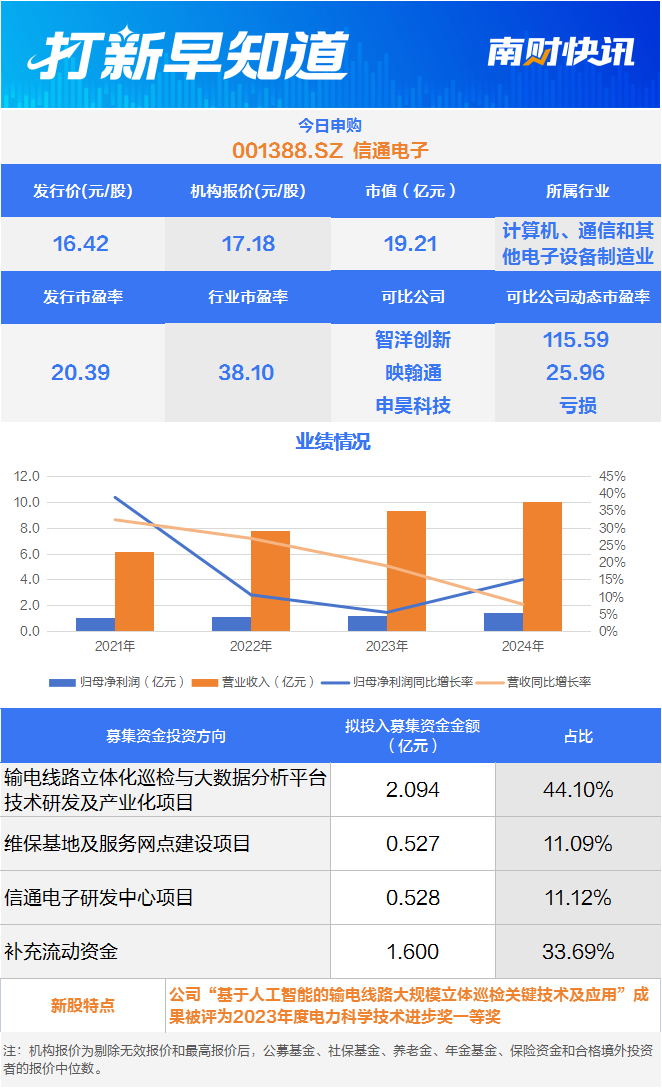
Core Viewpoint - The article discusses the recent IPOs of three companies: Xintong Electronics, Huazhi Jie, and Xinhenghui, highlighting their business models, funding plans, and market positions. Group 1: Xintong Electronics - Xintong Electronics is a provider of industrial IoT smart terminals and system solutions, focusing on power and communication sectors, and has been recognized as a national-level "little giant" enterprise [2] - The company plans to raise funds for projects including a transmission line inspection and big data analysis platform (2.094 billion), maintenance base construction (0.527 billion), R&D center (0.528 billion), and working capital (1.600 billion) [4][5] - In 2024, the main revenue sources are projected to be from transmission line inspection systems (6.51 billion, 64.88%), substation auxiliary control systems (1.53 billion, 15.24%), and mobile smart terminals (1.02 billion, 10.17%) [5] - Xintong has established long-term partnerships with major clients like State Grid and Southern Power Grid, with nearly 50% of its revenue coming from State Grid in 2024 [5] Group 2: Huazhi Jie - Huazhi Jie operates in the smart control industry, supplying key components for power tools and consumer electronics, including smart switches and brushless motors [7] - The company plans to use raised funds primarily for the production of 86.5 million smart components (4.26 billion, 87.66%) and for working capital (0.60 billion, 12.34%) [11] - Approximately 40% of Huazhi Jie's revenue comes from domestic sales, while 60% is from international markets, with significant partnerships with well-known companies [12] Group 3: Xinhenghui - Xinhenghui is an integrated circuit company focusing on chip packaging materials, with major business areas including smart card and etching lead frame businesses [12] - The company plans to allocate funds for high-density QFN/DFN packaging material projects (4.56 billion, 87.92%) and R&D center upgrades (0.63 billion, 12.08%) [13] - Xinhenghui has established long-term relationships with major security chip design firms and is a significant supplier in the smart card module market, holding a market share of 20.71% in 2022 [14]
电力“高速路”建设“加速跑”,支撑稳!梳理迎峰度夏电力保供新变化↓
Yang Shi Wang· 2025-06-17 06:55
Group 1: Power Supply and Demand Forecast - The upcoming summer is expected to see a significant increase in electricity demand due to rising temperatures, with maximum load in Hunan projected to reach 50 million kilowatts [1][3] - Hunan's power grid will enhance its supply capacity by over 5 million kilowatts through the commissioning of 12 key projects by the end of June [3] - The national grid's maximum load is anticipated to exceed 1.2 billion kilowatts, setting a historical record [6] Group 2: Regional Power Supply Enhancements - Hebei has increased its external power supply capacity to 19.54 million kilowatts, accounting for over 40% of its total supply, marking a historical high for the region [4] - The coal inventory in Hunan has reached 6.03 million tons, ensuring stable operation of hydro and thermal power plants [3] Group 3: Renewable Energy Integration - The integration of renewable energy sources is expected to peak in 2025, with significant contributions from wind and solar power [13][16] - By April 2025, the installed capacity of wind and solar power in China reached 540 million kilowatts and 990 million kilowatts, respectively, accounting for 44% of the total installed capacity [16] - The successful integration of renewable energy is crucial for maintaining grid stability during peak summer demand [17][18] Group 4: Infrastructure Development - Key power grid projects are under construction to enhance inter-regional power exchange capabilities, particularly in response to summer peak demand [20][22] - The construction of the 750 kV transmission project in Shaanxi is expected to replace 7 million tons of coal consumption annually and increase power delivery by 17 billion kilowatt-hours [21] - The completion of the 500 kV optimization project in Sichuan will facilitate the export of clean energy, with total installed capacity expected to exceed 50 million kilowatts by the end of the year [22]