大成基金

Search documents
六个月建仓期接近尾声,徐彦新基仍没动静,投资者:我在这基金里躲牛市
Sou Hu Cai Jing· 2025-09-10 20:25
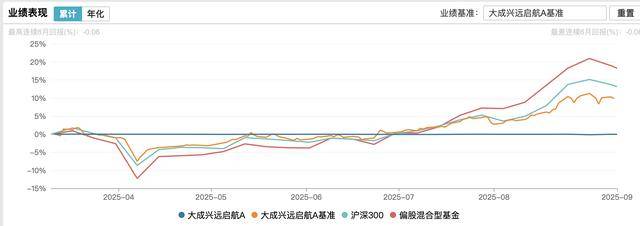
Core Viewpoint - The A-share market has shown unexpected enthusiasm since the beginning of the year, with many active equity funds recovering and achieving significant returns, while the newly established fund, Dachen Xingyuan Qihang, managed by Xu Yan, has remained inactive, leading to widespread controversy and questioning of its strategy [1][2][4]. Fund Performance - Dachen Xingyuan Qihang was established on March 11, 2025, but its net value has barely changed, with A-class shares at 0.9983 and C-class shares at 0.9953 as of September 9, 2025 [2][4]. - The fund has only invested in two stocks, Antu Biology and Meituan, with a stock position of just 0.73% and cash making up 84.95% of its net value [4]. Market Reaction - Since May, market skepticism has grown regarding the fund's "zero allocation" strategy, with investors expressing frustration over missed opportunities in a rising market [4][6]. - Xu Yan acknowledged the lack of systematic investment in the mid-year report, citing significant changes in market conditions and the need for caution due to rational valuation returns [4][5]. Comparison with Peers - In contrast to Dachen Xingyuan Qihang, many newly established active equity funds have quickly completed their allocations and participated in the market rally, with some achieving net value growth exceeding 20% [5][6]. - Funds like Anxin Balanced Growth, established on the same day as Dachen Xingyuan Qihang, have seen net value increases of 20.12% this year, highlighting the stark difference in performance [6]. Industry Trends - The performance of newly established funds this year has shown a clear dichotomy, with some achieving over 50% net value growth while others have recorded losses [7][9]. - The current market environment raises questions about the viability of value investing strategies that prioritize slow and steady approaches, especially in a rapidly changing market [9].

新基遭抢购,老基忙限购!基金市场迎来一股“热旋风”
Di Yi Cai Jing Zi Xun· 2025-09-08 01:00
Core Viewpoint - The fund market is experiencing a surge in activity, with a significant influx of new funds and a notable increase in investor confidence, leading to both new fund launches and restrictions on existing high-performing funds [1][2][5]. Group 1: Fund Market Activity - In the first week of September, 38 new funds were launched, raising a total of 27.573 billion yuan, with over 88% of this amount coming from equity products [2][3]. - A standout product, the招商均衡优选基金, achieved a record-breaking first-day fundraising of at least 8.7 billion yuan, making it the first non-initiated active equity fund to sell out in one day this year [2][3]. - The overall fundraising environment has improved, with 404 new funds initiated in the third quarter, marking the highest quarterly launch count since 2022 [3][4]. Group 2: Investor Sentiment and Behavior - Investor interest in the A-share market has increased, as evidenced by a rise in inquiries about market dynamics and fund allocation advice [5][6]. - Optimism among investors is growing, driven by the market's upward movement and supportive policies, although some analysts caution that the market sentiment has not yet reached overheating levels [5][6]. - Despite the positive sentiment, there are indications of accumulated risks in the micro-structural aspects of the market, prompting some funds to impose purchase limits to manage inflows [4][6]. Group 3: Market Trends and Predictions - The current market trend shows a strong performance in certain sectors, particularly in AI-related themes, while other thematic sectors have seen limited opportunities [7]. - Analysts predict that the market may shift towards cyclical assets as it approaches an upward turning point in the third quarter [6].
爆款单品亮点纷呈公募积极寻找规模抓手
Zhong Guo Zheng Quan Bao· 2025-09-07 20:52
Core Insights - The public fund industry is experiencing a fee reduction trend, yet over half of the fund managers achieved year-on-year growth in management fee income in the first half of 2025, indicating resilience and adaptation to market pressures [1][2][7] - Leading institutions like GF Fund and Fortune Fund have diversified their product offerings and optimized their product structures, resulting in significant scale highlights across various business types [2][3][4] - The success of specific products, such as ETFs and actively managed funds, has been pivotal in driving growth, with notable increases in assets under management and management fees [3][5][6] Group 1: Fund Performance and Growth - More than half of public fund managers reported a year-on-year increase in management fee income, particularly GF Fund and Fortune Fund, which leveraged their diverse product structures to withstand fee reduction pressures [2][3] - GF Fund's ETFs, including the GF Nasdaq 100 ETF and GF Hong Kong Innovation Drug ETF, saw substantial growth, with the latter achieving a nearly 90% return rate and increasing its scale by over 84 billion [3][4] - Fortune Fund's products, such as the Fortune China Securities Hong Kong Internet ETF, also experienced significant growth, with management fee income increasing by over 10 million [4][5] Group 2: Market Trends and Strategies - The trend of multi-asset allocation is gaining traction, with gold ETFs like Huaan Gold ETF seeing a surge in popularity, contributing significantly to management fee income [5][6] - Active equity funds are also finding success, with products like Yongying Advanced Manufacturing and Penghua Carbon Neutrality achieving remarkable performance and attracting a large number of new investors [6][7] - Industry experts suggest that public fund managers need to enhance their research capabilities, optimize product structures, and improve customer service to maintain competitiveness in a changing market [7][8]
ETF-FOF,迎来井喷!
Zhong Guo Ji Jin Bao· 2025-09-07 15:08
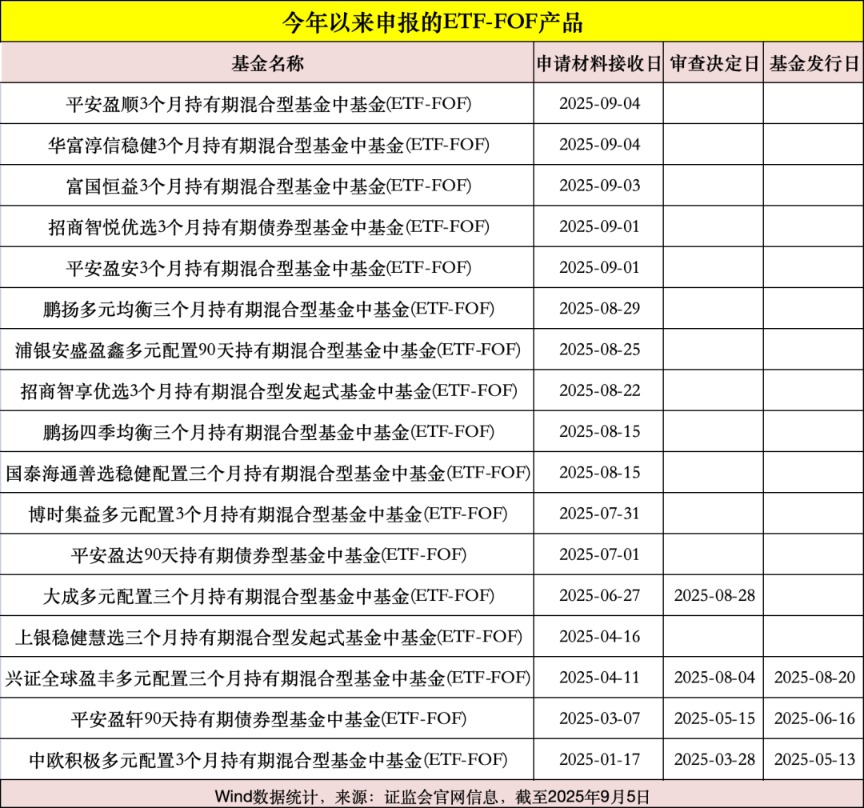
Group 1 - The core viewpoint is that public funds are increasing their layout of ETF-FOF products in response to the market recovery and the expansion of ETF scale, which has surpassed 5 trillion yuan [1][3][4] - A total of 17 ETF-FOF products have been reported by 12 public funds this year, with 5 products reported since September, indicating a growing interest in this investment vehicle [1][3][4] - The rapid development of ETFs, with over 1,200 products and a scale exceeding 5 trillion yuan, provides a solid foundation for the operation of ETF-FOF products [3][4] Group 2 - ETF-FOF is a subcategory of FOF that focuses on passive index fund allocation, with over 80% of non-cash underlying assets allocated to ETFs [3][4] - The advantages of ETFs over actively managed funds include lower fees, better liquidity, transparency, and style consistency, which enhance the interpretability and manageability of FOF products [4][6] - The recent surge in ETF-FOF product applications is attributed to the maturity of ETF development, which covers various types and risk levels, providing ample market conditions and investment targets [4][6] Group 3 - As an innovative product, domestic ETF-FOF has gradually matured after a period of pilot testing, with the Shanghai Stock Exchange promoting the listing of FOF applications since August 2021 [6][7] - As of September 7, there are 28 FOF-LOF products in the market, including several ETF-FOF products that have shown good performance since their establishment [6][7] - The management of FOF that allocates to ETFs requires strong macroeconomic analysis skills and market insight, as well as the ability to adjust asset allocation ratios based on market dynamics [7][8]
ETF-FOF,迎来井喷!
中国基金报· 2025-09-07 15:04
Core Viewpoint - The public fund industry in China is intensifying its layout of ETF-FOF products, with 17 products reported this year, reflecting a recovery in market conditions and an increase in ETF scale exceeding 5 trillion yuan [2][4][5]. Group 1: ETF-FOF Product Applications - In September alone, five ETF-FOF products were reported, including those from Ping An, Huafu, and Fuguo [5]. - A total of 17 ETF-FOF products have been reported by 12 public funds this year, with 12 of these applications occurring in the second half of the year [5][6]. - The first half of the year saw five products established, with their scales being 548 million yuan and 599 million yuan respectively [5]. Group 2: Market Conditions and ETF Growth - The rapid development of ETFs has provided a solid foundation for the operation of ETF-FOF products, with over 1,200 ETF products and a total scale exceeding 5 trillion yuan [6]. - ETFs offer significant advantages over actively managed funds in terms of fees, liquidity, transparency, and style sustainability, enhancing the manageability of FOF products [6][9]. Group 3: Development of ETF-FOF Products - The ETF-FOF segment has matured after a period of pilot testing, with the Shanghai Stock Exchange promoting the listing of FOFs to provide liquidity and exit channels for investors [8]. - As of September 7, there are 28 FOF-LOF products in the market, including several ETF-FOF products that have shown good performance since their establishment [8]. Group 4: Management Challenges and Skills - Managing FOFs that allocate to ETFs requires strong macroeconomic analysis and market insight, as well as the ability to adjust asset allocation based on market dynamics [9]. - Fund managers need to possess skills in portfolio optimization and risk control to navigate market volatility effectively [9].

这类主题基金,最猛狂赚123%!
中国基金报· 2025-09-07 15:04
Core Viewpoint - The Beijing Stock Exchange (BSE) has become a crucial force in supporting the development of new productivity over its four years of establishment, serving as a primary platform for innovative small and medium-sized enterprises (SMEs) [3][5]. Group 1: Achievements in Supporting Innovative SMEs - The BSE has successfully nurtured high-quality "specialized, refined, unique, and innovative" enterprises across various sectors, significantly contributing to the innovation and development of the real economy [5][6]. - The number of listed companies on the BSE has reached 274, with a total market capitalization exceeding 900 billion, and nearly 80% of these companies are SMEs [6][7]. - The BSE has filled the gaps between other major boards, providing multi-tiered capital market financing support for enterprises at different stages and with varying financing needs [5][6]. Group 2: Market Liquidity and Investor Structure - The average daily trading volume on the BSE has significantly increased, with daily turnover reaching nearly 30 billion in the first eight months of the year, far exceeding the previous year's average of less than 10 billion [10][7]. - The investor base has expanded, with over 9 million qualified investors now participating, including a growing proportion of institutional investors such as social security funds and insurance capital [10][11]. - The BSE has transitioned to a diversified investor group, with institutional investors leading and professional individual investors actively participating [11][10]. Group 3: Performance of Themed Funds - The average net value growth rate of BSE-themed funds has approached 60% this year, with some funds achieving over 123% growth [13][15]. - The strong performance of these funds is attributed to ongoing policy support, market confidence recovery, and a rise in risk appetite [18][19]. - Thematic funds have benefited from the valuation recovery of listed companies and their performance growth, indicating a favorable investment environment [19][18]. Group 4: Future Development and Challenges - The BSE is entering a "dual-index" era with the launch of the North Certificate Specialized and New Index alongside the North Certificate 50 Index, enhancing investment tools and opportunities [25][24]. - Despite significant progress, challenges remain, including the need for improved institutional frameworks, investor education, and the introduction of more high-quality enterprises to sustain growth [29][30]. - The BSE aims to enhance its attractiveness and service capabilities by optimizing listing mechanisms and increasing the participation of long-term funds [30][29].

新基遭抢购,老基忙限购
第一财经· 2025-09-07 12:34
Core Viewpoint - The fund market is experiencing a surge in activity, with new funds being launched and significant inflows, indicating a recovery in investor confidence and interest in equity funds [2][4][9]. Group 1: Fund Market Activity - In the first week of September, 38 new funds were established, raising a total of 27.573 billion yuan, with over 88% being equity products [4][5]. - A notable highlight is the "daylight fund" launched by招商均衡优选, which raised over 8.7 billion yuan on its first day, becoming the first non-initiated active equity product to sell out in one day this year [5][6]. - The overall fundraising efficiency has improved, with 404 new funds starting subscriptions in the third quarter, marking a peak since 2022 [6]. Group 2: Investor Sentiment - Investor interest in the A-share market has increased, as evidenced by a rise in inquiries about market dynamics and fund allocation suggestions [9]. - Optimism is spreading among investors, driven by the market's upward movement and supportive policies, although some analysts caution that the market sentiment has not yet reached overheating levels [9][10]. - Despite the positive sentiment, there are concerns about potential risks accumulating in the micro-structure of the market due to the strong performance of certain sectors [10]. Group 3: Market Trends and Adjustments - Recent market adjustments are attributed to short-term behaviors of funds, which may lead to a more stable market in the long run [11][12]. - Observations indicate that certain sectors, particularly those related to AI, have seen concentrated trading activity, while other thematic sectors have had limited opportunities [12].

从新发“日光基”到绩优“限购令”,市场现在“热不热”?
Di Yi Cai Jing· 2025-09-07 11:32
Group 1 - The fund market is experiencing a surge in activity, with 38 new funds launched in the first week of September, attracting a total of 27.5 billion yuan, primarily in equity products [1][2] - A notable highlight is the launch of the "Zhaoshang Balanced Optimal Fund," which achieved over 8.7 billion yuan in subscriptions on its first day, making it the first non-initiated active equity fund to sell out in one day this year [2][3] - Investor interest in the A-share market has increased, as evidenced by a rise in inquiries about market dynamics and fund allocation advice, indicating a recovery in investor confidence [1][6] Group 2 - The performance of equity funds has significantly improved, with 34 equity funds launched in a short span, raising 24.3 billion yuan, which constitutes over 88% of the total new fund issuance [2][3] - The number of new funds launched in the third quarter has reached a peak not seen since 2022, with 404 new funds initiated, and 93 funds opting for early closure due to high demand [3][4] - Some high-performing existing funds have had to impose purchase limits due to overwhelming inflows, such as the Yongying Technology Smart Selection Fund, which reduced its daily purchase limit from 1 million yuan to 10,000 yuan [4][5] Group 3 - Market sentiment remains optimistic, driven by the upward trend in the A-share market and supportive policies, although there are differing views among institutions regarding the sustainability of this sentiment [6][7] - Analysts suggest that while there is a positive outlook, caution is advised due to the accumulation of risks in the micro-structural level of the market [7][8] - The "AI+" sector has emerged as a key focus, with significant trading activity, while other thematic sectors have seen limited opportunities this year [8]
南下资金,创纪录!最新研判:牛市行情仍在
Zhong Guo Ji Jin Bao· 2025-09-07 11:10
Group 1 - Recent inflow of southbound funds into Hong Kong stocks has reached a record high, with net inflow exceeding 1 trillion HKD this year, marking a significant increase compared to last year's total [2][3] - The continuous inflow of southbound funds is expected to change and optimize the investment structure and valuation logic of the Hong Kong stock market, with technology and consumer sectors now dominating market capitalization [4][5] - The current market environment is characterized by a rotation in investment preferences, with southbound funds showing a clear preference for high dividend, low valuation, and high growth sectors [5][6] Group 2 - Despite recent market corrections, analysts believe that the fundamentals for a bull market in Hong Kong stocks remain intact, with the market undergoing a phase of value reassessment [7][8] - The Hong Kong IPO market has been robust, with 50 new stocks listed this year, raising over 128 billion HKD, which has attracted both southbound and foreign capital [3][4] - The shift in the dominance of southbound funds from retail to institutional investors has enhanced the professional investment capabilities and value discovery in the market [4][5]
“基金买手”持仓曝光!两大板块成“心头好”
券商中国· 2025-09-07 10:54
Core Viewpoint - The article highlights the increasing reliance of Funds of Funds (FOFs) on index-based tools, particularly ETFs, for asset allocation, reflecting a trend towards diversification and tool-based management in the current market environment [2][5]. Group 1: FOF Holdings Characteristics - In the first half of the year, FOFs have shown a pronounced preference for index-based tools, with a significant concentration in technology and commodity-themed ETFs [2][3]. - Specific ETFs such as the Huaxia Hang Seng Technology ETF and the Huaan Gold ETF have been widely held by multiple FOFs, indicating a trend towards diversified investment strategies [3][4]. - The Huaan Gold ETF has emerged as the most held fund by FOFs, being included in 228 FOF portfolios, showcasing its broad appeal [3]. Group 2: Performance and Strategy - Recent performance of FOFs has been strong, with many products achieving notable returns attributed to their investments in technology, commodities, and healthcare-themed ETFs [3][4]. - The shift towards equity and commodity ETFs is seen as a natural response to market conditions and reflects the evolution of FOF products [5]. - The use of ETFs allows FOFs to quickly adjust their portfolios in response to market volatility, enhancing their ability to capture opportunities and manage risks effectively [5][7]. Group 3: Investment Logic and Trends - The investment logic of FOFs is transitioning from a "timing-driven" approach to a "multi-factor balanced" strategy, recognizing the cyclical nature of asset performance [6]. - FOFs are increasingly utilizing ETFs to achieve a balance between growth-oriented sectors and risk-hedging through commodity investments, thereby reducing overall portfolio volatility [7]. - The trend of leveraging ETFs for flexible asset allocation is becoming a significant characteristic of FOF operations, aligning with international investment practices [5][7].