大疆

Search documents
探索跨境“来数加工”,东莞竞逐高端数据标注新赛道
2 1 Shi Ji Jing Ji Bao Dao· 2025-12-05 06:27
Core Insights - The establishment of the Dongguan Data Annotation Industrial Park marks a significant step in enhancing the data annotation industry, which is crucial for AI model training and applications in advanced fields like autonomous driving [1][2] - Dongguan is positioning itself as a hub for high-end data annotation, leveraging its industrial strengths and aiming to attract over 50 data companies and create more than 30 high-quality datasets within three years [2][6] - The data annotation industry is evolving from labor-intensive processes to high-tech, knowledge-intensive applications, with a growing demand for skilled data annotators [3][4] Industry Overview - Data annotation is essential for AI systems, with data, algorithms, and computing power being the three core elements [1] - The industry is transitioning from simple manual annotation to complex, high-value applications, particularly in industrial manufacturing, which is currently a national shortfall [2][4] - The demand for high-quality, specialized data annotation is increasing, especially with the rise of large AI models and the need for precise, efficient data processing [4][5] Regional Development - Dongguan is actively developing its AI application pilot base and data industry cluster, focusing on high-quality data annotation to extract value from vast industrial data [1][6] - The Dongguan Data Annotation Industrial Park is supported by significant investments and partnerships with major companies like Baidu and China Telecom, aiming to create a comprehensive data annotation ecosystem [6][8] - The region benefits from a rich talent pool, with approximately 176,500 university students and over 20,000 graduates in AI and big data fields annually [7] Strategic Initiatives - The park aims to provide substantial support to enterprises through rent reductions and talent subsidies, fostering collaboration with local industries [5][6] - The establishment of specialized data annotation bases by Baidu and China Telecom is set to enhance the capabilities of local companies in high-end data annotation [6][8] - The introduction of advanced technologies and platforms for data annotation is expected to create a differentiated, intelligent, and high-level data annotation capacity in Dongguan [8]


IDC:前三季度全球智能扫地机器人市场累计出货1742.4万台 同比增长18.7%
智通财经网· 2025-12-05 05:45
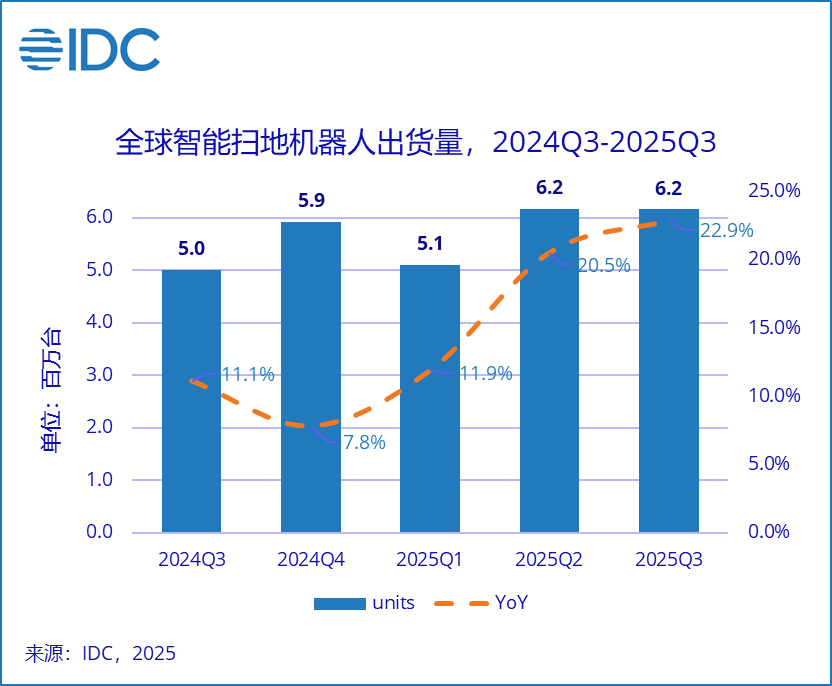
Global Market Overview - The global smart vacuum cleaner market shipped a total of 17.424 million units in the first three quarters of 2025, representing a year-on-year growth of 18.7%, with 6.161 million units shipped in Q3 alone, marking a 22.9% increase [1] - The Middle East, Africa, and Europe have emerged as key growth drivers for the industry [1] Company Performance - Stone Technology (688169.SH) led the global shipment with 3.788 million units in the first three quarters, showing strong performance in the U.S., Germany, South Korea, and Turkey, where it maintained the top position [4] - Ecovacs (603486.SH) shipped 2.453 million units in the first three quarters, achieving a year-on-year growth of 27.7%, and retained the top position in the Chinese market [5] - Dreame ranked first in the European market in the first three quarters, with a market share of 26.8% in Western Europe, although it faced a noticeable decline in its domestic market share [6] - Xiaomi (01810) continues to focus on mid-range value-for-money products while expanding into high-end product lines, performing well in domestic and Asia-Pacific markets [7] - Yunji's global shipment volume ranked among the top five, with significant growth in the U.S. and Asia-Pacific markets, while maintaining a 16.2% market share in the domestic market [8] Chinese Market Insights - The Chinese smart vacuum cleaner market shipped 4.63 million units in the first three quarters, with a year-on-year increase of 27.2%, indicating sustained industry growth [10] - Despite fluctuations in national subsidy policies, leading manufacturers have effectively countered these impacts through product upgrades and AI integration, maintaining steady market growth [10] - The market is experiencing increased competition, with DJI entering the market in August and ranking sixth in shipments, adding new competitive dynamics [10] - The industry faces significant inventory pressure, posing challenges for manufacturers in inventory turnover, profit management, and future product planning [10] Industry Trends - IDC's senior analyst Zhao Siquan noted that the robust growth of the global vacuum cleaner market is attributed to continuous product iteration by Chinese manufacturers, enhanced channel operations, and deepened market demand [11] - Future competition in the industry is expected to escalate, focusing on AI technology empowerment and home ecosystem collaboration, with technological innovation and ecosystem integration becoming key for companies to stand out [11]


中国扫地机器人霸榜全球:石头科技登顶,大疆跨界入局
Feng Huang Wang· 2025-12-05 05:40
Core Insights - The global smart vacuum cleaner market is expected to maintain strong growth, with a significant reshaping of the competitive landscape by 2025 [1][2] - All top five global vendors in terms of shipment volume are Chinese brands, indicating China's leading position in supply chain and technology in this sector [1] Group 1: Market Performance - In the first three quarters of 2025, the global smart vacuum cleaner market shipped a total of 17.424 million units, representing a year-on-year growth of 18.7% [1] - The third quarter alone saw shipments of 6.161 million units, with a year-on-year increase of 22.9% [1] - The Middle East, Africa, and Europe are identified as key growth engines driving the industry's expansion [1] Group 2: Company Performance - Roborock ranked first globally with cumulative shipments of 3.788 million units in the first three quarters, focusing on low-profile cleaning solutions [1] - Ecovacs achieved cumulative shipments of 2.453 million units, marking a year-on-year growth of 27.7%, and is accelerating its international expansion [1] - Dreame performed notably in the European market, holding a 26.8% shipment share in Western Europe, although it faced a decline in domestic market share [1] Group 3: Market Trends and Challenges - Xiaomi is performing well in the Asia-Pacific market due to its mid-range value-for-money strategy and ecosystem advantages [2] - The Chinese market saw shipments of 4.63 million units in the first three quarters, with a year-on-year increase of 27.2% [2] - DJI has entered the vacuum cleaner market, quickly becoming the sixth largest player in China, introducing new competition and uncertainty [2] - The industry faces challenges with high inventory pressure, impacting manufacturers' inventory turnover, profit management, and future product strategies [2]

150欧免税取消,中国电商如何应战?
Sou Hu Cai Jing· 2025-12-05 02:51
Core Viewpoint - The European cross-border e-commerce market is undergoing significant changes due to new tax policies and increasing scrutiny on Chinese e-commerce platforms like SHEIN and Temu, which face challenges in expanding their market presence in Europe [1][5][19]. Group 1: Regulatory Changes - The European Council has announced the implementation of a small package tax policy, which will take effect in early 2026, eliminating the previous exemption for goods under €150 [1]. - All incoming packages will now incur customs duties, VAT, and a customs inspection fee of approximately €2, which will complicate the logistics for e-commerce platforms [1][5]. - Experts suggest that these changes will shift consumer purchasing decisions from price-driven to value and trust-oriented, increasing the operational costs for sellers due to the need for more detailed customs data [5][21]. Group 2: Market Dynamics - In 2024, the EU is expected to receive 4.6 billion low-value e-commerce packages, with 91% originating from China, equating to approximately 4.186 billion packages [7][8]. - Despite regulatory challenges, Temu and SHEIN have seen substantial user growth in Europe, with Temu's monthly active users reaching 115.7 million in the first half of 2025, a 12.5% increase from the previous year [9]. - The economic downturn in Europe, exacerbated by the Russia-Ukraine conflict, has led consumers to seek more affordable options, benefiting discount retailers and platforms like Temu and SHEIN [10][11][14]. Group 3: Consumer Behavior - European consumers are increasingly turning to discount stores and e-commerce platforms for essential goods, reflecting a shift in spending habits due to inflation and economic uncertainty [10][14]. - The disparity between wealth and poverty in Europe is growing, with many middle-class consumers feeling the pinch and opting for cheaper alternatives like SHEIN [15][16]. - The demand for affordable products is evident, as consumers express a preference for low-cost options over locally produced goods, highlighting a significant market opportunity for Chinese e-commerce [15][16]. Group 4: Strategic Responses - Some sellers are considering shifting to local e-commerce platforms to navigate the new regulatory landscape, but experts argue that this strategy may be outdated due to declining marketing budgets on these platforms [19][21]. - Sellers are still required to pay customs duties regardless of whether they ship directly from China or use local warehouses, complicating the logistics further [21]. - Temu and SHEIN are viewed as the best options for sellers due to their traffic advantages and lower commission rates compared to other platforms [21][22]. Group 5: Brand Development - The long-term solution for sellers lies in building brands rather than relying solely on low-price strategies, which are unsustainable in the European market [28][31]. - Successful brand development requires a focus on product positioning, uniqueness, and alignment with market needs, as demonstrated by the success of brands like Avril Paris [31][33]. - The rise of the Print on Demand (POD) model has shown that Chinese sellers can effectively respond to market trends and consumer demands for personalized products [29][30].

做自动驾驶VLA的这一年
自动驾驶之心· 2025-12-05 00:03
Core Viewpoint - The article discusses the evolution of autonomous driving technology, particularly focusing on the development of Vision-Language Action (VLA) models that integrate perception, language understanding, and action execution into a unified framework, enhancing the interpretability and reliability of autonomous vehicles [5][6]. Summary by Sections Development Stages of Autonomous Driving - The evolution of autonomous driving can be categorized into several stages: 1. **Modular Pipeline**: Early systems separated perception, prediction, planning, and control into distinct subsystems. 2. **End-to-End Systems**: These systems directly mapped sensor inputs to control signals but suffered from poor interpretability and reliability in unusual scenarios. 3. **Vision-Language Models (VLM)**: These models enhanced interpretability by allowing vehicles to explain their actions but still required traditional modules for execution [5][6]. Introduction of VLA Models - The VLA model emerged as a solution to the limitations of previous models by integrating visual perception, language understanding, and action generation into a single framework. This allows the vehicle to comprehend natural language commands and make informed driving decisions based on visual context [6]. Advantages of VLA Models - VLA models inherit semantic priors from large models, enabling them to handle rare or unseen scenarios by leveraging common sense reasoning. This capability allows for better risk assessment and decision-making in complex driving environments, addressing the challenges faced by traditional end-to-end models [6]. Community and Learning Resources - The article promotes a community platform for knowledge sharing in autonomous driving, offering resources such as learning routes, technical discussions, and access to industry experts. This platform aims to support both beginners and advanced practitioners in navigating the complexities of autonomous driving technology [10][12][21].

无人智能引领装备升级
2025-12-04 15:36
无人智能引领装备升级 20251204 摘要 中国将低空经济列为"十五五"规划重点,新通航(以无人机为主)占 据 80%比重。中国在全球 eVTOL 创业公司中占比显著,消费级民用无 人机市场以大疆为首,占据全球 70%份额,国内低空装备企业数量已达 1,000 家。 全球民用无人机市场预计年均增长 15%,中国增速超 20%。摩根士丹 利预测,至 2050 年全球飞行汽车市场规模将达 9 万亿美元,中国占比 23%,反映国际金融机构对中国低空经济发展的高度认可。 国家大力发展低空经济,因中国在新兴赛道如电池、电控、飞控等关键 技术上具备较强竞争力,且无人机制造门槛较低,利于大众创业。政策 层面,多部委成立领导小组,并发布《无人驾驶航空器飞行管理条例》, 简化小型无人机适航取证流程。 低空经济在城市内部应用已较成熟,如深圳的空中物流航线。全国多数 城市具备开展无人机城市运营的条件,对 5G 网络和基站等基础设施提 出更高要求,而中国在这些领域处于全球领先地位。 Q&A 无人机产业在低空经济中的地位和发展现状如何? 低空经济目前是一个非常热门的领域,而无人机相关产业则是其中最热的板块。 无人机产业的发展现状可以 ...
叫板大疆!影石“飞天”
Shang Hai Zheng Quan Bao· 2025-12-04 14:25
Core Viewpoint - The launch of the Yingshi Antigravity's Yingshi A1, the world's first panoramic drone, integrates 360-degree imaging, immersive flight perspectives, and intuitive control, marking a significant innovation in the drone industry [2]. Product Launch and Sales - The Yingshi A1 is officially available for purchase, with three versions: standard, standard with extended battery, and long battery life, priced at 7999 RMB, 9399 RMB, and 9999 RMB respectively, with promotional prices of 6799 RMB, 7999 RMB, and 8499 RMB during the sales period [2]. - The drone is available on multiple platforms including the Yingshi official website, Tmall, JD.com, and Douyin [2]. Technological Innovations - The Yingshi A1 features the Vision flight glasses with a lightweight design of 340 grams, offering a continuous usage time of up to 150 minutes, enhancing the immersive flying experience [6]. - The Grip motion controller allows for intuitive "point and fly" operation, catering to both novice and advanced users, with a full FPV mode available for experienced pilots [6][8]. - The OmniLink 360 panoramic transmission system enables real-time synchronization of flight perspectives, with a maximum transmission distance of 10 kilometers under FCC standards [7]. Enhanced User Experience - The A1 includes features like flight path planning and a virtual cockpit, enhancing user engagement and immersion during flight [8]. - The drone's dual-lens panoramic imaging system captures 8K30fps, 5.2K60fps, or 4K100fps video, allowing users to focus on flying while automatically recording the surrounding environment [11]. - The A1's lightweight design (249 grams) meets most global regulations for simplified flight, with a standard battery life of approximately 24 minutes, extendable to 39 minutes with a long battery [11]. Safety and Control Features - The drone is equipped with an intelligent obstacle avoidance system, ensuring safe operation even for first-time users in complex environments [12]. - The A1's smart tracking feature allows for automatic subject locking and stabilization, providing a professional-level filming experience without the need for extensive training [14]. Software Ecosystem - The Yingshi A1 supports a complete software ecosystem, including the Antigravity App and Antigravity Studio, facilitating material transfer, intelligent cropping, color processing, and AI editing [14].

影石发布无人机新品,与大疆全面开打!CEO刘靖康:最大的幸运和不幸都是赛道上有大疆
Sou Hu Cai Jing· 2025-12-04 13:57
Core Viewpoint - The launch of the Antigravity A1, the world's first 8K panoramic drone by Yingstone Innovation, signifies a competitive escalation between Yingstone and DJI in the panoramic camera and drone markets [1][3]. Group 1: Product Launch and Features - Yingstone Innovation held a launch event for its first product, the Antigravity A1, which is the world's first 8K panoramic drone [1]. - The Antigravity A1 is available in three configurations: standard version, standard endurance with three batteries, and long endurance with three batteries, with the standard package priced at 6,799 yuan [1]. - The drone weighs 249 grams, complying with simplified flight regulations in most regions, and has a standard battery life of approximately 24 minutes, extendable to about 39 minutes with a long endurance battery [1]. Group 2: Competitive Landscape - The competition between Yingstone and DJI has intensified this year, with both companies actively engaging in product line confrontations [3]. - In November, a dispute over an exclusive agreement led to the removal of a sign at a Yingstone authorized experience store, highlighting the rivalry in ground channels [3]. - DJI initiated a large-scale price reduction campaign in October, marking the first price drop for its Osmo Pocket 3 since its launch, prompting Yingstone to respond with a 100 yuan voucher for customers who purchased DJI products during a specific period [3]. Group 3: Pricing Strategies - Currently, DJI's first panoramic camera, the Osmo 360, is priced around 2,700 yuan, which is over 200 yuan cheaper than Yingstone's flagship panoramic camera, the Insta 360 X5 [4]. - In response to DJI's pricing strategy, Yingstone is countering with the launch of its 8K panoramic drone, while reports suggest DJI is planning to integrate the Osmo 360 with its drones to create a new panoramic drone product expected to be released by the end of the year [4]. Group 4: Company Perspectives - Yingstone's CEO, Liu Jingkang, acknowledges the competitive pressure from DJI, stating that while it poses challenges, it also drives innovation within the industry [5]. - Liu expressed that the decision to enter the drone market five years ago was made with the anticipation of stimulating competitors to enhance their panoramic camera offerings [5].
家电ETF(159996)连续3日迎资金净流入,智能影像行业迎二次成长
Mei Ri Jing Ji Xin Wen· 2025-12-04 08:15
Core Viewpoint - The smart imaging industry is entering a new growth phase characterized by accelerated entry of new players, a shift from hardware competition to ecosystem competition, diversification of product forms, and integration of functions [1] Group 1: Industry Growth - The smart imaging industry is experiencing a new growth stage, marked by the entry of new players and increased competition [1] - DJI's involvement is driving product innovation and enhancing consumer awareness, leading to accelerated market expansion [1] - The product definition and innovation capabilities of companies like Yingshi are core advantages in maintaining leadership during this new phase [1] Group 2: ETF and Market Performance - The home appliance ETF (159996) has seen net inflows for three consecutive days, indicating positive investor sentiment [1] - The ETF tracks the home appliance index (930697), which reflects the overall performance of publicly listed companies in the home appliance manufacturing and sales sector [1] - The index exhibits strong consumer attributes and cyclical characteristics, providing a comprehensive view of the development status of China's home appliance industry [1]
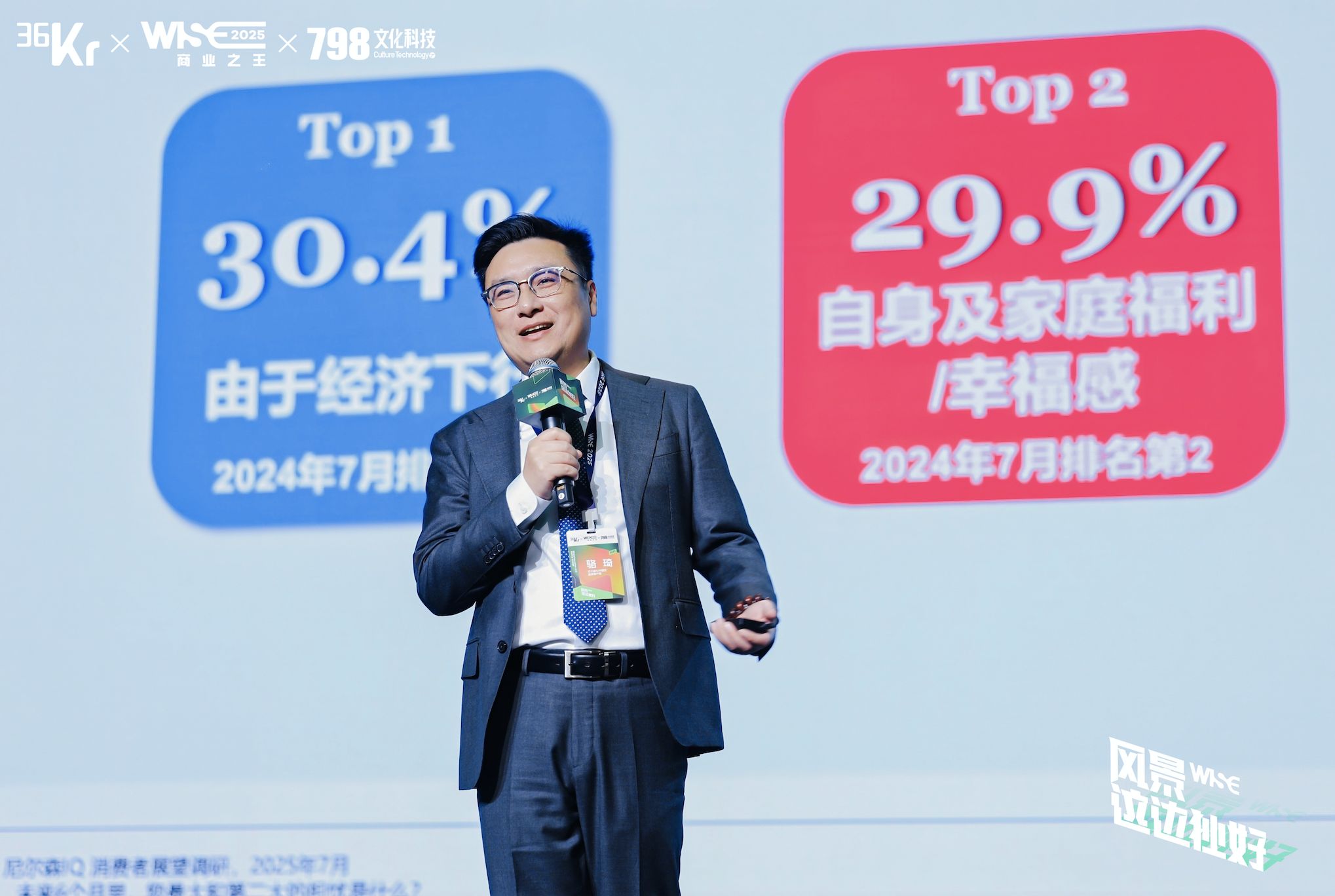
尼尔森 IQ 中国区首席客户官骆琦:“体验”成为未来推动消费的重要力量,不同世代消费者都愿意为“活得更好”买单丨WISE2025商业之王大会
3 6 Ke· 2025-12-04 07:57
Core Insights - The WISE 2025 Business King Conference aims to anchor the future of Chinese business amidst uncertainty, focusing on the theme "The Scenery Here is Unique" [1][2] Consumer Behavior - Global consumer confidence is declining, but Chinese consumer confidence is improving, although their continuous consumption ability is hindered [4][8] - Chinese consumers are less focused on promotions and pricing, with experience becoming a key driver for consumption [4][10] - Different generations exhibit varying consumption behaviors, with Baby Boomers and Generation Y being the most willing to spend, while Generation Z and affluent Generation X are more cautious [4][12] Generational Insights - Baby Boomers (60+) are redefining aging, showing a willingness to try new products and use AI for shopping, with 83% open to AI assistance [13][14] - Generation X (45-59) is pragmatic and financially savvy, with 37% being budget-conscious and preferring local brands [16][19] - Generation Y (29-44) prioritizes experience over products, with 70% willing to pay for better experiences and 81% favoring quick delivery services [20][21] - Generation Z (18-28) is divided, with 31% eager to spend while 34% are financially constrained, focusing on products that resonate with their social circles [22][23] Market Opportunities - The aging population presents new business opportunities, as older consumers seek to enhance their quality of life and are open to innovative products [14][15] - Companies need to adapt their strategies to cater to the unique needs of different generations, emphasizing product quality, experience, and effective communication [23]