
博通

Search documents
中国资产爆发,热门中概股普涨!美联储官员再对降息表态!
Sou Hu Cai Jing· 2026-02-07 08:15
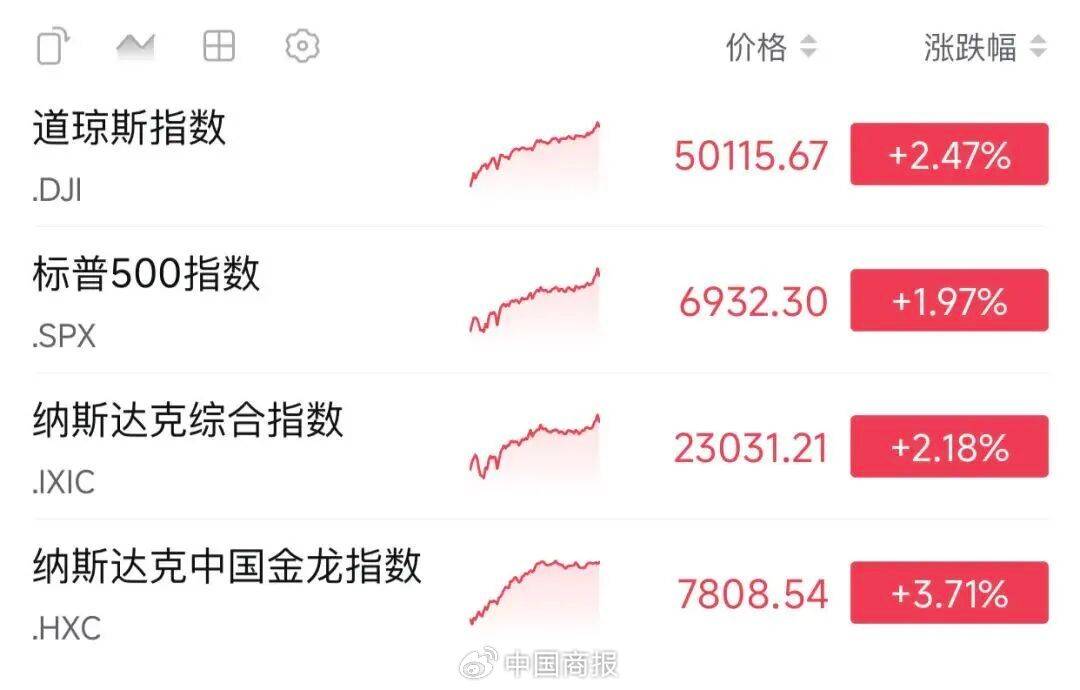
Group 1: Market Performance - The US stock indices experienced significant gains, with the Dow Jones rising by 2.47%, surpassing 50,000 points for the first time, and the S&P 500 increasing by 1.97%, marking its largest single-day gain since May of the previous year [1][3] - The Nasdaq China Golden Dragon Index surged by 3.71%, closing at 7808.54 points, indicating strong performance among Chinese concept stocks [1] Group 2: Technology Sector Insights - Major technology stocks saw widespread increases, with Nvidia rising nearly 8% and Broadcom over 7%, while Amazon fell over 5% [3] - Nvidia's CEO highlighted the "incredible" demand for artificial intelligence (AI), stating that AI companies are likely to significantly increase their investments as they become profitable [3] Group 3: Consumer Confidence and Economic Indicators - The University of Michigan reported a preliminary consumer confidence index of 57.3 for February, up from 56.4 in January, but still below the previous year's level [4][5] - The current economic conditions index rose to 58.3, while inflation expectations for the next year decreased from 4.0% to 3.5%, the lowest since January 2025 [5]

2025年唯一盈利的射频前端芯片公司
是说芯语· 2026-02-07 08:00
Core Viewpoint - The article highlights the performance of A-share listed companies in the chip design sector, particularly focusing on the profitability and growth of certain companies in 2025, with a notable emphasis on Weijie Chuangxin as the only profitable company in the RF front-end chip segment [4][23]. Summary by Sections 2025 Earnings Forecast - In January, A-share listed companies began releasing their 2025 earnings forecasts, with 45 chip design companies predicting revenue growth, and 39 of them expecting positive growth [4]. - Among 75 companies forecasting net profit attributable to shareholders, 49 anticipate positive growth, with 28 companies reporting a turnaround from losses to profits [4]. Notable Companies - Sixteen companies are expected to see net profit growth exceeding 100%, with Weijie Chuangxin leading the RF front-end segment [4][5]. - Weijie Chuangxin's net profit is forecasted to grow by 289.67%, making it the only profitable company in the RF front-end sector for 2025 [9][19]. Industry Challenges - The RF front-end sector faces challenges with stagnant demand and intense competition, making profitability difficult for many companies [6][8]. - Other companies in the RF front-end space, such as Zhuoshengwei and Angruiwei, are struggling with profitability despite some revenue growth [8]. Weijie Chuangxin's Success Factors - Weijie Chuangxin's profitability is attributed to advancements in three key markets: high-integration L-PAMiD modules, automotive-grade products, and WiFi7 products [11][13]. - The company has established strong partnerships with major platform chip manufacturers like MediaTek, which has significantly contributed to its market position and innovation capabilities [18][19]. Future Prospects - The article suggests that Weijie Chuangxin's focus on technology innovation and its unique position in the RF front-end market could lead to further growth opportunities in emerging areas such as satellite communication, 6G, and AI applications [26][24].

重大信号!瑞银集团,批量减持明星科技股!
证券时报· 2026-02-07 02:10
Core Viewpoint - UBS Group significantly reduced its holdings in major tech stocks during the fourth quarter of last year, with only a slight increase in Meta among the "Magnificent 7" tech stocks [1][3]. Group 1: Holdings and Changes - UBS disclosed a 5.65% decrease in the market value of its securities, totaling $616.68 billion as of the end of 2025 [1]. - The top five holdings of UBS include Nvidia ($14.45 billion), Microsoft ($13.56 billion), Apple ($12.11 billion), Broadcom ($8.23 billion), and Amazon ($7.99 billion), collectively accounting for 14.52% of the investment portfolio [3]. - In Q4, UBS reduced its holdings in Nvidia by 10.47% (10.04 million shares), Apple by 10.57% (5.27 million shares), Microsoft by 7.64% (2.32 million shares), Google by 9.05% (2.21 million shares), Amazon by 4.57% (1.66 million shares), and Tesla by 15.09% (0.71 million shares) [3]. Group 2: Financial Performance - UBS reported Q4 total revenue of $12.1 billion, exceeding the previous year's $11.6 billion and meeting analyst expectations [6]. - The net profit attributable to shareholders increased by 56% year-over-year to $1.2 billion, surpassing the analyst estimate of $919 million [6]. - Wealth management business saw a net inflow of $8.5 billion, significantly lower than the expected $27.4 billion, with a notable outflow of $14.1 billion from the U.S. wealth management sector [6]. Group 3: Future Outlook - UBS's CEO indicated that net new assets in the Americas wealth management division are expected to turn positive in 2026, although challenges are anticipated in the first half of 2026 [7]. - UBS's investment banking division contributed significantly to the overall profit, with a 34% increase in operating profit driven by market volatility [7].

道指收盘首次站上5万点,芯片股集体反弹,金龙指数涨3.7%
Di Yi Cai Jing Zi Xun· 2026-02-07 00:55
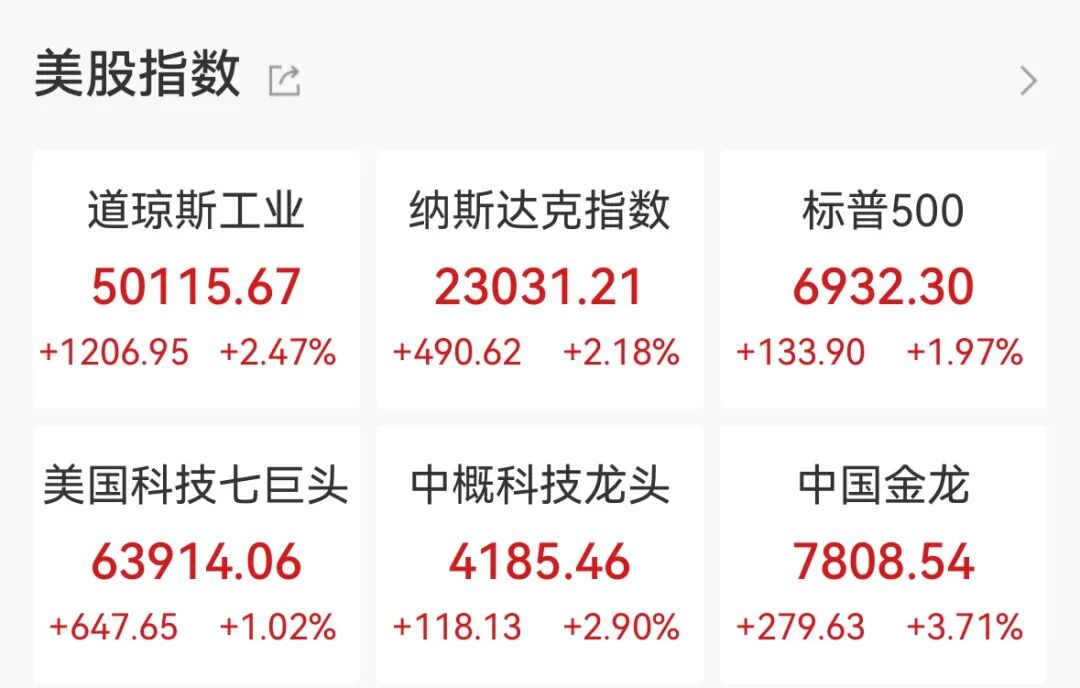
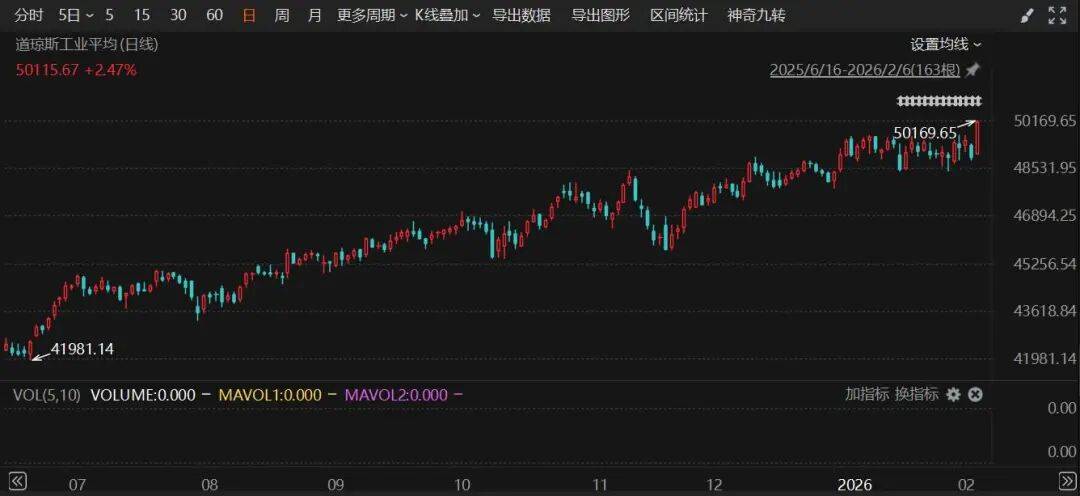
Market Overview - The US stock market experienced a significant rebound on Friday, with the S&P 500 and Nasdaq indices recovering from three consecutive days of decline, while the Dow Jones Industrial Average closed above 50,000 points for the first time in history [2][3] - The Dow Jones Industrial Average rose by 2.47% to close at 50,115.67 points, marking a record high; the S&P 500 increased by 1.97% to 6,932.30 points; and the Nasdaq Composite gained 2.18% to 23,031.21 points [2][3] - The Russell 2000 index, which reflects small-cap stock performance, surged by 3.6% [2] Sector Performance - Among the 11 sectors in the S&P 500, 9 sectors saw gains, with the Information Technology sector leading with a 4.1% increase, followed by the Industrial sector at 2.84% [3] - The Energy, Industrial, and Consumer Staples sectors reached new historical highs, with the S&P 500 Energy Index also setting a record [3] Weekly Performance - For the week, the Dow Jones rose by 2.5%, while the S&P 500 was nearly flat with a slight decline of 0.1%, and the Nasdaq fell by 1.9% [3] Notable Stock Movements - Nvidia saw a significant increase of 7.87% after a prior decline of 10.72% over five consecutive days; Tesla rose by 3.50%, Apple by 0.80%, and Microsoft by 1.90% [4][5] - Conversely, Amazon's stock dropped by 5.6%, impacting the overall gains of the three major indices due to investor concerns over a projected 50% increase in capital expenditures for the year [4][5] - Chip stocks collectively strengthened, with expectations of benefiting from increased capital investments in AI data centers by Amazon and Google [4] Chinese Stocks Performance - The Nasdaq Golden Dragon China Index rose by 3.71%, with notable increases in Alibaba (3.01%), Pinduoduo (3.65%), NIO (7.23%), Baidu (5.02%), JD.com (2.75%), and Tencent (2.33%) [6] Economic Indicators - The upcoming non-farm payroll report for January has been postponed due to a government shutdown, with economists predicting an addition of approximately 70,000 jobs and an unemployment rate of 4.4% [8] - Federal Reserve Vice Chairman Jefferson expressed a cautiously optimistic outlook for the economy in 2026, anticipating growth slightly above trend levels and a gradual return of inflation to the 2% target [8] Bond Market - The two-year US Treasury yield rose by 1.5 basis points to 3.498%, while the ten-year yield remained stable at 4.21% [9] Commodity Market - Oil prices increased, with Brent crude closing at $68.05 per barrel and US crude at $63.55 per barrel [10] - Gold prices rebounded, with spot gold rising by 3.9% to $4,954.92 per ounce, while silver saw an 8.6% increase [10]

道指首破5万点创历史!芯片股集体爆发、英伟达大涨7.87%,中概股强势反弹金龙指数大涨3.71%,黄金白银暴力拉升,市场情绪全面逆转
Jin Rong Jie· 2026-02-07 00:25
Group 1: Market Overview - The Dow Jones Industrial Average reached a historic milestone by closing above 50,000 points for the first time, ending at 50,115.67 points, a 2.47% increase, marking a new era for the U.S. stock market [1] - All three major U.S. stock indices rose, with the Nasdaq up 2.18% and the S&P 500 gaining 1.97%, achieving their best performance in recent times [3] - The Philadelphia Semiconductor Index surged by 5.7%, driven by strong performances from key companies like NVIDIA, which saw a 7.87% increase, adding approximately $325 billion to its market capitalization [3] Group 2: Technology Sector Performance - The technology sector emerged as the core driver of the recent market rally, with significant gains in semiconductor stocks reflecting optimism about AI hardware demand [4][5] - Other tech giants showed mixed results; Tesla rose by 3.5%, while Amazon fell by 5.6% following the announcement of a $200 billion capital expenditure plan [4][6] - Despite some concerns regarding AI investments, the overall sentiment in the tech sector remains positive, with analysts emphasizing the sustainability of AI-related expenditures [3][6] Group 3: Global Market Reactions - Chinese assets performed notably well, with the Nasdaq Golden Dragon China Index rising by 3.71%, indicating renewed investor confidence in Chinese tech companies [6] - The demand for safe-haven assets surged, with gold prices increasing nearly 4% and silver prices rising by 9.7%, driven by shifts in Federal Reserve policy and market preferences [7] - The cryptocurrency market also experienced a strong rebound, with Bitcoin surpassing $70,000 and other cryptocurrencies like Ethereum and Dogecoin rising over 10% [8]

道指收盘首次站上5万点,英伟达大涨近8%,芯片股集体反弹,金龙指数涨3.7%
Di Yi Cai Jing· 2026-02-07 00:24
Core Viewpoint - The U.S. stock market experienced a strong rebound, with the Dow Jones Industrial Average surpassing 50,000 points for the first time, driven by gains in financial and cyclical stocks [1][2]. Market Performance - The Dow Jones Industrial Average closed up 2.47% at 50,115.67 points, marking a historic high; the S&P 500 rose 1.97% to 6,932.30 points; and the Nasdaq Composite increased by 2.18% to 23,031.21 points [1]. - The Russell 2000 index, which reflects small-cap stocks, surged by 3.6% [1]. - The S&P 500 index saw 9 out of its 11 sectors rise, with the Information Technology sector leading with a 4.1% increase [2]. Sector Highlights - The Energy, Industrial, and Consumer Staples sectors reached new historical highs, with the S&P 500 Energy Index also setting a record [2]. - Chip stocks collectively strengthened, with Nvidia rebounding by 7.87% after a previous decline, and other semiconductor companies like AMD and Broadcom also showing significant gains [3][4]. Notable Stock Movements - Nvidia's stock rose significantly after a five-day decline, while Amazon's stock fell by 5.6% due to concerns over a projected 50% increase in capital expenditures [3][4]. - Other major tech stocks like Tesla and Microsoft also saw gains, while Google and Meta experienced declines [3][4]. Broader Market Trends - The market breadth improved as funds shifted from previously high-performing tech stocks to underperforming sectors [6]. - Caterpillar was a key driver in the Dow's performance, with its stock up over 26% year-to-date, benefiting from expectations of lower borrowing costs and fiscal stimulus [6][7]. Economic Indicators - Over 80% of S&P 500 companies that reported quarterly earnings exceeded analyst expectations, indicating strong corporate performance [7]. - The upcoming non-farm payroll report is anticipated to show an increase of approximately 70,000 jobs, with the unemployment rate expected to remain at 4.4% [7].
道指创造历史,突破50000点大关!中国资产、黄金集体爆发!
Sou Hu Cai Jing· 2026-02-07 00:23
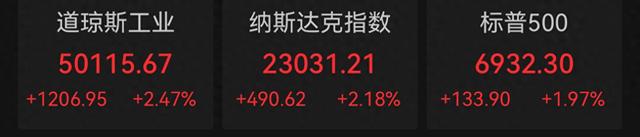
Market Performance - US stock market experienced a significant rise, with the Dow Jones Industrial Average increasing by 2.47% to surpass the 50,000 points mark for the first time, closing at a new high [1] - The Nasdaq Composite rose by 2.18%, and the S&P 500 index increased by 1.97% [1] Technology Sector - Major tech stocks saw substantial gains, with Supermicro rising over 11%, AMD increasing by over 8%, and Nvidia up nearly 8%, collectively adding $325 billion in market value [3] - Other notable performers included Broadcom with over a 7% increase, while Tesla rose over 3%. However, Amazon and Google saw declines of over 5% and 2%, respectively [3] Broader Market Trends - Despite a strong rebound on Friday, the S&P 500 index fell by 0.1% for the week, and the Nasdaq index dropped by 1.84%, primarily due to tech stock sell-offs [5] - Chinese concept stocks performed well, with the Nasdaq Golden Dragon China Index rising by 3.71%. Notable gains included NIO up over 7%, Li Auto up over 6%, and Baidu up over 5% [5] Cryptocurrency and Commodities - Bitcoin rebounded to over $70,000 after a significant drop of over 13% to below $61,000 earlier in the week, although it still recorded a cumulative decline of over 15% for the week [7] - Precious metals saw a surge, with spot gold rising nearly 4% and spot silver increasing over 9%. COMEX gold futures closed up 2.03% at $4,988.6 per ounce, while COMEX silver futures rose 1.06% to $77.525 per ounce, with gold showing a weekly increase of 1.65% [7] Economic Policy Insights - US Treasury Secretary Mnuchin stated that despite recent dollar depreciation, the Trump administration remains committed to a strong dollar policy, aiming to make dollar-denominated assets more attractive to investors [9] - Federal Reserve officials expressed openness to interest rate cuts, with some indicating a preference for potential reductions in 2026, although the exact timing remains uncertain [9]
美股中概股,集体上涨
Di Yi Cai Jing Zi Xun· 2026-02-06 14:57
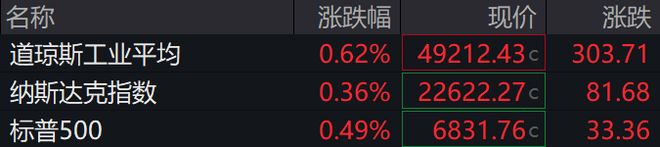
Market Overview - On February 6, US stock indices opened higher, with the Nasdaq up 0.36%, the Dow Jones up 0.62%, and the S&P 500 up 0.49% [1] Chinese Stocks Performance - Chinese stocks generally rose, with the Nasdaq China Golden Dragon Index increasing by nearly 1%. Notable gainers included NIO up over 5%, Baidu and Li Auto up over 3%, and XPeng, Bilibili, and Pony.ai up over 2% [2][3] Individual Stock Movements - NIO rose by 5.32% to $4.950 [3] - Li Auto increased by 3.93% to $18.490 [3] - Baidu Group gained 3.14% to $143.320 [3] - XPeng Motors rose by 2.37% to $17.280 [3] - Alibaba increased by 1.77% to $160.560 [3] Major Technology Stocks - Most large tech stocks saw gains, with SanDisk and AMD up over 3%, Oracle up over 2%, and NVIDIA up over 1% [2][3] Amazon's Decline - Amazon opened down 9%, with an initial drop of up to 10%, marking its largest decline since August 2024. The company projected capital expenditures (CapEx) could reach $200 billion by 2026, raising market concerns [4][5]
黄金、白银、美股,全线暴跌
Sou Hu Cai Jing· 2026-02-06 04:43
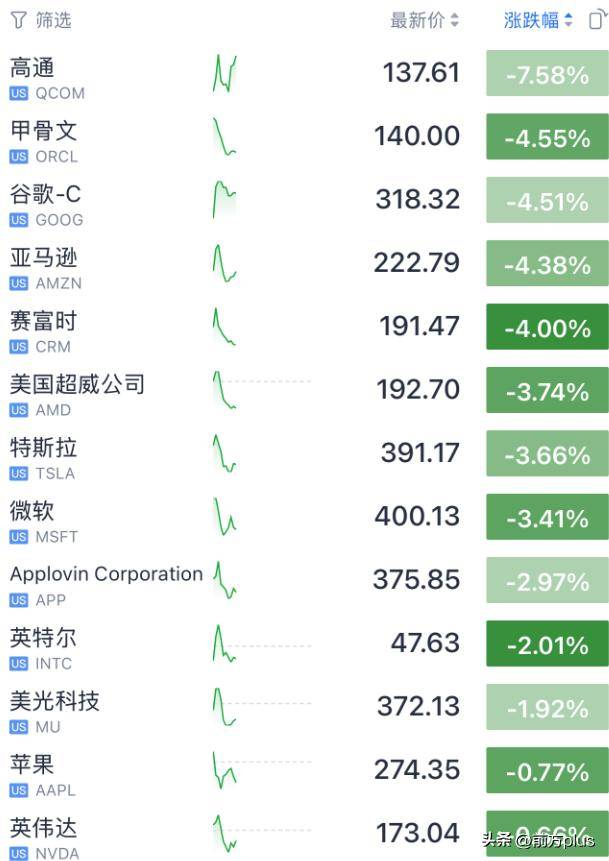
Market Overview - Global markets experienced a significant downturn, with major U.S. stock indices falling sharply; the Dow Jones dropped approximately 600 points, and the Nasdaq fell nearly 2% [1] - Technology stocks collectively declined, with notable drops in major companies [1] Company Performance - Qualcomm's stock fell by 7.58% to $137.61 after providing a lower-than-expected earnings guidance due to global memory shortages [2] - Alphabet, the parent company of Google, saw its stock decrease by 4% to $318.32, as it announced a substantial increase in AI-related capital expenditures, potentially reaching $185 billion by 2026 [6] - Other tech giants also faced declines, including Oracle (-4.55%), Amazon (-4.38%), and Tesla (-3.66%) [2] Commodity Market - Precious metals experienced a sharp decline, with silver prices plummeting over 16% [2] - Oil prices also saw a significant drop, contributing to the overall market downturn [3] Cryptocurrency Market - Bitcoin fell below the $70,000 mark, reaching $67,000, indicating a loss of interest from traditional investors and a growing pessimism towards cryptocurrencies [4] - The ongoing sell-off in the cryptocurrency market is attributed to diminishing confidence in Bitcoin as a store of value and inflation hedge [4] Economic Indicators - Concerns about a weakening labor market have intensified, with U.S. employers announcing 108,435 layoffs in January, the highest number for that month since the global financial crisis [6] - Initial jobless claims for the week ending January 31 also exceeded expectations, indicating potential economic challenges [6] - The U.S. Bureau of Labor Statistics reported that job vacancies fell to their lowest level since September 2020 by December 2025 [7]




市场对AI越来越挑剔:英伟达仅靠今年财报超预期已不够,关键要看2027收入可见性
Hua Er Jie Jian Wen· 2026-02-06 03:30
Core Viewpoint - Nvidia's upcoming Q4 earnings report is expected to exceed expectations, but investor focus is shifting towards future revenue visibility for 2027, which will be crucial for stock price movement [1] Group 1: Q4 Earnings Expectations - Goldman Sachs analyst James Schneider predicts Nvidia's Q4 revenue will exceed market expectations by approximately $2 billion, with a forecast of $67.34 billion compared to the market's $65.64 billion [1] - Adjusted earnings per share (EPS) for Q4 is expected to be $1.59, above the consensus of $1.52, while Q1 revenue is projected at $76.84 billion, surpassing the consensus of $71.15 billion [1] - The data center business remains a core growth driver, with expected revenues of $61.3 billion in Q4 and $71.1 billion in Q1 [1] Group 2: Long-term Revenue Projections - Nvidia's long-term target for data center revenue is $500 billion, but investors seek clarity on the timeline and customer composition [2] - Goldman Sachs estimates that data center revenue for FY2027 will reach $357.3 billion, 16% higher than market expectations, and further increase to $483.9 billion in FY2028, exceeding market expectations by 22% [2] - The product transition pace, particularly with the Rubin GPU expected to start shipping in Q3, is a key variable for revenue growth [2] Group 3: Demand from Non-Traditional Customers - OpenAI plans to begin large-scale deployment in the second half of 2026, aiming for approximately 26GW of computing power over 4-5 years [3] - Non-hyperscaler demand, including from companies like Anthropic, is expected to offset traditional customer fluctuations, contributing to revenue uncertainty for 2027 [3] - Key information regarding capital expenditures from major cloud providers and demand specifics from non-hyperscaler customers will be released in the first half of the year, serving as potential stock price catalysts [3] Group 4: Competitive Landscape - Competition is intensifying with Google, AMD, and Microsoft developing products that may closely match Nvidia's performance [4] - Nvidia is expected to highlight the competitive advantages of its CUDA ecosystem, which has developed a strong network effect among developers [4] - The growth rate of the inference market may surpass that of the training market, indicating a shifting competitive landscape [4] Group 5: Potential Contributions from China - The Chinese market may open up revenue opportunities before 2027, but specific contribution details and timelines require further disclosure from management [5] Group 6: Valuation and Structural Demand - Goldman Sachs sets a target price of $250 based on a 30x price-to-earnings ratio applied to normalized EPS of $8.25, indicating high profitability even if AI infrastructure spending slows [6] - Current stock price corresponds to a FY2027 P/E ratio of about 20x and approximately 14x for FY2028, suggesting that if Goldman Sachs' growth forecasts are accepted, the valuation is not excessive [6] - The realization probability of Goldman Sachs' forecasts is critical, as a 29% EPS increase requires sustained demand and high gross margins around 75% [6]