
Palantir

Search documents
X @Nick Szabo
Nick Szabo· 2026-02-05 16:26
RT Steve Howell (@FromSteveHowell)Palantir gets a £240m UK government contract without competition after a cosy chat with Starmer and Mandelson.For us mere mortals, public sector work has to go out to tender if it's worth more than £10,000. ...
Could This REIT Be the Best Way to Play the Data Center Surge?
Yahoo Finance· 2026-02-05 15:05
Core Viewpoint - The data center sector is emerging as a significant investment opportunity in the artificial intelligence (AI) revolution, with companies like Digital Realty Trust positioned favorably to benefit from this growth [1]. Group 1: Investment Opportunities - Data centers are crucial for the AI industry, and companies such as Vertiv, CoreWeave, and Applied Digital are well-placed to capitalize on this trend [1]. - Digital Realty Trust, as the world's largest data center operator, owns over 300 data centers across 50 cities and serves more than 5,000 customers, making it a prime candidate for investors looking to engage with the AI data center market [3]. Group 2: Business Structure and Financial Benefits - Digital Realty Trust operates as a real estate investment trust (REIT), allowing it to pass the majority of its profits from recurring rental revenue to shareholders as dividends, thus avoiding corporate-level taxation [4]. - This structure enables shareholders to benefit more directly from the growth of the AI data center industry, which is projected to grow at an average annualized rate of over 27% through 2035 [5]. Group 3: Growth and Performance - While the AI data center business does not exhibit the explosive growth seen in companies like Nvidia, Digital Realty's third-quarter revenue growth of 10% aligns with its historical performance and analysts' expectations [6].

三大股指期货齐跌,“软件股末日”论甚嚣尘上,亚马逊(AMZN.US)盘后公布财报
Zhi Tong Cai Jing· 2026-02-05 14:09
Market Overview - US stock index futures are all down, with Dow futures down 0.30%, S&P 500 futures down 0.52%, and Nasdaq futures down 0.68% [1] - European indices also show declines, with Germany's DAX down 0.63%, UK's FTSE 100 down 0.40%, France's CAC40 down 0.06%, and the Euro Stoxx 50 down 0.41% [2][3] - WTI crude oil prices fell by 2.15% to $63.74 per barrel, while Brent crude oil dropped by 2.06% to $68.03 per barrel [3][4] Software Sector - The software sector is experiencing significant declines, with Goldman Sachs' software index falling for the seventh consecutive day, down 19% year-to-date, contributing to a 1.4% drop in the Nasdaq 100 index [5] - Major software companies like Microsoft, Oracle, Salesforce, and Palantir have seen year-to-date declines exceeding 10%, with Adobe's stock plummeting by 20% [5] - The software sector has lost $2 trillion in market value from last year's peak, and hedge fund net positions have dropped to a historical low of 4.2% [5] Trade and Geopolitical Developments - The US is planning to establish a protected trade zone for rare earths, using tariffs to set price floors, as announced by Vice President Pence [6] - A recent Markets Pulse survey indicates that most respondents believe stock returns will outperform bonds due to international policy dynamics, with over half citing trade and geopolitical developments as the main catalysts for market volatility [6] Individual Company Updates - Amazon faces a $70 million fine from German antitrust regulators for price control practices, coinciding with its upcoming earnings report [8] - Barrick Gold reported a 64% increase in Q4 revenue and a 140% increase in dividends, announcing plans for an IPO to spin off its North American gold assets [9] - SiTime's Q4 revenue reached $113.3 million, a 66% year-over-year increase, with a strong performance in its communication and data center business [10][11] - Qualcomm's stock fell over 12% after it provided a weak earnings forecast, raising concerns about smartphone demand due to chip shortages [12] - Arm Holdings' stock dropped over 7% after its revenue forecast fell short of investor expectations, despite a 26% year-over-year revenue increase in Q3 [13] - BBVA's net profit grew by 4.1% to €2.53 billion, but increased provisions in emerging markets raised concerns about future growth [14] - Shell's Q4 adjusted profit fell to $3.26 billion, below market expectations, due to low oil prices and poor performance in its chemical business [15] - Vodafone's stock hit a one-year low despite a 6.5% increase in Q3 revenue, as growth in its key German market fell short of expectations [16] - NIO forecasts an operating profit of RMB 700 million to 1.2 billion for Q4 2025, marking its first anticipated quarterly operating profit [17]


迅策(3317.HK)被视为“中国版Palantir”,德银目标价对应超60%上行空间
Ge Long Hui· 2026-02-05 12:09
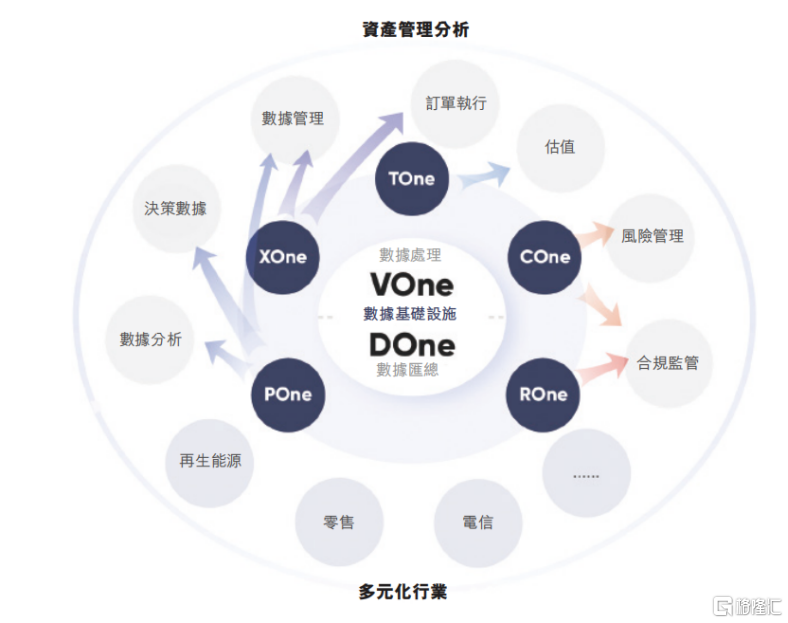
Core Viewpoint - Deutsche Bank has initiated coverage on XunCe Technology (3317.HK), positioning it as a leading player in China's real-time data infrastructure and analytics solutions, akin to "China's version of Palantir" [1][2] Group 1: Market Position and Business Model - XunCe is recognized as the "Data Agent first stock" and holds a leading position in the real-time data infrastructure and analytics market in China, particularly in asset management with an 11.6% market share [1] - The company has achieved full coverage of China's top ten asset management institutions, indicating its strong foothold in high-barrier industries [1] - XunCe's business model focuses on providing a "data operating system" rather than simple data display, integrating data collection, governance, computation, and analysis into clients' core business processes [3] Group 2: Growth Potential and Financial Projections - Deutsche Bank forecasts XunCe's revenue to grow from 632 million RMB in 2024 to 3.735 billion RMB in 2027, representing a compound annual growth rate (CAGR) of 81%, significantly surpassing industry averages [6][8] - The average revenue per user (ARPU) is expected to increase from 1.582 million RMB in 2022 to 2.724 million RMB in 2024, with a projected CAGR of 83% from 2024 to 2027 [7] - Revenue from industries outside asset management is anticipated to grow at a CAGR of 109% from 2024 to 2027, with telecommunications, urban management, and manufacturing identified as new growth drivers [8] Group 3: Profitability and Valuation - XunCe's gross margin exceeds 76%, significantly higher than the traditional IT outsourcing sector, providing a solid foundation for future profitability [8] - The company is expected to achieve adjusted net profit in 2026 with a net profit margin of 6.7%, increasing to 18.3% by 2027 [8] - Deutsche Bank's target price of 85 HKD implies over 60% upside potential from the current price of approximately 52 HKD, with a valuation that offers a significant margin of safety compared to global peers like Palantir and Snowflake [9][10]
银行股,资金出手了
3 6 Ke· 2026-02-05 11:21
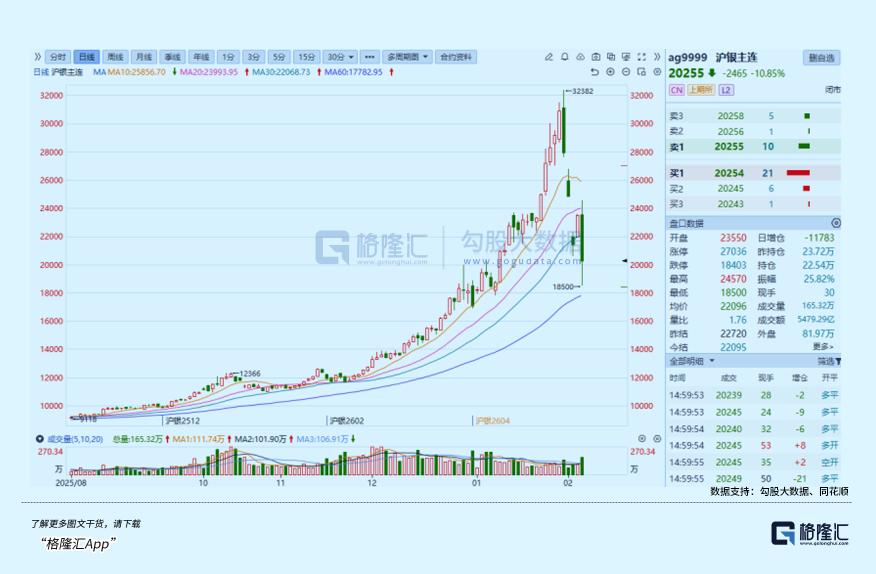
Core Viewpoint - A significant market shift occurred as global funds fled from technology stocks and precious metals, leading to a notable decline in major indices and a surge in bank stocks as a safe haven for investors [1][2][3]. Group 1: Market Reactions - On February 4, U.S. tech stocks experienced a sharp decline, with the Nasdaq dropping over 2% and major companies like Nvidia, Meta, and Tesla falling more than 3%. AMD saw a staggering drop of 17.3%, marking its largest single-day decline in nearly nine years [1][3]. - The panic spread to A-shares and Hong Kong stocks, with sectors like solar energy and precious metals witnessing significant sell-offs. Silver futures plummeted nearly 20% at one point, exacerbating market fears [2][5]. - Despite the overall market turmoil, the banking sector in A-shares rose by 2.1%, with all 42 bank stocks closing in the green, indicating a flight to safety among investors [2][10]. Group 2: Capital Flows - Southbound funds recorded a net purchase of over 22 billion HKD, with major Chinese banks like ICBC, CMB, and CCB becoming core targets for accumulation [3][13]. - A significant shift in capital is underway, with funds moving from tech and precious metals to banks, which are perceived as having a higher safety margin [3][9]. Group 3: Banking Sector Performance - The banking sector is supported by strong earnings growth and historically low valuations, making it an attractive option for risk-averse investors [15][20]. - As of February 4, several banks reported robust earnings, with Qingdao Bank, Hangzhou Bank, and others showing significant profit increases, further solidifying the sector's appeal [16][18]. - The banking sector's average dividend yield ranges from 4.87% to 5.2%, significantly higher than the 10-year government bond yield of around 2%, enhancing its attractiveness in a low-interest-rate environment [21][22]. Group 4: Future Outlook - The recent market volatility raises questions about whether the declines in tech stocks and precious metals will lead to further panic selling. However, the influx of funds into bank stocks suggests a potential shift in market sentiment [23].






“软件股末日”论调席卷华尔街之际 “AI重塑软件盈利”的增长叙事悄然扩散
智通财经网· 2026-02-05 10:48
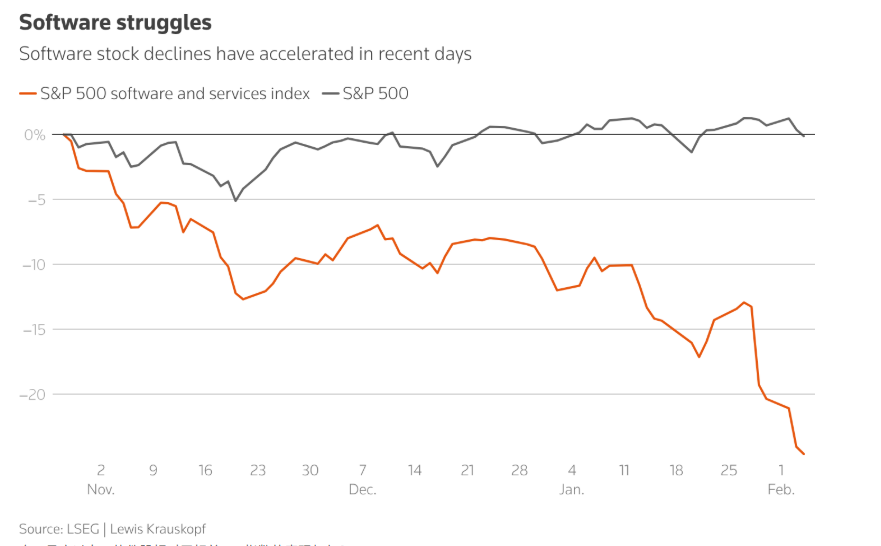
Group 1: Market Overview - The narrative of "Software-mageddon" is gaining traction among global investors, with debates on whether to initiate bullish calls on recently battered software stocks [1] - Large institutional investors are beginning to enter the market to buy the dip in software stocks that have experienced significant declines, with some supporting optimistic views on AI-focused software giants [1][3] - The S&P 500 Software and Services Index has dropped approximately 25% since its recent peak at the end of October, while the overall S&P 500 index has remained relatively stable [3][4] Group 2: Impact of AI Tools - The launch of Anthropic's AI programming tool, Claude Cowork, has intensified fears of AI agents disrupting the SaaS software industry, leading to a collective sell-off in software stocks [2] - The S&P 500 Software and Services Index experienced its worst performance since May 2002, with a significant market cap loss exceeding $800 billion [4] Group 3: Investor Reactions and Divergence - Institutional investors are showing mixed reactions, with some cautiously buying while others remain hesitant, indicating a divide in sentiment regarding the software sector [8] - Some portfolio managers are starting to see long-term value in certain software stocks, while others are waiting for stronger catalysts, such as robust AI-related revenue reports, before making aggressive purchases [8][9] Group 4: Future Outlook and AI Integration - The market is reassessing the value chain in the software industry, with AI potentially redistributing profits rather than completely replacing existing software infrastructure [11][12] - The current sell-off is seen as a response to the question of how much profit pools will be redistributed among SaaS vendors due to AI advancements, with a focus on real deployment and revenue growth from AI-related products [12][13]



银行股,资金出手了!
格隆汇APP· 2026-02-05 10:15
Core Viewpoint - A significant market shift is occurring, characterized by a mass exodus of funds from technology and precious metals sectors, with a notable influx into bank stocks as a safe haven amid rising panic and volatility [2][5][21]. Group 1: Market Dynamics - The U.S. tech stocks experienced a sharp decline, with the Nasdaq dropping over 2%, and major companies like Nvidia, Meta, and Tesla falling more than 3%. AMD saw a staggering drop of 17.3%, marking its largest single-day decline in nearly nine years [2][5]. - Panic spread to A-shares and Hong Kong stocks, with sectors like solar energy and oil equipment witnessing significant sell-offs. Precious metals, which had recently rebounded, also faced a sharp decline, with silver futures plummeting nearly 20% in a single day [3][5]. - The market turmoil was triggered by negative news affecting U.S. tech stocks, leading to a valuation bubble burst. Despite AMD's strong performance, its results fell short of the most optimistic analyst expectations, resulting in a drastic stock price drop [5][6]. Group 2: Bank Sector Resilience - In contrast to the broader market, the banking sector saw a rise, with A-share bank stocks collectively increasing by 2.1%. All 42 bank stocks closed in the green, with Xiamen Bank hitting a rare limit-up and several city commercial banks rising over 3% [3][15]. - Southbound funds significantly targeted bank stocks, with a net purchase exceeding 22 billion HKD, focusing on major banks like ICBC, CMB, and CCB as core investment targets [4][20]. - The banking sector is viewed as a "safe haven" due to its strong earnings growth and historically low valuations, making it an attractive option for risk-averse investors [21][22]. Group 3: Earnings and Valuation - Recent earnings reports from several banks indicate robust growth, with Qingdao Bank, Hangzhou Bank, and Shanghai Pudong Development Bank showing significant increases in net profits. For instance, Qingdao Bank reported a net profit of 51.88 billion CNY, a 21.66% year-on-year increase [23][25]. - The banking sector has undergone a six-month correction, leading to a new valuation bottom. The sector's price-to-earnings ratio stands at a low 6.7 times, and the average dividend yield is between 4.87% and 5.2%, making it appealing in a low-interest-rate environment [27][28]. - Institutional interest in bank stocks is rising, with over 370 institutions conducting research on 11 listed banks, indicating a strategic shift towards these stocks amid market volatility [28][29].





Anthropic's AI push raises analyst concerns over Indian IT services revenues
Yahoo Finance· 2026-02-05 08:07
Feb 5 (Reuters) - Rapid advances in artificial intelligence, triggered in part by Anthropic's latest automation push, could structurally erode the IT sector's high-margin application services revenues, creating downside risks to earnings and valuations, analysts warn. Shares in India's software exporters settled 0.6% lower on Thursday, a day after plunging 6% in their worst session for nearly six years, as AI-driven automation from U.S.-based Anthropic and Palantir fuelled fears of compressed project t ...
美股科技软件板块大崩盘,罪魁祸首竟是这家公司?
阿尔法工场研究院· 2026-02-05 07:48
Core Viewpoint - The emergence of native AI models, exemplified by Anthropic's new automation tools, poses a significant threat to traditional software companies, raising questions about the sustainability of their business models and competitive advantages [2][3]. Group 1: Impact of Anthropic's Tools - Anthropic's release of a legal tool plugin for its Claude Cowork platform has triggered panic selling in the software sector, particularly affecting legal software and data service companies [2]. - Major companies like Thomson Reuters and LegalZoom saw their stock prices plummet by 21% and over 20% respectively, as their core business models were directly challenged by the cost-effective and integrated solutions offered by AI [3]. - The market fears that if companies can use a single AI plugin to handle legal compliance tasks that previously required multiple expensive software subscriptions, the subscription value of traditional SaaS companies will be severely undermined [3]. Group 2: Subscription Model Crisis - The term "SaaSpocalypse" reflects the growing concern that AI advancements may not just assist growth but could potentially replace traditional subscription models entirely [5]. - The traditional software industry's reliance on high-margin recurring revenue from seat-based billing is threatened as AI agents can perform tasks that previously required multiple personnel [5]. - This shift in expectations regarding future growth is a key driver behind the current wave of panic selling in the software sector [5]. Group 3: Performance Discrepancies - Among S&P 500 software stocks, only 69% reported revenues above expectations, significantly lower than the tech sector's overall 85% success rate, indicating a weak position in the AI-driven market [6]. - Even strong performers like Microsoft are under scrutiny as their Azure cloud business shows signs of slowing growth, leading to a decline in stock price over four consecutive trading days [6]. - In contrast, Palantir emerged as a rare "safe haven" with a 70% revenue increase in Q4, suggesting that the market is selectively favoring companies that can effectively leverage AI to enhance productivity [6]. Group 4: Market Reallocation - Despite the Nasdaq's poor performance, the S&P 500 shows a "seesaw" effect, with companies like FedEx and Walmart gaining market value, indicating a shift of funds from vulnerable software stocks to more defensively positioned sectors [7]. - The selling pressure on software stocks is characterized by a "surrender" mentality among investors, who are eager to exit positions regardless of price [7]. - From an investment perspective, extreme panic often creates opportunities, as evidenced by Microsoft's valuation dropping to a three-year low with a forward P/E ratio around 25 [7]. Group 5: Future Outlook - The year 2026 is anticipated to be a pivotal moment for the software industry, as AI programming and automation lower development barriers and diminish traditional business moats [8]. - The consensus on Wall Street has shifted fundamentally, with software no longer seen as a guaranteed profit generator in the face of competition from companies like Anthropic that possess foundational AI models [8]. - Investors are advised to focus on identifying companies with core competencies that are not easily replaceable by automation, rather than blindly attempting to catch falling stocks [8].




招银国际每日投资策略-20260205
Zhao Yin Guo Ji· 2026-02-05 05:29
Core Insights - Pfizer reported strong Q4 2025 earnings with revenue of $17.6 billion, aligning closely with previous expectations of $18.1 billion, and adjusted net income of $3.8 billion, exceeding the prior forecast of $3.3 billion [2] - Total revenue for 2025 is projected at $62.6 billion, a 2% year-over-year decline, but operational revenue excluding COVID-19 products grew by 6%, indicating robust underlying business momentum [2] - The management reaffirmed guidance for 2026, expecting revenue between $59.5 billion and $62.5 billion, with adjusted EPS ranging from $2.80 to $3.00, highlighting a year rich in catalysts [2] Company Analysis - Pfizer's pipeline includes significant catalysts such as long-acting GLP-1 and Amylin projects, with key data readouts expected in 2026 [2] - The VESPER-3 study demonstrated a 12.3% weight loss effect at the 28-week mark for the mid-dose group of PF'3944, with predictions suggesting a 15.8% weight loss for the high-dose group [6] - The company plans to initiate a Phase 3 study for PF'3944 later this year, with further updates on its obesity product portfolio expected [6][7] Market Performance - The Hang Seng Index closed at 26,847, reflecting a slight increase of 0.05% for the day and a year-to-date gain of 4.75% [2] - The U.S. stock market saw declines, particularly in technology and consumer discretionary sectors, while energy and materials sectors showed strength [4] - Notable movements included a 17% drop in AMD shares following weak guidance, impacting the semiconductor sector [4]
