易方达基金

Search documents
金价站上4600美元 国内首只千亿黄金ETF诞生
Zheng Quan Shi Bao· 2026-01-15 18:14
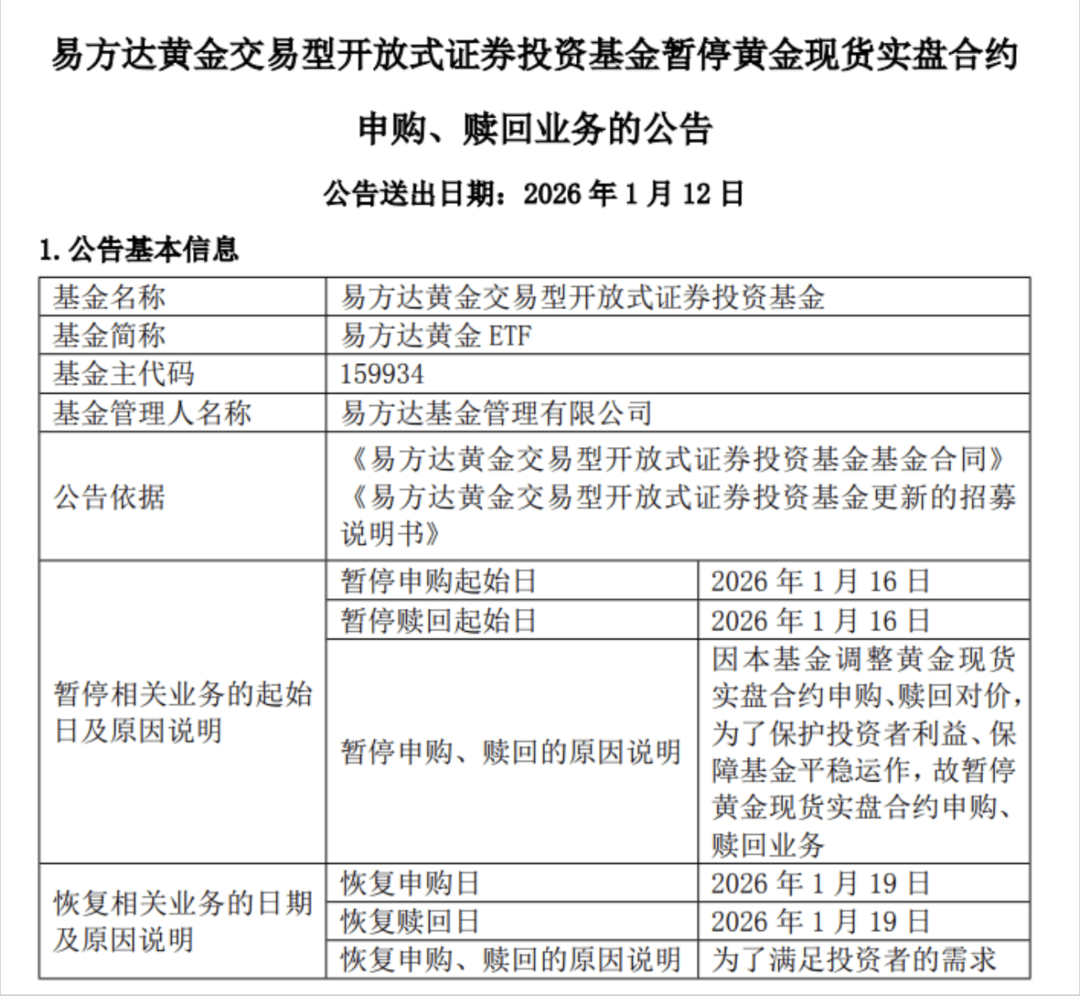
Core Viewpoint - The emergence of China's first gold ETF with a market capitalization exceeding 100 billion yuan coincides with international gold prices surpassing $4600 per ounce, indicating strong investor interest in gold as a safe-haven asset amid economic uncertainties [1][2]. Group 1: Gold ETF Market Development - The Huashan Gold ETF has reached a circulation scale of 100.76 billion yuan, making it the largest gold ETF in Asia [1][2]. - The total market scale of 14 gold ETFs in China has reached 263.44 billion yuan, with significant inflows into other ETFs such as Bosera Gold ETF and E Fund Gold ETF [2]. - The development of gold ETFs in China began in 2009, with the first product, Huashan Gold ETF, launched in July 2013 [2]. Group 2: Adjustments in ETF Operations - Several fund companies are adjusting their physical subscription and redemption mechanisms to enhance liquidity and risk management due to the surge in gold prices [3][4]. - E Fund announced a temporary suspension of subscriptions for its gold ETF starting January 16, with a reduction in the minimum subscription unit from 300,000 to 100,000 shares [3][4]. - The adjustment to unify the physical gold contract for subscriptions to Au99.99 is aimed at improving liquidity and ensuring fair pricing for all investors [4]. Group 3: Future Outlook on Gold Prices - Multiple public funds remain optimistic about the continued rise in gold prices, citing factors such as the ongoing Federal Reserve rate cut cycle and increasing global uncertainties [5][6]. - The trend of de-dollarization and geopolitical tensions are expected to drive demand for gold as a safe-haven asset, with predictions of gold becoming a new pricing anchor [6]. - Investment strategies are recommended to focus on medium-term allocations rather than short-term speculation due to increased volatility in the gold market [6].
金价攀升驱动资金涌入 国内首只千亿级黄金ETF诞生
Shang Hai Zheng Quan Bao· 2026-01-15 18:01
Group 1 - The first domestic commodity ETF with a scale exceeding 100 billion yuan has been established, with the Huaan Gold ETF reaching a scale of 100.762 billion yuan as of January 14, 2026, marking it as the first commodity ETF in China to surpass this threshold [1][2] - The Huaan Gold ETF has experienced explosive growth, with a net subscription amount of 42.293 billion yuan since 2025, increasing its scale from 28.676 billion yuan to 100.762 billion yuan [2] - The overall scale of domestic gold-related commodity ETFs reached 262.861 billion yuan as of January 14, 2026, with a total net subscription amount of 118.227 billion yuan since 2025 [2] Group 2 - The chief index investment officer of Huaan Fund, Xu Zhiyan, indicated that the gold market has entered a new cycle since 2023, driven by factors such as the continuation of the Federal Reserve's interest rate cut cycle and strong central bank gold purchasing demand [3] - The low correlation between gold and other assets like stocks and bonds in the current low domestic interest rate environment highlights gold's significant allocation value, suggesting that including gold could improve portfolio Sharpe ratios [3] - Market expectations for monetary easing have increased due to weak U.S. non-farm payroll data, reinforcing the positive outlook for precious metals, although short-term volatility may increase [3]
全市场首只千亿元级黄金ETF亮相
Zheng Quan Ri Bao· 2026-01-15 16:48
Group 1 - The core point of the news is the emergence of the first gold ETF in the market to surpass 100 billion yuan, specifically the Huaan Gold ETF, which reached a scale of 100.76 billion yuan as of January 14 [1] - Since 2025, the Huaan Gold ETF has experienced rapid growth, increasing from 28.68 billion yuan at the beginning of 2025 to 93.99 billion yuan by the end of that year, with a growth of over 65 billion yuan [1] - The price of gold has been on the rise, with the London spot gold price breaking the 4,600 USD/ounce mark for the first time on January 12, and reaching a historical high of 4,643 USD/ounce on January 14 [1] Group 2 - In addition to the Huaan Gold ETF, there are other significant gold ETFs, including Bosera Gold ETF, E Fund Gold ETF, Guotai Gold ETF, and Huaxia Gold ETF, each with scales exceeding 40 billion yuan, all showing growth of over 10 billion yuan since early 2025 [2] - Other gold-related funds have also seen growth, such as the Yongying Gold Stock ETF, which increased from 1.65 billion yuan at the beginning of 2025 to 14.32 billion yuan by January 14, 2026 [2] Group 3 - Industry insiders view gold ETFs and linked funds as efficient and low-cost tools for ordinary investors to allocate gold [3] - Gold is highlighted as a core asset for hedging inflation risks and optimizing asset portfolios in the medium to long term, although investors are advised to be cautious of short-term market sentiment [3] - It is recommended that investors maintain a gold allocation of 10% to 20% in their portfolios to effectively optimize their investment mix [3]
境内首只千亿级商品ETF,诞生
Shang Hai Zheng Quan Bao· 2026-01-15 14:28
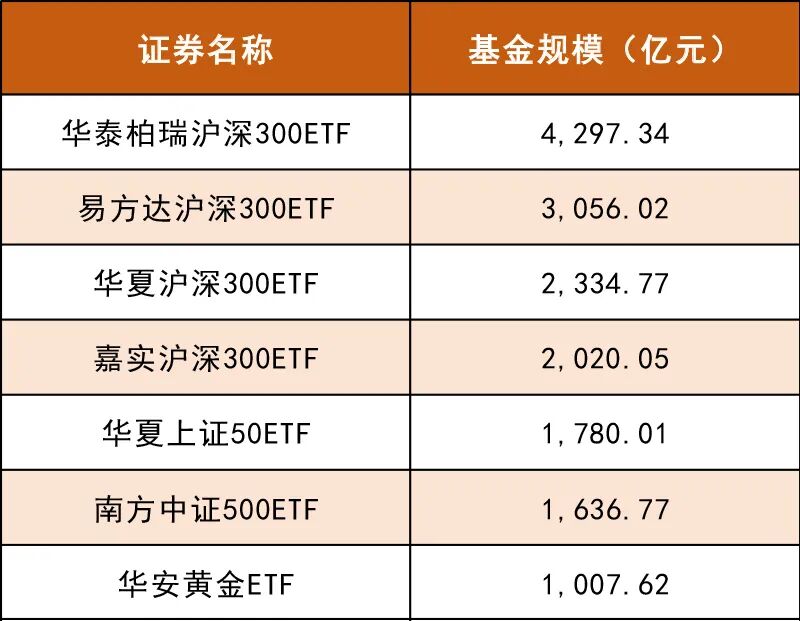
Group 1 - The core point of the article is the emergence of the first commodity ETF in China to surpass 100 billion yuan in scale, specifically the Huaan Gold ETF, which reached a scale of 1007.62 billion yuan as of January 14 [1][3][4] - As of January 14, there are a total of 7 ETFs in the Chinese market with scales exceeding 100 billion yuan, all of which are equity ETFs, including Huaan Gold ETF and several others focused on the CSI 300 and SSE 50 indices [1][3] - The Huaan Gold ETF was established on July 18, 2013, and its launch has contributed to the development and innovation of the Chinese gold market, providing new investment avenues for retail investors [3][4] Group 2 - The Huaan Gold ETF has experienced explosive growth over the past year, with net subscriptions amounting to 42.293 billion yuan, increasing its scale from 28.676 billion yuan to 100.762 billion yuan [4] - The overall scale of gold-related ETFs in China reached 262.861 billion yuan as of January 14, with a total net subscription of 118.227 billion yuan since 2025 [5] - The performance of gold has been strong, with the Huaan Gold ETF increasing by over 67% since 2025, indicating a favorable market environment for gold investments [5][7] Group 3 - The current low interest rate environment in China enhances the investment value of gold, as it shows low correlation with stocks and bonds, making it a significant asset class for portfolio diversification [7] - Market analysts expect continued strength in gold prices due to factors such as the ongoing Federal Reserve's interest rate cuts, strong central bank demand for gold, and the internationalization of the renminbi [7] - The recent weak U.S. non-farm payroll data has reinforced market expectations for a cooling labor market, which may further benefit precious metals [7]

再添一例!长盛基金副总郭堃卸任高管职位专注投资
Bei Jing Shang Bao· 2026-01-15 12:28
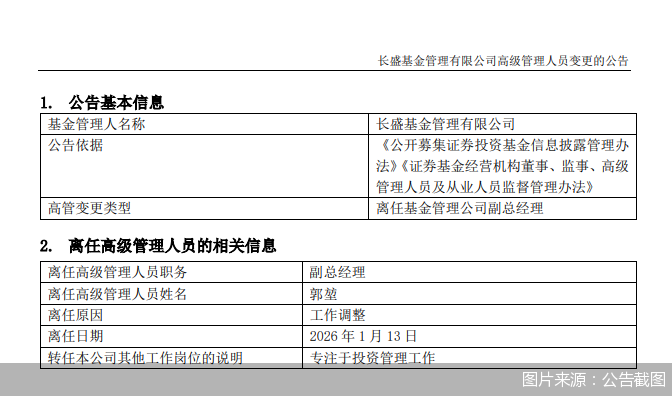
Core Viewpoint - Fund managers who have previously been promoted to executive positions are gradually stepping down to focus on investment management, indicating a shift in the industry towards prioritizing investment expertise over executive roles [1][4]. Group 1: Executive Changes - On January 15, Changsheng Fund announced that Vice President Guo Kun resigned due to work adjustments and will concentrate on investment management [1][3]. - Guo Kun had been with Changsheng Fund since December 2019 and was promoted to Vice President in July 2021, managing several active equity funds with a total management scale of 6.078 billion yuan, accounting for 40% of the company's active equity fund scale [3]. Group 2: Industry Trends - There is a growing trend of fund managers resigning from executive roles to focus on investment, as seen with several managers from various funds, including Yifangda Fund and Nuon Fund, who have stepped down from high-level positions to concentrate on their investment responsibilities [4][5]. - The industry is moving away from the "star fund manager" phenomenon, with regulatory bodies advocating for a more team-oriented and platform-based investment research structure [5][6]. Group 3: Talent Management - The promotion of high-performing fund managers to executive roles is a strategy to retain talent, while resignations may stem from internal adjustments or personal reasons [5]. - Industry experts emphasize the need for fund companies to establish a mature talent reserve and to avoid over-reliance on star fund managers, advocating for long-term assessment and development of a strong fund management team [5][6].
A股ETF开年火热,32只主题ETF涨超20%
3 6 Ke· 2026-01-15 12:03
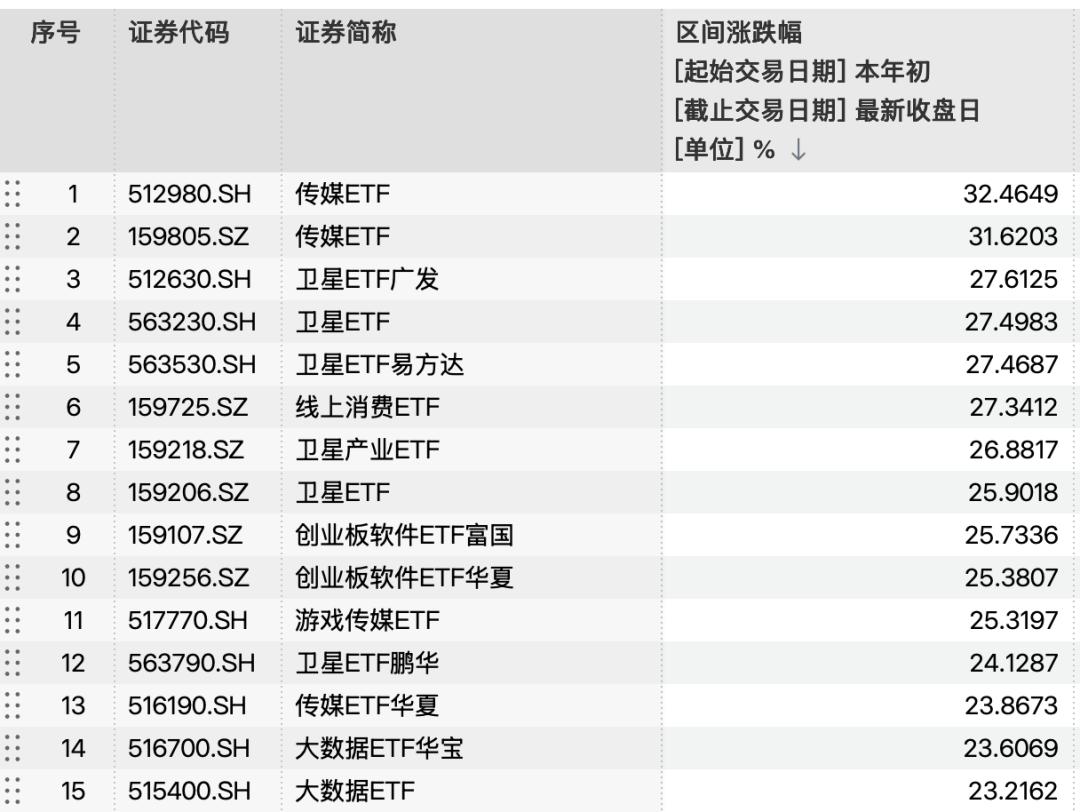
Core Viewpoint - The A-share market has experienced a "spring surge" at the beginning of 2026, with ETFs showing significant growth and a rare trend of "limit-up" occurrences in multiple products [1][5]. Group 1: ETF Market Overview - The total scale of ETFs in the market has increased from 6 trillion yuan to 6.24 trillion yuan, a growth of over 2245.82 billion yuan since the beginning of the year [2][3]. - Stock ETFs have been the main contributors to this growth, with an increase of over 2000 billion yuan, surpassing the 4 trillion yuan mark, reaching 4.05 trillion yuan [2][3]. - In contrast, bond ETFs have seen a decline of 761.53 billion yuan, and money market ETFs have decreased by 196.98 billion yuan [2]. Group 2: Performance of ETFs - The net value performance of various industry-themed ETFs has significantly outperformed major indices, with the media, satellite, and defense sectors showing notable gains [3][4]. - As of January 14, 2026, the media sector ETFs, such as the GF Media ETF and Penghua Media ETF, have recorded increases of 32.46% and 31.62%, respectively [4]. - Satellite-themed ETFs have also performed well, with the GF Satellite ETF leading with a 27.61% increase [3][4]. Group 3: Fund Flow Dynamics - There is a clear divergence in fund flows, with broad-based ETFs like the CSI A500 experiencing a net outflow of nearly 180 billion yuan, while thematic ETFs in sectors like non-ferrous metals and cross-border investments are attracting capital [7][8]. - The trend of passive investment is increasing, with more investors shifting from public funds to thematic ETFs, indicating a growing interest in sector-specific investments [7][9]. Group 4: Institutional Activity - Institutional investors are actively participating in the ETF market, with public funds moving away from homogeneous competition to focus on niche themes, resulting in the approval of 14 new ETF products since the beginning of 2026 [9]. - Leading fund management companies, such as Huaxia Fund, have seen significant growth in ETF management scale, surpassing 1 trillion yuan, indicating a trend towards increased concentration in the ETF management industry [9].
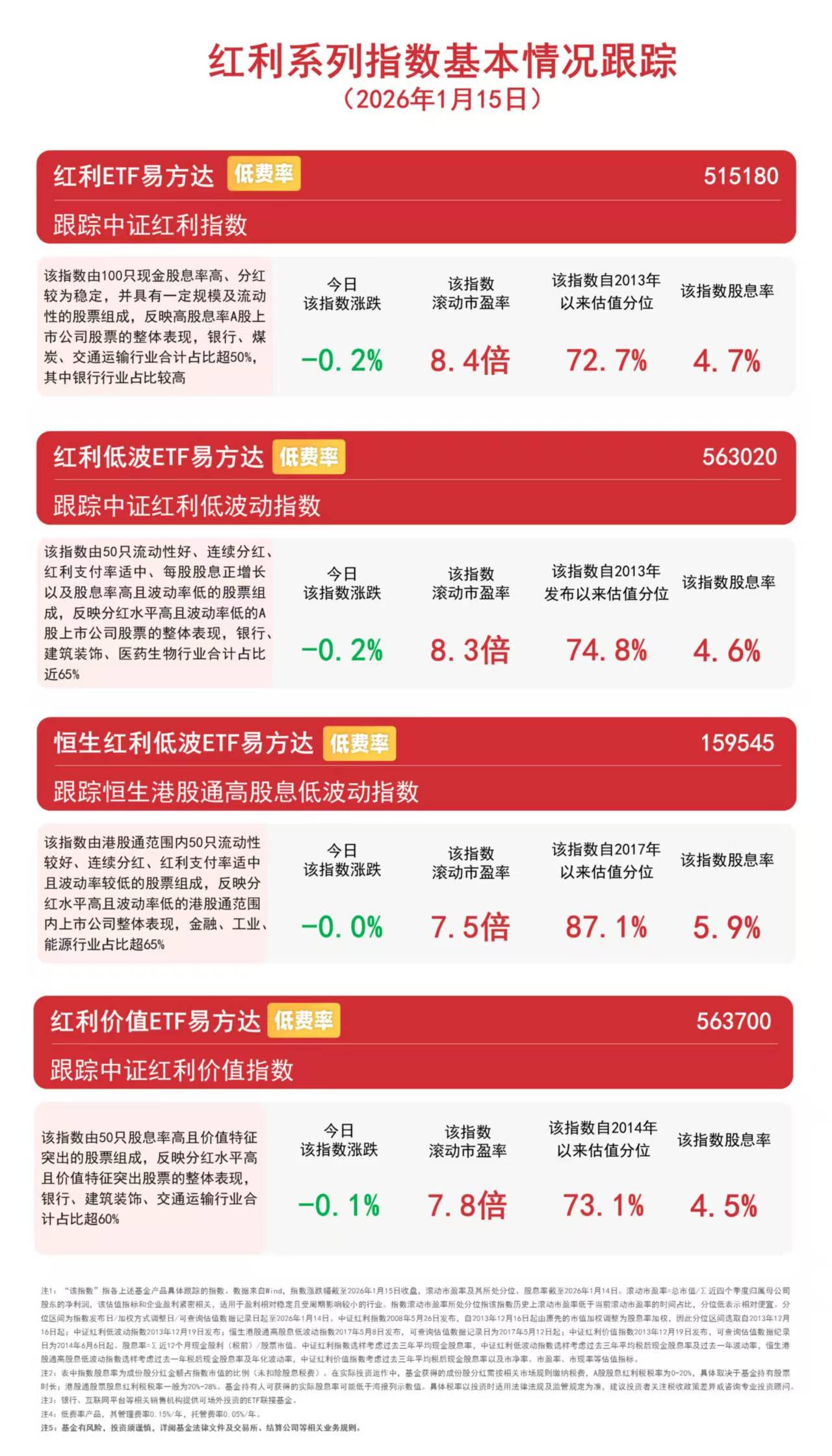
红利板块小幅回调,红利ETF易方达(515180)、红利低波ETF易方达(563020)受资金关注
Sou Hu Cai Jing· 2026-01-15 11:18
Core Viewpoint - The dividend sector experienced a slight decline today, with various indices reflecting a decrease in performance, while the E Fund dividend ETFs saw significant net inflows [1][4]. Group 1: Market Performance - The Hang Seng High Dividend Low Volatility Index fell by 0.01%, the CSI Dividend Value Index decreased by 0.1%, and both the CSI Dividend Index and CSI Dividend Low Volatility Index dropped by 0.2% [1]. - E Fund's dividend ETFs, including E Fund Dividend ETF (515180) and E Fund Low Volatility Dividend ETF (563020), received over 100 million yuan in net inflows yesterday [1]. Group 2: Fund Management and Fees - E Fund is currently the only fund company offering all dividend ETFs at a low fee rate of 0.15% per year, which aids investors in low-cost allocation to high-dividend assets [1][5]. - The management fee for E Fund's various dividend ETFs, including the Hang Seng Low Volatility Dividend ETF (159545), is set at 0.15% per year, with a custody fee of 0.05% per year [5]. Group 3: Index Composition - The CSI Dividend Index consists of 100 stocks with high cash dividend yields and stable performance, with banking, coal, and transportation sectors accounting for over 50% of the index [3]. - The CSI Low Volatility Dividend Index is composed of 50 stocks characterized by good liquidity, continuous dividends, and low volatility, with banking, construction, and pharmaceutical sectors making up nearly 65% of the index [3]. - The CSI Dividend Value Index includes 50 stocks with high dividend yields and value characteristics, with banking, construction, and transportation sectors representing over 60% of the index [4].
万亿ETF管理人现身行业竞争步入新阶段
Qi Lu Wan Bao· 2026-01-15 09:55
华夏基金旗下ETF管理规模日前突破1万亿元,成为国内首家万亿ETF管理人。易方达基金以超9200亿元 的ETF管理规模紧随其后,有望接力进入万亿"俱乐部"。2025年以来,境内ETF规模接连突破4万亿元、5万 亿元、6万亿元大关,规模增长背后是市场回暖带来的基金净值上涨,以及大量资金净流入。 新华 ...
资本热话 | ETF市场开年狂飙:万亿巨头诞生,科技赛道受捧
Sou Hu Cai Jing· 2026-01-15 09:36
Core Insights - The ETF industry is experiencing a significant expansion, with A-share market trading reaching historical highs and ETF total scale increasing to 6.24 trillion yuan as of January 13, marking a surge of 221.7 billion yuan in just half a month [2][4] - The emergence of the first trillion-yuan ETF manager, Huaxia Fund, signifies a milestone in the industry, with the second-largest player, E Fund, trailing by less than 100 billion yuan [6][7] - The competition among leading institutions has evolved beyond mere market share to include product standardization, investor returns, and ecosystem development [2][9] Market Performance - A-share market remains robust, with daily trading volumes consistently exceeding 3 trillion yuan, reaching nearly 4 trillion yuan on January 14 [4] - The ETF market is a key channel for capital inflow, with stock ETFs being the primary drivers of growth, adding over 220 billion yuan since the beginning of the year [4][5] - Technology-related sectors, including satellite and media, are attracting significant investment, with specific ETFs receiving over 80 billion yuan in net inflows [4][5] Fund Management Trends - The top three ETF managers control over 40% of the total market, with Huaxia Fund leading at over 1 trillion yuan, followed by E Fund and Huatai-PB [6][7] - The rapid growth of these leading firms is attributed to both net subscriptions and net asset value increases, with Huaxia Fund growing by 360.8 billion yuan and E Fund by 326.3 billion yuan in the past year [8] - Smaller ETF managers face challenges, with many having assets below 10 billion yuan, highlighting a trend of resource concentration among top firms [8] Competitive Landscape - The competition in the ETF market is shifting towards diversified strategies, including product naming standardization and enhanced dividend policies [9][10] - Recent announcements of significant dividend distributions by major funds indicate a trend towards improving product attractiveness [9] - The industry is witnessing a wave of rebranding efforts, with several funds standardizing their product names to enhance clarity and marketability [9] Future Outlook - The ETF market is expected to continue its rapid growth, driven by increasing penetration of public funds in asset allocation and a growing acceptance of index investing among investors [10] - Future competition will likely focus on the comprehensive capabilities of fund managers, emphasizing the importance of research, operations, and service integration [10]

果然财经|黄金市场再迎新突破,国内首只千亿黄金ETF诞生!
Sou Hu Cai Jing· 2026-01-15 09:31
Core Viewpoint - The gold market is experiencing significant growth, with record-high prices and ETF sizes, indicating strong investor interest and potential future trends in investment strategies [1][2]. Group 1: Gold Market Performance - As of January 14, 2026, international spot gold prices reached a record high of $4630 per ounce, while domestic gold ETF market saw the Huaan Gold ETF surpass 100.76 billion yuan, becoming the first commodity ETF to exceed the 100 billion yuan mark [1][2]. - The gold market has been a standout asset class since 2025, with domestic gold prices significantly outperforming other asset categories, ending 2025 above $4500 per ounce [2]. - In early 2026, gold prices increased by 6% within the first half of January, with silver prices also hitting a historical high of $93 per ounce, reflecting a 28% increase for the year [2]. Group 2: Growth of Gold ETFs - The Huaan Gold ETF, launched in 2013, saw an influx of 65.31 billion yuan in 2025, making it the largest growing ETF that year, and added another 6.777 billion yuan in January 2026 [2]. - Four other gold ETFs have also surpassed 10 billion yuan in size, including Bosera Gold ETF at 43.976 billion yuan, E Fund Gold ETF at 38.710 billion yuan, Guotai Gold ETF at 32.584 billion yuan, and Huaxia Gold ETF at 13.169 billion yuan [2][3]. Group 3: Factors Influencing Gold Prices - The rise in gold prices is attributed to both short-term and long-term factors, including geopolitical tensions and expectations of monetary policy changes due to investigations involving the Federal Reserve Chairman [4]. - Central bank demand for gold remains strong, driven by concerns over developed economies' debt and interest rate volatility, enhancing gold's status as a reserve asset [4][5]. - Recent adjustments in the Bloomberg Commodity Index (BCOM) may create short-term buying opportunities for gold and silver [4]. Group 4: Institutional Perspectives and Market Adjustments - Institutions are optimistic about the long-term outlook for gold, with predictions of prices potentially exceeding $5100 per ounce by the end of 2026, while short-term caution is advised due to insufficient fundamental support [10]. - Regulatory bodies and fund managers are implementing risk control measures, such as the temporary suspension of subscriptions for certain gold ETFs to optimize operational efficiency and manage risks [6][10]. - Investment strategies suggested include diversified asset allocation and a focus on medium-term positioning rather than short-term speculation [10].