
通富微电

Search documents
你的下一部手机,或不再有卡槽,京东iPhone Air成交额1秒破亿,苹果“引爆”eSIM手机商用,国产芯片供应进程到哪了?
3 6 Ke· 2025-10-22 01:49
Core Viewpoint - The approval of eSIM commercial trials by China's three major telecom operators marks a significant step towards the widespread adoption of eSIM technology in smartphones, with the iPhone Air leading the charge in the domestic market [1][2]. Group 1: eSIM Commercialization - China Mobile, China Unicom, and China Telecom have received approval to conduct eSIM mobile phone commercial trials across all 31 provinces in China, allowing users to register without a physical SIM card [1]. - The iPhone Air, set to launch on October 22, is the first domestic smartphone to support only eSIM, achieving over 100 million yuan in sales within one second during pre-sales [1]. - Domestic manufacturers like Huawei and OPPO are expected to follow suit by launching their own eSIM-enabled smartphones [1]. Group 2: Supply Chain and Technology - The supply of domestic eSIM chips is still in the early stages, with companies like Unisoc and Tongfu Microelectronics being key players in the chip supply chain [1][3]. - Unisoc has developed eSIM chip technology that is compatible with over 400 global operators, but the final selection of domestic operators and the business model remain unclear [1][5]. - The eSIM chip supply process is hindered by the need for clarity on cooperation between mobile manufacturers and telecom operators, as well as the establishment of relevant protocols [5]. Group 3: Industry Development and Future Prospects - China Unicom has been a pioneer in eSIM technology since 2015, with over 75 compatible devices and a user base exceeding one million [6]. - China Telecom aims to collaborate with industry partners to build an open and cooperative eSIM ecosystem, promoting innovation in terminal forms and service models [6]. - The introduction of eSIM Quick Transfer functionality by Apple in the Chinese market indicates a growing trend towards eSIM adoption, which could reshape the domestic communication industry [6].


权益类理财三季度平均涨16% 榜首新能源产品涨52%
2 1 Shi Ji Jing Ji Bao Dao· 2025-10-21 15:23
Market Performance - In Q3 2025, the A-share market showed strong performance, with the ChiNext Index rising over 50%, while the Shanghai Composite Index and Shenzhen Component Index increased by 12.73% and 29.25% respectively, marking the highest quarterly gains since April 2019 [4] - The total trading volume in the A-share market reached 139.24 trillion yuan in Q3 2025, with a cumulative total of 301.92 trillion yuan for the first three quarters, surpassing the total trading volume of 257.28 trillion yuan for the entire year of 2021, setting a new record for A-shares [5] Sector Performance - Among the 31 Shenwan industry indices, TMT-related sectors performed exceptionally well, with telecommunications, electronics, power equipment, and non-ferrous metals all seeing gains exceeding 40% [6] Product Performance - The hot market led to a positive performance for equity public funds in Q3, with an average net value growth rate of 16.02%. Out of 40 sample products, 12 had growth rates exceeding 20%, while only one product recorded a negative return [7] - The top-performing products were heavily focused on strong industry attributes, particularly in new energy, AI computing power, and new energy storage, with the top three products achieving growth rates of 51.78%, 46.55%, and 43.99% respectively [8] Notable Products - The "Tian Gong Ri Kai Financial Product No. 5 (AI Computing Power Index)" from Huaxia Wealth achieved a net value growth rate of 46.55% in Q3, ranking second on the list. This high-risk product had a significant annualized volatility of over 31% [9] - The "Bai Bao Xiang Stock Preferred Weekly Open No. 1" ranked fourth, with a diversified asset allocation including 52.60% equity assets and 32.27% in public funds. However, its past performance has shown negative returns for the years 2022, 2023, and 2024 [10]

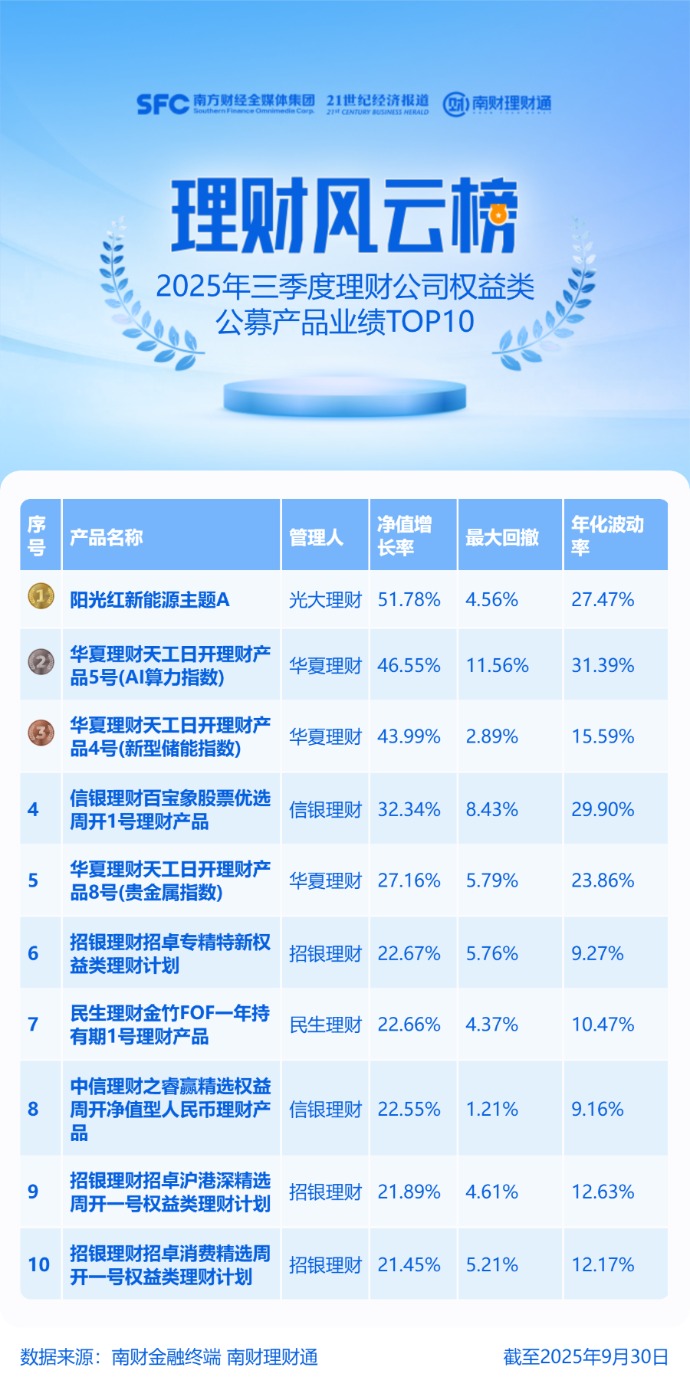
权益类理财三季度平均涨16%,榜首新能源产品涨52%
2 1 Shi Ji Jing Ji Bao Dao· 2025-10-21 09:37
Core Insights - The A-share market showed strong performance in Q3 2025, with the ChiNext Index rising over 50% and both the Shanghai Composite Index and Shenzhen Component Index achieving their highest quarterly gains since April 2019, with increases of 12.73% and 29.25% respectively [4] - The total trading volume in the A-share market reached a record high of 139.24 trillion yuan in Q3 2025, surpassing the total for the entire year of 2021 [6] - Equity wealth management products also performed well, with an average net value growth rate of 16.02% in Q3 2025, and 12 products exceeding a 20% growth rate [7] Market Performance - The A-share market experienced significant upward momentum from July 1 to September 30, 2025, with major indices reflecting strong growth [4] - The TMT sectors, including telecommunications, electronics, power equipment, and non-ferrous metals, led the market with gains exceeding 40% [6] Product Performance - The top-performing equity wealth management products in Q3 2025 were heavily focused on sectors like new energy, AI computing power, and new energy storage, with returns exceeding 40% [8] - Specific products such as "Sunshine Red New Energy Theme A" and "Hua Xia Wealth Management Tian Gong Ri Kai Product No. 5" achieved net value growth rates of 51.78% and 46.55% respectively [8] - The "Tian Gong Ri Kai Product No. 5" is classified as a high-risk product with significant volatility, showing a year-to-date return of -3.59% prior to Q3 [8] Asset Allocation - The "Bai Bao Xiang Stock Preferred Weekly Open No. 1" product has a diversified asset allocation, including 52.60% in equity assets and 32.27% in public funds [9] - Despite past negative returns from 2022 to 2024, the investment manager remains optimistic about the market's recovery potential due to ongoing economic transformation and increased funding sources [9]
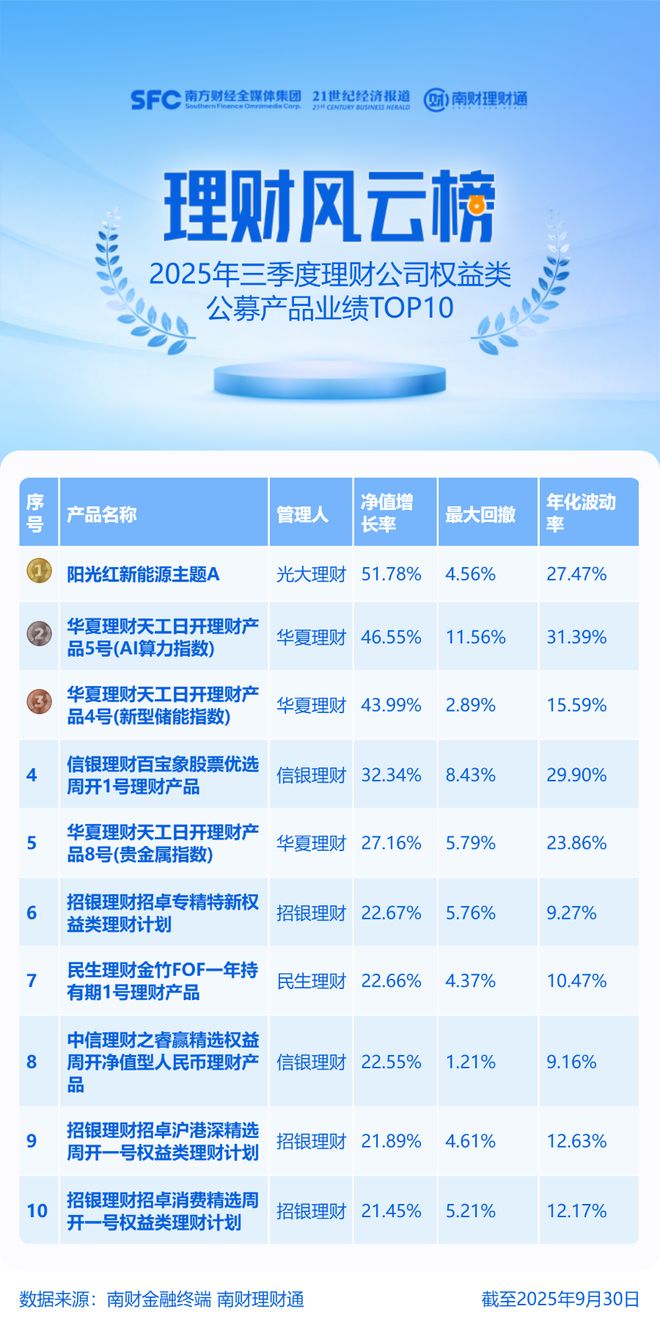
重回3900点!A股三大指数集体收涨
Sou Hu Cai Jing· 2025-10-21 08:25
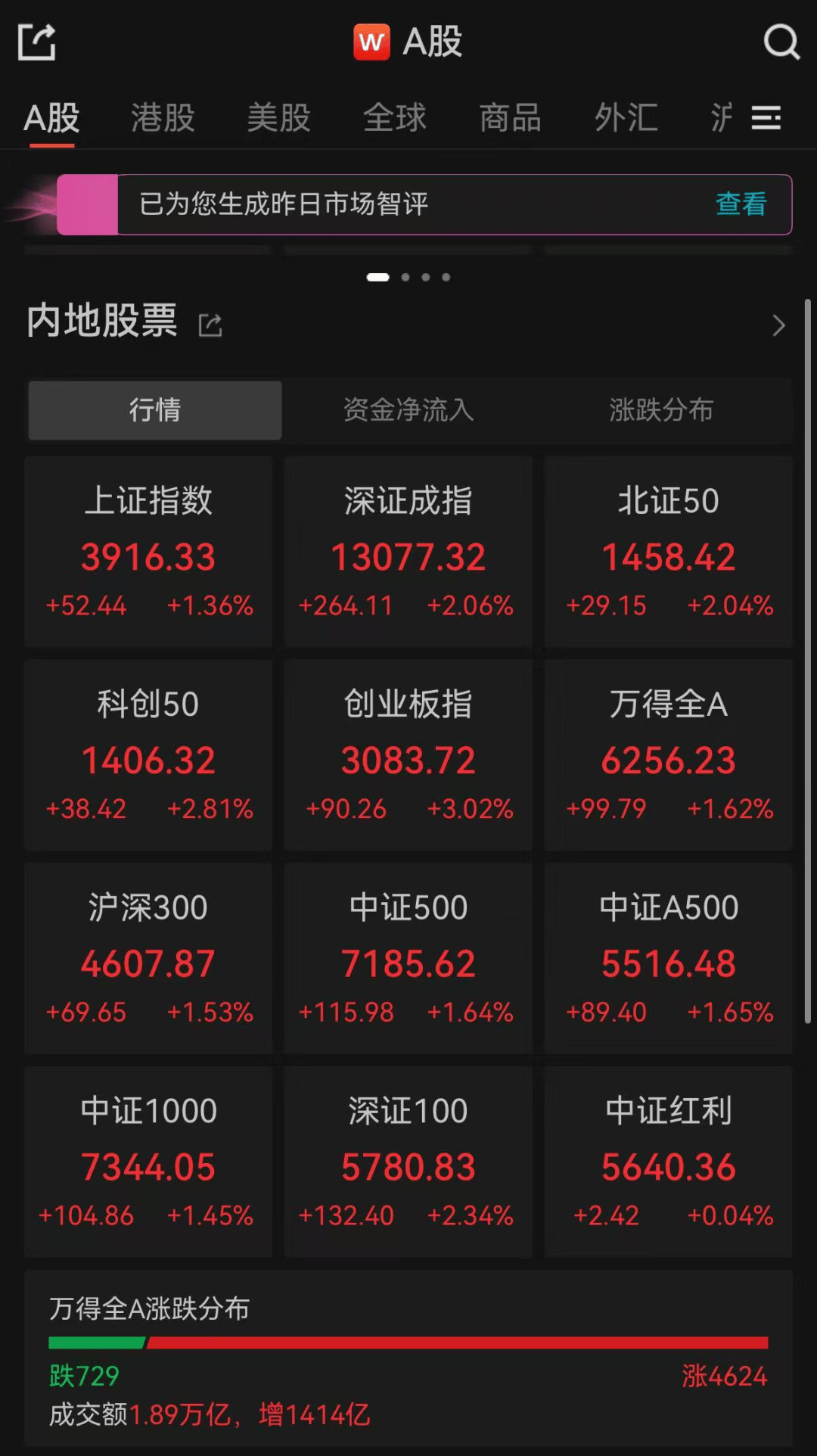
Market Overview - On the 21st, all three major A-share indices closed higher, with the Shanghai Composite Index rising by 1.36% to 3916.33 points, the Shenzhen Component Index increasing by 2.06%, and the ChiNext Index up by 3.02% [1] - The total trading volume for A-shares reached 1.89 trillion yuan, with over 4600 stocks rising across the market [1] Sector Performance - The CPO, HBM, and consumer electronics sectors saw significant gains, while the electrolyte, coal, and civil aviation sectors experienced declines [4] - The fruit supply chain concept had notable performance, with companies like Luxshare Precision hitting the daily limit, and others such as Wingtech Technology and Huanxu Electronics also reaching their limits [4] - AI hardware led the gains, with Yuanjie Technology hitting a historical high, and companies like Zhongji Xuchuang and Xinyisheng seeing increases of over 10% [4] Detailed Sector Tracking - Communication equipment rose by 4.81%, energy equipment by 4.39%, and heavy machinery by 3.15% [5] - Real estate stocks strengthened, with Guangming Real Estate and Shenzhen Zhenye A hitting the daily limit, and Yunnan Chengdu Investment rising over 5% [6] - Brokerage stocks also saw gains, with Ruida Futures and Tianfeng Securities hitting the daily limit, and Changjiang Securities increasing by over 5% [6] Declines - Coal stocks generally fell, with China Coal Energy and Yanzhou Coal Mining dropping over 2% [7] - Civil aviation stocks retreated, with China Southern Airlines and China National Aviation falling by 2% [7]
京东iPhone Air成交额1秒破亿!苹果“引爆”eSIM手机商用 国产芯片供应进程到哪了?
Mei Ri Jing Ji Xin Wen· 2025-10-21 07:19
Core Viewpoint - The approval of eSIM mobile phone commercial trials by China's three major telecom operators marks a significant step towards the widespread adoption of eSIM technology in the country, with the iPhone Air set to lead the market [1][2][3]. Group 1: eSIM Technology Launch - China Mobile, China Unicom, and China Telecom have received approval to conduct eSIM mobile phone commercial trials across all 31 provinces in China [1]. - The iPhone Air, launching on October 22, is the first smartphone in China to support only eSIM, achieving over 100 million yuan in sales within one second during pre-sales [1]. - Domestic manufacturers like Huawei and OPPO are expected to follow suit by launching their own eSIM phones [1]. Group 2: Supply Chain and Manufacturing - The supply of domestic eSIM chips is still in the early stages, with companies like Unisoc and Tongfu Microelectronics being key players in the supply chain [1][3]. - Unisoc has confirmed that its eSIM chip technology is mature and compatible with over 400 global operators, but the final selection of domestic operators remains unclear [1][5]. - Companies such as Jiangsu Changjiang Electronics Technology and New Henghui are actively developing new technologies and expanding their market share in the eSIM sector [4][6]. Group 3: Industry Development and Challenges - The eSIM market in China has experienced a halt due to the suspension of certain services by the three major operators in 2023, impacting the entire eSIM industry chain [3]. - The collaboration model between chip manufacturers, telecom operators, and smartphone manufacturers is still undefined, with the need for regulatory clarity from the Ministry of Industry and Information Technology [5]. - China Unicom and China Telecom are committed to building an open and collaborative eSIM ecosystem, aiming to innovate and enhance service models in the telecommunications industry [6].
你的下一部手机,或不再有卡槽!京东iPhone Air成交额1秒破亿!苹果“引爆”eSIM手机商用,国产芯片供应进程到哪了?
Mei Ri Jing Ji Xin Wen· 2025-10-21 07:11
Core Insights - The three major telecom operators in China, China Mobile, China Unicom, and China Telecom, have been approved to conduct commercial trials of eSIM technology nationwide, allowing users to register without a physical SIM card [1][2][3] - The iPhone Air, set to launch on October 22, is the first smartphone in China to support only eSIM, achieving over 100 million yuan in sales within one second during pre-sales [1][2] - Domestic manufacturers like Huawei and OPPO are expected to release eSIM-enabled smartphones soon, indicating a significant shift towards eSIM technology in the market [1][3] Industry Developments - The eSIM technology in China has evolved through various stages, including exploration, trials, and pauses, with significant contributions from China Unicom since 2015 and China Mobile's introduction of the smallest eSIM module in 2017 [3][5] - The eSIM market faced a setback in 2023 when the three major operators paused the one-number dual-terminal service and independent eSIM card applications, leading to stagnation in the eSIM market [3][5] - Unisoc is the first domestic company to achieve global commercial use of eSIM chips, with products compliant with GSMA standards [3][5] Supply Chain and Collaboration - The supply of domestic eSIM chips is currently dependent on establishing new business models and protocols for integration into smartphones, with uncertainty regarding the final partners involved [5][6] - Companies like Unisoc and Changdian Technology are actively developing technologies and expanding their market presence in the eSIM sector, indicating a positive outlook for future opportunities [4][5] - The telecom operators are pursuing different strategies for eSIM technology, with China Mobile focusing on domestic chip and OS development, while China Unicom emphasizes innovation and collaboration within the industry [5][6] Future Prospects - Apple plans to introduce an eSIM Quick Transfer feature in the Chinese market, highlighting the growing importance of eSIM technology in the telecommunications landscape [7] - The readiness of domestic chip manufacturers to meet market demand will be crucial for the success of the eSIM transition in China [7]

2026-2032年中国集成电路(IC)市场前景研究与市场分析预测报告
Sou Hu Cai Jing· 2025-10-21 06:35
Core Insights - The report titled "2026-2032 China Integrated Circuit (IC) Market Outlook Research and Market Analysis Forecast" provides a comprehensive analysis of the IC industry in China, including market trends, regulatory environment, and competitive landscape [2][3][4]. Chapter Summaries Chapter 1: Overview of the Integrated Circuit (IC) Industry - Defines the electronic device manufacturing industry and its classifications [2]. - Provides definitions and classifications of integrated circuits (IC), including technical complexity and application breadth [2][3]. - Explains the terminology used in the IC industry and the classification within the national economic industry codes [2]. Chapter 2: Macro Environment Analysis of China's IC Industry (PEST) - Analyzes the policy environment, including regulatory frameworks and standard systems in the IC industry [2][3]. - Discusses the economic environment, including GDP growth and structural changes in China's economy [2][3]. - Examines the social environment, focusing on urbanization, disposable income, and consumer spending patterns [2][3]. - Reviews the technological environment, including key processes, research investments, and innovation outcomes in the IC sector [2][3]. Chapter 3: Global IC Industry Development and Market Trends - Provides an overview of the global IC industry, including historical development and macroeconomic background [4]. - Analyzes global market size, shipment volumes, and competitive landscape [4]. - Discusses regional market dynamics, focusing on key players in the US and South Korea [4]. Chapter 4: Supply and Demand Conditions in China's IC Industry - Reviews the development history and trade status of China's IC industry, including import and export dynamics [5][6]. - Analyzes market supply conditions, including production capacity and output levels [5][6]. - Discusses market demand characteristics and sales performance of IC enterprises [5][6]. Chapter 5: Competitive Landscape and M&A Analysis in China's IC Industry - Examines the competitive layout and market concentration in the IC industry [6][7]. - Analyzes the investment and merger trends within the industry, highlighting significant transactions [6][7]. Chapter 6: Structure and Layout of the IC Industry Chain - Analyzes the structure and value chain of the IC industry, including upstream supply markets [7][8]. - Discusses the market analysis of IC chip design, manufacturing, and packaging/testing [7][8]. Chapter 7: Case Studies of Key Enterprises in China's IC Industry - Provides detailed case studies of major IC companies in China, including their business structures and market strategies [9][10]. Chapter 8: Market and Investment Strategy Recommendations - Conducts a SWOT analysis of the IC industry and evaluates its development potential [11][12]. - Offers strategic recommendations for investment opportunities and sustainable development in the IC sector [11][12].

3年亏掉30亿!国产GPU龙头沐曦IPO,盈利最早要等明年
Bei Ke Cai Jing· 2025-10-21 03:11
Core Viewpoint - The IPO process of Mu Xi Integrated Circuit (Shanghai) Co., Ltd., a leading domestic GPU chip company, is progressing, attracting significant attention from the capital market as it aims to raise 3.904 billion yuan for various GPU development projects [1][3][5]. Company Overview - Mu Xi plans to issue no more than 40.1 million A-shares and aims to raise 3.904 billion yuan, with 2.459 billion yuan allocated for high-performance general-purpose GPU R&D and industrialization, 453 million yuan for AI inference GPU R&D, and 991 million yuan for high-performance GPU technology R&D [5]. - The company has not yet achieved profitability, with revenues from 2022 to Q1 2025 showing significant growth: 426,400 yuan, 53.0212 million yuan, 740 million yuan, and 320 million yuan, while net losses were 780 million yuan, 870 million yuan, 1.4 billion yuan, and 230 million yuan respectively [4][5]. - Mu Xi's core revenue sources include the Xi Yun C500 series and Xi Si N100 series GPU boards, with the Xi Yun C500 contributing over 70% of revenue [5]. Market Context - The domestic GPU market is experiencing a surge in demand due to increased investments in computing power from major internet companies, with Alibaba planning to invest over 380 billion yuan in cloud and AI hardware infrastructure over the next three years [10]. - The domestic accelerated computing server market is projected to reach 22.1 billion USD in 2024, with GPU servers accounting for 69% of this market [11]. - The competitive landscape is dominated by NVIDIA and AMD, but domestic brands are gaining market share due to the push for domestic alternatives [12]. Investment Landscape - Mu Xi has attracted notable investors such as Sequoia Capital and Matrix Partners, indicating strong interest in the domestic GPU sector [8]. - The capital influx is reshaping the domestic GPU industry, with companies like Mo Er Thread also seeking substantial funding [9]. - The trend of "demand-driven + capital support + industry chain collaboration" is accelerating the maturity of the domestic GPU industry, gradually breaking the market monopoly held by foreign companies [13].
传感器概念震荡拉升,理工光科20%涨停
Mei Ri Jing Ji Xin Wen· 2025-10-21 03:11
Group 1 - The sensor concept has experienced a significant surge, with companies like LIGONG Optics reaching a 20% limit-up [1] - Other companies such as Shanhe Intelligent, Pioneer Electronics, and several others including Gaohua Technology, Lens Technology, GoerTek, Suao Sensor, Bicon Technology, and Tongfu Microelectronics have also seen increases in their stock prices [1]

GPU指数盘中强势拉升,日涨幅达2.01%
Mei Ri Jing Ji Xin Wen· 2025-10-21 02:53
Core Viewpoint - The GPU index experienced a strong rally, with a daily increase of 2.01% on October 21 [1] Company Performance - Beijing Junzheng saw an increase of 3.85% [1] - Tongfu Microelectronics rose by 3.49% [1] - SMIC (Semiconductor Manufacturing International Corporation) increased by 3.27% [1] - Chipone Technology gained 3.03% [1] - Changdian Technology experienced a rise of 2.02% [1]




