OPPO

Search documents
广东各地市陆续召开市委全会 因地制宜谋划“十五五”发展蓝图
Nan Fang Ri Bao Wang Luo Ban· 2025-12-23 07:46
Core Insights - The article discusses the strategic planning of Guangdong's economic and social development during the "15th Five-Year Plan" period, emphasizing the transition to a new stage of regional development [1] - The focus is on leveraging technological innovation and industrial upgrades to enhance competitiveness and achieve high-quality development across various regions in Guangdong [2][3] Group 1: Economic Development Strategies - The Pearl River Delta (PRD) is shifting from factor-driven growth to innovation-driven development, aiming to create a modern industrial system with international competitiveness [2][5] - Guangzhou plans to establish a "12218" modern industrial system, focusing on six major trillion-yuan industrial clusters while exploring future industries like low-altitude economy and artificial intelligence [3] - Shenzhen aims to enhance its real economy by integrating digital, network, and financial services into manufacturing upgrades, focusing on smart, green, and health trends [3] Group 2: Regional Collaboration and Integration - The Guangdong-Hong Kong-Macao Greater Bay Area is a key focus, with cities embedding their plans into national strategies to optimize regional development through both hard and soft connectivity [6][7] - Cities like Huizhou and Zhuhai are actively participating in urban integration and collaboration, enhancing connectivity and promoting coordinated development within the Bay Area [7] Group 3: Urban Quality and Sustainability - The emphasis is on transforming urban development from scale expansion to quality improvement, with cities aiming to build modern, resilient, and livable environments [8][9] - Guangzhou's approach includes urban renewal and village renovation, while Dongguan focuses on creating a "smart and beautiful" city [9][10] Group 4: Emerging Industries and Innovation - The article highlights the importance of new industries such as artificial intelligence, digital economy, and renewable energy in driving economic growth in the PRD [4][12] - Cities like Shaoguan and Yangjiang are positioning themselves as hubs for emerging industries, including smart computing and commercial aerospace [12][13] Group 5: Ecological and Cultural Development - The development of cultural tourism and ecological projects is emphasized, with cities leveraging their unique resources to enhance local economies [17][18] - The focus on green development is evident, with initiatives aimed at improving ecological quality and promoting sustainable practices across various regions [18][19]
华米OV竞速AI,谁都不想成为“诺基亚”
3 6 Ke· 2025-12-23 04:29
Core Insights - The smartphone market is experiencing a dichotomy, with stagnant hardware specifications and extended replacement cycles on one side, while AI smartphones are gaining traction on the other [2][3][4] Market Trends - The average global smartphone replacement rate has dropped to 23.7%, corresponding to a replacement cycle of approximately 51 months [2] - AI smartphones are projected to reach a global shipment of 170 million units in 2024, accounting for 15% of total smartphone shipments [3] - In China, the share of AI smartphones is expected to exceed 50% by 2027, with a global penetration rate surpassing 35% by 2026 [4] Company Performance - As of Q3 2025, vivo leads the Chinese smartphone market with a 17.2% share, despite a year-on-year decline of 7.8% [8][9] - Xiaomi and OPPO are hovering around a 14% market share, with Xiaomi experiencing a 1.7% decline and OPPO a slight increase of 0.4% [8][9] - Honor's market share stands at 14.4%, down 1.5% year-on-year [8][9] AI Integration and Strategy - The introduction of AI features in smartphones has not yet significantly boosted overall sales, but there is a noticeable impact in the high-end market segment [11] - Companies like vivo and OPPO are heavily investing in AI, with vivo's investment exceeding 23 billion yuan and OPPO's surpassing 10 billion yuan [13][15] - Honor plans to invest $10 billion in AI terminal technology over the next five years, while Xiaomi aims to invest over 200 billion yuan in AI research and development [15] Technological Advancements - The shift towards "on-device AI" is a key focus, allowing smartphones to perform complex tasks independently [16][20] - Major advancements in AI chip performance are enabling more sophisticated AI applications in smartphones, with Qualcomm and MediaTek leading the way [21][22][24] Competitive Landscape - The smartphone market is highly concentrated, with the top six brands holding a combined market share of 91.8% [11] - The overall smartphone shipment in China is projected to remain stagnant, with a slight year-on-year decline of 0.3% [11][13] Future Outlook - The AI smartphone market is seen as a critical area for growth, with companies needing to adapt or risk obsolescence [26][30] - Despite challenges such as rising costs and competition from other smart devices, smartphones remain the central hub for personal AI interactions [30]



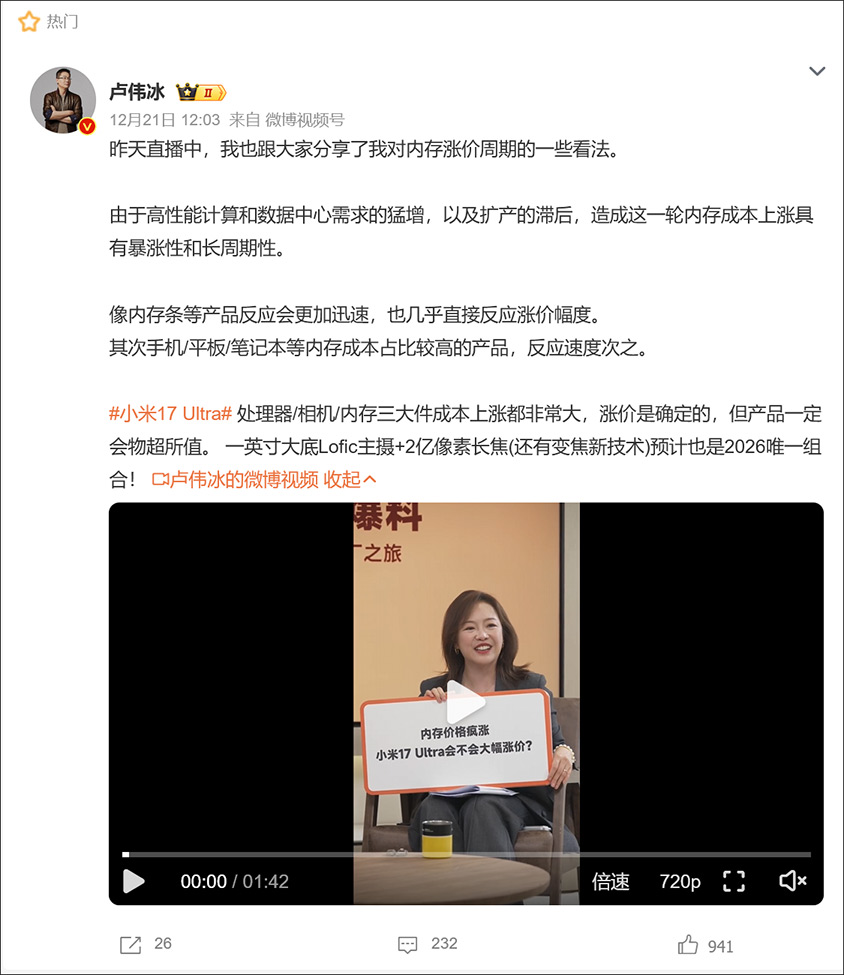
手机成本趋势非常恶劣?小米、荣耀再发声:刚需别等了
Guan Cha Zhe Wang· 2025-12-23 03:45
Group 1 - The global memory chip market is experiencing a significant price increase due to tight supply from DRAM manufacturers, impacting consumer electronics pricing [1][4] - Major smartphone manufacturers like Xiaomi, OPPO, and Honor have raised prices for new models by 100 to 600 yuan, with predictions of further price hikes in 2024 [1][3] - Xiaomi's president confirmed that the price of the Xiaomi 17 Ultra series will increase significantly due to rising memory costs, with estimates suggesting a 500 yuan increase to a starting price of 6999 yuan [1][3] Group 2 - The overall cost pressure in the electronics industry is severe and expected to persist for at least one to two years, leading to potential price increases for previously released products [3][4] - TrendForce forecasts a 30.9% increase in DRAM industry revenue in Q3 2025, with contract prices expected to rise by 45-50% in Q4 2025 [4] - Counterpoint Research predicts a 2.1% decline in global smartphone shipments in 2026 due to memory chip shortages and rising prices, with Apple and Samsung positioned to better withstand these challenges [5][7] Group 3 - The rising memory costs are forcing manufacturers to either increase product prices or reduce specifications, with a focus on optimizing product structure to mitigate losses [7][8] - PC manufacturers like Dell have already announced price increases of 10% to 30% for commercial PCs, with other brands likely to follow suit [8][9] - The DIY market is also affected, with some companies offering "no memory" options for custom builds due to skyrocketing memory prices [9][10] Group 4 - The decline in motherboard sales by 40% to 50% indicates a broader impact on the sales of CPUs and SSDs, as consumers are hesitant to purchase components amid rising prices [10] - The consensus within the industry suggests that a price increase across consumer electronics is inevitable, leading to a potential missed opportunity for consumers who delay purchases [11]
网传段永平牵头OPPO、vivo联手众泰汽车造车,众泰汽车:目前没有合作
Xin Lang Cai Jing· 2025-12-23 01:33
Core Viewpoint - Recent rumors suggest that Duan Yongping will lead OPPO and vivo in participating in the restructuring of Zotye Auto, but both OPPO and vivo have not responded officially as of the report date [1][2]. Group 1: Company Developments - Zotye Auto's new board of directors, announced in October, includes nearly half of its non-independent directors who previously worked at Chery Automobile, raising speculation about a potential collaboration between Budweiser and Chery in the restructuring of Zotye Auto [2]. - Independent directors Ma Yanhong and Xu Mingzhe are closely associated with Duan Yongping's BBK Group, further fueling industry speculation about possible partnerships involving OPPO and vivo in terms of technology and distribution [2]. Group 2: Official Responses - As of the report date, both OPPO and vivo have not provided any official comments regarding the rumors of their involvement in Zotye Auto's restructuring [1][2]. - Zotye Auto has addressed investor inquiries about potential collaboration with Chery and Budweiser, stating that there is currently no partnership and that any future collaborations will be disclosed in accordance with legal requirements [2].

快手直播间出现大量涉黄内容,快手回应:遭到黑灰产攻击;吉利汽车宣布完成极氪私有化;Waymo无人车闯祸了!路口集体趴窝导致堵车
雷峰网· 2025-12-23 00:34
Key Points - Waymo's autonomous vehicles experienced a significant malfunction, causing traffic congestion in San Francisco due to a power outage affecting traffic lights, leading to passengers being trapped for extended periods [4][5] - Light sail technology company, a Xiaomi-affiliated startup, is set to launch the world's first AI headphones with a camera, aiming to enhance human-computer interaction [8][9] - Kuaishou faced a major issue with explicit content appearing in live streams, which the platform attributed to a black market attack, and has reported the incident to authorities [10] - BYD confirmed salary increases for its R&D personnel, with adjustments targeting engineers in key areas such as battery materials and autonomous driving algorithms [12] - Geely announced the completion of the privatization of its electric vehicle brand, Zeekr, which will now be a wholly-owned subsidiary [15] - Tencent has hired a key talent from ByteDance's AI team, indicating a strategic move to bolster its capabilities in artificial intelligence [18] - Polestar, supported by Geely, secured a $600 million loan to stabilize its operations amid financial challenges, with plans for new model launches [31] - Honor's executive highlighted the ongoing cost pressures in the electronics industry, indicating that price increases for smartphones are inevitable [32] - Noitom Robotics completed a Pre-A+ funding round, raising several hundred million yuan to enhance its data solutions for humanoid robots [29][30] - The German railway company has ordered 200 electric buses from BYD, sparking controversy over local manufacturing preferences [48] - Nvidia's $5 billion investment in Intel aims to reshape the chip industry, focusing on developing customized CPUs and integrating GPU technologies [49][51]

8点1氪:明年1月1日起,向好友发淫秽信息违法;多平台回应陈震账号解封传闻;日本最大核电站将重启,此前因福岛核事故关闭
36氪· 2025-12-23 00:16
Group 1 - The revised "Public Security Administration Punishment Law" will take effect on January 1, 2026, increasing penalties for disseminating obscene information [2][3] - The new law clarifies that using information networks, telephones, and other communication tools to spread obscene information is punishable, regardless of whether it occurs in public groups or private chats [5] - Penalties include detention of 10 to 15 days and fines up to 5,000 yuan for serious cases, while lighter cases may incur detention of up to 5 days or fines between 1,000 and 3,000 yuan [5] Group 2 - The law aims to correct the public misconception that private dissemination of obscene information is merely a moral issue [5] - Even sending inappropriate photos or videos in private chats can lead to legal consequences if reported and verified [6]





三星明年计划推“阔折叠”手机,与iPhone Fold正面交锋
3 6 Ke· 2025-12-22 11:38
Core Viewpoint - Samsung plans to launch a "wide-foldable" smartphone in the fall of 2026 to compete directly with Apple's first foldable phone, the iPhone Fold [2][3] Group 1: Product Details - The "wide-foldable" smartphone will feature a 7.6-inch inner screen and a 5.4-inch outer screen, both made of OLED material, with a 4:3 aspect ratio [2] - This device is expected to support 25W wireless charging, making it one of Samsung's fastest wireless charging phones [2] - The inner screen's aspect ratio is designed to provide a more tablet-like display experience, enhancing web browsing and photo viewing capabilities [2] Group 2: Competitive Landscape - Apple is also expected to release the iPhone Fold in the second half of 2026, with an inner screen size of 7.76 inches and an outer screen of 5.49 inches [2] - Other brands like OPPO, vivo, Xiaomi, and Honor are planning to launch "wide-foldable" phones next year [3] - Omdia forecasts that global shipments of foldable smartphones will remain around 6.6 million units in the first half of 2025, with a significant growth of 32.8% in the Chinese market [3] Group 3: Market Dynamics - The foldable smartphone market is expected to see a 51% year-on-year increase in shipments by 2026, driven by intensified competition and more affordable flip models [3] - Despite the growth potential, foldable phones will remain a niche market, accounting for a low single-digit percentage of the overall smartphone market [6] - Samsung holds a 19% market share, maintaining its position as the global leader for three consecutive quarters, while Apple follows closely with an 18% share [7]

华为Mate80助力份额登顶,连续两周超越苹果夺魁
Xin Lang Cai Jing· 2025-12-22 11:24
Group 1 - Huawei's market share in the domestic smartphone market has surpassed Apple's for two consecutive weeks since the launch of the Mate 80 series, reclaiming the top position [2][3] - In weeks 48 and 49, Huawei held market shares of 27.81% and 22.89% respectively, while Apple's shares were 17.12% and 18.65%, placing it in second [2][3] - The sales ranking for week 49 shows that the iPhone 17 Pro Max achieved the highest sales, followed by Huawei's Mate 80 in second place, indicating strong sales performance for both models [2][3] Group 2 - The top ten sales rankings also include models such as Honor X70, Vivo Y50 2025, OPPO Reno15, A5x, Honor 500, and Vivo Y500, listed in order [3]
从0到4300万用户,Qpon如何破局东南亚本地生活
3 6 Ke· 2025-12-22 09:49
Core Insights - The article discusses how Indonesia is becoming a testing ground for Chinese internet companies as they transition from "tool export" and "content export" to "service and model export" [2] - Qpon, an application incubated by Chinese smartphone manufacturer OPPO, has rapidly gained traction in Indonesia's local life service market, highlighting the potential for digital payment and online consumption [3][5] Market Landscape - Indonesia, as the largest economy in Southeast Asia, has a smartphone penetration rate exceeding 75%, and a standardized QR payment system (QRIS) has been implemented nationwide [6] - Despite a retail market size of $183 billion, only 20% of merchants have moved online, indicating a significant gap in service supply despite mature infrastructure [6] Qpon's Growth Strategy - Qpon has successfully identified and capitalized on the gap in local life services, avoiding the crowded food delivery market and focusing on in-store services [6] - The application has achieved over 43 million users and an average of 660,000 daily orders within a year, indicating strong market demand [3] Localization and Adaptation - Qpon has adapted successful Chinese business models to fit local Indonesian characteristics, achieving high growth efficiency [7] - The platform employs low-cost user acquisition strategies leveraging OPPO's extensive user base and offline channels [7] User Engagement and Retention - Qpon utilizes pricing strategies such as "7K coffee" and "1K first order" to attract price-sensitive users, embedding savings into social interactions [9] - The platform's approach to turning "personal savings" into "social currency" has effectively reduced customer acquisition costs and replicated early-stage growth patterns seen in China's mobile internet [9] AI and Data Utilization - Qpon is leveraging AI technology to address the unstructured nature of information in the local life market, enhancing supply-demand matching efficiency [11] - The upcoming "QponX" feature will utilize AI to clean and structure data, improving user decision-making processes [11][13] Future Directions - Qpon's investment in AI and data technology signifies a shift towards enhancing operational efficiency and matching capabilities within the local life service chain [14] - The company is exploring a growth path that prioritizes algorithmic efficiency over labor intensity, which may offer greater scalability in the diverse and culturally rich Southeast Asian market [14]

从0到4300万用户,Qpon如何破局东南亚本地生活
36氪· 2025-12-22 09:30
Core Viewpoint - The article emphasizes that Indonesia is becoming a testing ground for Chinese internet companies as they transition from "tool export" and "content export" to "service and model export" in the Southeast Asian market [2] Group 1: Market Landscape - The digital consumption market in Indonesia has a mature infrastructure, yet there is a gap in software services, leading to the emergence of applications like Qpon, which has gained over 43 million users and 660,000 daily orders within a year [4][6] - Indonesia's retail market is valued at $183 billion, but only 20% of merchants have moved online, indicating a significant opportunity for digital service providers [9] Group 2: User Acquisition and Retention - Qpon leverages low-cost user acquisition strategies by utilizing OPPO's extensive user base and offline channels, achieving high growth efficiency [11] - The platform employs pricing strategies like "7K coffee" and "1K first order" to attract price-sensitive users, integrating social elements to enhance user engagement and retention [12][14] Group 3: Technological Integration - Qpon is utilizing AI to address the issue of unstructured data in the local market, aiming to create a new digital infrastructure that enhances supply-demand matching efficiency [16] - The introduction of features like "Qpon Adviser" allows for more intuitive user interactions, making decision-making simpler and more accessible for users in Southeast Asia [18] Group 4: Competitive Landscape - Qpon's growth reflects the importance of timing and adapting business models to local markets, showcasing the potential of Chinese internet experiences when localized [19] - The competition in Southeast Asia is shifting towards enhancing operational efficiency and service intelligence, indicating that the next phase of competition will focus on digitalization and smart services [19]