
纳芯微

Search documents
一图看懂模拟芯片反倾销对国产厂商影响
Xuan Gu Bao· 2025-09-15 00:42
Core Viewpoint - The article discusses the potential impact of anti-dumping measures on the Chinese semiconductor market, specifically focusing on general interface chips and gate driver chips, highlighting production, demand, import statistics, and market elasticity under different scenarios [1]. Group 1: Production and Demand - In 2024, China's self-produced quantity of general interface chips is projected to be 520 million units, while gate driver chips are expected to reach 660 million units, totaling 1.18 billion units [1]. - The demand for general interface chips is estimated at 2.48 billion units, and for gate driver chips, it is 1.06 billion units, leading to a total demand of 3.54 billion units [1]. - Imports of chips are expected to be 2.36 billion units, with 1.59 billion units coming from the U.S., representing 67.5% of total imports [1]. Group 2: Pricing and Market Size - The average price for general interface chips is 1.6 yuan, while gate driver chips are priced at 1.7 yuan [1]. - The potential value of products affected by anti-dumping measures is estimated at 2.51 billion yuan, with 1.84 billion yuan for general interface chips and 670 million yuan for gate driver chips [1]. Group 3: Market Elasticity Scenarios - Under a neutral assumption where the anti-dumping measures lead to market expansion without price recovery, the market size for self-produced chips is projected at 1.94 billion yuan, with a market expansion elasticity of 229% for total chips [1]. - In an optimistic scenario where prices recover to U.S. domestic levels, the market size could reach 20.69 billion yuan, with an elasticity of 1067% for total chips [1]. Group 4: Related Companies - Companies such as Naxin Micro and Sirepu are highlighted, with significant revenue from industrial, automotive, and communication sectors, and a substantial portion of their revenue linked to anti-dumping affected products [1]. - Other companies to watch include Shengbang Co., Nanchip Technology, Longxun Co., Chipbond Micro, and Diaomicro, which are also involved in the semiconductor sector [1].

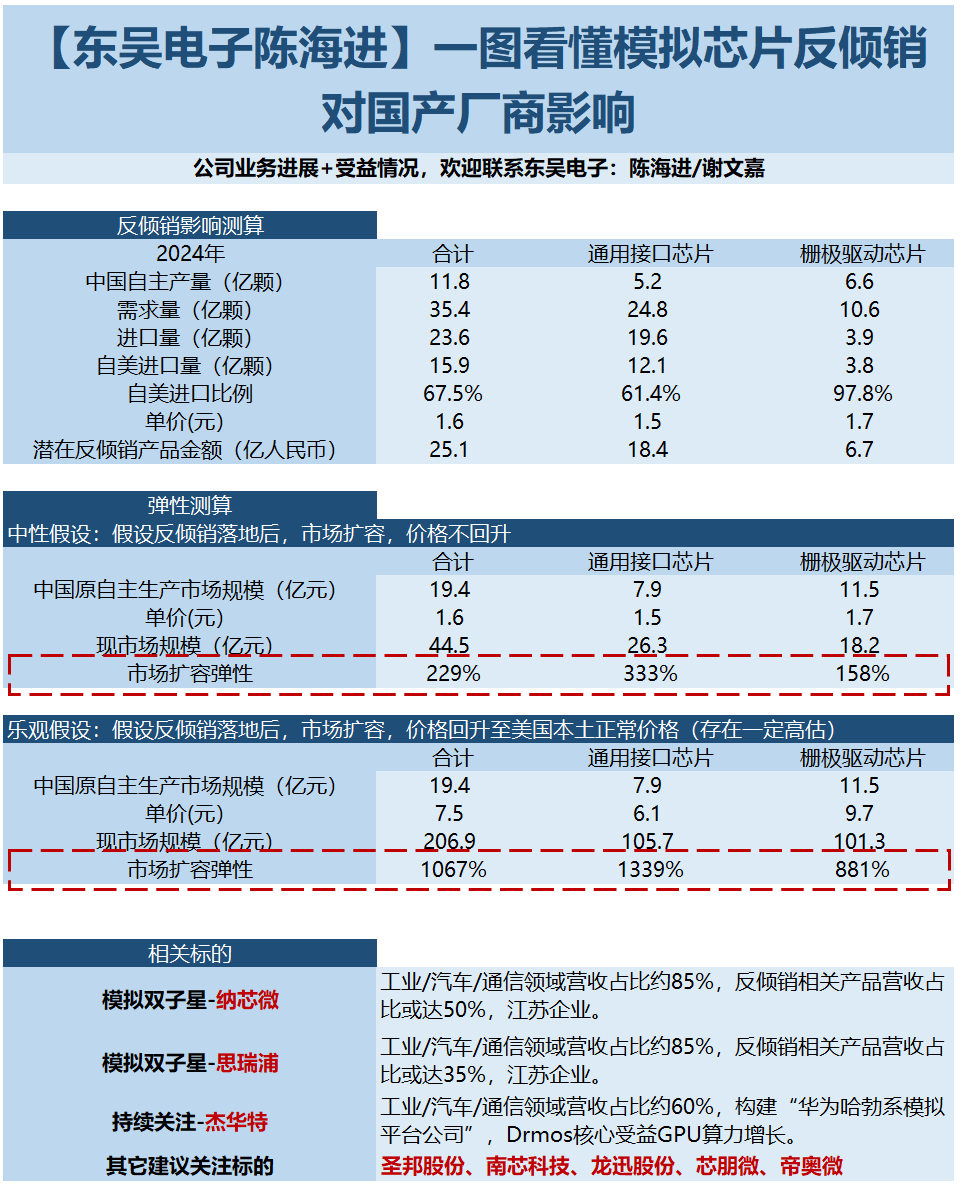
美模拟芯片倾销幅度300%以上,两大细分国产化空间巨大
Xuan Gu Bao· 2025-09-14 23:32
Core Insights - The Ministry of Commerce received an anti-dumping investigation application regarding imported analog chips from the U.S., with evidence showing a dumping margin exceeding 300% and a market share of 41% in China [1][2] - Major U.S. manufacturers involved include Texas Instruments, ADI, Broadcom, and ON Semiconductor, with significant import volumes of general interface chips and gate driver chips from the U.S. [1] - The anti-dumping measures are expected to significantly expand the market for domestic general interface chips and gate driver chips in China [3] Market Dynamics - In 2024, China is projected to account for approximately 35% of the global analog chip market, making it a key revenue source for major overseas manufacturers [2] - The revenue from major U.S. companies like TI, ADI, and MPS from China is estimated at $30 million, $21 million, and $12 million respectively, totaling $630 million [2] - The domestic analog chip leaders in A-shares are expected to generate only 3.35 billion yuan in revenue in 2024, indicating substantial potential for domestic production [2] Impact of Anti-Dumping Measures - According to estimates, the anti-dumping measures could expand the market for general interface chips and gate driver chips in China by 3.3 times and 1.6 times respectively [3] - The projected domestic production for general interface chips in 2024 is 1.18 billion units, with a demand of 3.54 billion units, indicating a significant gap that could be filled by domestic manufacturers [4] - The current import volume of general interface chips is 2.36 billion units, with 1.59 billion units coming from the U.S., representing 67.5% of total imports [4] Company Developments - Several semiconductor companies in Jiangsu, such as Naxin Micro, Sirepu, and Chipeng Micro, are positioned to benefit from the potential market expansion [5] - Tuojing Technology announced plans to raise 4.6 billion yuan for the construction of a high-end semiconductor equipment industrialization base, indicating a strong commitment to the semiconductor sector [5] - The semiconductor equipment sector is expected to see significant growth driven by the AI wave and domestic production demands, with potential for exceeding performance expectations [6]
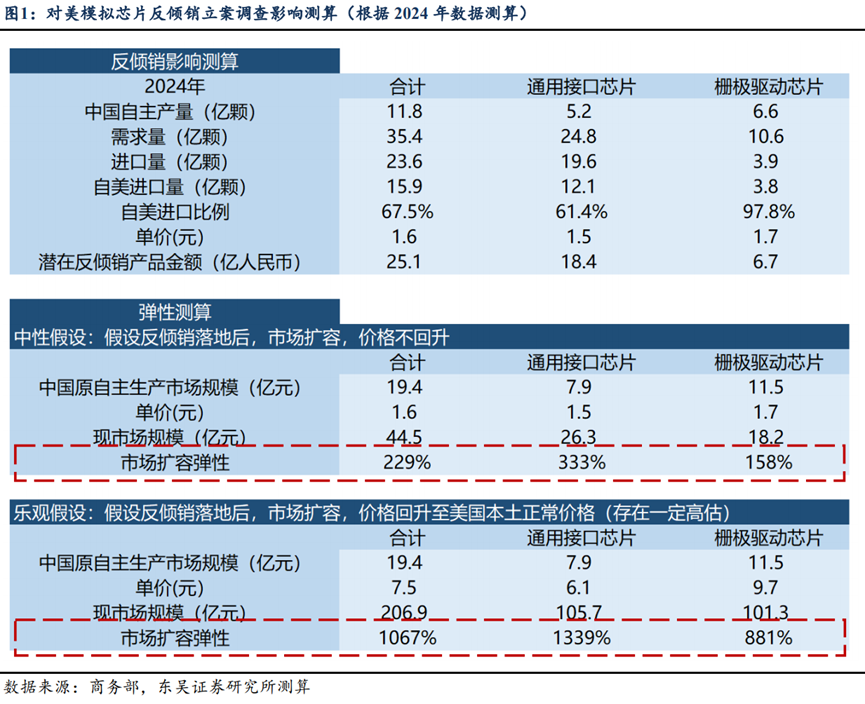
前有TI涨价,现有对美进口模拟芯片反倾销立案调查,模拟芯片国产替代趋势加强
Huaan Securities· 2025-09-14 12:05
Investment Rating - Industry investment rating is "Overweight" [1] Core Viewpoints - The Ministry of Commerce has initiated an anti-dumping investigation against imported analog chips from the United States, which strengthens the trend of domestic substitution for analog chips [4] - Texas Instruments (TI) has raised prices significantly, affecting various sectors including industrial control and automotive, with price increases exceeding 28% for certain products [5][6] - The anti-dumping investigation is seen as a countermeasure to the U.S. sanctions against Chinese entities, potentially leading to increased opportunities for domestic analog chip manufacturers [8] Summary by Relevant Sections - **Anti-Dumping Investigation**: The investigation targets U.S. manufacturers including Texas Instruments, ADI, Broadcom, and ON Semiconductor, with evidence showing a dumping margin exceeding 300% and a market share of 41% for the investigated products in China [4] - **Price Increases by TI**: TI's recent price hikes affect a wide range of products, with over 40% of industrial control chips experiencing significant increases. For example, the price of a 16-bit ADC chip rose from $3.2 to $4.1, marking a 28% increase [5][6] - **Investment Recommendations**: The report recommends focusing on companies like SiRuPu in the analog chip sector, along with others such as Shengbang Co., Naxin Micro, and Aiwei Electronics [8]

市场复苏、代工增长之下,信号链芯片赛道“涨声一片”
Ju Chao Zi Xun· 2025-09-14 09:28
Core Viewpoint - The signal chain chip industry is experiencing a recovery alongside the overall simulation chip sector, with companies focusing on expanding into high-end markets such as automotive electronics while maintaining their existing market positions [1] Revenue Performance - In the first half of the year, leading signal chain companies reported significant revenue growth, with all major firms achieving both revenue and net profit increases [1] - The top revenue-generating companies include: - Shengbang Co., Ltd.: 1.818 billion yuan, up 15.37% [2] - Naxin Micro: 1.523 billion yuan, up 79.49% [2] - Aiwei Electronics: 1.369 billion yuan, down 13.4% [2] - Shanghai Beiling: 1.347 billion yuan, up 21.27% [2] - Jiehuate: 1.187 billion yuan, up 58.2% [2] - Siripu: 949 million yuan, up 87.33% [2][4] Profitability Analysis - Shengbang Co., Ltd. reported a net profit of 200 million yuan, a year-on-year increase of 12.42%, while its non-recurring net profit decreased by 14.98% [5][7] - Aiwei Electronics achieved a net profit of 156 million yuan, a significant increase of 71.09%, with a non-recurring net profit growth of 81.88% [5][7] - Shanghai Beiling's net profit was 134 million yuan, up 2.25%, with a slight increase in non-recurring net profit [5][7] - Naxin Micro and Jiehuate reported net losses but showed improvement in revenue growth [7] R&D Investment - Companies are maintaining high levels of R&D investment, with the following expenditures: - Shengbang Co., Ltd.: 507 million yuan, 27.88% of revenue [8][10] - Naxin Micro: 361 million yuan, 23.71% of revenue [8][10] - Aiwei Electronics: 262 million yuan, 19.20% of revenue [8][10] - Shanghai Beiling: 201 million yuan [8][10] - Jiehuate: 420 million yuan, 35.45% of revenue [8][10] - Siripu: 268 million yuan, 28.29% of revenue [8][10] Market Dynamics - The global signal chain chip market is dominated by international giants like Texas Instruments and Analog Devices, particularly in high-end sectors such as industrial and automotive [10] - The domestic simulation chip market is projected to grow from 124.9 billion yuan in 2020 to 195.3 billion yuan in 2024, with a compound annual growth rate of 11.8% [10] - The signal chain chip market is expected to reach 105.9 billion yuan by 2029, with a compound annual growth rate of 7.2% from 2024 to 2029 [10][11] Regulatory Environment - Recent U.S. export controls and anti-dumping investigations may provide domestic signal chain chip companies with increased market opportunities, particularly in high-end sectors [11][12] - The investigation into U.S. manufacturers indicates significant price drops in products exported to China, suggesting a potential shift in market strategy by international firms [12]



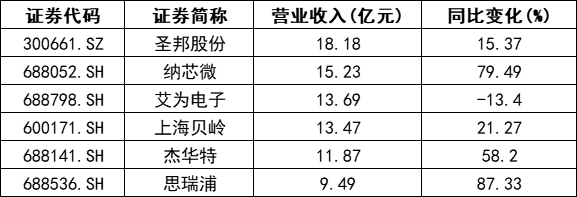
电子行业点评报告:模拟反倾销调查启动,多维拆解影响几何?
Soochow Securities· 2025-09-14 04:34
证券研究报告·行业点评报告·电子 电子行业点评报告 模拟反倾销调查启动,多维拆解影响几何? 2025 年 09 月 14 日 增持(维持) [Table_Tag] [Table_Summary] 投资要点 ◼ 风险提示:政策不及预期,技术发展不及预期,市场竞争风险。 行业走势 0% 11% 22% 33% 44% 55% 66% 77% 88% 99% 2024/9/18 2025/1/15 2025/5/14 2025/9/10 电子 沪深300 相关研究 《国产算力认知强化!GPU"芯片"视 角向"超节点"转换》 2025-09-11 证券分析师 陈海进 执业证书:S0600525020001 chenhj@dwzq.com.cn 研究助理 谢文嘉 执业证书:S0600125020003 xiewenjia@dwzq.com.cn 《百万 Token 时代来临,Rubin CPX 重塑推理架构与产业链》 2025-09-10 东吴证券研究所 1 / 3 请务必阅读正文之后的免责声明部分 ◼ 核心观点:我们认为"海外价格战"一直为模拟板块核心压制,尤其是 汽车/工业/通信领域。反倾销的推进,有望解放模拟厂商 ...
芯片大战,再次爆发
Sou Hu Cai Jing· 2025-09-13 14:22
Core Insights - A new round of competition has erupted between China and the U.S. in the semiconductor sector, particularly following the U.S. Department of Commerce's decision to place 23 Chinese companies on an export control entity list [1][2][5]. Group 1: Impact on Semiconductor Companies - Among the 23 companies listed, 13 are related to semiconductors and integrated circuits, including notable firms like Fudan Microelectronics and Shanghai Hualing Integrated Circuit [4]. - The U.S. export controls will prevent these semiconductor companies from obtaining supplies from the global supply chain, effectively cutting them off [5]. - The announcement of anti-dumping investigations by China's Ministry of Commerce indicates a potential retaliatory measure against U.S. restrictions, which could lead to increased market opportunities for domestic semiconductor firms [8][10]. Group 2: Market Opportunities for Domestic Firms - The anti-dumping investigation may benefit several domestic companies such as Sanan Optoelectronics, Nanjing Microelectronics, and others, as it raises the cost and barriers for importing U.S. analog chips [11]. - China is the largest consumer market for electronic products and imports over 300 billion yuan worth of analog chips annually, with a significant portion coming from the U.S. [10]. - The shift towards domestic production and the potential for increased market share for local firms could lead to a more competitive landscape in the semiconductor industry [12]. Group 3: Future Trends and Negotiations - The ongoing competition signals a broader trend of decoupling in core technology sectors, with China beginning to assert its capabilities in response to U.S. actions [12]. - Upcoming negotiations between Chinese and U.S. officials will address unilateral tariff measures and export controls, indicating a potential for dialogue despite the competitive tensions [13]. - The expectation is that both countries may eventually reach a trade agreement, suggesting a complex interplay between competition and cooperation in the semiconductor sector [14].
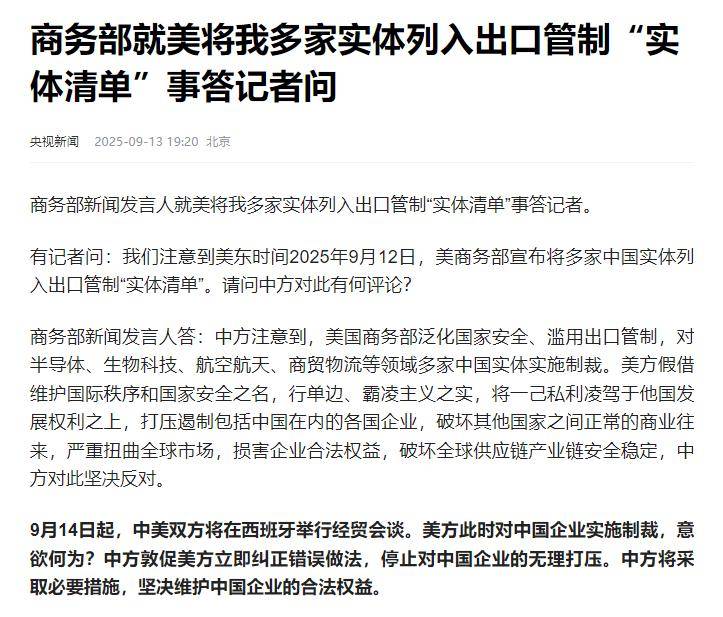
国产替代加速!中国对美国模拟芯片发起反倾销调查!
Sou Hu Cai Jing· 2025-09-13 14:00
Core Viewpoint - The Chinese Ministry of Commerce has initiated an anti-dumping investigation into imported analog chips from the United States, which may benefit domestic manufacturers if punitive tariffs are imposed on U.S. companies found guilty of dumping [2][13]. Group 1: Anti-Dumping Investigation - The Ministry of Commerce received a formal application for an anti-dumping investigation on July 23, 2025, from the Jiangsu Semiconductor Industry Association regarding U.S. analog chips [2]. - The investigation was officially launched on September 13, 2025, after the Ministry's preliminary review confirmed the applicant's qualifications and the impact of the imported products on the domestic industry [4]. Group 2: U.S. Export Controls - On September 12, 2025, the U.S. Department of Commerce added 23 Chinese entities to its export control "entity list," which has been criticized by the Chinese government as a form of unilateral and bullying behavior [5]. - The Chinese government argues that such actions distort the global market and harm legitimate business rights, particularly in the semiconductor sector [5]. Group 3: Market Overview - The global analog chip market was valued at approximately $74 billion in 2021, with major U.S. companies like Texas Instruments, Analog Devices, and Skyworks holding nearly 40% of the market share [8]. - By 2024, the global analog chip market is projected to reach $79.43 billion, with China expected to account for about $45 billion, representing 58.5% of the global market [8]. Group 4: Domestic Industry Landscape - Despite the high demand in China, local manufacturers hold only about 11% of the global market share, primarily in low-end power management chips, while foreign companies dominate the high-end market [8][10]. - The Chinese analog chip industry is characterized by a "large but weak" profile, with many companies generating revenues below $5 billion, in stark contrast to Texas Instruments, which is projected to generate $15.64 billion in 2024 [10]. Group 5: Growth Potential - The Chinese analog chip market is expected to grow to approximately $43.99 billion by 2025, with a compound annual growth rate (CAGR) of 8.32% projected until 2030 [8]. - Domestic companies are increasingly focusing on sectors like automotive and industrial applications, with some achieving significant milestones in chip supply [11].

【国信电子|模拟芯片专题】推荐具有高端化和平台化能力的企业
剑道电子· 2025-09-12 14:20
Core Viewpoint - The analog chip industry is entering an upward cycle, with expected global market growth of 3.3% in 2025 and 5.1% in 2026, reaching $82.2 billion and $86.4 billion respectively. The long-term growth is driven by AI applications such as data centers, autonomous driving, and humanoid robots, indicating significant potential for domestic companies [3][7][12]. Industry Overview - The global analog chip market has a CAGR of 4.77% from 2004 to 2024, with a projected market size of $79.6 billion in 2024, which is a 2.0% decrease from the previous year. The market is expected to recover in 2025 and 2026 [3][12]. - The Chinese analog chip market is projected to reach ¥195.3 billion in 2024, with a CAGR of 11% from 2025 to 2029. The market is driven by sectors such as industrial, automotive, and AI [18][21]. Key Applications and Growth Areas - Key growth areas for analog chips include industrial applications, AI, and automotive sectors. The industrial sector is expected to see a recovery in procurement and new product introductions, while the automotive sector is experiencing a shift towards electrification and intelligence [7][21][37]. - AI applications are expected to significantly increase the demand for analog chips, particularly in power management and signal processing [31][34]. Domestic Market Potential - China accounts for approximately 35% of the global analog chip market, making it a crucial revenue source for international manufacturers. However, the domestic self-sufficiency rate remains low, indicating substantial room for growth [7][34]. - Major international players like TI and ADI derive significant revenue from China, with TI's revenue from China estimated at $3 billion in 2024, while ADI's is around $2.1 billion [34][35]. Competitive Landscape - The competitive landscape is characterized by a mix of established international firms and emerging domestic players. The industry is seeing increased competition as domestic companies aim to capture market share in high-end applications [51][52]. - The growth model for analog chip companies often involves a combination of product diversification and customer base expansion, with established firms leveraging extensive product lines and customer relationships to drive revenue [23][28]. Investment Strategy - The report recommends investing in companies with high-end and platform capabilities, as these firms are better positioned to capitalize on the growth opportunities in the analog chip market [5][8].



国信证券:模拟芯片行业周期向上 推荐具有高端化和平台化能力的企业
智通财经网· 2025-09-12 01:24
Core Viewpoint - The analog chip industry is in an upward cycle, with domestic companies expected to enter a phase of scale expansion for new products in the coming years [1][2] Industry Overview - The global analog chip market is projected to grow at a CAGR of 4.77% from 2004 to 2024, with expected growth rates of 3.3% and 5.1% in 2025 and 2026, reaching market sizes of $82.2 billion and $86.4 billion respectively [1] - Major domestic companies recommended include: Shengbang Co. (300661.SZ), Jiewate (688141.SH), Sirepu (688536.SH), Naxinwei (688052.SH), Nanxin Technology (688484.SH), Aiwei Electronics (688798.SH), Chipengwei (688508.SH), Diaowei (688381.SH), and Jingfeng Mingyuan (688368.SH) [1] Domestic Market Potential - In 2024, China is expected to account for approximately 35% of the global analog chip market, representing a significant revenue source for international manufacturers [2] - Major international companies like TI, ADI, and MPS are projected to generate revenues of approximately $30 million, $21 million, and $12 million from China in 2024, respectively [2] Key Application Areas - **Industrial Sector**: After inventory depletion, normal procurement and new product introduction are expected to resume, with domestic companies' new products likely to achieve scale [2] - **AI Sector**: The AI industry is driving overall demand for analog chips, with a focus on domestic production of core power management chips [2] - **Automotive Sector**: The electrification and intelligence of vehicles provide growth opportunities for domestic analog chip companies, with the market for automotive analog chips still in its early stages [3] - **Consumer Electronics**: Companies are increasingly diversifying their product offerings to provide comprehensive solutions for applications like mobile devices, leading to a more pronounced "Matthew Effect" [3]


推荐具有高端化和平台化能力的企业 | 投研报告
Zhong Guo Neng Yuan Wang· 2025-09-12 00:51
Core Viewpoint - The analog chip industry is entering an upward cycle, with global market size expected to grow by 3.3% in 2025 and 5.1% in 2026, reaching $82.2 billion and $86.4 billion respectively [1][2]. Industry Overview - The global analog chip market is projected to have a CAGR of 4.77% from 2004 to 2024, with WSTS forecasting growth of 3.3% and 5.1% for 2025 and 2026 [1][2]. - In 2024, China is expected to account for approximately 35% of the global analog chip market, making it a significant revenue source for major overseas analog chip manufacturers [2]. Company Insights - Major companies like TI, ADI, and MPS are projected to generate revenues from China of approximately $30 million, $21 million, and $12 million respectively in 2024, totaling $630 million [2]. - The leading A-share analog chip company, Shengbang Co., is expected to generate revenue of only 3.35 billion yuan in 2024, indicating substantial potential for domestic market growth [2]. Sector Analysis Industrial Sector - The industrial sector is anticipated to recover from inventory depletion, leading to normal procurement and new product introductions, which could enhance profitability for domestic companies [3]. - The demand for analog chips in the industrial sector is characterized by a variety of small-volume needs, with generally higher gross margins compared to consumer electronics [3]. AI Sector - The AI sector is expected to drive overall demand for analog chips, with a focus on domestic production of core power management chips, which represent both a growth market and a challenge for localization [3]. Automotive Sector - The electrification and intelligence of vehicles are providing new opportunities for analog chips, with domestic manufacturers actively engaging in these areas [3]. - The automotive analog chip market is still in its early stages of localization, with recent years focused on product development and introduction, now transitioning to a phase of significant volume production [3]. Consumer Electronics - Domestic analog chip companies are shifting from focusing on individual product lines to developing a comprehensive range of products for applications like mobile devices, leading to a more integrated solution for clients [4]. - The core recommendation logic for domestic analog chip companies includes the end of inventory cycles, AI-driven growth, increased localization rates, market share enhancement, and improved profitability [4].