
博时基金

Search documents
11月公募机构调研506只个股,电子、机械设备和医药生物行业最受关注
Xin Hua Cai Jing· 2025-12-01 08:18
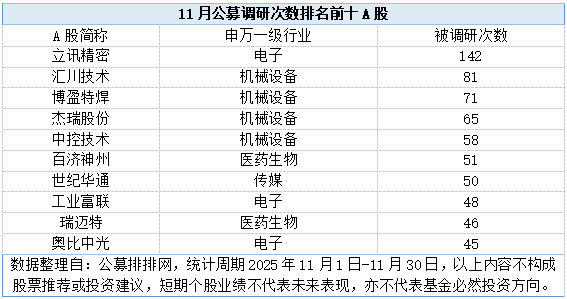
Core Insights - In November 2025, a total of 154 public fund institutions participated in A-share market research activities, covering 506 stocks across 30 Shenwan primary industries, with a total of 4,298 research instances recorded [1][3]. Company Highlights - Luxshare Precision became the most researched stock in November, with 142 instances of inquiry, focusing on its Q3 operational performance [1]. - Other notable stocks in the electronics sector included Industrial Fulian and Aobi Zhongguang, which were researched 48 and 45 times, respectively [1]. - In the mechanical equipment sector, the top researched stocks were Huichuan Technology (81 times), Boying Special Welding (71 times), Jereh Petroleum Equipment (65 times), and Zhongkong Technology (58 times) [1][3]. - In the biopharmaceutical sector, the key stocks were Baiji Shenzhou and Ruimai Te, researched 51 and 46 times, respectively, with a focus on their recent business developments [2]. Industry Focus - The electronics industry led with 974 research instances, covering 88 stocks, significantly outpacing other sectors [3]. - The mechanical equipment sector followed with 819 research instances across 71 stocks [4]. - The biopharmaceutical sector ranked third, with 403 research instances across 38 stocks [4]. - Other industries with notable research activity included electric power equipment, automotive, basic chemicals, and computers, each with at least 95 research instances [4]. Institutional Activity - Bosera Fund led the research activity in November with 111 instances, focusing primarily on electronics, mechanical equipment, and electric power equipment stocks [4]. - Huaxia Fund followed closely with 101 research instances, also favoring mechanical equipment and electronics [4]. - Guotai Fund ranked third with 93 instances, maintaining a similar focus on mechanical equipment and electronics [4].

通信ETF上周领涨,机构看好光通信产业链机会丨ETF基金周报
2 1 Shi Ji Jing Ji Bao Dao· 2025-12-01 03:22
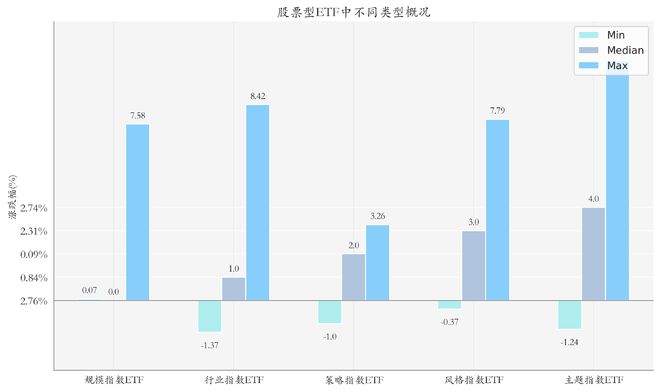
Market Overview - The Shanghai Composite Index rose by 1.4% to close at 3888.6 points, with a peak of 3895.59 points during the week from November 24 to November 28 [1] - The Shenzhen Component Index increased by 3.56% to 12984.08 points, reaching a high of 13082.77 points [1] - The ChiNext Index saw a rise of 4.54%, closing at 3052.59 points, with a maximum of 3113.44 points [1] - Global markets also experienced gains, with the Nasdaq Composite up by 4.91%, the Dow Jones Industrial Average up by 3.18%, and the S&P 500 up by 3.73% [1] - In the Asia-Pacific region, the Hang Seng Index increased by 2.53%, and the Nikkei 225 rose by 3.35% [1] ETF Market Performance - The median weekly return for stock ETFs was 2.33% [2] - The highest weekly return among scale index ETFs was 7.58% for the E Fund Shanghai Stock Exchange Science and Technology Innovation Board 200 ETF [2] - The highest return in the industry index ETFs was 8.42% for the Harvest National Index Communication ETF [2] - The top five stock ETFs by weekly return included the Fortune National Communication Equipment Theme ETF at 10.3% [4][5] ETF Liquidity and Fund Flows - Average daily trading volume for stock ETFs decreased by 7.3%, while average daily trading volume increased by 17.8% [6] - The top five stock ETFs by fund inflow included the Huaxia SSE 50 ETF with an inflow of 417 million yuan [9][10] - The largest outflows were seen in the Huabao National Bank ETF, which had an outflow of 428 million yuan [10] ETF Financing and Inventory - The financing balance for stock ETFs decreased from 50.5535 billion yuan to 47.097 billion yuan [11] - The total number of existing ETFs reached 1363, with 1069 being stock ETFs [12] - The total market size for ETFs reached 5687.882 billion yuan, an increase of 84.359 billion yuan from the previous week [14] Institutional Insights - Zhongyuan Securities highlighted a supply-demand imbalance in high-end optical chips, predicting price increases due to tight supply and accelerated domestic innovation [17] - Guoyuan Securities noted that the demand for computing power remains strong, driven by the accelerated penetration of model applications in the AI sector [17]


大中矿业股价跌5.02%,博时基金旗下1只基金重仓,持有29.69万股浮亏损失46.91万元
Xin Lang Cai Jing· 2025-12-01 03:12
Group 1 - The core point of the news is that Dazhong Mining's stock price has dropped by 5.02%, currently trading at 29.89 CNY per share, with a total market capitalization of 45.075 billion CNY [1] - Dazhong Mining Co., Ltd. is located in Baotou City, Inner Mongolia, and was established on October 29, 1999. It was listed on May 10, 2021. The company's main business includes iron ore mining, production and sales of iron concentrate and pellets, and processing and sales of manufactured sand and gravel [1] - The revenue composition of Dazhong Mining is as follows: iron concentrate 71.07%, pellets 20.48%, sulfuric acid 4.58%, sand and gravel 2.73%, others 0.81%, zinc concentrate 0.32%, and lithium ore 0.02% [1] Group 2 - From the perspective of fund holdings, one fund under Bosera Fund has a significant position in Dazhong Mining. Bosera Yuyi Mixed A (000219) held 296,900 shares in the third quarter, accounting for 2.95% of the fund's net value, ranking as the tenth largest holding [2] - The estimated floating loss for Bosera Yuyi Mixed A today is approximately 469,100 CNY. The fund was established on July 29, 2013, with a current size of 128 million CNY. Year-to-date return is 30.35%, ranking 2466 out of 8199 in its category; the one-year return is 29.95%, ranking 2569 out of 8131; and since inception, the return is 270.47% [2]
216只ETF获融资净买入 博时中证可转债及可交换债券ETF居首
Zheng Quan Shi Bao Wang· 2025-12-01 02:18
Core Viewpoint - As of November 28, the total margin balance for ETFs in the Shanghai and Shenzhen markets is 118.316 billion yuan, showing a decrease of 0.221 billion yuan from the previous trading day [1] Summary by Category ETF Financing and Margin Balance - The ETF financing balance stands at 110.65 billion yuan, down by 0.325 billion yuan compared to the previous trading day [1] - The ETF margin short balance is 7.666 billion yuan, which has increased by 0.104 billion yuan from the previous trading day [1] Net Buy and Performance of ETFs - On November 28, 216 ETFs experienced net financing purchases, with the highest net purchase amounting to 92.1675 million yuan for the Bosera CSI Convertible Bonds and Exchangeable Bonds ETF [1] - Other ETFs with significant net financing purchases include the E Fund ChiNext ETF, HFT CSI Short-term Bond ETF, Huaan ChiNext 50 ETF, Guotai CSI All-Share Communication Equipment ETF, and others [1]
陪伴理念重构投教底层逻辑 公募基金创新服务满足投资者多样需求
Zheng Quan Shi Bao· 2025-11-30 18:25
Core Insights - The article emphasizes the importance of investor education in enhancing public financial literacy and promoting high-quality development in financial markets [1][3] - The traditional model of investor education is being redefined to focus on "accompaniment" rather than mere knowledge transmission, addressing the disconnect between wealth management institutions and investors [2][3] - The integration of AI technology is significantly improving the efficiency and quality of investor education, allowing for personalized and timely support [9][10] Group 1: Evolution of Investor Education - The concept of investor education is shifting from a one-way knowledge transfer to a more supportive and engaging approach, focusing on the investor's experience [2][3] - Recent regulatory guidelines emphasize the strategic importance of investor education, urging institutions to incorporate it into their corporate culture and allocate dedicated budgets [3] - Fund companies are increasingly focusing on long-term investment strategies and enhancing investor satisfaction through tailored educational initiatives [4][6] Group 2: Diversification and Innovation in Educational Content - The content and format of investor education are becoming more diverse, moving beyond traditional articles and lectures to include short videos, live broadcasts, and interactive activities [5][6] - Innovative collaborations, such as those between fund companies and cultural institutions, are creating immersive educational experiences that blend investment knowledge with other fields [7] - Fund companies are developing comprehensive educational frameworks that address various demographic needs, including youth, elderly, and special groups [8][12] Group 3: Role of Technology in Investor Education - AI technology is being leveraged to enhance the production and dissemination of educational content, significantly reducing the time and cost involved [9][10] - AI's capabilities in emotional analysis allow for real-time support and personalized content delivery, improving the overall investor experience [9] - The introduction of AI-driven platforms is providing investors with tailored educational resources and answers to their investment queries [10] Group 4: Differentiated Services for Diverse Investor Needs - The growing segmentation of investor demographics necessitates the development of personalized educational services that cater to specific needs and preferences [11][12] - Fund companies are adopting differentiated content strategies to ensure that educational materials resonate with various investor groups, enhancing engagement and understanding [11][12] - Initiatives are being implemented to create a comprehensive educational network that spans all age groups and investment scenarios, promoting financial literacy across the board [12]
博时基金王萌:AI赋能叠加自主可控,看好工业软件投资机会
Shang Hai Zheng Quan Bao· 2025-11-30 14:09
Core Insights - The industrial software market is experiencing increased demand, driven by AI empowerment and the push for self-sufficiency, indicating promising future growth and investment opportunities [1][2]. Group 1: Industry Overview - The National Index for Industrial Software reflects the price changes of listed companies in the industrial software sector [2]. - Industrial software is categorized into four main types: R&D design, production control, digital management, and embedded software, each serving distinct functions in the industrial process [2]. - The industry is benefiting from multiple favorable factors, including government policies that aim to update approximately 2 million sets of industrial software by 2027, creating clear market growth potential [2][3]. Group 2: Strategic Positioning - The global manufacturing landscape is shifting towards high efficiency, flexibility, and personalized customization, highlighting the strategic importance of industrial software [3]. - Domestic software is currently in a phase of breaking into high-end products, with embedded software showing significant market potential, although it still faces challenges in competing with foreign products [3]. Group 3: Investment Opportunities - Three core investment logics are identified: the steady advancement of self-sufficiency in industrial software, the significant replacement potential for imported software, and the ongoing R&D and acquisition efforts by manufacturers to enhance product capabilities [4]. - AI is seen as a transformative force for domestic industrial software, potentially enabling leapfrog development and creating significant valuation premiums in the industry [4][5]. Group 4: Market Characteristics - The National Industrial Software Index primarily consists of small and mid-cap stocks, with over 70% of the total market capitalization being below 50 billion yuan [6]. - The index's largest sector is computers, with substantial representation from manufacturing industries such as machinery, electrical equipment, and communications [6]. - The index aligns well with the technology growth characteristics of the Sci-Tech Innovation Board and the Growth Enterprise Market, indicating strong investment value due to high and steadily increasing R&D investments [6].
公募基金周报:首批科创创业机器人ETF上报-20251130
CAITONG SECURITIES· 2025-11-30 13:18
Report Industry Investment Rating No relevant information provided. Core Views - Important news: Public funds are "betting" on dividend assets in the second half of the year; the total scale of public funds is approaching 37 trillion yuan; QDII is globally deploying AI marketing, and the US stock logic is mapped to Hong Kong stock funds [2]. - Market review: During the week of 20251124 - 20251128, the major broad - based indices in the A - share market showed an upward trend. The Shanghai Composite Index closed at 3888.60, up 1.40%. The CSI 300 Index closed at 4526.66, up 1.64%. The CSI 500 Index closed at 7031.55, up 3.14%. The CSI 800 Index closed at 4945.49, up 2.04%. The CSI 1000 Index closed at 7334.21, up 3.77%. The ChiNext Index closed at 3052.59, up 4.54%. Most overseas indices also showed an upward trend. The Nasdaq Index rose 4.91% this week, the Canadian S&P/TSX Composite rose 4.05%, and the Hang Seng Tech Index rose 3.77% [2][17]. - Fund market review: Most active equity funds achieved positive returns this week, and the median interval return rate of active equity funds was 3.03%. In terms of different sectors, technology and pharmaceutical theme funds performed outstandingly, with median interval return rates of 5.14% and 3.87% respectively [2][24]. - ETF fund statistics: Performance: The top three ETF categories in terms of performance this week were technology (4.64%), international broad - based (3.55%), and A - share broad - based (3.19%) theme ETFs. Fund flow: There were 339 ETFs with net capital inflows and 653 ETFs with net capital outflows this week. By category, the categories with the highest capital inflows were strategy style (39.68 billion yuan), commodity futures (18.76 billion yuan), and consumption (7.55 billion yuan) theme ETFs. The categories with the highest capital outflows were A - share broad - based (210.66 billion yuan), technology (112.68 billion yuan), and financial real estate (28.65 billion yuan) theme ETFs [2][29]. - Fund market dynamics: Fund manager changes: 43 public funds had new fund managers appointed this week, involving 36 fund managers from 23 fund management companies. Newly established funds this week: A total of 48 public funds were newly established this week, with a combined issuance share of 178.59 billion shares. Newly issued funds this week: A total of 45 public funds entered the issuance stage for the first time this week, with the largest number being passive index funds, at 15. Pending issuance funds: As of Sunday, November 30, 2025, there were 57 public funds pending issuance [2][38][42]. - Equity fund issuance tracking: The issuance scale of equity funds reached 95.24 billion yuan this week, a decrease of 44.75 billion yuan compared with last week. Currently, there are still 263 newly issued funds in the position - building period, of which it is estimated that 33.84% have a position - building ratio of less than 5%, and it is estimated that there is still 760.32 billion yuan of funds from newly issued funds that have not been invested. It is expected that these funds will bring significant incremental funds to industries such as electronics, communications, and machinery [2]. Summary by Relevant Catalogs 1. Important News 1.1 Market Dynamics - The pilot program for commercial real estate REITs has been officially launched, and the REITs market is expanding in high - quality. The China Securities Regulatory Commission issued a notice on November 28, 2025, and related regulations were clarified [7]. - The total scale of public funds is approaching 37 trillion yuan, reaching a new high for seven consecutive months. As of the end of October, the total scale of public funds reached 36.96 trillion yuan. In October, the share and scale of public funds both increased compared with September. Investors were most enthusiastic about subscribing to stock, QDII, and money - market funds, while bond, hybrid, and closed - end funds faced net redemptions [8]. - The regulatory authorities issued new requirements, including establishing and improving the settlement mechanism for fund sales and settlement funds [8]. 1.2 Product Hotspots - Public funds are "betting" on dividend assets in the second half of the year. As of November 27, 49 dividend funds have been reported in the second half of this year, a significant increase from 37 in the first half. As of November 25, 7 dividend - themed funds were established in November, and the total scale of 35 newly established dividend funds in the second half of the year reached 176.85 billion yuan, compared with 55.65 billion yuan in the first half [10]. - The first batch of 7双创 artificial intelligence ETFs are scheduled for launch. On November 28, 7 funds from companies such as E Fund and Huatai - Peregrine Fund will be launched, with different fundraising periods and limits [11][12]. - The first batch of science - innovation and entrepreneurship robot ETFs have been submitted. From November 24 to 26, 7 products from multiple fund companies were submitted, tracking the CSI Science - Innovation and Entrepreneurship Robot Index [13]. - The number of newly established index - enhanced funds this year has increased by more than 400% year - on - year. As of November 27, 160 index - enhanced funds were newly established, with a total fundraising amount of over 888.47 billion yuan. Most of the index - enhanced products are based on broad - based indices [14]. 1.3 Overseas/Overseas Markets - QDII is globally deploying AI marketing, and the US stock logic is mapped to Hong Kong stock funds. Many funds are embracing the AI marketing track due to risk - aversion needs. Some AI marketing stocks in the US and Hong Kong have shown significant performance [14][15][16]. - The overseas expansion of ETFs has achieved a new breakthrough. The depositary receipt of Invesco Great Wall ChiNext 50 ETF was listed in Thailand on November 25, 2025 [16]. 2. Market Review - During the week of 20251124 - 20251128, major A - share broad - based indices showed an upward trend, and most overseas indices also rose. The communication and electronics industries had the highest increases among the primary industries of CITIC [17][19]. 3. Fund Market Review 3.1 Active Equity Fund Performance - In the past week, technology and pharmaceutical theme funds performed outstandingly, with average interval returns of 5.08% and 3.95% respectively. In the past three months, cycle and manufacturing theme funds led the way [23]. - Most active equity funds achieved positive returns this week, with a median interval return rate of 3.03%. Technology and pharmaceutical theme funds had median interval return rates of 5.14% and 3.87% respectively [24]. 3.2 Top - Performing Fund Performance Statistics - The top - performing active equity fund this week was the Qianhai Kaiyuan Shanghai - Hong Kong - Shenzhen Enjoy Life Fund, with an interval return rate of 12.13%. The top - five funds in each sector are also listed [27][28]. 4. ETF Fund Statistics 4.1 ETF Fund Performance - In terms of the average interval return rate this week, the top three ETF categories were technology, international broad - based, and A - share broad - based theme ETFs. In the past month, the top three were commodity futures, bond, and consumption theme ETFs [29]. 4.2 ETF Fund Flow Statistics - This week, the ETF categories with the highest net capital inflows were strategy style, commodity futures, and consumption, while the A - share broad - based category had the highest net capital outflows. In the past month, technology, bond, and strategy style ETFs had the highest net capital inflows, and the cycle category had the highest net capital outflows [32]. - There were 339 ETFs with net capital inflows and 653 ETFs with net capital outflows this week. The top three ETFs with net capital inflows were Huaxia Shanghai - Stock - Exchange Benchmark Market - Making Treasury Bond ETF, Dacheng CSI AAA Science - and - Technology Innovation Corporate Bond ETF, and Huaxia Shanghai 50 ETF. The top three with net capital outflows were E Fund ChiNext ETF, Southern CSI 500 ETF, and Huaxia Shanghai - Stock - Exchange Science and Technology Innovation 50 ETF [34]. 4.3 ETF Fund Premium/Discount Statistics - As of November 28, 2025, the top three ETFs in terms of premium rate were Huatai - Peregrine CSI Korea Exchange Korea - China Semiconductor ETF, Huaan Mitsubishi UFJ Nikkei 225 ETF, and Huaxia Nomura Nikkei 225 ETF. The top three in terms of discount rate were E Fund Shanghai 580 ETF, Guotai CSI 2000 ETF, and Zheshang Huijin CSI Phoenix 50 ETF [35]. 5. Fund Market Dynamics 5.1 Fund Manager Changes - 43 public funds had new fund managers appointed this week, involving 36 fund managers from 23 fund management companies. The top three fund management companies in terms of the number of funds with new managers were E Fund, GF Fund, and Orient Fund [38]. - 49 public funds had fund managers leave this week, involving 37 fund managers from 20 fund management companies. The top three fund management companies in terms of the number of funds with departing managers were E Fund, Dacheng Fund, and Tianhong Fund [39]. 5.2 Newly Established Funds This Week - A total of 48 public funds were newly established this week, with a combined issuance share of 178.59 billion shares. The fund type with the largest number was partial - stock hybrid funds, and the type with the largest combined issuance share was passive index funds [42].
“教育”还是“陪伴”?基金投教不断进阶
Zheng Quan Shi Bao Wang· 2025-11-30 13:03
Core Insights - Investor education is crucial for enhancing public financial literacy and promoting high-quality development in financial markets, evolving through innovative paths and leveraging AI technology to meet diverse investor needs [1][3][7] Group 1: Educational Philosophy and Approach - The traditional model of investor education has been criticized for its one-way knowledge transmission, leading to investor resistance; a shift towards a "companion" approach is necessary to enhance investor experience [2][3] - Recent regulatory guidelines emphasize the importance of integrating investor education into corporate strategy, focusing on long-term investment principles and enhancing investor satisfaction [3][4] Group 2: Diverse Educational Formats - The industry is moving from traditional formats like articles and lectures to more engaging methods such as short videos, live broadcasts, and immersive experiences, breaking the limitations of previous educational approaches [4][5] - Companies like Bosera Fund and China Europe Fund are innovating by integrating education with art and community activities, creating unique educational experiences that resonate with investors [5][6] Group 3: AI Integration in Education - AI technology is significantly enhancing the efficiency and quality of investor education by streamlining content creation and enabling personalized service delivery [7][8] - AI's role includes emotional analysis to provide timely support and tailored educational content, marking a shift towards a service-oriented and value-driven educational model [8] Group 4: Differentiated Services for Diverse Needs - The increasing stratification of investor demographics necessitates personalized educational services that cater to varying levels of knowledge and specific needs [9][10] - Companies are adopting differentiated service models to create tailored educational content, ensuring that it meets the unique demands of different investor groups [10][12]
“教育”还是“陪伴”?基金投教不断进阶
券商中国· 2025-11-30 12:47
Core Viewpoint - Investor education is crucial for enhancing public financial literacy and promoting high-quality development of financial markets, requiring a long-term and systematic approach [2] Group 1: Educational Philosophy - The traditional view of investor education as a one-way knowledge transfer is being redefined to focus on "accompaniment" rather than mere education, addressing investor resistance to being "taught" [3] - The shift emphasizes the need for investment education to be centered around the investor's experience and feelings, rather than a top-down approach [3] Group 2: Regulatory Support - Regulatory bodies are increasingly emphasizing the importance of investor education, as seen in the guidelines issued by the China Securities Investment Fund Industry Association, which call for integrating investor education into corporate strategy and culture [4] - The "Action Plan for Promoting High-Quality Development of Public Funds" encourages fund companies to adopt a long-term investment philosophy and enhance investor satisfaction [4] Group 3: Innovative Formats and Content - The approach to investor education is evolving from traditional formats like articles and lectures to more engaging methods such as short videos, live broadcasts, and interactive activities [5] - Leading fund institutions are creating unique educational service systems that move beyond conventional methods, making investor education a vital link between investors and the capital market [5] Group 4: AI Integration - AI technology is significantly enhancing the efficiency and quality of investor education by streamlining content production and enabling personalized service [8] - AI's role includes rapid content generation, precise user matching, and emotional support, transforming investor education into a more service-oriented and value-driven process [9] Group 5: Differentiated Services - The increasing stratification of investor demographics necessitates personalized educational services that cater to diverse needs, moving away from a one-size-fits-all approach [11] - Fund companies are developing tailored educational content that aligns with the specific needs of different investor groups, ensuring a more effective educational experience [13]

年内,超2100亿元!
Zhong Guo Ji Jin Bao· 2025-11-30 11:18
Core Insights - The total dividend amount from funds in the first 11 months of the year exceeded 210 billion yuan, marking a year-on-year increase of over 20% [1][2] - More than 3,200 funds distributed dividends, with bond funds being the primary contributors, accounting for 73% of the total dividend amount [1][4] Fund Performance - A total of 3,278 fund products announced dividends, with a cumulative total of 211.8 billion yuan, compared to 2,749 funds and 175.1 billion yuan in the same period last year, reflecting a growth of 19.24% in quantity and 20.95% in amount [2] - 525 public funds distributed dividends exceeding 100 million yuan, with the top three being Huatai-PB CSI 300 ETF at 8.39 billion yuan, E Fund CSI 300 ETF at 7.15 billion yuan, and Huaxia CSI 300 ETF at 5.55 billion yuan [2] Fund Company Contributions - Bosera Fund led in the number of products distributing dividends, with over 160 products, followed by E Fund with over 100 products, and GF Fund and CMB Fund with over 90 and 80 products respectively [3] - The increase in total dividend amounts is attributed to policy guidance, market performance, and strategic adjustments by fund companies [3] Fund Types and Trends - Bond funds remain the dominant force in dividend distribution, with a total of 154.7 billion yuan, representing 73% of the total, primarily driven by medium- and long-term pure bond funds [4] - Passive index funds emerged as a new force in the dividend landscape, contributing 376.97 billion yuan, which accounts for 80% of the total dividends from equity funds [4][5] Market Outlook - As public funds focus on high-quality development, more fund companies are expected to increase dividend distributions to enhance investor satisfaction [6]