小米

Search documents
新势力11月销量跟踪报告:年底旺季效应趋弱,小鹏首款超级增程车型X9上市
EBSCN· 2025-12-02 04:38
Investment Rating - The report maintains a "Buy" rating for the automotive and auto parts industry [4]. Core Insights - The report highlights a weakening year-end peak season effect, with the launch of Xiaopeng's first super extended-range model, the X9 [1]. - November delivery data for new forces shows: 1) Xiaopeng delivered 36,728 units, up 18.9% year-on-year but down 12.6% month-on-month; 2) NIO delivered 36,275 units, up 147.9% year-on-year but down 10.2% month-on-month; 3) Li Auto delivered 33,181 units, down 31.9% year-on-year but up 4.5% month-on-month [1][2]. - Xiaopeng's X9 model achieved a record for daily pre-orders within one hour of its launch, indicating strong market interest [1]. Summary by Sections Delivery Performance - Xiaopeng: 36,728 units delivered in November, +18.9% YoY, -12.6% MoM [1]. - NIO: 36,275 units delivered, +147.9% YoY, -10.2% MoM [1]. - Li Auto: 33,181 units delivered, -31.9% YoY, +4.5% MoM [1]. Model Launches and Market Strategy - Xiaopeng launched the X9 super extended-range model on November 20, aiming to differentiate with "large battery + full-domain high-voltage platform" technology [1]. - The report suggests that Xiaopeng's strategy of introducing high-cost-performance "dual-energy" models may help capture more market segments [1]. Company Recommendations - The report recommends buying shares of NIO and Xiaopeng, while also suggesting attention to Geely [3]. - For auto parts, it recommends Fuyao Glass for its strong performance and overseas expansion, and Wuxi Zhenhua, Huguang Co., and Bojun Technology for their attractive valuations [3].
国新证券每日晨报-20251202
Guoxin Securities Co., Ltd· 2025-12-02 02:46
Domestic Market Overview - The A-share market opened positively in December, with the Shanghai Composite Index closing at 3914.01 points, up 0.65%, and the Shenzhen Component Index closing at 13146.72 points, up 1.25% [1][4] - A total of 27 out of 30 CITIC first-level industries saw an increase, with consumer services, non-ferrous metals, and telecommunications leading the gains, while only comprehensive finance, agriculture, forestry, animal husbandry, and real estate experienced slight declines [1][4] - The total trading volume of the entire A-share market reached 18894 billion, showing an increase compared to the previous day [1][4] Overseas Market Overview - The three major U.S. stock indices all closed lower, with the Dow Jones falling by 0.9%, the S&P 500 down by 0.53%, and the Nasdaq decreasing by 0.38% [2][4] - Merck's stock dropped nearly 3%, and Amgen fell over 2%, leading the decline in the Dow [2][4] - Chinese concept stocks mostly rose, with NetEase increasing by approximately 5% and Alibaba rising over 4% [2][4] News Highlights - The Ministry of Public Security and ten other departments jointly issued opinions on strengthening the ecological police mechanism [3][11] - The Ministry of Industry and Information Technology held a symposium for the manufacturing enterprises in the power and energy storage battery industry [3][12] - The China Securities Regulatory Commission is soliciting public opinions on the pilot announcement for commercial real estate investment trust funds [3][13][15] - The Chinese Center for Disease Control and Prevention reported that national influenza activity has reached a moderate level, with some provinces at a high level [3][16] - Starting from now until September 14, 2026, Chinese citizens can travel to Russia without a visa [3][17] - Important global economic data has been released [3][18]
射频行业大变局:写在Qorvo与Skyworks合并后
半导体行业观察· 2025-12-02 01:37
Core Viewpoint - The merger between Skyworks Solutions and Qorvo is a strategic response to market pressures, creating a new RF industry giant valued at up to $22 billion with annual sales of approximately $7.7 billion, aiming to save over $500 million in operating costs annually [2][5][53]. Group 1: Merger Details - The merger is structured as a "cash and stock" transaction, allowing the new entity to continue operating under the Skyworks Solutions name with the same NASDAQ ticker symbol SWKS [2][5]. - This merger marks a significant shift in the RF front-end industry, potentially restructuring the competitive landscape and signaling the end of an era for the two leading companies [5][6]. Group 2: Market Context - Skyworks and Qorvo have maintained a dominant position in the RF front-end market, particularly in China, despite larger competitors like Qualcomm and Broadcom having different business models [4][5]. - The RF industry has seen multiple mergers and acquisitions that have reshaped market dynamics, with this merger being particularly impactful due to its strategic focus on efficiency rather than competition [6][8]. Group 3: Industry Dynamics - The RF front-end industry is characterized by a high degree of order and stability, with a projected market size of approximately $15.4 billion by 2025, indicating significant growth potential [14]. - The industry has evolved through three stages: initial technological barriers, design capabilities, and now market strategies, with the current phase focusing on efficiency and cost reduction [19][51]. Group 4: Competitive Pressures - The RF front-end market is facing saturation, with global smartphone shipments plateauing around 1.2 billion units annually, leading to increased competition and reduced growth opportunities for major players [55][59]. - Both Skyworks and Qorvo have experienced declining profit margins due to rising competition from Chinese manufacturers and the need to maintain pricing power in a saturated market [60][66]. Group 5: Future Opportunities - The merger is seen as a strategic move to consolidate resources and enhance bargaining power within the supply chain, allowing the new entity to better navigate the competitive landscape [80]. - The restructuring of the RF industry presents a unique opportunity for Chinese manufacturers to transition from being technology followers to active participants in shaping industry standards [75][79].


“不造手机”的字节手机
Bei Jing Shang Bao· 2025-12-01 16:36
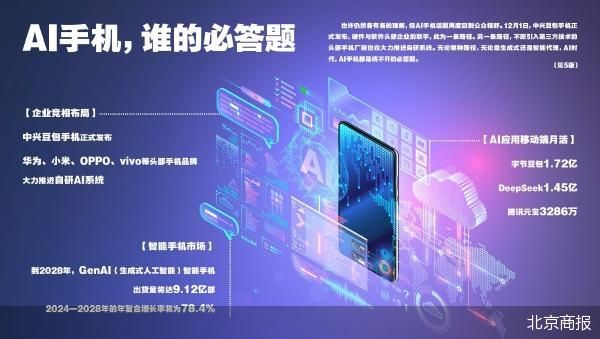
Core Insights - ByteDance emphasizes its focus on AI technology rather than developing its own smartphones, launching the Doubao mobile assistant in collaboration with ZTE [1][3] - The Doubao mobile assistant is designed to enhance user interaction and experience, leveraging ByteDance's AI capabilities and ZTE's hardware [4][5] - The AI mobile assistant is positioned as a core component of ByteDance's ecosystem cooperation strategy, aiming to integrate with various smartphone brands [3][4] Group 1: Product Launch and Market Impact - The Doubao mobile assistant was officially released on December 1, priced at 3499 yuan, and is currently available only to industry professionals as an engineering sample [1] - Following the announcement, ZTE's A-share stock hit the daily limit of 46.3 yuan, and its Hong Kong stock surged by 13.94% [1] - ByteDance's Doubao model has achieved 172 million monthly active users, leading the market, which provides a strong foundation for the technology's implementation [6] Group 2: Industry Dynamics and Competitive Landscape - Major smartphone manufacturers are increasingly developing their own AI systems, creating challenges for ByteDance's strategy of supplying AI technology to larger firms [4][9] - The collaboration between ByteDance and ZTE highlights the trend of integrating software and hardware to enhance AI mobile capabilities [5] - The competition in the AI terminal market is intensifying, with various tech giants launching AI-enabled devices to capture consumer interest [8][9] Group 3: Future Directions and Challenges - ByteDance plans to continue exploring ecosystem partnerships to integrate the Doubao mobile assistant into different smartphone models [3] - The AI terminal market faces challenges, including the need for consumer education on the unique value of AI devices and ongoing technological innovation to improve functionality [9] - The shift towards AI technology by major players indicates a consensus on the importance of AI terminals in the future market landscape [9]
2026年可能的惊喜与惊吓
2025-12-01 16:03
Summary of Conference Call Records Industry Overview - The market outlook for 2026 is generally optimistic, with expectations of increased capital expenditure (capex) in hardware and a tightening supply chain due to slow overseas production [1][5] - The AI industry is viewed as a revolutionary technology, but concerns about credit risks, potential price wars, and the sustainability of computational power accumulation are highlighted [1][9][11] Key Points and Arguments Market Trends - The market in 2025 is expected to outperform 2024, showing characteristics of a local bull market with rapid sector rotation [1][4] - Investors need to react quickly to market changes, as strong sector performance can reverse rapidly [1][8] - The consensus among investors is that the market is in a stable phase, with a positive outlook for the first half of 2026 due to anticipated monetary policy easing [2][7] AI Industry Risks - The AI sector faces several risks, including: 1. Credit risk, which historically has been a precursor to market bubbles [9] 2. The potential disruption of GPU monopolies by Google Gemini 3, which could lead to price wars affecting companies like NVIDIA [11] 3. Concerns about the sustainability of computational power accumulation [9] 4. Risks associated with private credit markets, particularly the reliance on low-interest environments [12][13] Economic and Policy Environment - The U.S. private credit market is experiencing a carry trade phenomenon, which is unsustainable in a changing interest rate environment [10][12] - Global supply chains are shifting towards a dual-track system, emphasizing self-sufficiency to mitigate risks [26] - Resource assets like gold and oil are viewed as safe investments, with gold prices rising due to various factors including central bank purchases and geopolitical instability [26] Investment Strategies - Some investment managers are increasing their positions in Chinese consumer stocks, focusing on high-dividend, stable ROE assets [25] - The performance of resource assets is expected to influence market dynamics, with potential implications for oil prices in 2026 [26][30] Additional Important Insights - Japan's economy faces significant challenges, including inflation, interest rate, and currency issues, which could lead to global market instability [16][20] - The U.S. economy is grappling with widening wealth gaps and inflation pressures, impacting consumer behavior and market dynamics [17] - The potential for synchronized recovery in China's PPI and CPI could enhance corporate ROE and attract investment [27] - The overall macroeconomic environment is less volatile than in previous years, with ongoing fiscal stimulus expected to support growth [15] This summary encapsulates the key insights and trends discussed in the conference call, providing a comprehensive overview of the current market landscape and future expectations.
互联网大厂入局,端侧AI硬件加速
2025-12-01 16:03
互联网大厂入局,端侧 AI 硬件加速 20251201 摘要 端侧 AI 硬件在消费电子领域的发展背景是什么? 端侧 AI 硬件的发展背景主要有两个逻辑。首先,从必要性角度来看,随着云端 算力的快速发展,将云端算力下沉到端侧成为一个重要方向和议题。在全球数 十亿台手机、PC 和平板的保有量下,消费群体庞大,因此在 To C 市场中,手 机与消费者日常生活紧密联系,各大巨头(无论是互联网公司还是硬件厂商) 都在尝试开发端侧 AI 硬件。其次,从可行性角度来看,云端算力的 token 消 耗量持续增加,如果未来在 To C 市场大规模推广,仅依靠云端算力调用会面 临成本和安全方面的问题。因此,端侧 AI 硬件作为未来 To C 应用和云端算力 之间的桥梁应运而生。未来,端云结合的算力部署和消耗分布将成为主流。 智能化功能对传统设备渗透率潜力巨大,若 2%的普通眼镜转变为智能 化设备,即可达到 4,000 万副市场规模。大厂推动消费者教育和成熟产 品发布将扩大智能设备在传统领域的渗透。 端侧 AI 加速落地推动传统蜂窝通信模组智能化升级,模组厂商角色日益 重要,业务延伸至解决方案方向。预计到 2030 年,嵌入式 ...
豪声电子新增“小米概念”概念
Xin Lang Cai Jing· 2025-12-01 15:32
Group 1 - The core point of the article is that Haosheng Electronics has added a new concept, "Xiaomi Concept," effective December 1, 2025, indicating a strategic alignment with Xiaomi as a key customer [1] - The company's main business involves the research, production, and sales of micro-electronic acoustic components and audio products, including micro speakers, receivers, and integrated modules [1] - Haosheng Electronics' primary products also include speakers for vehicles and ships, as well as standing audio systems, showcasing a diverse product range in the audio electronics sector [1]
佳能中山工厂关闭背后:工厂所生产产品已100%外销 中国打印机本土品牌是如何迅速崛起的?
Mei Ri Jing Ji Xin Wen· 2025-12-01 14:30
Core Viewpoint - Canon (Zhongshan) Office Equipment Co., Ltd. has announced the decision to cease operations due to a rapidly changing market environment, a continuous decline in the laser printer (LBP) market, and the rapid rise of domestic LBP brands [1][5] Group 1: Company Overview - Canon Zhongshan Factory was established in 2001 and was one of Canon's key laser printer production bases globally [1][5] - The factory aimed to become the "world's No. 1 LBP production company" but faced significant operational difficulties leading to its closure [1][5] - As of the end of 2023, the factory had 2,031 employees, which is expected to decrease to approximately 1,400 by September 2025 [7][8] Group 2: Market Dynamics - The market share of Canon in China's laser printer market has declined from 7.7% in 2018 to 3.9% in the first three quarters of 2025 [5][8] - Domestic brands have gained significant market share, reaching 41.5% in the first three quarters of 2025, while foreign brands hold 58.5% [11] - The overall laser printer market in China is experiencing saturation, with domestic brands like Pantum, Lenovo, Huawei, and Xiaomi offering lower-priced products that meet local safety needs [10][11] Group 3: Financial Impact - Canon's printing business accounted for approximately 55.9% of the group's total revenue in the 2024 fiscal year, making it the largest revenue-generating segment [5][9] - The factory's products have shifted to 100% export, indicating a significant change in its operational strategy due to declining domestic sales [6][7] Group 4: Industry Trends - The global printer market has seen an average annual decline of over 5% in shipment volumes [10] - The A4 laser printer shipment volume in China decreased by 5% year-on-year in the first half of 2025, while A3 laser printer shipments fell by 10% [10]

字节手机,旧事重提
Bei Jing Shang Bao· 2025-12-01 13:44
Core Insights - ByteDance has reiterated its stance of not developing its own smartphones while launching the Doubao mobile assistant, which is a system-level AI assistant developed in collaboration with ZTE [1][2] - The Doubao mobile assistant is positioned as an engineering prototype, priced at 3499 yuan, and is currently available only to industry professionals for experience [1] - The launch has positively impacted ZTE's stock prices, with a significant increase observed in both A-share and Hong Kong markets [1] Group 1: Product Launch and Market Impact - The Doubao mobile assistant is based on the Doubao large model and aims to enhance user interaction and experience compared to previous mobile AI applications [1][5] - ZTE's stock reached a limit-up price of 46.3 yuan shortly after the announcement, reflecting strong market interest [1] - ByteDance has clarified that it will not pursue smartphone development but will instead integrate the Doubao assistant into various brands through ecological cooperation [1][2] Group 2: Strategic Positioning - ByteDance's approach to entering the mobile market is through AI technology rather than hardware, similar to Huawei's strategy in the automotive sector [2][4] - The Doubao assistant is designed to address practical usage pain points, emphasizing a collaborative development model with hardware manufacturers [5] - The collaboration between ByteDance and ZTE combines ByteDance's data processing capabilities with ZTE's hardware expertise, highlighting the trend towards integrated AI solutions in mobile devices [5] Group 3: Competitive Landscape - The AI mobile assistant market is becoming increasingly competitive, with major players like Huawei, Xiaomi, and others developing their own AI systems [4][10] - The shift towards AI integration in mobile devices is seen as a necessary evolution, with companies focusing on enhancing user experience through AI capabilities [10][11] - The industry is witnessing a collective move from conceptual discussions to tangible investments in AI technology, indicating a response to consumer demand and market potential [10][11]

首款“豆包助手”手机3499元开售
第一财经· 2025-12-01 11:47
Core Viewpoint - The article discusses the rising trend of AI mobile phone concept stocks in the A-share market, highlighting the collaboration between ByteDance and various mobile manufacturers, particularly ZTE, in developing AI-integrated mobile devices without a self-developed phone plan [3][4][7]. Group 1: Market Performance - As of the closing on December 1, the AI mobile phone index rose by 2.71%, with notable increases in stocks such as Beilong Precision (up 20%), ZTE (up 10%), and Transsion Holdings (up 9.41%) [3]. - ZTE's A-share trading volume exceeded 14.6 billion yuan, and its H-share rose over 13% [7]. Group 2: Collaboration and Development - ByteDance confirmed ongoing discussions with multiple phone manufacturers, emphasizing that it does not have plans for self-developed phones [4]. - ZTE's Nubia has begun testing engineering samples of a phone equipped with the Doubao mobile assistant technology, which is set to be sold at a starting price of 3,499 yuan [5][10]. - The collaboration involves Doubao leading the AI assistant's product definition and experience, while Nubia focuses on hardware engineering and technical development [10]. Group 3: AI Assistant Integration - The Doubao mobile assistant is designed to operate across various applications, enabling tasks such as ticket booking and logistics tracking [7]. - Despite the collaboration, the core control of AI on mobile devices remains with the phone manufacturers, who have established their own voice assistant ecosystems [8][9]. Group 4: Data Privacy and Security - Concerns regarding data privacy and security are highlighted, particularly with the use of AI assistants that may access sensitive information [11][12]. - The Guangdong Standardization Association has issued standards addressing the risks associated with AI assistants, emphasizing the need for user authorization before executing tasks through third-party applications [11]. Group 5: Future Hardware Strategy - ByteDance is focusing on hardware development to enhance its AI capabilities, recognizing that hardware serves as both a data entry point and an amplifier for AI training [16]. - The company has made strategic acquisitions, such as the purchase of Oladance for AI-enabled headphones, and is exploring the VR space despite previous setbacks [17][18]. Group 6: Strategic Focus and Challenges - ByteDance's leadership is intensifying its focus on AI strategy, with key personnel changes aimed at improving cross-team collaboration [18]. - The company faces challenges in maintaining competitive technology and exploring sustainable revenue models while addressing its limitations in self-developed chips and infrastructure [18].