
南京银行

Search documents
成交价低至六折银行“直供房”密集挂牌 不良处置提速
Zheng Quan Shi Bao· 2025-11-19 18:01
Core Viewpoint - The increase in "direct supply housing" from banks is a response to the need for banks to dispose of non-performing assets and recover funds quickly, with a notable rise in the number of properties being auctioned directly by banks [1][4][6]. Group 1: Overview of "Direct Supply Housing" - "Direct supply housing" refers to properties that banks acquire through debt recovery processes after borrowers default on loans, allowing banks to sell these properties directly to the market [1][3]. - The trend of banks listing "direct supply housing" is growing, with over a hundred properties currently available for auction across various regions, including commercial shops, residential units, and industrial properties [2][4]. - Properties listed as "direct supply housing" often have starting prices significantly below market value, with many properties marked as "below market average" [2][4]. Group 2: Market Impact and Trends - The auctioning of "direct supply housing" is primarily a strategy to shorten the asset disposal cycle and recover funds more rapidly, as many of these properties have previously failed to sell at judicial auctions [4][6]. - Despite concerns that the sale of "direct supply housing" at discounted prices could impact the second-hand housing market, analysts suggest that its influence is limited due to its small market share and the nature of the properties involved [4][5]. - The overall stability of the real estate market is expected to remain intact, as "direct supply housing" constitutes a niche segment that does not significantly affect broader housing prices [4][5]. Group 3: Non-Performing Asset Management - The acceleration of non-performing asset transfers among banks indicates a rising trend in retail loan defaults, particularly in personal loans and credit card debts [6]. - The emergence of "direct supply housing" highlights the challenges faced by commercial banks, especially smaller institutions, in managing non-performing assets effectively [6]. - Experts recommend that banks adopt diverse strategies for asset recovery, including cash collection, write-offs, and securitization of non-performing assets, while also suggesting that local governments provide support through tax incentives and debt restructuring [6].
@各位银行股东,你的“中期红包”正陆续到账!
Jin Rong Shi Bao· 2025-11-19 08:56
Core Viewpoint - The banking sector in China is experiencing a mid-term dividend distribution wave, with numerous listed banks announcing substantial cash dividends to reward investors, reflecting a broader trend of increasing shareholder returns across the industry [1][2][5]. Group 1: Dividend Announcements - Hangzhou Bank announced a cash dividend of 0.38 yuan per share, totaling 27.55 billion yuan, marking a year-on-year increase of 24.10% [1]. - As of mid-November, ten listed banks, including Ping An Bank, Minsheng Bank, and Shanghai Bank, have already distributed mid-term dividends [2]. - China’s six major state-owned banks are set to distribute over 204.65 billion yuan in mid-term dividends, with individual banks like China Bank and Construction Bank planning to hold shareholder meetings to approve their dividend proposals [3]. Group 2: Industry Trends - A total of 24 A-share listed banks have disclosed their mid-term dividend plans, with the total cash dividend amount reaching 263.79 billion yuan [3]. - Several banks, including Industrial Bank and Changsha Bank, are implementing mid-term dividends for the first time since their listings [3]. - The trend of increasing mid-term dividends is seen as a response to regulatory encouragement for companies to enhance shareholder returns [5]. Group 3: Market Impact - The mid-term dividend distribution has led to a surge in bank stock prices, with the Shenwan Bank Index rising by 7.7% from October 14 to November 14 [7]. - Major banks have seen significant stock price increases, with Industrial Bank and Agricultural Bank experiencing gains of 13.5% and 23.0%, respectively [7]. - The early timing of dividend distributions this year compared to last year is expected to sustain the upward momentum in bank stocks until the end of November [6][7].




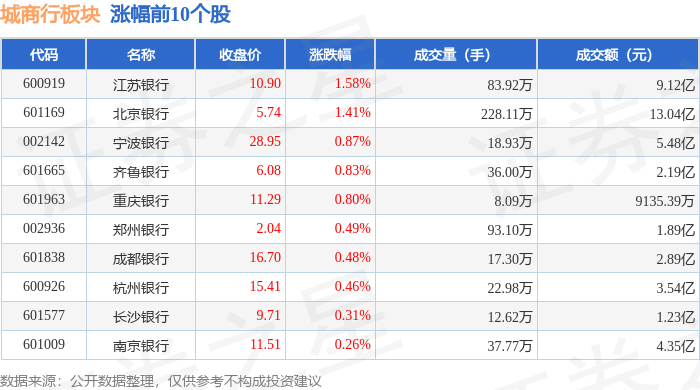
城商行板块11月19日涨0.64%,江苏银行领涨,主力资金净流入1.07亿元
Zheng Xing Xing Ye Ri Bao· 2025-11-19 08:52
Core Viewpoint - The city commercial bank sector experienced a rise of 0.64% on November 19, with Jiangsu Bank leading the gains, while the Shanghai Composite Index increased by 0.18% and the Shenzhen Component Index remained flat [1] Group 1: Market Performance - Jiangsu Bank closed at 10.90, up by 1.58%, with a trading volume of 839,200 shares and a transaction value of 910 million [1] - Beijing Bank saw a closing price of 5.74, increasing by 1.41%, with a trading volume of 2,281,100 shares and a transaction value of 1.304 billion [1] - Ningbo Bank's closing price was 28.95, up by 0.87%, with a trading volume of 189,300 shares and a transaction value of 548 million [1] - Qilu Bank closed at 6.08, up by 0.83%, with a trading volume of 360,000 shares and a transaction value of 219 million [1] - Chongqing Bank's closing price was 11.29, increasing by 0.80%, with a trading volume of 80,900 shares and a transaction value of 91.35 million [1] - Zhengzhou Bank closed at 2.04, up by 0.49%, with a trading volume of 931,000 shares and a transaction value of 189 million [1] - Chengdu Bank's closing price was 16.70, increasing by 0.48%, with a trading volume of 173,000 shares and a transaction value of 289 million [1] - Hangzhou Bank closed at 15.41, up by 0.46%, with a trading volume of 229,800 shares and a transaction value of 354 million [1] - Changsha Bank's closing price was 9.71, increasing by 0.31%, with a trading volume of 126,200 shares and a transaction value of 123 million [1] - Nanjing Bank closed at 11.51, up by 0.26%, with a trading volume of 377,700 shares and a transaction value of 435 million [1] Group 2: Fund Flow - The city commercial bank sector saw a net inflow of 107 million from main funds, while retail funds experienced a net outflow of 13.57 million [1] - Speculative funds had a net outflow of 93.29 million [1]


区域银行频获增持,银行ETF天弘(515290)规模近62亿元,机构:银行营收端增速有望持续改善
2 1 Shi Ji Jing Ji Bao Dao· 2025-11-19 03:31
Group 1 - The A-share market showed a positive trend on November 19, with the banking index rising by 0.93% [1] - The Tianhong Bank ETF (515290) recorded a trading volume exceeding 35 million yuan, indicating strong investor interest [1] - Major banks such as Bank of China, Everbright Bank, and Postal Savings Bank saw their stock prices increase by over 2% [1] Group 2 - As of November 18, the Tianhong Bank ETF had a total scale of nearly 6.2 billion yuan, covering 42 listed banks across various categories [2] - There has been significant insider buying in regional banks this year, with several banks announcing plans for share buybacks in November [2] - Securities firms noted that the profit growth rate for listed banks improved in Q3, driven by reduced provisioning, stabilized net interest margins, and improved wealth management income [2]



11.19犀牛财经早报:多家公募调整旗下产品风险等级 大疆“密会”百家投资机构
Xi Niu Cai Jing· 2025-11-19 01:37
Group 1 - Public funds are adjusting the risk levels of their products to better match investor suitability following the draft of the "Publicly Raised Securities Investment Fund Investor Suitability Management Guidelines" [1] - Over 90% of public funds have achieved net value growth this year, with 39 products exceeding 100% growth, particularly in the equity mixed fund category [1] - The A-share market's increased risk appetite has led to significant inflows into growth sectors, benefiting actively managed funds through sector rotation and stock selection [1] Group 2 - Several public institutions have warned about the premium risk associated with cross-border ETFs, particularly those tracking foreign indices amid a market correction [2] - The recent adjustments in deposit product structures by small and medium-sized banks indicate a trend away from long-term fixed deposits due to narrowing net interest margins [2] Group 3 - The international gold price has shown volatility, dropping below $4,000 per ounce after reaching a peak of $4,245.22, influenced by changing market sentiments and economic data uncertainties [3] - The "Two Heavy" construction projects are expected to boost infrastructure investment growth as they are prioritized in national strategic planning [4] Group 4 - The market for electrolyte additives is experiencing a recovery, with prices for key products like vinylene carbonate and fluoroethylene carbonate rising due to increased demand from energy storage and power batteries [4] - China's lithium battery shipments are projected to triple over the next decade, driven by strong demand in the power battery and energy storage markets [4] Group 5 - Executives from various local banks have been actively buying shares in their own institutions, indicating confidence in their companies' prospects [5] - DJI has held closed-door meetings with multiple investment institutions but has stated there are no current plans for financing or an IPO [8] Group 6 - The latest financial report from Yamafin Sports shows a 30% increase in revenue for Q3, with a significant 161% rise in net profit, particularly in the Greater China region [9] - China First Heavy Industries announced the arrest of its chairman for bribery, but the company's operations remain normal [9] - ST Lingda has been accepted for reorganization by the court, facing delisting risk while continuing to trade [9]
四大证券报精华摘要:11月19日
Xin Hua Cai Jing· 2025-11-19 00:07
Group 1 - The "Two Heavy" construction projects are set to boost infrastructure investment growth, as they are positioned as key drivers for effective investment and new productivity cultivation [1] - The State Council emphasizes the strategic, forward-looking, and holistic requirements for the "Two Heavy" projects, aiming for enhanced collaboration among departments and a combination of soft and hard measures [1] Group 2 - Insurance capital is increasingly entering the real estate sector, with recent examples of significant property acquisitions, indicating a trend towards stable cash flow investments that align with insurance asset allocation needs [2] - The low correlation of real estate with stocks and bonds helps insurance companies optimize their investment portfolios [2] Group 3 - The offshore RMB bond market, known as "dim sum bonds," is experiencing significant growth, with issuance nearing 1 trillion yuan this year, driven by demand from major tech companies like Tencent and Alibaba [3] - The expansion of the dim sum bond market is supported by policy benefits, market demand, and improved asset quality, playing a crucial role in supporting the real economy and promoting RMB internationalization [3] Group 4 - Foreign investment institutions are increasing their allocations to Chinese assets, particularly in the tech sector, as evidenced by significant purchases of the China Overseas Internet ETF by major financial firms [4] - The perceived value of Chinese assets, especially in technology, is rising among investment institutions [4] Group 5 - The Chinese lithium battery market is projected to triple its shipment volume over the next decade, driven by growing demand in the power battery and energy storage markets [6] - The solid-state battery sector is expected to see significant capacity expansion between 2027 and 2030, marking a critical phase for the industry [6] Group 6 - A surge in AI application stocks has been observed, particularly among companies like Alibaba, following major investments from prominent firms like Berkshire Hathaway in tech giants [9] - The AI sector's rapid growth is contributing to a notable increase in stock prices for related companies [9] Group 7 - Several A-share listed companies are entering the robotics sector through various strategies, indicating a shift towards large-scale development in the industry [11] - The domestic robotics industry is moving from technology validation to a critical phase of large-scale development, supported by advancements in core components and favorable policies [11] Group 8 - The "Specialized, Refined, Unique, and Innovative" board has gathered 15,600 enterprises over three years, indicating a robust growth in specialized small and medium enterprises [12] - The board has successfully served a significant number of "little giant" enterprises, showcasing its impact on fostering innovation [12] Group 9 - The recent government initiative to promote scene cultivation and large-scale application is expected to reshape the technology, industry, and capital ecosystems, driving economic transformation [13] - The focus on new scenes is seen as a strategic pivot for future competition and innovation potential [13]
地方上市银行高管频频增持自家银行股份
Zheng Quan Shi Bao· 2025-11-18 18:13
Core Viewpoint - The announcement from Hu Nong Commercial Bank indicates significant insider buying by top executives, reflecting confidence in the bank's future performance and aligning with a broader trend of regional banks experiencing similar increases in executive and institutional shareholdings [1]. Group 1: Executive Purchases - Five senior executives of Hu Nong Commercial Bank, including the president and several vice presidents, purchased a total of 259,100 shares from November 13 to November 17, 2025, at prices ranging from 9.02 to 9.08 yuan [1]. - This trend of executive share purchases is not isolated, as other regional banks such as Nanjing Bank, Wuxi Bank, and Suzhou Bank have also seen similar actions from their management teams [1]. Group 2: Institutional Purchases - Qingdao Bank reported that its major shareholder, Qingdao Guoxin Financial Holdings Group Co., Ltd., increased its holdings through the Hong Kong Stock Connect, raising its total stake to 15.42%, making it the largest shareholder of the bank [1]. - In addition, Su Nong Bank's executives plan to purchase at least 1.8 million yuan worth of A-shares within six months starting from November 11, 2025 [1]. - Qilu Bank disclosed that its management has already purchased approximately 3.15 million yuan worth of shares, achieving 90% of its planned increase since announcing its buyback plan in mid-September [1].

地方上市银行高管 频频增持自家银行股份
Zheng Quan Shi Bao· 2025-11-18 18:08
在机构增持方面,青岛银行透露,该行股东青岛国信产融控股(集团)有限公司近期通过港股通渠道增持 该行H股股份,总持股比例增加至15.42%,跃升至该行第一大股东。 今年以来,区域银行频获高管人员和机构股东增持,包括南京银行(601009)、无锡银行(600908)、 苏州银行(002966)、兰州银行(001227)、成都银行(601838)、重庆银行(601963)、青岛银行 (002948)、厦门银行(601187)等。仅11月以来,就有常熟银行(601128)、苏农银行(603323)、 青岛银行、齐鲁银行(601665)等披露了股东和高管团队的增持计划或进展。 11月18日,沪农商行(601825)发布公告称,行长汪明、职工董事应长明、副行长张宏彪、副行长顾贤 斌、副行长兼首席信息官沈栋,共计5名高管人员于2025年11月13日至11月17日期间,以自有资金从二 级市场买入公司普通股股票,合计买入25.91万股股票,成交价格区间为9.02~9.08元。 在管理层增持方面,据苏农银行披露,该行行长王亮、副行长费海滨、耿植计划自2025年11月11日起6 个月内增持该行A股股份不少于180万元。此外,齐鲁银 ...
注意!银行开始亲自下场卖房了!背后玄机何在?这些便宜房,能抄底吗?
Sou Hu Cai Jing· 2025-11-18 09:53
Core Insights - The article discusses the growing trend of "bank direct supply" properties, where banks sell real estate directly through auction platforms, often at significant discounts compared to market prices [1][3][5]. Group 1: Market Dynamics - Several banks, including Agricultural Bank, Construction Bank, and Transportation Bank, are accelerating their direct property sales, with listings marked as "bank direct supply" increasing by 24.7% year-over-year on Alibaba's asset platform [1][5]. - The market for bank direct supply properties is expanding, with local city commercial banks and rural credit cooperatives dominating the supply [5][7]. Group 2: Property Characteristics - Bank direct supply properties are obtained through judicial processes or debt-for-property exchanges, ensuring clear ownership before sale, which is a significant advantage over traditional auction properties [3][9]. - These properties are typically listed at 70% to 90% of their market valuation, making them attractive to buyers. For instance, a property with an assessed value of approximately 26.18 million yuan was auctioned starting at about 18.92 million yuan, reflecting a 72% discount [5][7]. Group 3: Banking Strategy - Banks are motivated to expedite the sale of distressed properties due to multiple factors, including capital pressure, profitability concerns, and market risks. This shift is also influenced by regulatory changes aimed at improving asset management [7][13]. - The transition to direct sales is seen as a response to the cooling traditional auction market, where the clearance rate for auctioned properties was only 28.5% in the third quarter of this year [7][13]. Group 4: Buyer Considerations - For buyers, the main appeal of bank direct supply properties lies in the clarity of ownership, as banks have already secured full ownership before sale, reducing the risk of disputes [9][11]. - Buyers are advised to conduct thorough due diligence, including verifying property titles and understanding any potential restrictions or conditions attached to the sale [11][15]. Group 5: Future Outlook - As banks increase their asset disposal efforts, particularly in the current real estate market adjustment phase, direct sales to consumers may become a significant channel for property supply [13][15]. - Regulatory bodies are encouraged to oversee the pricing strategies of banks to prevent disorderly price declines in the real estate market [13][14].

大金融基本面和政策展望
2025-11-18 01:15
Summary of Key Points from Conference Call Records Industry Overview: Real Estate Market - The real estate market is under significant pressure, with transaction volumes in some cities showing slight month-on-month increases but remaining stable overall. Price reduction strategies are effective, but the market is characterized by buyer dominance, making conversion from viewings to purchases challenging, with premium space remaining high [1][2][3] - The number of listings is marginally decreasing, likely due to homeowners holding back on sales and intermediaries cleaning up ineffective listings. Both new and second-hand home prices continue to decline, with luxury and improved housing markets cooling down, and newly built homes facing downward pressure [1][5] Policy Outlook - Conventional policies such as relaxing purchase restrictions and moderate interest rate cuts have limited effectiveness. More meaningful actions would include lowering provident fund interest rates or increasing loan limits. Extraordinary policies should focus on mortgage rate discounts and may require fiscal subsidies for deep interest rate cuts [1][6] - The current environment suggests that some cities' rental-to-sale ratios are approaching loan interest rates. If deep interest rate cuts or loan subsidies are implemented alongside stable income expectations, some cities may stabilize [1][7] Financial Sector Insights - The financial industry is expected to focus on mid-to-long-term capital market policies and the allocation of insurance funds to equity assets as year-end approaches. The expiration of deposit products may lead to increased sales of insurance products, creating allocation pressures [1][8] - In the banking sector, there is optimism regarding the valuation recovery of bank stocks, driven by mid-term dividend distributions and a recovery in net interest income, particularly among city commercial banks [1][4][9] Credit and Lending Trends - October's social financing data showed weak performance, with a year-on-year decrease in both government bonds and RMB loans. The demand remains weak, influenced by tightened risk controls [1][11][12] - The overall deposit situation in October remained stable, but both resident and corporate deposits saw a decline, while non-bank deposits increased significantly, reflecting the current market environment and policy direction [1][13] Investment Recommendations - The focus should be on high-quality companies with leading products and strong cash flow, particularly in the context of potential policy support. Companies with fundamental flaws but high elasticity may also present investment opportunities if policies are enacted [1][7]