大成基金

Search documents
牛市点燃中,基金公司新发产品明显提速
3 6 Ke· 2025-07-30 03:09
Group 1 - The core viewpoint of the articles highlights a significant recovery in the A-share market, with the Shanghai Composite Index surpassing 3600 points, leading to increased investor confidence and a surge in new fund issuances [1][2] - The number of new funds launched in July reached a record high for the year, with 149 new funds issued, reflecting a strong market sentiment and proactive adjustments by fund companies to meet investor demand [3][4] - The total share of public funds has been on the rise, reaching 30.94 trillion units by the end of July, indicating a continuous inflow of capital into the fund market since May [4][5] Group 2 - The recent week saw a notable acceleration in new fund launches, with 31 new funds initiated, marking a 34.78% increase from the previous week, and the average subscription period shortened to 14.97 days [2][3] - Equity funds dominated the new issuances, with stock and mixed equity funds accounting for 83.87% of the total, while bond funds saw a significant decline in issuance [2][3] - The market is witnessing a shift towards low-cost investment tools, particularly passive index funds, as fund companies adapt to the structural market changes [2][6] Group 3 - The year-to-date issuance of new funds has shown a high concentration in both type and structure, with the largest fund, "Oriental Red Yingfeng Stable Configuration," raising 6.573 billion yuan [6][7] - Active equity funds have seen a resurgence, with several products exceeding expectations in fundraising, reflecting renewed investor confidence in long-term growth themes [6][7] - Index funds remain a crucial pillar for annual issuance, with 471 new index funds launched by the end of July, representing over 60% of total new funds [8]
中证协发布2024年网下专业机构投资者“白名单”
Jin Rong Shi Bao· 2025-07-30 02:31
Group 1 - The China Securities Association (CSA) has released a "white list" of 21 qualified offline institutional investors, including Bosera Fund and Great Wall Fund, as part of a reputation management mechanism for past participation in offline inquiries and subscriptions for initial public offerings (IPOs) [1][2] - The "white list" is not a comprehensive evaluation of financial institutions but aims to enhance the quality of offline investors in response to the ongoing reforms in the stock issuance registration system [1][2] - The CSA emphasizes the importance of professional capability development among offline investors to meet the higher standards required by the reform [1] Group 2 - The CSA has implemented incentive measures for "white list" institutions, including a green channel for registration, reduced information reporting requirements, and priority in various administrative processes [2] - The classification management of the "white list" will be used as a reference by regulatory bodies and self-regulatory organizations for classification supervision and self-discipline management [2] - The CSA plans to strengthen self-discipline management among offline investors to maintain order in new stock offline issuance and improve the rationality of pricing behavior [2]
财达证券每日市场观察-20250730
Caida Securities· 2025-07-30 02:16
Market Performance - On July 29, the Shanghai Composite Index rose by 0.33%, the Shenzhen Component Index increased by 0.64%, and the ChiNext Index surged by 1.86%[1] - The total trading volume in the Shanghai and Shenzhen markets approached 1.8 trillion yuan, showing a slight increase compared to the previous trading day[1] - Over 2,200 stocks in the two markets experienced gains, indicating a strong market performance[1] Sector Highlights - Key sectors that saw significant gains included telecommunications, pharmaceuticals, electronics, steel, oil, and defense industries[1] - The ChiNext Index's strong performance was driven by technology growth stocks, particularly in the innovation drug and computing power supply chains[2] Capital Flow - On July 29, net inflows into the Shanghai Stock Exchange amounted to 13.446 billion yuan, while the Shenzhen Stock Exchange saw net inflows of 8.955 billion yuan[3] - The top three sectors for capital inflow were semiconductors, communication equipment, and medical services, while the largest outflows were from state-owned banks, urban commercial banks, and the electricity sector[3] Economic Policies - The Ministry of Agriculture and Rural Affairs announced a plan to boost agricultural product consumption, involving 23 specific measures to stimulate market growth[4] - The establishment of a third central enterprise automobile group aims to enhance the development of smart connected new energy vehicles[5][6] Monetary Policy - The People's Bank of China conducted a 449.2 billion yuan reverse repurchase operation, resulting in a net injection of 234.4 billion yuan into the market[7] Trade Statistics - In the first half of the year, trade between China and Central and Eastern European countries reached 522.88 billion yuan, marking a 6.8% year-on-year increase[8] Fund Management - In the second quarter, public funds increased their holdings in bank stocks, with the banking sector reaching its highest allocation in nearly four years[12] - QDII funds have begun to impose purchase limits, with some funds suspending large subscriptions due to high demand[13]
QDII基金规模再创新高 机构加码布局港股市场
Shang Hai Zheng Quan Bao· 2025-07-29 17:53
Core Insights - The number of QDII funds in China reached 319 with a total scale of 683.77 billion yuan, marking an 11.85% increase from the end of last year, a historical high [1][2] - Significant growth in QDII fund shares investing in the Hong Kong stock market, with eight out of the top ten funds by share increase being QDII funds focused on Hong Kong stocks [2] - The Hong Kong technology-themed QDII funds saw remarkable share increases, particularly index funds, with the largest being the Huaxia Hang Seng Technology ETF, which increased by 9.51 billion shares [2] QDII Fund Growth - As of the end of June, QDII funds' total scale reached 683.77 billion yuan, a historical high [1][2] - The share of QDII funds investing in Hong Kong stocks significantly increased, with eight funds in the top ten for share growth [2] - The Huaxia Hang Seng Technology ETF had a share increase of 9.51 billion, leading the market [2] Global Fund Allocation - There is a growing trend in domestic funds for global allocation, with several funds like the Bosera S&P 500 ETF and Huaxia Nasdaq 100 ETF showing notable share increases [3] Domestic Fund Holdings in Hong Kong - As of July 28, net inflows from southbound funds reached 772.19 billion yuan, surpassing the total for the entire year of 2024 [4] - The number of domestic public funds investing in Hong Kong stocks increased to 4,048, with total assets reaching 2.62 trillion yuan [4] - The stock market value held by public funds in Hong Kong reached 734.3 billion yuan, a 12.8% increase [4] Outlook on Hong Kong Market - The Hong Kong market has rebounded significantly, with the Hang Seng Index and Hang Seng Technology Index rising by 27.43% and 26.77% respectively [5] - Fund managers maintain an optimistic outlook on the Hong Kong market, citing signs of economic recovery and the presence of globally competitive Chinese companies [6]
126家公募逾5400次自购 今年以来基金公司密集出手释放积极投资信号
Shang Hai Zheng Quan Bao· 2025-07-29 17:53
Group 1 - The core viewpoint is that the value of Chinese asset investments is becoming increasingly prominent, leading to intensified self-purchase efforts by fund companies, with 126 companies having made over 5400 purchases this year, and net subscription amount for equity funds exceeding 2.5 billion yuan [1][2] - Fund companies are showing a strong trend in self-purchases, with a total of 126 companies having engaged in 5429 self-purchases this year, resulting in a net subscription amount of 2.537 billion yuan for mixed and stock funds [2] - The self-purchase actions by fund companies are seen as a positive signal, reflecting their optimistic judgment on policy benefits and economic fundamentals, with expectations for future policy signals to act as catalysts for market trends [3] Group 2 - Fund companies' self-purchase behavior aligns their interests with those of investors, creating a community of "shared risks and shared returns," which demonstrates confidence in their investment research capabilities and commitment to mutual progress with investors [3] - The commitment to hold purchased funds for at least one year indicates fund companies' long-term optimism about the market, which is beneficial for enhancing investor trust [3]
年内225只基金涨超50%,近两成限购!绩优基金“闭门”为哪般?
Sou Hu Cai Jing· 2025-07-29 11:01
Core Viewpoint - The recent trend of fund subscription limits reflects a response to significant performance gains in the active equity fund sector, with many funds experiencing substantial inflows and subsequently implementing restrictions to manage investor behavior and maintain stability [1][2][5]. Fund Subscription Limits - Da Cheng Fund has reduced the subscription limit for its Da Cheng Global USD Bond Fund's RMB share to 50,000 yuan as of July 29 [1]. - A total of 225 funds have seen year-to-date growth exceeding 50%, with 12 funds currently suspended from subscriptions and 21 funds limiting large subscriptions [2]. - Notable funds like Huatai-PineBridge Hong Kong Advantage Select have reported year-to-date returns of 134.72% and 135.08% for their A and C classes, respectively [2]. Performance and Market Trends - The active equity fund sector has rebounded significantly, with many funds experiencing over fivefold growth in size during the second quarter [2]. - Small-cap stocks have outperformed large-cap stocks in the first half of 2025, driven by favorable industry trends and macroeconomic conditions [2]. - Despite the positive performance, some funds are limiting subscriptions to prevent investors from chasing high returns and to manage volatility [2][4]. Fund Management Strategies - Funds like Nuon Multi-Strategy have focused on small-cap stocks, which have contributed to their net value growth, although they also exhibit higher volatility [3][4]. - The strategy of limiting subscriptions is aimed at maintaining portfolio stability and preventing forced adjustments due to large inflows [5]. - Some funds have implemented subscription limits to mitigate the impact of large institutional investments and to avoid dilution of returns [5].

QDII基金开始限购 年内冠军基已关门谢客
news flash· 2025-07-29 02:53
Group 1 - QDII funds have started to impose subscription limits, with Dachen Fund adjusting the limit for its global dollar bond fund's RMB share to 50,000 yuan in direct sales channels [1] - Wanji Nasdaq 100 has suspended subscriptions for amounts exceeding 500,000 yuan, while the top-performing fund of the year, Huatai-PB Hong Kong Advantage Selected Mixed (QDII), has also stopped accepting new subscriptions, reporting a year-to-date net return of 134.72% [1] - Guotai S&P 500 ETF has also suspended subscriptions as of yesterday [1]
超6000亿资金“到账”!知名基金经理入场,释放什么信号
Zhong Guo Zheng Quan Bao· 2025-07-28 12:09
Group 1 - The market is experiencing a surge in new fund issuances, with 31 new funds launched this week alone, indicating a competitive environment among fund managers [1] - A total of 782 new funds have been established this year, with a combined issuance of 6229.80 billion units, showcasing strong market activity [2] - The majority of new funds this year are bond funds, which account for 48.08% of total issuance, reflecting a shift in investor preference towards fixed-income products [2] Group 2 - Notable fund managers are launching significant products, such as those managed by Han Chuang, Cui Chenlong, and Ma Fang, which may signal confidence in the market [1] - The largest equity fund launched this year is the Huaxia SSE Sci-Tech Innovation Board Comprehensive Linkage A, with an issuance of 48.92 billion units, highlighting investor interest in technology sectors [3] - Market outlook remains optimistic, with expectations for continued high levels of fund issuance and a potential upward trend in the market as risk appetite increases [4]
基金产品周报:周期行业基金表现靠前,资金流入债券型ETF速度放缓-20250728
Shanghai Aijian Securities· 2025-07-28 10:37
1. Report Industry Investment Rating No relevant content provided. 2. Core Viewpoints of the Report - In the week from July 21 - July 25, 2025, ETF funds had the highest average weekly increase of 2.40%. Other types of funds ranked by average weekly returns from high to low were: quantitative funds (2.25%), active equity funds (1.76%), QDII funds (1.12%), FOF funds (0.65%), bond funds (-0.04%), and REITs funds (-1.87%) [2][8]. - Year - to - date, QDII funds led with an average return of 18.73%, followed by REITs funds (16.80%), active equity funds (13.86%), quantitative funds (12.69%), ETF funds (12.46%), FOF funds (6.94%), and bond funds (1.68%) [8]. 3. Summary According to the Table of Contents 3.1 Cross - Category Fund Product Return Overview - This week, ETF funds had the highest average weekly increase of 2.40%, followed by quantitative funds (2.25%), active equity funds (1.76%), QDII funds (1.12%), FOF funds (0.65%), bond funds (-0.04%), and REITs funds (-1.87%) [2][8]. - Year - to - date, QDII funds had an average return of 18.73%, REITs funds 16.80%, active equity funds 13.86%, quantitative funds 12.69%, ETF funds 12.46%, FOF funds 6.94%, and bond funds 1.68% [8]. 3.2 Active Equity Funds - **Performance of Major Broad - based Indexes in A - share and Hong Kong Markets**: This week, all major broad - based indexes in the A - share market rose, with the overall increase lower than last week. The Science and Technology Innovation 50 Index had the best performance with a 4.63% increase, followed by the CSI 500 Index (3.28%), and the SSE 50 Index had the smallest increase of 1.12%. In the Hong Kong market, major broad - based indexes also rose, with the increase lower than last week. The Hang Seng Index and Hang Seng Tech Index increased by 2.27% and 2.51% respectively [12]. - **Performance of Shenwan Primary Industry Indexes**: Most Shenwan primary industry indexes rose this week. The building materials, coal, and steel industry indexes performed relatively well, with weekly increases of 8.20%, 7.98%, and 7.67% respectively. The public utilities, communication, and banking industry indexes performed weakly, with weekly increases of - 0.27%, - 0.77%, and - 2.87% respectively [15]. - **Overview of High - performing Active Equity Funds**: The average weekly return of active equity funds was 1.76%. Jinxin Industry Preferred Hybrid A had the best performance with a weekly return of 11.66%. High - performing funds mostly held stocks in the electronics, non - ferrous metals, and coal industries [17]. - **Overview of Industry - specific Active Equity Funds**: The average weekly return of industry - specific active equity funds was 1.51%, slightly weaker than the overall level of active equity funds. Cyclical industry funds performed brightly this week, with an average return of 4.86%. TMT industry funds had an average weekly return of 2.12%, ranking second. Pharmaceutical industry funds had a relatively weak performance with an average weekly return of - 0.15%. The average returns of other three types of industry funds were: mid - stream manufacturing (1.87%), consumption (1.56%), and financial real estate (1.35%) [19]. - **Overview of Non - industry Active Equity Funds**: The average weekly return of non - industry funds was 1.78%, slightly better than the overall level of active equity funds. The value - style funds significantly outperformed this week, with an average weekly return of 2.43%. The average returns of the other two styles were: growth (1.33%) and balanced (1.80%) [22]. 3.3 Quantitative Funds - **Overview of Quantitative Fund Returns**: The average weekly return of quantitative funds was 2.25%. Huabao CSI Rare Metals Theme A had the highest weekly return of 10.92%. In terms of strategy types, index - enhanced funds had the best performance with an average weekly return of 2.47%. The average weekly returns of the other two types were: active quantitative (2.21%) and stock long - short (0.10%) [24]. - **Overview of Returns of Major Index - enhanced Quantitative Funds**: Among index - enhanced quantitative funds this week, funds tracking the CSI 500 Index performed best, with an average return of 3.18%. The average weekly returns of funds tracking the CSI 300, CSI 1000, and Guozheng 2000 Indexes were 1.75%, 2.42%, and 2.31% respectively. In terms of excess returns, the proportion of funds achieving positive excess returns was 54.13%, similar to last week. Funds tracking the Guozheng 2000 Index had the highest average excess return of 0.19%. The average weekly excess returns of funds tracking the other three indexes were: CSI 300 Index (0.06%), CSI 500 Index (- 0.10%), and CSI 1000 Index (0.06%) [26]. 3.4 Bond Funds - **Performance of Major Bond Indexes**: This week, major bond market indexes declined overall. The CSI Aggregate Bond Index fell 0.49% to close at 260.12, the CSI Treasury Bond Index fell 0.59% to 246.44, and the CSI Credit Bond Index fell 0.37% to 213.20 [28]. - **Performance of Convertible Bond Indexes**: This week, the CSI Convertible Bond Index rose 2.14% to close at 463.57, with the weekly trading volume increasing by 14.16%. The median convertible bond price rose 1.66% to 129.66, and the median conversion premium rate rose 0.93% to 26.77% [30]. - **Overview of Bond Fund Returns**: The average weekly return of bond funds was - 0.04%. Galaxy Zhaoyi 6 - month Holding Hybrid A had the best performance with a weekly return of 9.26%. High - performing bond funds were mostly hybrid bond - type, convertible bond - type, and partial - debt hybrid - type [32]. - **Overview of Pure - bond Fund Returns**: The average weekly return of pure - bond funds was - 0.27%. The returns of short - term and medium - long - term pure - bond funds were - 0.10% and - 0.30% respectively. Fullgoal Dingli Pure Bond Three - month Regular Open Bond - type Initiated Fund performed relatively best, with an average weekly return of 1.43% [34]. - **Overview of Hybrid Bond Fund Returns**: The average weekly return of hybrid bond funds was 0.16%. The return of hybrid bond - type first - level funds was - 0.06%, and that of hybrid bond - type second - level funds was 0.32%. Hongta Hongtu Shengshang One - year Regular Open Bond A performed best, with an average weekly return of 5.92% [36]. - **Overview of Partial - debt Hybrid and Flexible Allocation Bond Fund Returns**: The average weekly return of partial - debt hybrid bond funds was 0.33%, and that of flexible allocation bond funds was 0.19%. Galaxy Zhaoyi 6 - month Holding Hybrid A performed best, with a weekly return of 9.26% [38]. - **Overview of Convertible Bond Fund Returns**: The average weekly return of convertible bond funds was 2.37%. Huashang Convertible Bond A performed best, with an average weekly return of 5.69% [41]. 3.5 ETF Funds - **Overview of ETF Fund Fund Flows**: This week, ETF funds had a net inflow of 2.007 billion yuan, a 96.43% decline from the previous week. Except for bond - type and cross - border ETFs, which had net inflows, other types of ETFs had net outflows. Bond - type ETFs had a net inflow of 9.969 billion yuan, a 86.41% decline from the previous week. Commodity - type ETFs had a net outflow of 5.544 billion yuan, about 3.5 times the change from the previous week. Stock - type ETFs had a net outflow of 4.496 billion yuan. Among them, scale - index ETFs had the largest outflow of 14.341 billion yuan, with a 49.48% change from the previous week [43]. - **Overview of ETF Funds with Top Net Inflows by Index**: Among the tracked indexes, ETFs tracking the Shanghai 30 - year Treasury Bond, CSI 30 - year Treasury Bond Wealth Index, and AAA Sci - tech Innovation Bonds had the top net inflows, with 5.272 billion yuan, 3.673 billion yuan, and 3.483 billion yuan respectively. Among equity indexes, ETFs tracking the Hong Kong Securities and Hong Kong Stock Connect Internet Index had the top total net inflows, with 3.762 billion yuan and 3.705 billion yuan respectively [47]. - **Overview of ETF Funds with Top Net Outflows by Index**: This week, the tracked indexes with top net outflows included bond - type, equity - type, and commodity - type indexes. ETFs tracking the Shanghai Market - made Corporate Bonds had a total net outflow of 2.717 billion yuan. Among equity indexes, ETFs tracking the CSI A500, Science and Technology Innovation Composite Index, and Science and Technology Innovation 50 Index had total net outflows of 6.737 billion yuan, 1.583 billion yuan, and 1.512 billion yuan respectively. ETFs tracking the SGE Gold 9999 Index had a total net outflow of 4.777 billion yuan [48]. - **Overview of ETF Funds with Top Net Inflows**: This week, the ETFs with top net inflows were mostly bond - type ETFs. The 30 - year Treasury Bond ETF Boshi had the largest net inflow of 5.272 billion yuan, followed by the Hong Kong Securities ETF with a net inflow of 3.762 billion yuan. Among theme - index ETFs, the Steel ETF and Chemical ETF also had top net inflows [51]. - **Overview of ETF Funds with Top Net Outflows**: This week, the Yinhuari ETF had the largest net outflow of 3.798 billion yuan. Among scale - index ETFs, the CSI A500ETF Invesco had a relatively large net outflow of 3.252 billion yuan. Among bond - type ETFs, the Short - term Financing ETF had a net outflow of 1.266 billion yuan [53]. - **Overview of High - performing ETF Fund Returns**: This week, the average change of ETF funds was 2.40%. The Rare Metals ETF Fund had the highest weekly increase of 11.80%, mainly driven by the tightening global supply of rare metals and increased demand in the new energy field, which pushed up the sector price. High - performing ETF funds were mostly theme - index ETFs, with investment themes such as rare metals and rare earths. In addition, among industry - index ETFs, the Rare Metals ETF Fund also had a top increase of 9.74% [55]. 3.6 FOF Funds This week, the average return of FOF funds was 0.65%. Guotai Industry Rotation Stock (FOF - LOF) A had the best performance with a weekly return of 7.97%. In terms of types, stock - type FOF funds performed best, with an average return of 2.91%. The average returns of the other two types were: hybrid FOF (0.69%) and bond - type FOF (0.01%) [57]. 3.7 QDII Funds This week, the overall average return of QDII funds was 1.12%. Huaxia Nomura Nikkei 225ETF had the highest weekly return of 5.02%. The average returns of different types of QDII funds were: stock - type (1.39%), hybrid (0.79%), bond - type (0.07%), and other types (0.55%) [59]. 3.8 REITs Funds This week, the average change of REITs funds was - 1.87%. Boshi Jinkai Science and Industry Park REIT had the best performance with a weekly change of 8.49% [61].
两市ETF两融余额减少9.36亿元丨ETF融资融券日报
2 1 Shi Ji Jing Ji Bao Dao· 2025-07-28 04:57
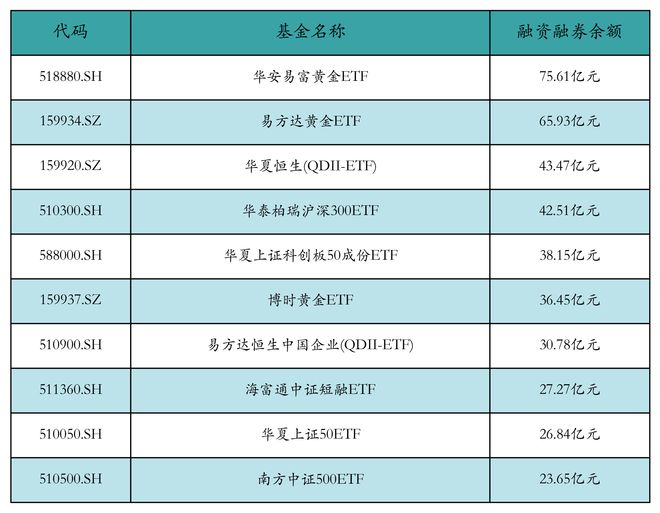
Market Overview - On July 25, the total ETF margin balance in the two markets was 99.456 billion yuan, a decrease of 0.936 billion yuan from the previous trading day [1] - The financing balance was 93.569 billion yuan, down by 0.936 billion yuan, while the securities lending balance increased by 356,300 yuan to 5.888 billion yuan [1] - In the Shanghai market, the ETF margin balance was 67.031 billion yuan, a decrease of 0.724 billion yuan, with a financing balance of 61.932 billion yuan, down by 0.722 billion yuan [1] - In the Shenzhen market, the ETF margin balance was 32.426 billion yuan, a decrease of 0.213 billion yuan, with a financing balance of 31.637 billion yuan, down by 0.214 billion yuan [1] ETF Margin Balance - The top three ETFs by margin balance on July 25 were: - Huaan Yifu Gold ETF (7.561 billion yuan) - E Fund Gold ETF (6.593 billion yuan) - Huaxia Hang Seng (QDII-ETF) (4.347 billion yuan) [2] - The top ten ETFs by margin balance included: - Huatai-PB CSI 300 ETF (4.251 billion yuan) - Huaxia Shanghai Stock Exchange Sci-Tech Innovation Board 50 ETF (3.815 billion yuan) - Bosera Gold ETF (3.645 billion yuan) [2] ETF Financing Buy Amount - The top three ETFs by financing buy amount on July 25 were: - E Fund CSI Hong Kong Securities Investment Theme ETF (1.31 billion yuan) - Hai Fu Tong CSI Short Bond ETF (1.097 billion yuan) - Huaxia Shanghai Stock Exchange Sci-Tech Innovation Board 50 ETF (0.855 billion yuan) [3] ETF Financing Net Buy Amount - The top three ETFs by financing net buy amount on July 25 were: - Fuguo Medium and Long-term Policy Financial Bond ETF (99.463 million yuan) - E Fund CSI Hong Kong Securities Investment Theme ETF (84.699 million yuan) - E Fund CSI Artificial Intelligence Theme ETF (58.040 million yuan) [5] ETF Securities Lending Sell Amount - The top three ETFs by securities lending sell amount on July 25 were: - Southern CSI 500 ETF (53.323 million yuan) - Huatai-PB CSI 300 ETF (10.948 million yuan) - Guolian An CSI All-Index Semiconductor Products and Equipment ETF (7.437 million yuan) [7]