
三六零

Search documents
国泰海通:计算机年报业绩增长与下滑两极分化 行业呈现“两头大、中间小”特征
智通财经网· 2026-02-04 06:17
Group 1 - The core viewpoint indicates that the median data shows that the profit performance of computer companies in 2025 is expected to outperform revenue [1] - Among the 238 companies that released performance forecasts, only 70 provided revenue data, with a median revenue growth rate of 0.97%. In contrast, the median growth rate for net profit attributable to shareholders is 17.83%, and for non-recurring net profit, it is 28.68% [1] - Large-cap companies tend to lean towards the growth side in performance statistics, with stronger certainty in fourth-quarter performance [1] Group 2 - In 2025, over half of the computer industry performance forecasts are positive, indicating a polarization between growth and decline [2] - Among the 358 computer companies, 238 released performance forecasts, representing 66.5%. The distribution of expected net profit growth rates shows that 42.9% (103 companies) expect growth of over 30%, while 36.3% (87 companies) anticipate a decline of over 30% [2] - The high-growth and significant decline segments combined account for 79.2% of the companies, with 60% (142 companies) expecting growth and 40% (96 companies) expecting decline [2] Group 3 - Among companies with a net profit of approximately 100 million and above, significant performance differentiation is observed [3] - Companies with clear improvements in performance and expected year-on-year growth of over 30% include Tonghuashun, Daotong Technology, and iFLYTEK, among others [3] - Conversely, companies facing profit pressure with year-on-year declines include Bosi Software and Keyuan Wisdom, with the latter showing nearly 40% growth when excluding impairment losses [3]

国内外AI年报分析展望




2026-02-04 02:27
Summary of the Conference Call on AI Annual Report Analysis Industry Overview - The conference focused on the analysis and outlook of AI annual reports, particularly in the TMT (Technology, Media, and Telecommunications) sector, with a specific emphasis on domestic and international AI companies [1][2][4]. Key Points and Arguments General Market Sentiment - The period from October 31 to March is characterized as a performance vacuum, where the focus is on thematic investments rather than immediate earnings results [2][3]. - The spring market is expected to see a resurgence, with significant activity anticipated around March [3][4]. North American Companies - North American companies, particularly those involved in AI and cloud computing, have reported earnings that exceeded expectations, indicating strong capital expenditure in AI [4][6]. - Companies like Microsoft and Meta have shown robust spending on AI infrastructure, reflecting a positive outlook for the sector [4][6]. - Despite some domestic companies underperforming, their stock prices have rebounded, suggesting that market sentiment is more focused on thematic trends rather than immediate earnings [5][6]. Domestic AI Companies - Domestic AI companies are experiencing a supply-demand imbalance, with strong demand for AI-related products and services, despite some companies reporting earnings below expectations [6][7]. - The industry is characterized by a shortage of materials and components, which is driving prices up and creating a favorable environment for growth [6][7][10]. Future Growth Projections - There is a consensus that the growth trajectory for AI companies will continue to be strong, with expectations for significant growth in 2026 and beyond [8][9]. - Many companies are currently undervalued, trading at price-to-earnings (P/E) ratios between 15x to 20x, which presents a potential investment opportunity [8][9]. Specific Company Insights - Companies like Wan, Tianfu Communication, and others are highlighted for their potential despite recent earnings misses, as the overall industry outlook remains positive [4][6][7]. - The demand for GPUs and AI chips is expected to remain high, with domestic companies like Cambrian facing challenges but still showing potential for recovery [9][10]. Application and Innovation - The conference emphasized the importance of AI applications, particularly in gaming and media, with companies like Tencent and ByteDance leading the charge [14][15]. - The emergence of AI-driven applications is seen as a significant growth area, with expectations for increased investment and innovation in this space [14][15]. Regulatory and Market Concerns - There are concerns regarding potential regulatory impacts on the gaming industry, but these are largely viewed as unfounded and not likely to affect the overall market significantly [15][16]. - The market is currently experiencing volatility, but analysts suggest that this presents buying opportunities for fundamentally strong companies [21][22]. Additional Important Insights - The conference highlighted the importance of monitoring capital expenditure trends among major tech companies, as this will influence the demand for AI infrastructure and services [36][37]. - The potential for new technologies, such as diamond-based cooling materials for semiconductors, was discussed as a future growth area [24][25]. - Analysts recommend focusing on companies with strong fundamentals and growth potential, particularly in the AI and semiconductor sectors, as the market continues to evolve [22][23][39].
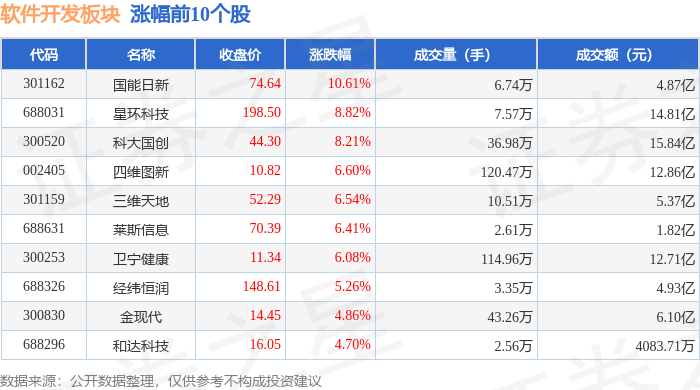
软件开发板块2月3日涨2.26%,国能日新领涨,主力资金净流出5.07亿元
Zheng Xing Xing Ye Ri Bao· 2026-02-03 09:11
Group 1 - The software development sector increased by 2.26% on February 3, with Guoneng Rixin leading the gains [1] - The Shanghai Composite Index closed at 4067.74, up 1.29%, while the Shenzhen Component Index closed at 14127.1, up 2.19% [1] - Notable stock performances included Guoneng Rixin with a closing price of 74.64, up 10.61%, and Xinghuan Technology at 198.50, up 8.82% [1] Group 2 - The software development sector experienced a net outflow of 507 million yuan from institutional investors, while retail investors saw a net inflow of 751 million yuan [2] - Key stocks with significant net inflows from retail investors included Weining Health with 52.54 million yuan and Jinxian Modern with 45.04 million yuan [3] - Major stocks like Keda Xunfei and Tonghuashun faced net outflows from institutional and retail investors, indicating mixed investor sentiment [3]



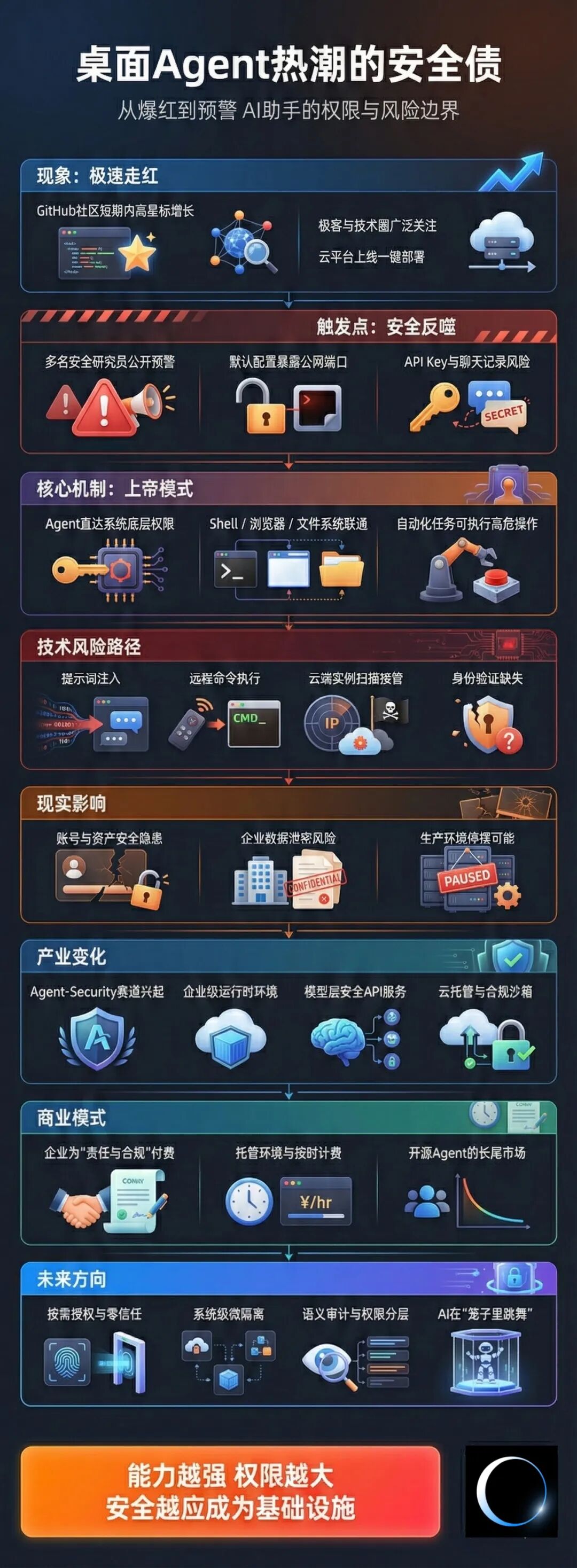
谁来防御桌面Agent的危险边界
3 6 Ke· 2026-02-03 07:52
Core Insights - The AI assistant OpenClaw has rapidly gained popularity but has also faced significant security issues, leading to a backlash from users and experts alike [1][3][15] - The emergence of OpenClaw has highlighted the potential risks associated with AI agents, particularly regarding user account security and data privacy [9][10][15] Industry Impact - The rise of OpenClaw has exposed vulnerabilities in account and asset security, as well as risks of data leaks and operational disruptions for businesses [3][10] - The incident has catalyzed the emergence of a new market focused on Agent-Security, with companies recognizing the need for robust security measures in AI applications [15][16] Market Trends - The global market for generative AI cybersecurity is projected to grow significantly, from $3.27 billion in 2024 to $14.88 billion by 2029, with a compound annual growth rate of 35.4% [16] - Major cybersecurity firms, including Microsoft and CrowdStrike, are quickly developing solutions to address the security challenges posed by AI agents [17][19] Business Models - Companies are likely to pay for "enterprise-level Agent runtime environments" to ensure liability coverage in case of security incidents [20] - The DIY market for self-built agents presents a long-tail opportunity, although monetization remains challenging due to the prevalence of free open-source solutions [21] Future Directions - The future of AI security will focus on nuanced authorization and zero-trust principles, allowing for dynamic privilege escalation based on specific tasks [25][26] - The integration of advanced security technologies, such as semantic auditing and micro-isolation, aims to enable businesses to confidently delegate core operations to AI [26][28]
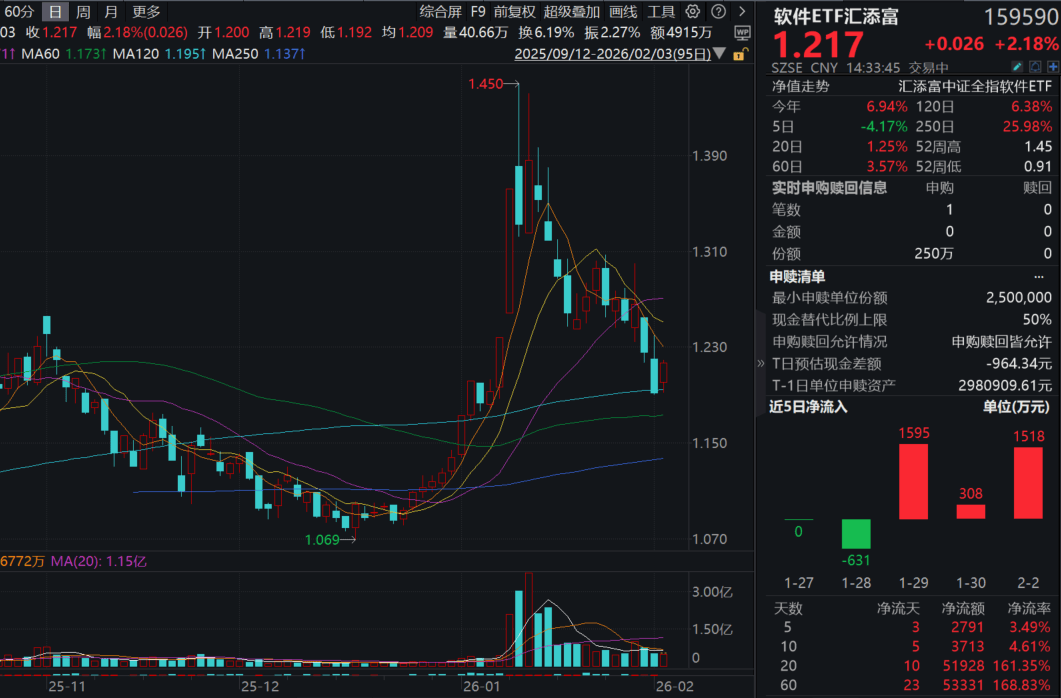
阶跃星辰发布新开源Agent基座模型,软件板块持续走强!顺网科技涨超14%,软件ETF汇添富(159590)涨超2%,盘中再“吸金”!
Sou Hu Cai Jing· 2026-02-03 07:11
Group 1 - The core viewpoint of the news highlights the strong performance of AI applications and the software sector, with the software ETF Huatai (159590) rising over 2% and attracting funds for the fourth consecutive day [1] - The software ETF's index includes popular constituent stocks, most of which showed positive performance, with Shunwang Technology rising over 13% and other stocks like Deepin Technology and Zhongke Xingtai increasing over 3% [5] - Recent advancements in AI model development were announced by Jiyue Xingchen, including the launch of the new generation model Step4 and the open-sourcing of the latest base model Step3.5Flash, which features a total parameter count of 196 billion [3] Group 2 - Citic Securities noted a surge in demand for overseas inference and training computing power, with Amazon Cloud and Google Cloud both raising prices due to increased demand for AI applications [4] - The price increase by AWS and Google Cloud is attributed to the explosive growth in computing power demand driven by AI applications, particularly those related to agents [4] - Changjiang Securities predicts that 2026 will be a pivotal year for the commercialization of agents, with significant advancements in their capabilities and a potential explosion in commercial potential [6]


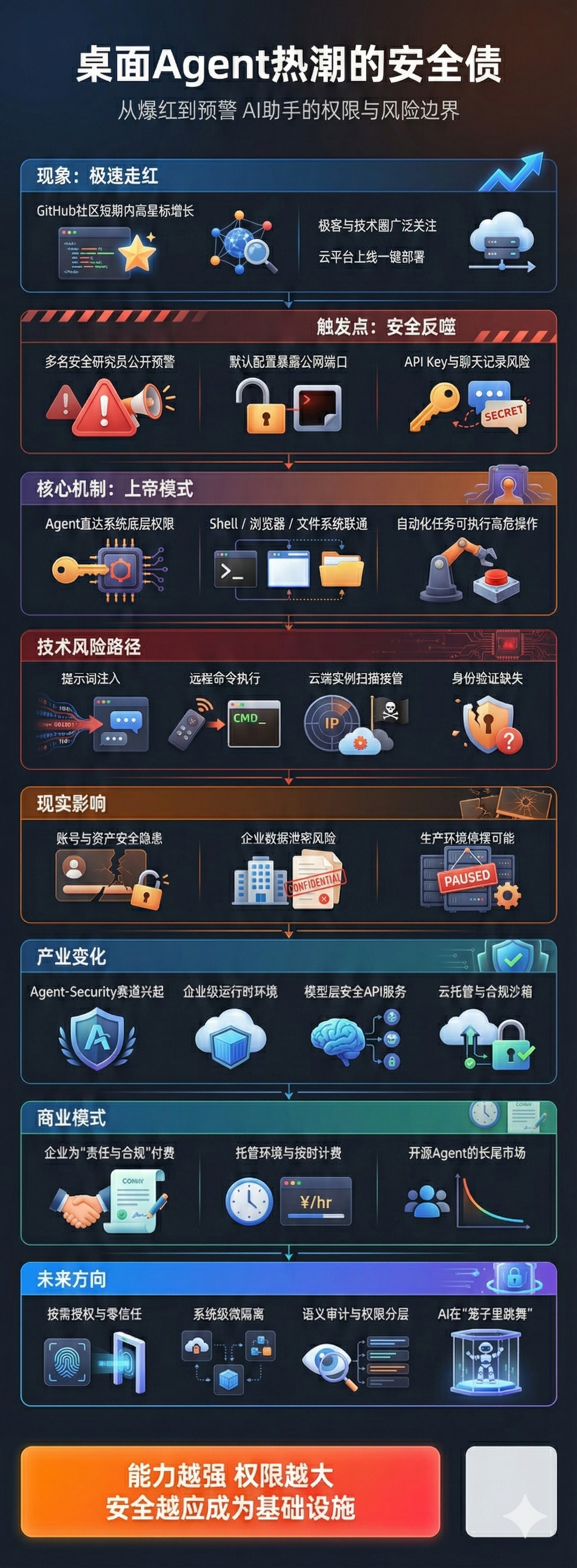
桌面Agent热潮“安全债”调查
Hua Er Jie Jian Wen· 2026-02-03 03:19
Core Insights - The AI assistant OpenClaw has rapidly gained popularity but has also faced significant security issues, leading to a swift decline in its reputation [2][3] - The emergence of security vulnerabilities in AI systems like OpenClaw highlights the need for robust security measures in the AI industry [15][16] Group 1: OpenClaw's Rise and Fall - OpenClaw, an AI assistant, quickly gained traction on platforms like GitHub, amassing 80,000 stars in just ten days [2] - Users have reported severe security breaches, including account theft and data exposure, due to operational errors and vulnerabilities in OpenClaw [2][9] - The initial praise for OpenClaw has turned into criticism as security researchers warn about its flaws, indicating a rapid shift in public perception [2][3] Group 2: Security Risks and Implications - OpenClaw's architecture allows for excessive control, posing risks such as remote command execution and data leaks [9][10] - The default configurations of OpenClaw expose users to potential attacks, with over 15,000 instances identified globally, particularly in the U.S. and China [8][9] - The lack of proper sandboxing and security measures can lead to severe consequences, including unauthorized access to sensitive information [10][11] Group 3: Market Opportunities in AI Security - The security concerns surrounding OpenClaw are driving the growth of a new market focused on agent security, projected to be worth billions [16][17] - Companies are increasingly investing in AI security solutions, with a forecasted market growth from $3.27 billion in 2024 to $14.88 billion by 2029, reflecting a compound annual growth rate of 35.4% [17] - Major cybersecurity firms are rapidly developing solutions to address the vulnerabilities associated with AI agents, indicating a shift in focus towards security in AI applications [18][19][20] Group 4: Future Directions in AI Security - The future of AI security will involve a balance between functionality and safety, with a focus on dynamic permission granting and micro-isolation techniques [27][29] - The integration of security measures into AI systems is essential for fostering trust and enabling businesses to leverage AI without compromising their core operations [29][31] - As the AI security market matures, the ultimate goal is to create a safe environment where AI can operate effectively without posing risks to users [29][30]
2026年中国人工智能生成内容(AIGC)产业链、用户规模及竞争现状,行业加速向垂直行业深度渗透[图]
Chan Ye Xin Xi Wang· 2026-02-03 01:35
Core Insights - The AIGC (Artificial Intelligence Generated Content) industry is experiencing explosive growth in China, with revenue expected to rise from approximately 440 million yuan in 2020 to 544.55 billion yuan by 2032, positioning China as a potential global leader in this market [1][10]. Group 1: AIGC Industry Overview - AIGC is defined as a new content production method utilizing AI technology to automatically generate content, categorized as a type of content from the producer's perspective [2]. - The core infrastructure of the AI industry consists of computing power, algorithms, and data, which are essential for the innovation and development of the AIGC sector [2]. Group 2: AIGC Industry Advantages - AIGC significantly reduces costs and increases efficiency by automating repetitive content production tasks, thus shortening the overall content creation cycle and lowering labor and time costs [3][4]. - The technology enables multi-modal creation, allowing for cross-media conversion of different content forms, enhancing creativity and broadening the scope of content presentation [3][4]. - AIGC offers high customization accuracy, deeply analyzing user inputs to generate tailored content that meets diverse user needs [4]. Group 3: AIGC Industry Policies - Since 2023, China has been establishing a multi-layered policy framework for AIGC, progressing from basic regulations to comprehensive empowerment and safety governance [5]. - Policies encourage innovation in AIGC technology across various fields, aiming to create a robust application ecosystem [5]. Group 4: AIGC Industry Chain - The upstream of the AIGC industry includes data collection, cleaning, and labeling, which provide high-quality data support for AI model training [7]. - The downstream involves various applications that utilize AI models to solve specific problems, including the development and operation of applications that automatically generate images, text, and music [7]. Group 5: AIGC Industry Development Status - Since 2023, advancements in large model capabilities and decreasing operational costs have accelerated the development of AIGC, with commercial products like ChatGPT and Midjourney emerging [8][9]. - The global AIGC market is projected to grow from approximately $2.3 billion in 2020 to about $19.5 billion by 2024, with a compound annual growth rate of 70.6% [9]. Group 6: AIGC User Growth - The user base for AIGC in China is expected to reach 515 million by June 2025, driven by the expansion of application scenarios and increased product usability [11][12]. - The demographic profile shows that young and middle-aged groups constitute the majority of users, reflecting the adoption patterns of emerging internet technologies [12]. Group 7: AIGC Competitive Landscape - Major international players in the AIGC space include OpenAI, Microsoft, Google, and Meta, while Chinese companies like Baidu, Alibaba, and Tencent are also significant competitors [13][14]. - The competition is shifting from technical parameter comparisons to the ability to implement and commercialize solutions across various scenarios [14]. Group 8: AIGC Industry Development Trends - AIGC technology is evolving towards systematic upgrades, with multi-modal integration breaking down barriers between different types of data [17]. - The industry is moving towards deeper penetration into vertical sectors, creating tailored solutions that meet specific needs [17].




大摩:AI算力一路向西
Ge Long Hui· 2026-02-02 08:10
Core Insights - Morgan Stanley's latest report highlights a positive trend in the data center sector driven by demand scale, resource availability, and the "East Data West Computing" policy, which encourages large-scale cloud service providers to shift data center deployments to remote areas, benefiting local data center builders [1] Group 1: Market Demand and Investment - The capital expenditure of mainland China's large-scale cloud service providers is projected to reach 440 billion RMB by 2026, with an estimated 32% (approximately 141 billion RMB) allocated for domestic computing power [1] - The report estimates that the total new orders for third-party data centers (excluding self-built data centers by cloud service providers) will increase by 66% to 3.4 gigawatts by 2026 [1] Group 2: Impact of AI Chips and Policy Changes - If the import of H200 chips by ByteDance, Alibaba, Tencent, and DeepSeek is fully approved, the forecast for new orders in China's third-party data centers could be revised upwards to approximately 4.5 gigawatts by 2026, representing a year-on-year increase of 120% [1] - In a baseline scenario, remote data centers are expected to contribute 2.4 gigawatts of new orders by 2026, increasing to 3.3 gigawatts by 2027, accounting for about 70% of new orders [1] Group 3: Regional Development and Infrastructure - The "East Data West Computing" initiative effectively consolidates supply into ten major clusters, primarily focused on four remote cities, with Inner Mongolia's Ulanqab and Ningxia's Zhongwei identified as key beneficiaries in the AI era [1] - Zhongwei is emerging as a new data center hub, aiming for a total capacity of 750 megawatts by the end of 2025, with a long-term goal of achieving 2 gigawatts by the end of 2027 [1] - Alibaba is a key player in the Zhongwei cluster, having established infrastructure connecting the hub with data transmission capabilities [1] Group 4: Historical Context and Future Prospects - Since 2016, Zhongwei has welcomed its first batch of data center projects, with clients including AWS China, Qihoo 360, and Meituan, indicating a mature local network infrastructure and talent pool [1] - Several internet and cloud companies, including Tencent, Alibaba, and Baidu, are interested in establishing parks in Zhongwei, along with AI firms like Zhipu [1]
AI人工智能ETF(512930)盘中成交1.52亿,AI应用开启春节档红包大战
Xin Lang Cai Jing· 2026-02-02 06:44
华源证券指出,目前AI仍是全球产业叙事中最重要的方向之一,大厂AI产品进度仍是核心,AI入口竞 争后续会持续演绎,手机端侧(苹果等)、超级APP(微信、抖音等)和垂直AI平台(类似豆包、元 宝、千问、智谱等)将从不同维度持续推进AIAgent入口用户层面的教育和圈定,同时通过不同方式完 成应用层生态的连接和统一。建议重视产品落地且有收入结构的应用方向。 截至2026年2月2日 14:17,中证人工智能主题指数(930713)成分股方面涨跌互现,新易盛领涨6.65%,润 泽科技上涨3.87%,三六零上涨3.46%;北京君正领跌。AI人工智能ETF(512930)最新报价2.34元,盘中 换手4.5%,成交1.52亿元。 消息面上,阿里加入春节档红包大战,千问APP宣布投入30亿启动"春节请客计划",将于2月6日正式上 线。春节期间,千问App将联合淘宝闪购、飞猪、大麦、盒马、天猫超市、支付宝等阿里生态业务,以 免单形式请全国人民在春节期间吃喝玩乐。此前腾讯元宝上线春节红包活动,当日腾讯元宝已超过字节 跳动旗下豆包升至第一名。 数据显示,截至2026年1月30日,中证人工智能主题指数(930713)前十大权重股分 ...
AI Agent正加速从概念走向规模化落地,软件ETF(159852)获资金关注
Xin Lang Cai Jing· 2026-02-02 02:51
Group 1 - The software development sector is experiencing fluctuations, with the CSI Software Service Index down by 0.81% as of 10:21 on February 2, 2026, and individual stocks showing mixed performance [1] - Alibaba has launched a localized intelligent Agent tool, QoderWork, designed for desktop office use, which operates entirely on user terminals without uploading data to the cloud, indicating a shift towards an "end-edge-cloud" collaborative AI software paradigm [1] - The introduction of QoderWork is expected to reshape the competitive landscape of office software and user interaction habits in China [1] Group 2 - AI Agents are transitioning from concept to large-scale implementation, with modern Agents requiring the ability to run hundreds to thousands of independent environment instances, increasing the operational pressure on CPU and memory bandwidth [2] - The DeepSeek Engram architecture and Anthropic Claude Cowork's introduction of a permanent knowledge base highlight the evolution of CPUs from traditional computing units to central hubs in the AI era [2] - As of January 30, 2026, the top ten weighted stocks in the CSI Software Service Index account for 60.27% of the index, including companies like iFlytek, Kingsoft Office, and 360 [2] Group 3 - The Software ETF (159852) tracks the CSI Software Service Index, providing a convenient tool for investing in the computer software industry [3] - Investors can also access AI software investment opportunities through the Software ETF linked fund (012620) [4]