
国家开发银行

Search documents
委内瑞拉石油困局中的中国棋局:百亿投资能否撬动千亿桶油藏?
Sou Hu Cai Jing· 2026-01-03 12:05
Core Insights - Venezuela, once wealthy from oil, is now struggling between recovery and turmoil, with the world's largest proven oil reserves of approximately 47.3 billion tons [1] - Oil production in Venezuela plummeted by 78% since 2010, but signs of recovery emerged in 2021, with production expected to reach 53 million tons in 2024, growing at about 9% annually [1] - Chinese investment has been pivotal in this recovery, as Chinese companies are the only ones willing to invest after Western firms withdrew [1] Chinese Investment - China plans to invest over $1 billion in developing two oil fields, aiming to increase daily production from 12,000 barrels to 60,000 barrels by the end of 2026 [3] - Since 2019, China has provided approximately $50 billion in loans to Venezuela through oil-for-loan agreements, with over $8 billion in oil and gas investments expected in 2024 [3] - The cooperation model between China and Venezuela includes a "production sharing" agreement, allowing transactions in RMB, which aids in the internationalization of the currency [3] Geopolitical Risks - U.S. military presence in the Caribbean is increasing, with a fleet dispatched to the South Caribbean region, posing direct sanctions and military threats to Chinese investments in Venezuela [4] - The U.S. has imposed a 25% tariff on all countries importing Venezuelan oil, complicating the investment landscape for Chinese companies [4] Financial Network - As of April 2025, the China Development Bank has provided approximately $165 billion in financing support to over 260 projects across 21 Latin American countries [4] - The share of RMB in cross-border settlements in Latin America reached 14% in 2024, a nearly fivefold increase since 2019 [4] - Venezuela's proposal to pay suppliers in RMB is a strategy to circumvent U.S. sanctions and further the internationalization of the currency [4] Economic Special Zones - Venezuela is focusing on economic special zones to reduce dependence on oil, with the Economic Special Zone Organization Law enacted in June 2022, inspired by Chinese practices [6] - The establishment of these zones allows for tax incentives and temporary processing permits, strengthening the bilateral relationship and providing a stable political environment for Chinese energy interests [6] - China's investment strategy in Venezuela, including daily imports of 463,000 barrels of oil and over $1 billion in oil field investments, forms a robust foundation for its energy strategy in Latin America [6]


近30笔千万级罚单!2025年银行业罚单大盘点
证券时报· 2026-01-03 05:27
Core Viewpoint - In 2025, the Chinese banking industry is undergoing significant regulatory scrutiny characterized by "strict regulation, strong accountability, and zero tolerance," leading to a notable increase in both the quantity and severity of penalties imposed on banks [1]. Group 1: Regulatory Environment - The number of penalties exceeding 10 million yuan in the banking sector reached nearly 30, affecting various types of institutions including state-owned banks, policy banks, joint-stock banks, city commercial banks, private banks, and bank-affiliated wealth management subsidiaries [2]. - Regulatory focus has expanded beyond traditional areas like credit management to include corporate governance, related party transactions, anti-money laundering, data security, and wealth management business oversight [2][4]. Group 2: Major Penalties - Major state-owned banks such as Bank of China, Industrial and Commercial Bank of China, and Agricultural Bank of China received substantial fines, with Bank of China facing a fine of 97.9 million yuan for issues related to corporate governance and asset quality management [4]. - In December 2025, China Communications Bank was fined 68.07 million yuan for violating multiple regulations, including account management and anti-money laundering obligations [4][5]. Group 3: Compliance and Risk Management - The penalties highlight a trend of inadequate compliance and risk management across various banking operations, including loan management, interbank transactions, and wealth management [7][10]. - The regulatory environment has intensified scrutiny on compliance with anti-money laundering regulations, with significant fines imposed for failures in customer identity verification and transaction reporting [8][9]. Group 4: Emerging Business Areas - New banking business models, such as wealth management subsidiaries and direct banks, are also facing strict regulatory penalties, indicating that the regulatory environment is not limited to traditional banking practices [13]. - For instance, Jiaoyun Wealth Management was fined 17.5 million yuan for non-compliance in product information disclosure and post-investment management [13]. Group 5: Double Penalty System - The implementation of a "double penalty system" has become prevalent, where not only institutions are fined but also individual responsible parties face penalties, enhancing accountability within financial institutions [15]. - This system links the career prospects of involved personnel directly to the compliance performance of their institutions, thereby increasing regulatory pressure [15]. Group 6: Future Outlook - The ongoing trend of strict regulation and accountability is expected to continue, prompting banks to improve their internal governance structures and compliance management systems [16]. - The adjustments in business processes and increased technological investments are anticipated to have a profound impact on the operational models and competitive landscape of the banking industry [16].




重拳出击!近30笔千万级罚单!2025年银行业罚单大盘点
券商中国· 2026-01-03 03:33
Core Viewpoint - In 2025, the Chinese banking industry is undergoing significant regulatory scrutiny characterized by "strict regulation, strong accountability, and zero tolerance," leading to a notable increase in both the quantity and amount of penalties imposed on various banking institutions [1]. Regulatory Penalties Overview - The number of penalties exceeding ten million yuan has reached nearly 30, affecting a wide range of institutions including state-owned banks, policy banks, joint-stock banks, city commercial banks, private banks, and bank-affiliated wealth management subsidiaries [1]. - Penalties are not limited to traditional areas like credit management but also extend to corporate governance, related party transactions, anti-money laundering, data security, and wealth management [2]. Corporate Governance and Compliance - Major state-owned banks such as Bank of China, Industrial and Commercial Bank of China, and Agricultural Bank of China have received substantial fines for issues related to corporate governance and business management [3]. - The largest penalty of the year was imposed on Bank of China, amounting to 97.9 million yuan for various management issues [3]. - Regulatory focus has shifted to deeper issues such as the effectiveness of board responsibilities and the integrity of internal control processes [3]. Compliance and Anti-Money Laundering - There has been an intensified crackdown on compliance, particularly in the anti-money laundering sector, with significant fines imposed on banks for failing to adhere to basic financial management regulations [4]. - For instance, China Merchants Bank was fined 68.07 million yuan for violating 11 regulations related to account management and anti-money laundering [4]. Business Management Issues - The primary reasons for penalties in the banking sector include: - Inadequate management across various business areas such as loans, interbank transactions, and wealth management [6]. - Non-compliance with anti-money laundering responsibilities, including failure to identify customers and report suspicious transactions [7]. - Violations in foreign exchange and investment operations, including illegal currency transactions and improper investment disclosures [8]. - Insufficient implementation of regulatory requirements, leading to non-compliance in data reporting and employee management [9]. Emerging Business Areas - New banking business models, including wealth management subsidiaries and direct banks, have also faced penalties, indicating strict regulatory oversight in these emerging sectors [11]. - For example, a wealth management subsidiary was fined 17.5 million yuan for non-compliance in product information disclosure and post-investment management [12]. Double Penalty System - The implementation of a "double penalty system" has become a significant aspect of regulatory actions, where both institutions and responsible individuals face penalties [13]. - This system aims to link the career prospects of involved personnel directly to the compliance performance of their institutions, thereby enhancing accountability [14]. Summary of Penalties - A detailed overview of penalties reveals that various banks have faced significant fines for a range of compliance failures, with amounts often exceeding ten million yuan [15][16].



国开行2025年发放城市建设领域贷款1.16万亿元
Xin Hua Wang· 2026-01-01 04:14
国家开发银行日前在京召开服务城市高质量发展暨城市更新业务推进会。会议提出,国开行将精 准、高效、合规投放信贷资源和投资资源,进一步增强政策性金融服务城市高质量发展的功能作用。同 时,加强政银企合作,深化融资模式和金融产品"两个创新",抓实政策制度、内部协同、风控合规和人 才队伍"四个保障",助力建设现代化人民城市。 【纠错】 【责任编辑:张樵苏】 新华社北京1月1日电(记者张千千)记者从国家开发银行获悉,2025年,国开行发放城市建设领域 贷款1.16万亿元,服务城市功能品质提升和人居环境改善。截至2025年末,国开行在城市建设领域贷款 余额6.3万亿元。 ...
做好“海”的文章 国家开发银行以金融之力护航青岛高质量发展
Jin Rong Shi Bao· 2025-12-30 02:03
Group 1: Infrastructure Development - The Qingdao Jiaozhou Bay Second Undersea Tunnel is a major infrastructure project, measuring 17.48 kilometers, and is currently the largest and longest of its kind in the world, with a construction challenge that includes complex geological conditions [1][2] - The project aims to enhance traffic efficiency and reduce costs between Qingdao's urban area and Huangdao District, addressing the saturation of existing transportation links [2] - The China Development Bank (CDB) has provided significant financial support, including a customized financing plan and a total of 20.32 billion yuan in loans to facilitate the project's progress [2] Group 2: Marine Economy - The development of a modern marine fishery industry park is underway, focusing on the Atlantic salmon, which requires a land-sea relay model for successful cultivation [3] - The park aims to create a comprehensive industrial chain that includes research, breeding, farming, processing, and support services, leveraging digital management and automation [3][4] - CDB has provided 90 million yuan in new policy financial tools to support the project, addressing the capital needs of enterprises [4][5] Group 3: Cultural and Historical Preservation - Qingdao is focusing on the transformation and upgrading of its old port and city areas to protect historical culture while promoting urban development [6][7] - The Qingdao International Cruise Port area is being developed to connect new and old urban areas, enhancing the integration of cultural heritage and modern infrastructure [7] - CDB has issued loans totaling 3.1 billion yuan and 60 million yuan in new policy financial tools to support the transformation of the old port area into a modern cultural tourism hub [7][8] Group 4: Water Resource Management - The newly completed Gonglu Reservoir, with a total capacity of 2.11 billion cubic meters, is crucial for addressing Qingdao's water scarcity issues [9][10] - The reservoir will not only secure water supply but also improve the balance between urban and agricultural water use, contributing to food security and ecological sustainability [9] - CDB has provided 3.28 billion yuan in medium- and long-term loans and 915 million yuan from the infrastructure investment fund to support the reservoir's construction [10] Group 5: Future Development Plans - The CDB plans to continue supporting Qingdao's development by focusing on building a modern industrial system and enhancing marine economic capabilities [11] - The bank aims to contribute to the construction of an innovative industrial system and support key areas such as technological innovation, advanced manufacturing, and ecological protection [11]
中国银行业协会发布《中国银行业中间业务发展报告暨创新案例选编》
Xin Lang Cai Jing· 2025-12-26 12:21
Core Viewpoint - The report highlights the trends, characteristics, significant changes, and achievements in the development of intermediary business in China's banking sector, while also analyzing the challenges faced and forecasting future directions [1][5] Group 1: Service National Strategy and Improve Service Quality - Due to factors such as slowing economic growth and policy interest rate cuts, commercial banks are experiencing a continuous narrowing of net interest margins, necessitating a shift towards intermediary business with lighter capital and assets [2][6] - Commercial banks are actively serving key sectors like advanced manufacturing, strategic emerging industries, and the elderly care industry, while enhancing product innovation and accelerating business transformation [2][6] - The implementation of fee reduction policies aims to improve financial service quality and optimize customer financial experiences, thereby supporting high-quality economic development [2][6] Group 2: Strengthen Management Capabilities and Solidify Operational Foundation - Intermediary business is crucial for commercial banks to serve the real economy and promote their own high-quality development [7] - In the context of narrowing net interest margins and tightening capital constraints, banks are enhancing refined management and professional capabilities to achieve cost reduction and efficiency improvement [7] - The report emphasizes the need for product and service innovation, building a versatile talent pool, deepening technological empowerment, and strengthening compliance management to enhance value creation capabilities [7] Group 3: Learn from International Experience to Promote Transformation and Upgrading - The report reviews the overall development and structural characteristics of intermediary business in European and American banks over the past three years, comparing income structure, product service innovation, and management models [3][7] - By integrating China's national conditions and policy guidance, the report suggests adopting mature practices from international banks in terms of management philosophy, operational models, and technological innovation to facilitate the transformation and upgrading of intermediary business in China [3][7] Group 4: Select Excellent Cases to Showcase Good Practices - The report selects exemplary cases of intermediary business product innovation from various banks, including the China Development Bank, Agricultural Development Bank of China, and others, showcasing innovation models, service effectiveness, significance, and specific application scenarios [4][7] - This selection aims to demonstrate the innovative development of intermediary business in commercial banks and the effective practices in addressing key issues [4][7]
“十五五”规划建议的“必答题”,银行业何解?
Jin Rong Shi Bao· 2025-12-26 11:47
Core Viewpoint - The construction of the Western Land-Sea New Corridor is a clear requirement outlined in the "14th Five-Year Plan," with the People's Bank of China and other departments issuing guidelines to enhance financial services for this initiative [1] Group 1: Financial Support Measures - The guidelines propose 21 key measures across six areas to improve financial services for the Western Land-Sea New Corridor, focusing on logistics, trade, and industry integration [1] - The measures include enhancing organizational collaboration, strengthening financial connectivity, optimizing cross-border payment processes, and supporting the digital transformation of financial services [1] Group 2: Cross-Regional Collaboration - The issuance of the guidelines is significant for establishing cross-regional financial collaboration mechanisms among banking institutions [2] - Current challenges include a lack of regular coordination platforms between banks and other entities, slow response times for cross-province services, and inefficient cross-border settlement processes [2] Group 3: Digital Financial Services - The guidelines encourage the adoption of digital financial services, highlighting the advantages of risk identification, service efficiency, and cost control through digitalization [4] - Financial institutions are urged to innovate product offerings and optimize their overseas presence to better support the digital transformation of financial services [5] Group 4: Innovative Financing Models - The National Development Bank's Guangxi branch has adopted an innovative financing model, providing 7.373 billion yuan for the Pinglu Canal project, demonstrating the financial sector's role in enhancing logistics and infrastructure [6] - Strengthening trade relations with ASEAN countries is a key focus of the Western Land-Sea New Corridor, emphasizing the need for expanded financial cooperation [6] Group 5: Responsibilities of the Banking Sector - The guidelines call for the banking sector to take on greater responsibilities in establishing financial cooperation mechanisms and exploring international financial collaboration [7] - Banks are encouraged to work with domestic and international financial institutions to develop tailored financial solutions that meet regional trade characteristics [7]
国开行、工行、农行、中行、建行、交行、邮储银行等迅速响应!
Jin Rong Shi Bao· 2025-12-26 04:46
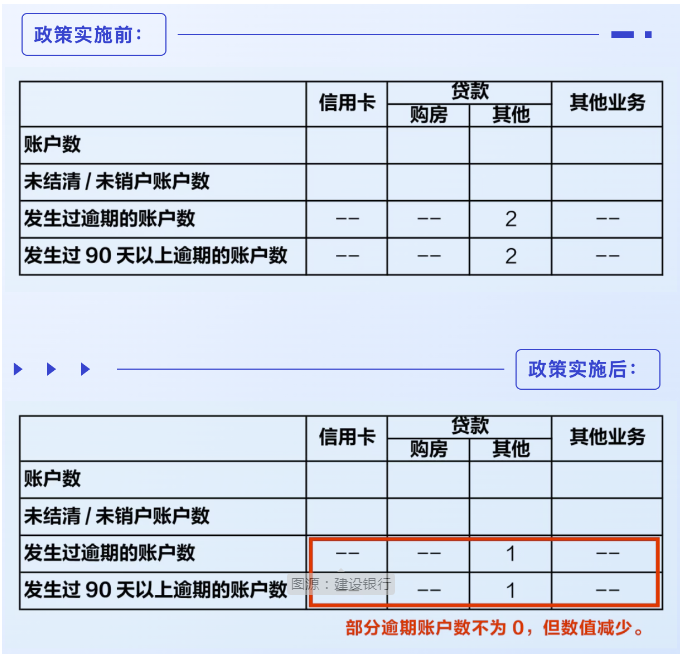
Core Viewpoint - The People's Bank of China has announced a one-time credit repair policy that allows individuals with overdue debts of up to 10,000 RMB to have their overdue information removed from the credit reporting system if they repay their debts in full by March 31, 2026 [1] Group 1: Policy Details - The policy applies to all types of personal credit, including credit cards, housing loans, and consumer loans, as long as they meet the specified conditions [1] - Individuals must fully repay overdue debts, including principal, interest, and penalties, and make timely payments for the current month to qualify for the credit repair [2] - The overdue information in credit reports will be adjusted, changing the repayment status from overdue to normal and the overdue amount from a non-zero value to zero [3][4] Group 2: Implementation and Support - Banks, including major institutions like Industrial and Commercial Bank of China and Agricultural Bank of China, are actively preparing to implement the policy and provide guidance to the public [6][7] - The central bank will offer an additional two free credit report inquiries in the first half of 2026 to accommodate increased demand for credit report checks following the policy implementation [5] - The policy is not to be viewed as a means of "credit washing," but rather as a special arrangement to address public concerns while maintaining the principle of punishing dishonesty [7]



直击融资痛点,助企纾困解难 北京举办人工智能领域银企融资交流活动
Xin Lang Cai Jing· 2025-12-26 00:44
Core Viewpoint - The event "Moli AI Lecture Hall" held in Beijing aims to enhance financing connections between AI enterprises and financial institutions, promoting the development of the AI industry in the region [1][6]. Group 1: AI Industry Development - Beijing's efforts in high-quality development of the AI sector include the registration of 205 large models and 147 AI products, with a user base of 1.439 billion for leading models [2][7]. - The average daily usage frequency of these models is 746 million, maintaining the top position in model registration and industrial application scale nationwide [2][7]. - The city aims to become a globally influential hub for AI innovation and industry, contributing to national technological competitiveness [2][7]. Group 2: Financial Policy and Support - The People's Bank of China Beijing Branch is implementing supportive monetary policies to optimize financial resource allocation and enhance service quality for the tech sector [3][8]. - A comprehensive financial policy framework has been established, including a "technology finance" and "green finance" product supermarket to support tech enterprises [3][8]. Group 3: Service Stations and Resource Integration - The establishment of two large model ecological service stations in Haidian and Mentougou aims to address challenges faced by AI companies, particularly SMEs, in accessing policies, funding, and resources [4][9]. - The "Moli AI Lecture Hall" initiative has conducted 21 events, reaching over 1,200 companies and 12,000 participants, facilitating easier business operations in Beijing [4][9]. Group 4: Banking Support for AI Enterprises - Major banks, including the National Development Bank and several commercial banks, are introducing tailored financial products to address the financing challenges faced by AI companies [5][10]. - These banks are establishing regular communication channels with enterprises to broaden financing options and reduce costs, enabling tech companies to focus on development [5][10].
直击融资痛点,助企纾困解难,北京举办人工智能领域银企融资交流活动
Jin Rong Jie· 2025-12-25 10:29
Group 1 - The event "Moli AI Lecture Hall" was co-hosted by the Beijing Cyberspace Administration and the Beijing Branch of the People's Bank of China, attracting over 50 internet and AI companies and nearly 100 executives and financial personnel [1] - Beijing is focusing on high-quality development in the AI sector, having registered 205 large models and 147 AI products, with a user base of 1.439 billion for leading models and an average daily call frequency of 746 million [2] - The People's Bank of China is implementing supportive monetary policies and optimizing financial resource allocation, introducing a "technology finance" and "green finance" product supermarket to enhance service quality and support innovation [3] Group 2 - The establishment of AI service stations aims to address challenges faced by small and medium-sized enterprises in the AI sector, facilitating access to policies, funding, computing power, talent, and partnerships [4] - Major banks, including the China Development Bank and several commercial banks, presented financing policies to tackle the issues of "difficult and expensive financing" for AI companies, promoting inclusive finance and reducing financing costs [5]