
微创医疗

Search documents
微创医疗(00853.HK):1月13日南向资金减持128.36万股
Sou Hu Cai Jing· 2026-01-13 19:21
Core Viewpoint - Southbound funds reduced their holdings in MicroPort Medical (00853.HK) by 1.2836 million shares on January 13, while experiencing a net increase of 9.0865 million shares over the past five trading days [1] Group 1: Southbound Fund Activity - In the last 20 trading days, MicroPort Medical saw southbound funds increase their holdings on 12 occasions, resulting in a total net increase of 4.915 million shares [1] - Currently, southbound funds hold 908 million shares of MicroPort Medical, which represents a certain percentage of the company's total issued ordinary shares [1] Group 2: Company Overview - MicroPort Medical Science Co., Ltd. is primarily engaged in the sales, production, research, and development of medical devices [1] - The company operates through eight divisions, including cardiovascular intervention, orthopedic medical devices, cardiac rhythm management, large artery and peripheral vascular intervention, neurointervention, structural heart disease, surgical robotics, and surgical medical devices [1]


JPM峰会上的中国医疗公司,现在都走了到哪一步?
GLP1减重宝典· 2026-01-13 14:15
Core Viewpoint - The article discusses the evolving landscape of the Chinese healthcare sector, particularly in the context of the upcoming JP Morgan Healthcare Conference, highlighting the diversification of Chinese companies and their strategic positioning in the global market [4][29]. Group 1: Conference Overview - The JP Morgan Healthcare Conference is the largest and most informative international healthcare investment and business development meeting, scheduled for January 12-15, 2026, in San Francisco [4]. - Approximately 22 Chinese companies are participating, categorized into four distinct roles: transaction-oriented innovative drug companies, disclosure companies at commercialization or regulatory milestones, supply-side platforms for global R&D and production outsourcing, and device companies focusing on efficiency and international expansion [4]. Group 2: Supply-Side Platforms - Supply-side platform companies are becoming essential in the global innovation chain, as they focus on delivering stable and efficient R&D and production capabilities, especially during periods of increased volatility in innovative drug companies [6][8]. - WuXi Biologics is shifting its focus from project quantity to project quality, emphasizing capacity utilization and long-term contract stability as key indicators of its value in the global biopharmaceutical supply chain [8]. Group 3: Cross-Border Licensing and Outbound Companies - The pricing logic for Chinese innovative drugs in cross-border licensing has evolved, with a focus on the overall deliverable capabilities rather than just the individual molecules [14]. - Companies like Kelun-Blotech and BaiLi Tianheng are exemplifying this trend by integrating their platforms into global R&D systems and establishing long-term collaborations with multinational pharmaceutical companies [16][18]. Group 4: Regulatory and Commercialization Companies - Companies that have accumulated clinical data and registration progress are transitioning towards verifiable sales and profit curves, shifting their valuation logic from future expectations to tangible cash flows [19]. - Zai Lab and Antengene are in the early commercialization stages, with their success hinging on their products' acceptance in clinical settings and the speed of prescription growth [21][23]. Group 5: Medical Device Companies - Mindray Medical is recognized for its comprehensive coverage of hospital workflows, with a focus on multi-product synergy rather than single-device performance, which is crucial for establishing long-term customer relationships [26]. - MicroPort Scientific is navigating a challenging environment where operational efficiency and cash flow management are critical for sustaining long-term clinical validation and international expansion [28]. Group 6: Industry Trends and Insights - The Chinese healthcare sector is transitioning from a phase of visibility to one of selection, where companies must clearly define their positions and deliverables in a high-intensity global exchange [29]. - The differentiation among Chinese companies in the global system is accelerating, with a clear divide between transaction-oriented innovative drug companies and those that have crossed critical regulatory milestones, focusing on verifiable growth [31].



CXO、消费医疗大崩盘:这三年医疗行业发生了什么?
Sou Hu Cai Jing· 2026-01-13 03:48
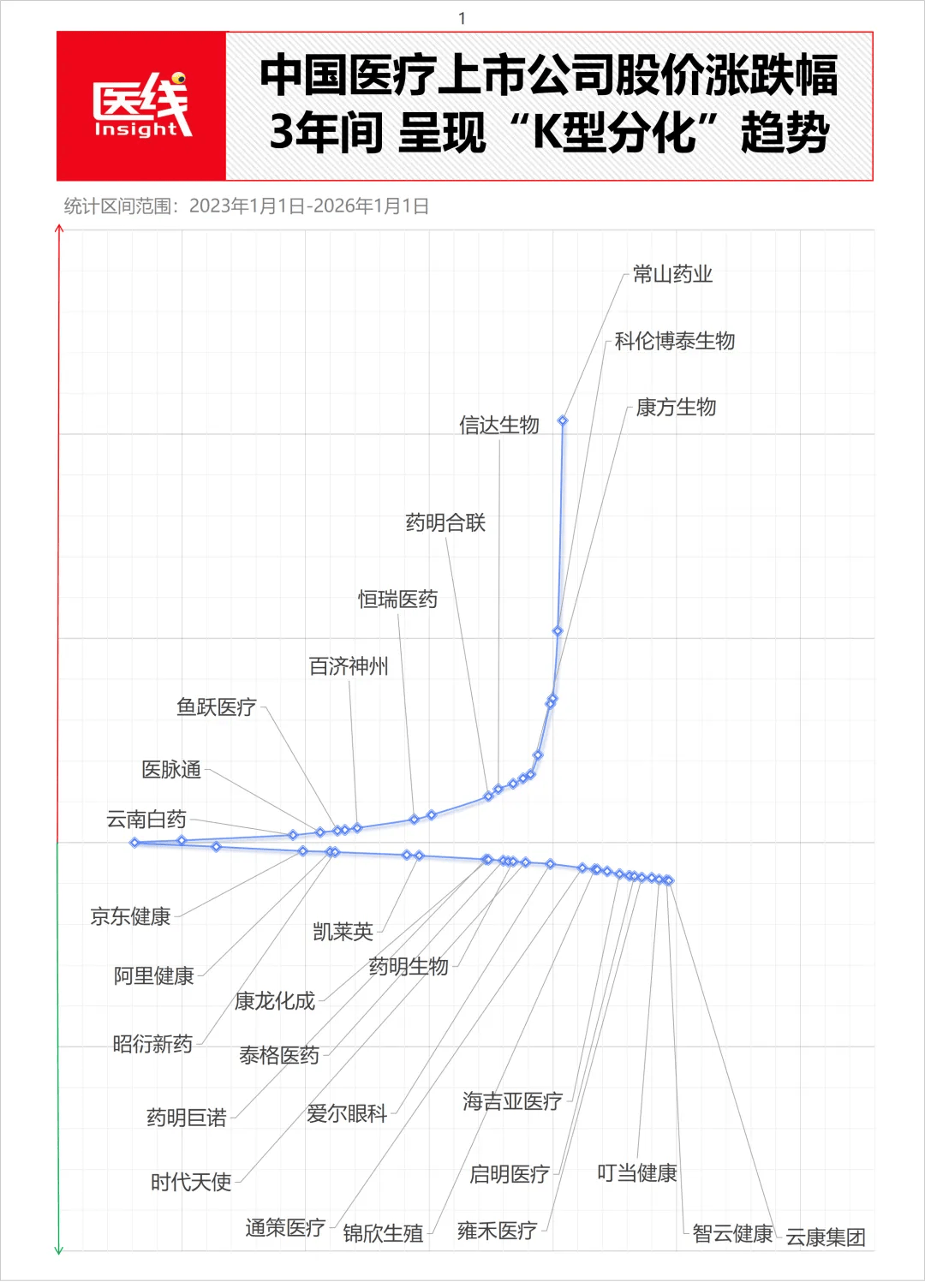
Core Insights - The Chinese healthcare industry has undergone a significant transformation from 2020 to 2025, transitioning from a "golden era" of investment to a "bubble-clearing period" characterized by a K-shaped divergence in market performance [1][2][4]. Group 1: K-shaped Downward Trends - The collapse of previously successful business models, particularly in CXO, consumer healthcare, and internet healthcare, has led to substantial market value losses, with some companies experiencing declines of over 90% [4][7]. - The downturn is attributed to macroeconomic factors such as U.S. interest rate hikes and geopolitical tensions, as well as microeconomic issues like supply-demand imbalances and the disappearance of growth dividends [8][10]. - The CXO sector, once seen as a perpetual growth engine, has faced a 46.68% decline for WuXi Biologics and 44.47% for Tigermed, revealing the fragility of its business model reliant on continuous global financing [12][10]. - Consumer healthcare has suffered a "Davis double whammy," with companies like Yonghe Medical and Aier Eye Hospital seeing declines of 86.19% and 52.69%, respectively, as consumer spending shifts away from discretionary healthcare services [14][15]. - Internet healthcare companies, including Zhiyun Health and Dingdang Health, have also faced severe declines, with drops of 92.44% and 90.67%, as the market realizes that their revenue largely comes from online drug sales rather than innovative healthcare solutions [19][21]. Group 2: K-shaped Upward Trends - In contrast, companies with strong global rights and hard-core technology have thrived, with Keren Biotechnology and Kangfang Biopharma seeing increases of 518.33% and 166.72%, respectively, marking a shift towards biopharma and global market engagement [29][31]. - The rise of these companies signifies a new era where capital is attracted to firms that can demonstrate robust clinical data and global market potential, moving away from mere concepts [30][31]. - Even within struggling sectors, some companies like WuXi AppTec and Yuyue Medical have shown resilience, with increases of 113.36% and 28.75%, respectively, by focusing on high-tech, high-barrier services [34][35]. Group 3: Challenges Ahead - Despite the emergence of new leaders, significant challenges remain, including the risks associated with licensing agreements that may compromise long-term profitability [36][37]. - The ADC sector is experiencing a rush similar to the past PD-1 craze, raising concerns about market saturation and price competition, which could undermine future profitability [39][40]. - The ongoing "ice age" in the primary market poses a threat to innovation, as funding for early-stage companies has become increasingly scarce, potentially leading to a decline in new drug approvals in the coming years [42][43].
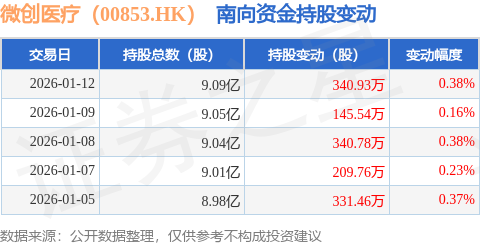
微创医疗(00853.HK):1月12日南向资金增持340.93万股
Sou Hu Cai Jing· 2026-01-12 19:20
Group 1 - The core point of the article highlights that southbound funds have increased their holdings in MicroPort Medical (00853.HK) by 3.4093 million shares on January 12, 2026, with a total net increase of 13.6847 million shares over the past five trading days [1] - Over the last 20 trading days, southbound funds have increased their holdings on 13 days, resulting in a cumulative net increase of 1.9521 million shares [1] - As of now, southbound funds hold 909 million shares of MicroPort Medical, which represents a certain percentage of the company's total issued ordinary shares [1] Group 2 - The total number of shares held by MicroPort Medical on January 12, 2026, is 2.6606 billion, reflecting a change of 3.4093 million shares, which is an increase of 0.38% [2] - The company has seen various changes in shareholding over the past few days, with notable increases of 1.4554 million shares (0.16%) on January 9, 2026, and 3.4078 million shares (0.38%) on January 8, 2026 [2] - MicroPort Medical is primarily engaged in the sales, production, research, and development of medical devices, operating through eight divisions, including cardiovascular intervention, orthopedic medical devices, cardiac rhythm management, and surgical robotics [2]
手术机器人公司精锋医疗港交所上市首日涨超30% 成都一天使投资人8年获益超过130倍
Mei Ri Jing Ji Xin Wen· 2026-01-12 13:39
Core Viewpoint - Shenzhen Precision Medical Technology Co., Ltd. (referred to as Precision Medical) successfully listed on the Hong Kong Stock Exchange on January 8, 2026, with a market capitalization of HKD 22.507 billion and a stock price increase of over 30% on the first day of trading [1][3]. Company Overview - Founded by a couple of PhD graduates in 2017 with an initial capital of CNY 100,000, Precision Medical has grown to a valuation exceeding CNY 10 billion in less than nine years [3][5]. - The company has three approved products, including the multi-port laparoscopic surgical robot, which has been registered for use in various surgical fields and has signed sales agreements for 61 units globally [3][9]. Financial Performance - Precision Medical has reported significant losses, with cumulative losses exceeding CNY 1.1 billion since 2020. The company’s revenues for 2023, 2024, and the first half of 2025 were CNY 48.042 million, CNY 160 million, and CNY 149 million, respectively, while net losses were CNY 213 million, CNY 219 million, and CNY 89.087 million [10][11]. Market Position and Competition - The surgical robot market in China is projected to exceed CNY 100 billion by 2033, with the laparoscopic surgical robot segment being the largest [9]. - Precision Medical faces intense competition, with over 10 similar products already approved in the market, including the well-established Da Vinci system, which has begun local production, thereby increasing competitive pressure on domestic manufacturers [11][12]. Product Development and Strategy - The company has developed a "shared platform" design allowing its multi-port and single-port laparoscopic robots to share the same control console, aiming to reduce costs for hospitals and enhance operational efficiency [12][13]. - Precision Medical is also expanding its training centers globally and has received CE certification for its products, indicating a focus on international market expansion and advanced applications like remote surgery [13].


把握出海陡峭曲线,卡位AI医疗商业化落地:医疗器械2026年度策略
Huafu Securities· 2026-01-12 12:57
Core Insights - The report maintains a strong market rating for the medical device industry, emphasizing the importance of capitalizing on overseas expansion and the commercialization of AI in healthcare [1][3][5] Medical Device Strategy - The strategy focuses on a three-step approach: prioritizing overseas expansion, benefiting from centralized procurement, and being sensitive to fiscal policies [3][5] - The report highlights the acceleration of overseas growth, particularly in high-value orthopedic, electrophysiology, and robotic sectors, which are expected to be the main contributors to growth in 2025 [5][24] - Companies such as MicroPort, Tianzhihang, and Weigao are recommended for their potential in overseas markets and innovative product offerings [5][24] AI Applications and Brain-Computer Interfaces - The report identifies a significant opportunity in AI applications, with a focus on the commercialization phase driven by policy support and market demand [4][9] - The brain-computer interface sector is poised for growth, with several leading companies expected to go public soon, which could catalyze the market [9][24] Financial Performance and Market Trends - The medical device sector is showing signs of recovery, with Q3 2025 revenues reaching 593.7 billion yuan, a year-on-year increase of 2.9%, indicating a clear upward trend [13][31] - The report notes a significant contraction in fund allocation to the medical device sector, dropping from 24.5% to 15% from Q3 2022 to Q3 2025, suggesting potential for valuation recovery [14][21] Overseas Growth Potential - The report emphasizes the importance of overseas markets, particularly in Europe and the U.S., where companies are transitioning from product-focused strategies to comprehensive commercialization partnerships [5][24] - Key growth areas include surgical robots and high-value consumables, with companies like Tianzhihang and MicroPort leading the charge in international markets [24][30] Fiscal Policy Impact - The report discusses the sensitivity of equipment demand to fiscal policies, with expectations of a more favorable environment as inventory levels decrease and demand normalizes [31][34] - The anticipated release of more proactive fiscal signals in the upcoming years is expected to support the recovery of the medical device sector [31][34]
微创医疗(00853.HK):1月8日南向资金增持340.78万股
Sou Hu Cai Jing· 2026-01-08 19:23
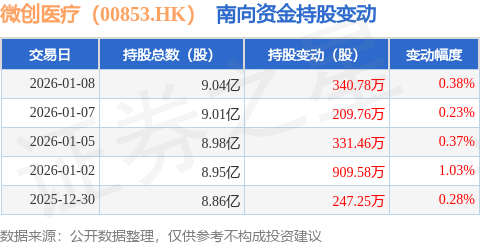
Core Viewpoint - Southbound funds have increased their holdings in MicroPort Medical (00853.HK) by 3.4078 million shares on January 8, 2026, indicating a positive trend in investor sentiment towards the company [1]. Group 1: Shareholding Changes - Over the past five trading days, Southbound funds have increased their holdings for five days, with a total net increase of 20.3882 million shares [1]. - In the last twenty trading days, there were seven days of net reduction in holdings, totaling 442,100 shares [1]. - As of now, Southbound funds hold 904 million shares of MicroPort Medical, accounting for 47.24% of the company's total issued ordinary shares [1]. Group 2: Shareholding Data - On January 8, 2026, the total number of shares held was 904 million, with a change of 3.4078 million shares, reflecting a 0.38% increase [2]. - On January 7, 2026, the total number of shares held was 901 million, with a change of 2.0976 million shares, reflecting a 0.23% increase [2]. - On January 5, 2026, the total number of shares held was 898 million, with a change of 3.3146 million shares, reflecting a 0.37% increase [2]. - On January 2, 2026, the total number of shares held was 2,556.8 million, with a change of 9.0958 million shares, reflecting a 1.03% increase [2]. - On December 30, 2025, the total number of shares held was 886 million, with a change of 2.4725 million shares, reflecting a 0.28% increase [2]. Group 3: Company Overview - MicroPort Medical is primarily engaged in the sales, production, research, and development of medical devices, operating through eight divisions [2]. - The cardiovascular intervention division includes products such as implantable devices and access devices [2]. - The orthopedic medical device division includes instruments for joint reconstruction and spinal applications [2]. - The cardiac rhythm management (CRM) division includes devices such as pacemakers and defibrillators [2]. - The aortic and peripheral vascular intervention division includes products like the "L-REBOA" aortic occlusion balloon [2]. - The neuro-intervention division includes products for treating cerebral artery atherosclerosis and coils [2]. - The structural heart disease division includes products for transcatheter aortic valve implantation [2]. - The surgical robotics division is involved in the manufacturing and R&D of surgical robotic instruments [2]. - The surgical medical device division focuses on the manufacturing and R&D of surgical medical devices [2].
BD交易与政策红利共振 医药板块2025年强势反弹
BambooWorks· 2026-01-08 10:21
Core Insights - The core viewpoint of the article emphasizes that the surge in innovative drug licensing and BD transactions has significantly driven the stock price explosion in the pharmaceutical sector, with total transaction amounts reaching $135.655 billion in 2025, marking a 161% increase from 2024 [1][4]. Group 1: Market Performance - The Hong Kong biopharmaceutical sector has rebounded strongly in 2025, with the Hang Seng Healthcare Index (HSHCI) rising by 76%, outperforming the Hang Seng Index and the overall A-share biopharmaceutical sector, which saw a 25.64% increase [1]. - Southbound capital inflow reached a record high of HKD 1.4 trillion in 2025, with healthcare sector holdings increasing by 125.51% to HKD 540 billion, providing substantial liquidity to the market [1][3]. Group 2: Structural Differentiation - The structural differentiation within the biopharmaceutical sector is becoming more pronounced, with companies that have First-in-Class or Best-in-Class pipelines and stable BD revenue sources being favored, while those reliant on single core projects face valuation pressures [3]. - The CXO sector also performed well in 2025, benefiting from ongoing investments in innovative drugs, while the medical device and supplies sector showed solid performance due to stable cash flows [3]. Group 3: Policy and Regulatory Environment - The policy environment has been continuously optimized, with 76 innovative drugs approved for market entry by the National Medical Products Administration in 2025, significantly surpassing the 48 approvals in 2024 [5]. - The introduction of the first version of the innovative drug commercial insurance catalog marks a shift to a dual protection system of basic medical insurance and commercial health insurance, enhancing clinical medication standards and overall industry R&D returns [6]. Group 4: Future Outlook - The explosive growth in BD transactions and active IPOs is injecting strong cash flow and confidence into the biopharmaceutical industry, with expectations for leading companies like BeiGene to achieve profitability in 2026 [5]. - However, challenges remain, including potential market pressure from a wave of unlocks post-IPO lock-up periods and stricter regulatory scrutiny on IPO applications [7].


花旗:重新覆盖微创医疗予“买入”评级 目标价16港元
Zhi Tong Cai Jing· 2026-01-08 06:37
花旗发布研报称,微创医疗(00853)的基本面持续改善,因此已重新覆盖该股,予"买入"评级和目标价 16港元,相当于2026年及2027年市盈率39倍及24倍,并列为行业首选股之一。 报告提到,微创医疗2025年上半年,净亏损同比收窄66%,该行预计公司将在2025年下半年录得盈利。 另外,该行预期高增长的海外平台将在2025年同比实现70%至80%,且增长趋势或在2026年持续。公司 亦获得合并后的协同效应,将成为公司的上行潜力。 花旗维持微创医疗2025至2027财年的收入预测,分别为10.98亿、12.53亿及14.22亿元人民币。盈利方 面,该行上调公司2025财年预测17%至亏损4,100万元人民币,但维持2026及2027财年的盈测9,500万和 1.54亿元人民币。 ...
花旗:重新覆盖微创医疗(00853)予“买入”评级 目标价16港元
智通财经网· 2026-01-08 06:36
花旗维持微创医疗2025至2027财年的收入预测,分别为10.98亿、12.53亿及14.22亿元人民币。盈利方 面,该行上调公司2025财年预测17%至亏损4,100万元人民币,但维持2026及2027财年的盈测9,500万和 1.54亿元人民币。 报告提到,微创医疗2025年上半年,净亏损同比收窄66%,该行预计公司将在2025年下半年录得盈利。 另外,该行预期高增长的海外平台将在2025年同比实现70%至80%,且增长趋势或在2026年持续。公司 亦获得合并后的协同效应,将成为公司的上行潜力。 智通财经APP获悉,花旗发布研报称,微创医疗(00853)的基本面持续改善,因此已重新覆盖该股, 予"买入"评级和目标价16港元,相当于2026年及2027年市盈率39倍及24倍,并列为行业首选股之一。 ...