
菲利华

Search documents
国防ETF(512670)涨超1.3%,我国完成首次载人飞船返回舱海上搜索回收任务
Xin Lang Cai Jing· 2026-02-12 05:53
Group 1 - The core viewpoint of the news highlights the successful test of the "Dream Boat" manned spacecraft's maximum dynamic pressure escape during the Long March 10 rocket system demonstration, indicating advancements in China's space capabilities [1] - In 2025, China achieved a record high of 92 space launches, with commercial space achieving 50 launches, and new rocket models like Long March 8A successfully making their first flights [1] - The Aerospace Science and Technology Group's annual meeting in 2026 emphasized the goal of breaking through reusable rocket technology, with several new rocket models planned for their inaugural flights, marking a potential turning point for the commercialization of space [1] Group 2 - The China Defense ETF closely tracks the CSI Defense Index, which includes listed companies under the top ten military industrial groups and those providing equipment to the armed forces, reflecting the overall performance of defense industry stocks [2] - As of January 30, 2026, the top ten weighted stocks in the CSI Defense Index accounted for 42.4% of the index, including companies like Aerospace Electronics and AVIC Engine [2]
菲利华:高阶电子布需求旺盛,公司业绩有望快速成长-20260212
CSC SECURITIES (HK) LTD· 2026-02-12 03:24
Investment Rating - The report assigns a "Buy" rating to the company, indicating a potential upside in the stock price [4][7]. Core Insights - The company is a leading player in the quartz materials sector and a rare supplier of quartz glass fibers for the aerospace industry. It is transitioning from a traditional materials supplier to high-value sectors such as semiconductors and AI computing [7]. - The demand for advanced electronic fabrics is expected to grow rapidly, driven by the AI industry's expansion. The company is positioned to benefit from this growth while also fulfilling the role of domestic replacement [7]. - The projected net profits for 2025, 2026, and 2027 are expected to be 420 million, 830 million, and 1.24 billion RMB, respectively, with year-on-year growth rates of 34%, 97%, and 49% [7][10]. Financial Projections - The company anticipates achieving net profits of 4.2 billion, 8.3 billion, and 12.4 billion RMB for the years 2025, 2026, and 2027, with corresponding EPS of 0.81, 1.59, and 2.37 RMB [9][10]. - The price-to-earnings (P/E) ratios for 2026 and 2027 are projected to be 62 and 42, respectively [10]. Market Position and Demand - There is a significant demand gap for high-end electronic fabrics, with global demand expected to exceed 15 million meters by 2026, while effective global production capacity is insufficient to meet this demand [10]. - The company is actively expanding its capabilities in the quartz electronic fabric sector and aims to become a leading supplier by 2027 [10].

玻璃纤维板块反复活跃,机构:供需错配下建议关注这些公司丨盘中线索
2 1 Shi Ji Jing Ji Bao Dao· 2026-02-12 03:09
Group 1 - The fiberglass sector is experiencing significant activity, with companies like Shandong Fiberglass and Honghe Technology hitting the daily limit up, while China National Materials and China Jushi also saw gains [1] - The fiberglass index rose by 2.89%, reaching a price of 5968.64, with a transaction amount of 32.2 million [2] - Key companies in the sector include Shandong Fiberglass, which saw a price increase of 10.03% and a market cap of 6.08 billion, and Honghe Technology, which increased by 10% with a market cap of 64.5 billion [2] Group 2 - The recent surge in the fiberglass concept sector is driven by rising prices of electronic cloth and increased demand from AI computing, leading to supply-demand tension [4] - Traditional fiberglass electronic cloth prices have accelerated since February, confirming earlier reports of a supply gap due to production shifts towards AI electronic cloth [4] - Companies such as China National Materials, International Composites, Honghe Technology, and Feilihua are recommended for attention due to the favorable market conditions [4]


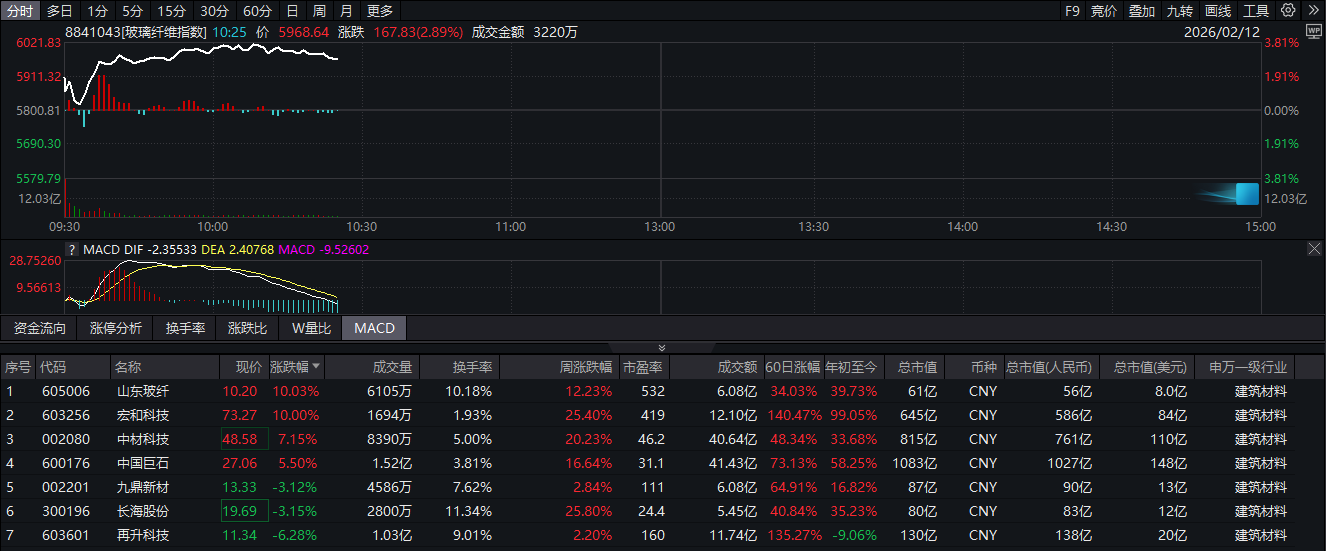
算力市场供不应求,电子布涨价趋势确立 | 投研报告
Zhong Guo Neng Yuan Wang· 2026-02-12 02:52
Core Viewpoint - The report highlights a significant acceleration in capital expenditures driven by AI among major US cloud service providers, which is expected to benefit the computing materials market substantially [1][2]. Group 1: Capital Expenditure Trends - Major US cloud service providers are increasing their capital expenditures significantly, with Meta projecting a capital expenditure of $115 to $135 billion for 2026, representing a year-over-year increase of 73%, focusing on superintelligent labs and AI infrastructure [1][2]. - Alphabet (Google's parent company) anticipates capital expenditures of $175 to $185 billion for 2026, with a year-over-year increase of 97%, primarily for AI functionality optimization and cloud infrastructure expansion [2]. - Amazon expects capital expenditures of approximately $200 billion for 2026, reflecting a year-over-year increase of 52% [2]. - Microsoft indicates that short-term assets (CPU and GPU servers) will constitute about two-thirds of its capital expenditures [2]. - All four major US cloud service providers expect to face supply constraints for critical computing resources in 2026, necessitating accelerated investments and optimized capacity configurations to meet rising demand [2]. Group 2: Transition in Electronic Fabric Production - Traditional electronic fabric production is shifting towards low-dielectric electronic fabric production, with companies like Taiyo stopping the production of certain E-glass electronic fabric series due to market structure changes and special product demand adjustments [3]. - The demand for Low-Dk electronic fabric is increasing, leading to a gradual reduction in the production of traditional E-glass products, with plans to cease production of specific series by 2026 [3]. Group 3: Price Trends in Electronic Fabrics - Prices for traditional electronic fabrics and low-dielectric electronic fabrics are expected to rise, with Showa Denko announcing price increases of over 30% for CCL and PCB due to tight supply and demand for raw materials [3]. - E-glass prices have already seen a 15% increase in January, with an expected further rise of 10-15% in February, while new price negotiations for Low-Dk fabrics aim for a 20% increase [3]. - The supply-demand mismatch, driven by high demand for high-end low-dielectric electronic fabrics, is leading to a contraction in traditional electronic fabric production and subsequent price increases [3]. Group 4: Investment Recommendations - The company remains optimistic about the continued growth in capital expenditures in the computing market, which is expected to drive technological iterations and demand growth, benefiting the computing materials market [4]. - The transition from traditional electronic fabric production to low-dielectric electronic fabric production is seen as a critical juncture, with anticipated price increases for both types of fabrics [4]. - Companies to watch include Zhongcai Technology, International Composites, Honghe Technology, and Feilihua [4].




菲利华(300395):高阶电子布需求旺盛,公司业绩有望快速成长
CSC SECURITIES (HK) LTD· 2026-02-12 02:46
Investment Rating - The report assigns a "Buy" rating to the company, indicating a potential upside in the stock price [4][7]. Core Insights - The company is a leading player in the quartz materials sector and a rare supplier of quartz glass fibers for the aerospace industry. It is transitioning from a traditional materials supplier to high-value sectors such as semiconductors and AI computing. The company has established a complete industrial chain from quartz sand to composite materials [7]. - With the rapid growth of the AI industry, the demand for low dielectric constant electronic fabrics is increasing. The company is expected to benefit from industry growth while also fulfilling the role of domestic substitution. Projected net profits for 2025-2027 are expected to be 420 million, 830 million, and 1.24 billion RMB, representing year-on-year growth of 34%, 97%, and 49% respectively [7][10]. - The company is positioned to become a leading supplier of high-end quartz electronic fabrics by 2027, with a significant supply-demand gap expected in the market due to increasing global demand [10]. Financial Summary - The company’s projected net profits for 2025, 2026, and 2027 are 420 million, 830 million, and 1.24 billion RMB, with corresponding EPS of 0.81, 1.59, and 2.37 RMB. The price-to-earnings ratios for 2026 and 2027 are estimated at 62 and 42 times, respectively [9][10]. - Revenue is expected to grow from 2.08 billion RMB in 2025 to 3.95 billion RMB in 2027, with operating profits increasing significantly during the same period [14].
盘中线索丨玻璃纤维板块反复活跃,机构:供需错配下建议关注这些公司
2 1 Shi Ji Jing Ji Bao Dao· 2026-02-12 02:38
Group 1 - The fiberglass sector is experiencing significant activity, with companies like Shandong Fiberglass and Honghe Technology hitting the daily limit up, while China National Materials and China Jushi also see gains [1] - Honghe Technology's stock price volatility is attributed to media reports linking the company to the "PCB concept," although the company clarifies that its main business remains unchanged [1] Group 2 - The recent surge in the fiberglass sector is driven by rising prices of electronic cloth and increased demand from AI computing, leading to supply-demand tension [2] - Traditional fiberglass electronic cloth prices have accelerated in February, confirming earlier reports that loom capacity is shifting towards AI electronic cloth, resulting in a supply gap for traditional cloth [2] - Analysts suggest that both traditional and low-dielectric electronic cloth prices are expected to rise due to a mismatch in supply and demand, recommending companies like China National Materials, International Composites, Honghe Technology, and Feilihua for investment [2]
山西证券研究早观点-20260212
Shanxi Securities· 2026-02-12 01:28
Core Insights - The report highlights strong growth in capital expenditures in North America, particularly in the AI new materials sector, suggesting investment opportunities in upstream developments [5][6] - The report indicates that the new materials index fell by 1.53%, outperforming the ChiNext index by 1.76%, with various sub-sectors showing mixed performance [5] Market Performance - The report provides a summary of the domestic market indices, noting the closing values and percentage changes for major indices such as the Shanghai Composite Index and Shenzhen Component Index [4] - The new materials sector experienced a decline, with specific indices like semiconductor materials and electronic chemicals showing significant drops of 3.70% and 1.61% respectively [5] Price Tracking - Weekly price tracking of various materials shows fluctuations, with amino acids like valine decreasing by 1.42% to 13,850 RMB/ton, while vitamin E increased by 2.70% to 57,000 RMB/ton [5] - Prices for biodegradable materials remained stable, with PLA and PBS prices unchanged, indicating a steady market for these products [5] Investment Recommendations - The report recommends focusing on AI new materials due to the anticipated increase in demand driven by major cloud service providers like Amazon AWS, Microsoft, Google, and Meta, whose combined capital expenditures are projected to exceed $670 billion in 2026, a year-on-year increase of over 60% [5] - Specific companies are highlighted for potential investment, including Shengquan Group and Dongcai Technology in the resin sector, and Zhongcai Technology and Honghe Technology in the electronic fabric sector [5][6]
中银晨会聚焦-20260212-20260212
Bank of China Securities· 2026-02-12 01:01
Group 1: Macro Insights - January CPI growth rate year-on-year was lower than expected, while PPI growth rate was slightly higher than expected, influenced by the Spring Festival timing and base period rotation [4][5] - The average impact of the base period rotation on CPI and PPI year-on-year indices is estimated to be approximately 0.06 and 0.08 percentage points, respectively, which is relatively small [4][5] - CPI in January increased by 0.2% month-on-month and year-on-year, with core CPI rising by 0.8%, indicating a mixed inflationary environment influenced by seasonal factors and external inputs [5] Group 2: Real Estate Sector - The traditional residential development sector is contracting, while commercial real estate is entering a policy-driven growth phase, with a focus on creating new consumption scenarios to meet diverse consumer needs [12][13] - The shift from traditional commercial spaces to new consumption scenarios emphasizes emotional engagement and immersive experiences, moving beyond mere transactional spaces [14][20] - The rise of non-standard commercial projects, characterized by innovative space and operational models, is gaining traction, particularly in major cities like Shanghai and Beijing [16][17] Group 3: Chemical Industry - The dye industry is experiencing price increases due to rising costs of intermediate products, with significant price hikes observed in January, benefiting integrated companies with stable market shares [24][25] - The concentration of supply in the dye industry is improving due to stringent safety and environmental regulations, which may lead to a more favorable market environment for leading companies [26][27] Group 4: Electronics Sector - The demand for AI computing materials is expected to rise significantly as cloud service providers increase capital expenditures, leading to a supply-demand mismatch in the electronic fabric market [29][30] - Traditional electronic fabric production is transitioning to low-dielectric materials, with price increases anticipated across both traditional and low-dielectric electronic fabrics due to supply constraints [32][33]
电子布成AI时代关键材料,低介电产品供不应求,赛道红利持续释放,头部企业成长空间全面打开
Xin Lang Cai Jing· 2026-02-11 10:16
Group 1 - International Composite Materials (301526) is a core supplier of electronic-grade glass fiber and products in China, focusing on high-performance glass fiber material research and production, with a full industry chain layout advantage in electronic cloth [1][21] - The company’s main business includes electronic-grade glass fiber yarn, electronic cloth, and composite material products, widely used in copper-clad laminates (CCL) and printed circuit board (PCB) manufacturing, featuring electrical insulation and fire resistance [1][21] - The company is focusing on high-end products such as low-dielectric electronic cloth, suitable for high-speed PCB scenarios like AI servers and data centers, with production capacity and technical strength among the industry leaders [1][21] Group 2 - Honghe Technology (603256) is a leading enterprise in the global mid-to-high-end electronic-grade glass cloth segment, breaking international monopolies in ultra-thin and extremely thin electronic cloth [2][22] - The company’s main business focuses on the research, production, and sales of electronic-grade glass fiber yarns and fabrics, with applications covering various electronic devices including mobile phones, computers, and AI servers [2][22] - As a core supplier to global top copper-clad board manufacturers, the company has a significant competitive advantage in high-end PCB manufacturing, especially in AI computing-related high-speed PCB fields [2][22] Group 3 - China National Materials (002080) is a comprehensive leader in the new materials sector, leveraging state-owned enterprise resources to maintain industry leadership in glass fiber and wind power blades [3][23] - The company’s main business includes glass fiber and products, wind power blades, and lithium battery separators, with glass fiber being a core segment [3][23] - The company’s subsidiary, Taishan Glass Fiber, developed the first generation of low-dielectric fine yarn and electronic cloth, which won a global leading ICT manufacturer’s "Technology Breakthrough Award" [3][23] Group 4 - China Jushi (600176) is the absolute leader in the global glass fiber industry, with production capacity and technical strength at the forefront globally [4][24] - The company has built a full industry chain advantage from glass fiber yarn to electronic cloth, with products widely used in construction, electronics, and automotive sectors [4][24] - The company’s electronic cloth production capacity ranks among the top globally, with significant cost advantages in self-developed low-dielectric glass fiber (TLD-glass) [4][24] Group 5 - Jinan Guojin (002636) is a key player in the copper-clad board industry, with a complete electronic materials industry chain layout [5][25] - The company focuses on the research and production of copper-clad boards and related materials, maintaining a stable market share in East China [5][25] - The company’s electronic-grade glass fiber cloth is a core raw material for copper-clad boards, enabling effective cost reduction through in-house production [5][25] Group 6 - Hongchang Electronics (603002) is an important enterprise in the domestic electronic-grade epoxy resin and copper-clad board sector, covering core upstream and downstream segments of electronic cloth [6][26] - The company has established long-term partnerships with major domestic PCB manufacturers, focusing on the production and sales of electronic-grade epoxy resin, copper-clad boards, and semi-cured sheets [6][26] - The company benefits indirectly from the development of the electronic cloth industry through its copper-clad board business [6][26] Group 7 - Filihua (300395) is a leading enterprise in the global quartz glass materials sector, being the only company in China to achieve mass production of high-end quartz electronic cloth (Q cloth) [7][27] - The company’s main business focuses on the research, production, and sales of quartz glass and products, with applications in high-end fields such as semiconductors and optical communications [7][27] - The company’s third-generation quartz cloth has a dielectric constant as low as 2.3, making it a core enhancement material for M9 copper-clad boards [7][27] Group 8 - Changhai Co., Ltd. (300196) is an important enterprise in the domestic glass fiber and composite materials industry, focusing on high-end electronic cloth business through its subsidiaries [8][28] - The company’s main business includes glass fiber yarn, glass fiber products, and composite materials, with a stable production capacity layout in East China [8][28] - The company’s subsidiary, Guangyuan New Materials, focuses on producing low-dielectric electronic cloth and electronic yarn, entering the high-end PCB materials market [8][28] Group 9 - Jiuding New Materials (002201) is one of the leading enterprises in the domestic electronic cloth industry, with deep accumulation in glass fiber and composite materials [9][30] - The company’s main business includes glass fiber products, composite materials, and wind power blades, with electronic cloth being a core segment [9][30] - The company is continuously advancing the research and development of special glass fibers and electronic cloth, with significant revenue growth expected in the second quarter of 2025 [9][30] Group 10 - Shandong Glass Fiber (605006) is an important enterprise in the domestic glass fiber industry, with electronic cloth being a key focus area [10][31] - The company leverages the glass fiber industry cluster advantage in Shandong, steadily expanding its production capacity [10][31] - The company is focusing on mid-to-high-end electronic cloth products, adapting to the upgrading needs of the PCB industry [10][31]


AI算力材料行业更新:算力市场供不应求,电子布涨价趋势确立
Bank of China Securities· 2026-02-11 09:11
电子 | 证券研究报告 — 行业点评 2026 年 2 月 11 日 强于大市 AI 算力材料行业更新 算力市场供不应求,电子布涨价趋势确立 海外云服务厂商大幅提高资本开支,算力材料市场亦有望深度受益。传统电 子布产能向低介电电子布产能切换的过程中引发供需错配,传统电子布和低 介电电子布价格有望迎来普涨。 支撑评级的要点 投资建议 ◼ 我们看好算力市场资本开支持续推动技术迭代和需求增长,算力材料市 场亦有望深度受益。在传统电子布产能向低介电电子产能切换的关键节 点,市场供给和需求错配,传统电子布和低介电电子价格均有望上涨。建 议关注中材科技、国际复材、宏和科技、菲利华。 评级面临的主要风险 ◼ AI 市场需求过热引发行业泡沫。远期供给端产能过剩引发价格下滑。技 术变革导致原有产品淘汰。 相关研究报告 《存储行业深度报告》20260123 《2026 年 CES 英伟达演讲》20260107 《存储行业点评》20260105 中银国际证券股份有限公司 具备证券投资咨询业务资格 电子 证券分析师:苏凌瑶 lingyao.su@bocichina.com 证券投资咨询业务证书编号:S1300522080003 证券 ...