ARM

Search documents
美股科技芯片集体狂飙,特斯拉、英伟达涨超4%,文远知行涨9%
2 1 Shi Ji Jing Ji Bao Dao· 2025-11-20 16:00
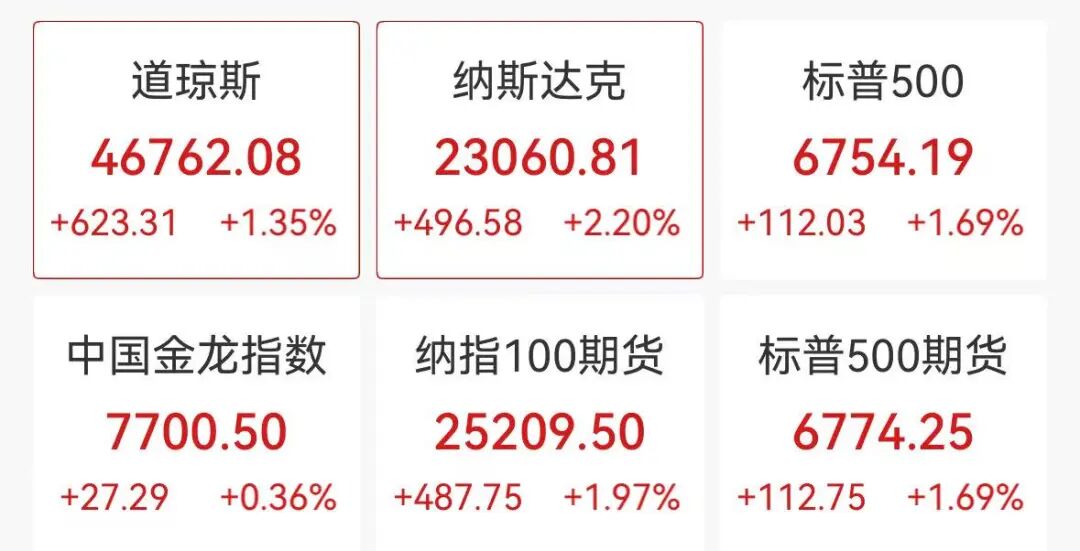
Group 1: Stock Performance - Tesla's stock increased by over 5%, while Nvidia and Google rose nearly 4%, with Google's market capitalization reaching $3.67 trillion, surpassing Microsoft and entering the top three in U.S. stock market capitalization [2][3] - The Philadelphia Semiconductor Index rose over 2.8%, with Broadcom increasing by over 5% and TSMC, ARM, AMD, and Intel all rising by over 3% [3] Group 2: Earnings Reports - Nvidia released a strong Q3 earnings report that exceeded expectations, countering market concerns about "peak growth" and "AI bubble," providing a boost to the currently volatile tech stock market [4] Group 3: Chinese Stocks - The Nasdaq Golden Dragon China Index rose by 0.36%, with notable gains from companies such as Agora (up 19%), WeRide (up over 9%), and Wanwu Xingsheng (up over 7%), while companies like Canadian Solar and Miniso saw declines [4][5] Group 4: Gold Market - Spot gold prices rose again, surpassing $4,100 per ounce, with a recent increase of 0.67% [5] - Gold prices have experienced high volatility, dropping to $3,900 per ounce after reaching a historical high, followed by a significant rebound [6] - Analysts suggest that unless the Federal Reserve ends its easing cycle or the U.S. economy enters a strong recovery phase, the medium-term upward trend for gold prices is likely to continue, with a possibility of exceeding $5,000 per ounce next year [6] Group 5: Cryptocurrency Market - Multiple cryptocurrencies experienced declines, with Bitcoin dropping over 1.5% to $90,495 per coin, and over 210,000 traders liquidated positions in the past 24 hours [6][7][8] Group 6: U.S. Employment Data - The U.S. Bureau of Labor Statistics reported an increase of 119,000 non-farm jobs in September, significantly above the market estimate of 52,000, while the unemployment rate rose to 4.4%, the highest since October 2021 [8][9] - Following the release of this economic data, traders increased bets on potential interest rate cuts by the Federal Reserve, although a December rate cut is still seen as unlikely [8]

美股科技芯片集体狂飙,特斯拉、英伟达涨超4%,文远知行涨9%,加密货币超21万人爆仓
2 1 Shi Ji Jing Ji Bao Dao· 2025-11-20 15:55
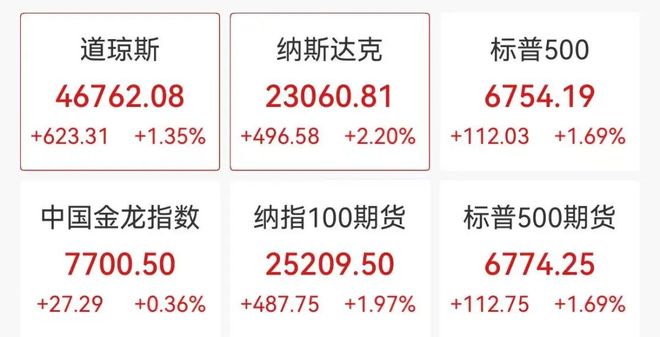
记者丨金珊 编辑丨江佩霞 11月20日,美股开盘集体上涨,截至北京时间23:20,道指涨1.35%,纳指涨2.2%,标普500指数涨 1.69%。互联网科技股、半导体板块强势上涨。 | 道琼斯 | 纳斯达克 | 标普500 | | --- | --- | --- | | 46762.08 | 23060.81 | 6754.19 | | +623.31 +1.35% | +496.58 +2.20% | +112.03 +1.69% | | 中国金龙指数 | 纳指100期货 | 标普500期货 | | 7700.50 | 25209.50 | 6774.25 | | +27.29 +0.36% | +487.75 +1.97% | +112.75 +1.69% | 热门科技股中,特斯拉涨超5%,英伟达、谷歌涨超4%,谷歌总市值达到3.68万亿美元,略超过微软公 司,进入美股总市值前三。 中概股方面,纳斯达克中国金龙指数涨0.36%,声网大涨19%,文远知行涨超9%,万物新生涨超7%、 万国数据涨超5%,阿特斯太阳能跌9%,名创优品、霸王茶姬跌超3%。 | 名称 | 现价 | 涨跌 | 涨跌幅 ▼ | | -- ...
美股科技芯片集体狂飙,特斯拉、英伟达涨超4%,文远知行涨9%,加密货币超21万人爆仓
21世纪经济报道· 2025-11-20 15:47
记者丨金珊 编辑丨江佩霞 现货黄金拉升 再次涨超4100美元 ,最新涨0.67%, 报4104美元/盎司。11月20日盘后,上海黄金交易所发布《关于继续做好近期市场风险控制 工作的通知》,这是上海黄金交易所继10月16日发布风险提示后再度提示金价波动风险。 11月以来,黄金价格高位震荡,现货黄金突破历史新高后快速下跌至3900美元/盎司,此后出现深V反弹。除了交易所,银行等机构也纷纷做了 风险提示。 中金认为,除非美联储彻底结束宽松周期或美国经济重新进入"通胀下行+增长上行"的强复苏阶段,否则黄金的中期上涨逻辑仍将 维持。在此趋势延续下,不排除明年黄金价格突破5000美元/盎司的可能。 加密货币方面,多个币种下跌,比特币跌超1.5%,报90495美元/枚,过去24小时,全市场超21万人爆仓。 11月20日,美股开盘集体上涨,截至北京时间23:20,道指涨1.35%,纳指涨2.2%,标普500指数涨1.69%。互联网科技股、半导体板块强势上 涨。 热门科技股中,特斯拉涨超5%,英伟达、谷歌涨超4%,谷歌总市值达到3.68万亿美元,略超过微软公司,进入美股总市值前三。 | 特斯拉(TESLA) | 428.090 ...

ARM20251118
2025-11-19 01:47
Summary of ARM's Conference Call Company Overview - **Company**: ARM Technology - **Industry**: Semiconductor and AI technology Key Points and Arguments AI and Chip Development - ARM is collaborating with Meta to optimize AI algorithms for ARM chips, with plans to potentially launch its own silicon-based chips by 2026, currently in decision-making phase [2][5][11] - Demand for AI and edge device chips is significantly unmet, contrasting with the internet bubble 25 years ago; current data center GPU and accelerator utilization is at 100% [2][6] - The development of edge AI is expected to accelerate, with more algorithms migrating from data centers to edge devices, leading to higher TOPS (trillions of operations per second) capabilities [2][9] Financial Performance - In Q3 2025, ARM's revenue reached $1 billion, a 34% year-over-year increase, with licensing revenue growing by 56% [3] - The growth was driven by enhanced design services for SoftBank and high-value licensing agreements with major companies, including a Chinese firm [3] - ARM raised its annual guidance by $100 million, while keeping EPS unchanged due to increased R&D investments in AI [3] Market Trends and Strategies - The trend in chip design is moving towards breaking down large complex chips into multiple chiplets, which can be packaged into super chips [4][12] - ARM plans to sell different functional chiplets to customers for custom assembly, avoiding direct competition and helping clients reduce time to market [13] - ARM does not foresee significant revenue decline in China due to geopolitical factors, as ARM China aims for technology localization, with a recent 20% year-over-year growth in licensing revenue [10] Collaboration and Future Outlook - ARM's partnership with OpenAI involves a $3 billion annual investment to access technology and insights crucial for developing next-generation CPUs [11] - The company is exploring the need for a complete semiconductor solution, which could enhance revenue but may lower profit margins [14][15] - ARM is focused on ensuring that future AI algorithms can run on ARM architecture, which is a core strategic direction for the coming years [20] Competitive Landscape - ARM believes that the collaboration between Intel and NVIDIA will not significantly impact its market share, as ARM chips offer lower power consumption and cost-effectiveness compared to x86 chips [19] - ARM's position in the Windows PC market is currently limited, but there are expectations for more companies to enter this space in the near future [20] Emerging Technologies - New chiplet technology has potential in the Chinese market, with TSMC leading the process, while challenges remain in energy-sensitive products like smartphones [16] - ARM is committed to addressing the technical challenges of cross-application data access for AI functionalities in edge devices [9] Conclusion - ARM is strategically positioned to capitalize on the growing demand for AI and edge computing, with strong partnerships and a focus on innovative chip design and technology localization in key markets.
AMD and ARM gaining market share amid Intel supply constraints: analysts
Proactiveinvestors NA· 2025-11-18 20:27
Core Insights - Proactive provides fast, accessible, and actionable business and finance news content to a global investment audience [2] - The company focuses on medium and small-cap markets while also covering blue-chip companies and broader investment stories [3] - Proactive's news team delivers insights across various sectors including biotech, mining, oil and gas, and emerging technologies [3] Technology Adoption - Proactive is committed to adopting technology to enhance workflows and content production [4] - The company utilizes automation and software tools, including generative AI, while ensuring all content is edited and authored by humans [5]


光芯片,被引爆
半导体行业观察· 2025-11-18 01:40
Core Insights - The rapid growth of artificial intelligence (AI) is creating a bottleneck in traditional electrical communication methods, prompting a shift towards photonics for chip interconnectivity [2][3] - Significant venture capital is flowing into photonics startups, with companies like Lightmatter and PsiQuantum achieving valuations of $4.4 billion and $7 billion respectively [3] - The semiconductor industry is undergoing a transformation as companies race to develop new networking technologies to support AI workloads, which are doubling every three months [2][3] Group 1: Industry Trends - Traditional networking technologies are struggling to keep up with the demands of AI, leading to innovations in speed and efficiency [3][6] - Major companies like NVIDIA and Broadcom are investing heavily in AI data centers and custom chip solutions, indicating a shift towards highly specialized networking [4][6] - The competition is intensifying as established firms and startups alike seek to capitalize on the growing need for faster data transmission in AI applications [7] Group 2: Company Developments - NVIDIA's foresight in acquiring Mellanox Technologies for $7 billion in 2020 has positioned it well in the AI data center market [3][4] - Broadcom is becoming a preferred partner for companies like Google and Meta, showcasing its expertise in custom data center chips [4][6] - Startups like Celestial AI and Lightmatter are innovating in optical interconnect technology, with Lightmatter claiming to have developed the fastest AI chip photonic engine [5][6] Group 3: Challenges and Opportunities - While photonics technology presents significant opportunities, it also faces challenges such as high costs and the need for integration with existing electrical systems [5][6] - The industry is moving towards highly customized solutions, which may favor larger companies over startups, despite the latter's valuable intellectual property [6][7] - The outcome of this technological race will determine which companies will dominate the infrastructure that drives the next generation of AI [7]


重注AI下半场,资本“惩罚”软银
3 6 Ke· 2025-11-18 00:59
(原标题:重注AI下半场,资本"惩罚"软银) 作者 | 范亮 编辑 | 张帆 11月11日,软银集团宣布清仓英伟达,将资金投向OpenAI后,股价在后续三个交易日累计下跌10%。进 入11月后,年内暴涨200%的软银集团股价涨势戛然而止,开始从高位剧烈回调。至今已经回调近 30%。 那么,市场为何对软银态度陡转? 软银,也是OpenAI影子股 要深入分析软银集团(SoftBank Group)的股价表现,首先必须清晰地理解其复杂的业务构成及核心利 润来源。整体来看,软银的业务版图可划分为两大主要板块:实体商业运营与金融投资。 软银的商业板块涵盖了芯片架构及设计(ARM)、通信及互联网(如雅虎日本)等核心业务。在2026 财年上半年(即2025年第二、三季度),该分部实现了3.74万亿日元的营业收入和1.96万亿日元的毛利 润。相较之下,其金融投资板块(包括自有资金投资和愿景基金)同期斩获了高达3.9万亿日元的投资 收益。 数据明确显示,金融投资是软银当前最主要的利润引擎。然而,这一来源也伴随着显著的波动性。例 如,在2022至2024财年(软银财年为当年二季度至下年一季度)期间,软银的投资业务曾面临持续亏 损 ...

瞄准ARM痛点!深圳一实验室发布量产级RISC-V处理器IP
2 1 Shi Ji Jing Ji Bao Dao· 2025-11-16 11:07
Core Viewpoint - The launch of the OpenRio high-performance open-source RISC-V processor IP by the RISC-V International Open Source Laboratory (RIOS) marks a significant milestone in the development of domestic semiconductor IP in China, addressing the low localization rate of semiconductor IP and providing a foundation for the domestic operating system ecosystem [1][4]. Group 1: Market Context - China is one of the largest chip consumption markets globally, but the localization rate of semiconductor IP remains low [1]. - The global semiconductor design IP market is projected to reach $8.4916 billion in 2024, a 20.2% increase from $7.0625 billion in 2023, with strong growth in wired interface IP and processor IP, which grew by 23.5% and 22.4% respectively [2]. - The global IP market is highly concentrated, with the top four suppliers (ARM, Synopsys, Cadence, Alphawave) holding approximately 75% of the market share [2]. Group 2: Competitive Landscape - The current global chip IP market is dominated by a few giants, but the landscape is changing due to trends like AI and Chiplet technology [2][3]. - ARM, while leading in mobile device CPU IP, faces challenges from a slowing smartphone market and competition in the AI and high-performance computing sectors from Synopsys and Cadence [2][3]. - RISC-V, as an open-source instruction set architecture, is emerging as a third mainstream architecture alongside x86 and ARM, appealing to global innovators and posing potential challenges to existing giants [3]. Group 3: RIOS and OpenRio - The OpenRio IP core is designed to fill the gaps in ARM's product line and supports domestic operating systems, offering a "zero licensing cost, high-efficiency starting point" for small and medium-sized manufacturers and developers [4]. - RIOS laboratory aims to accelerate the integration of domestic operating systems and chips, providing a common technological foundation for the deep integration of international open-source RISC-V instruction sets and domestic operating systems [5][6]. - OpenRio is a high-reliability IP core that has undergone multiple rounds of verification and is compatible with mainstream EDA tools, making it suitable for key areas such as smart homes, industrial control, and automotive electronics [6]. Group 4: Future Prospects - RIOS plans to build an open-source REPO platform to create a CPU IP open-source foundation, aiming to provide continuous and reliable technological supply for the industry [6]. - The Shenzhen Qianhai area will be the first to pilot the application of OpenRio, with RIOS collaborating with more partners to create a win-win situation through IP licensing, technical cooperation, and scenario co-construction [6].
孙正义再次清仓英伟达
Jing Ji Guan Cha Wang· 2025-11-12 09:16
Core Viewpoint - SoftBank Group has liquidated its entire stake in Nvidia, cashing out $5.83 billion (approximately 415 billion RMB), leading to a significant drop in Nvidia's stock price and a loss of $100 billion in market capitalization overnight [1] Group 1: SoftBank's Investment History - SoftBank's relationship with Nvidia began in 2014 when it recognized Nvidia's potential in AI infrastructure, purchasing nearly 5% of its shares for $4 billion [1] - In 2019, SoftBank sold all its Nvidia shares for $7 billion, missing out on Nvidia's rise from a $100 billion market cap to $4 trillion [1] - SoftBank re-invested in Nvidia in 2024, increasing its stake to $1 billion, and later to $3 billion by March 2025, before selling all shares again for $5.83 billion [1] Group 2: Market Reactions and Analyst Opinions - Analysts are divided on Masayoshi Son's decision to sell; some view it as a wise move reflecting market risk sensitivity, while others see it as a negative signal given the long-term prospects of AI technology [1][2] - Concerns about an impending AI bubble are growing, with many investors fearing that the current valuations of AI stocks, including Nvidia's P/E ratio exceeding 100, are unsustainable [2][3] Group 3: Broader Market Sentiment - The performance of AI stocks has been under scrutiny, with Nvidia's market cap dropping from $5 trillion to $4.69 trillion, and other AI-related companies also experiencing significant declines [4][5] - A recent Bank of America survey indicated that over 60% of fund managers believe there is a bubble in AI stocks, marking a historical high [4][5] - Major financial institutions, including the Bank of England and the IMF, have warned that the current market conditions for AI stocks resemble the peak of the internet bubble [5] Group 4: Strategic Shifts and Future Outlook - SoftBank's decision to shift its investment focus towards ARM's AI chip development has been interpreted as a move towards more stable technologies rather than speculative investments [5] - Nvidia's founder, Jensen Huang, has also sold over $1 billion worth of Nvidia shares since June, indicating a lack of confidence in the stock's current valuation [6]

孙正义,撤了
投资界· 2025-11-12 07:30
Core Viewpoint - SoftBank Group has completely liquidated its holdings in NVIDIA, cashing out approximately $5.8 billion (around 415 billion RMB), leading to a significant drop in NVIDIA's market value by $100 billion overnight, raising questions about the sustainability of the current AI bubble [4][10]. Group 1: SoftBank's Investment Journey - SoftBank initially acquired a significant stake in NVIDIA in 2017 for $4 billion, becoming one of its largest shareholders, but sold its shares for $7 billion two years later to lock in profits [7]. - After missing out on substantial gains from NVIDIA's stock price surge, SoftBank increased its investment in NVIDIA to $3 billion by March 2024, only to sell all shares in October 2023 [8][10]. - The recent liquidation allowed SoftBank to realize a profit of approximately $3 billion within six months, coinciding with NVIDIA's market capitalization surpassing $5 trillion [4][10]. Group 2: Market Reactions and AI Bubble Concerns - Following the announcement of SoftBank's exit, NVIDIA's stock price plummeted, reflecting broader concerns about the potential bursting of the AI bubble, as many analysts question the sustainability of current valuations [4][14]. - Major financial figures, including JPMorgan's CEO, have warned of a significant risk of market correction, citing that many assets appear to be in bubble territory [14]. - The concentration of market capitalization among the top five U.S. companies has reached its highest level in half a century, raising alarms about potential overvaluation in the AI sector [14][15]. Group 3: Future Investments and Strategies - SoftBank plans to invest an additional $2.25 billion in OpenAI, increasing its total investment to $10.8 billion, reflecting a strong commitment to AI despite market volatility [11]. - The company has also expanded its financing against ARM shares and made significant acquisitions, indicating a bold strategy in the AI and technology sectors [11]. - CEO Masayoshi Son has expressed a willingness to invest heavily in AI, predicting it could impact global GDP by 5% to 10% over the next decade, emphasizing a proactive rather than defensive investment approach [11].