Arm

Search documents
西部证券晨会纪要-20251120
Western Securities· 2025-11-20 02:33
Group 1 - The report highlights the recovery of free cash flow in the manufacturing sector due to the "anti-involution" policy and the Federal Reserve's interest rate cuts, leading to a 37.2% increase in the free cash flow investment portfolio this year, with an excess return of 8.6% [1][7][10] - The report identifies specific industries where free cash flow (FCFF) is actively or passively improving, emphasizing the importance of EBIT and CAPEX in this recovery [7][10] - The analysis indicates that sectors such as resources, consumption, and light asset technology experience significant excess returns when free cash flow improves, while heavy asset technology and pre-involution manufacturing sectors show excess returns despite deteriorating cash flow [8][9] Group 2 - The advanced manufacturing sector is characterized by high differentiation among sub-sectors, with automotive valuations currently at relatively low levels, suggesting potential investment opportunities [2][14] - The report recommends focusing on funds tracking indices related to new productivity in areas such as new energy, power equipment, military industry, and automotive sectors, listing specific ETFs for investment [2][15] - Historical performance of the advanced manufacturing index shows a 120.56% increase since 2019, with power equipment performing the best among sub-sectors [14] Group 3 - The vehicle power supply industry is projected to grow significantly, with an expected market size of 64.8 billion yuan by 2027, driven by the rise of new energy vehicles and the increasing penetration of 800V systems [17][18] - Leading manufacturers in the vehicle power supply sector are well-positioned to expand into the AIDC server power supply market, with recommendations to focus on companies like Weimais and Fute Technology [17][19] - The competitive landscape is dominated by top-tier manufacturers with strong cost advantages and customer loyalty, indicating a trend of "the strong getting stronger" in this industry [19] Group 4 - The banking sector has seen a cumulative increase of 10.80% since early 2025, with significant performance variations among banks, driven by macroeconomic conditions and regulatory changes [22][24] - Historical analysis reveals that the banking sector's performance is closely tied to economic stability and liquidity conditions, with past bull markets often linked to favorable economic indicators [24][25] - The report emphasizes the importance of bank fundamentals, such as profitability and asset quality, in supporting stock performance, particularly during earnings disclosure periods [24][25]
泡沫恐慌?芯片,突传重磅!
券商中国· 2025-11-19 15:09
Core Viewpoint - Concerns about an AI valuation bubble persist in the market, yet major chip companies continue to make significant investments in the sector [1] Group 1: Investment in AI Startup Anthropic - Microsoft and NVIDIA plan to invest up to $15 billion in AI startup Anthropic, raising its valuation to $350 billion from $183 billion in September [2][4] - Anthropic will purchase $30 billion worth of computing power from Microsoft's Azure cloud platform, committing to a capacity of up to 1 billion watts [2][3] - This investment reflects the growing interdependence between cloud computing, chip suppliers, and leading AI developers, with concerns about potential cyclical AI transaction bubbles [3] Group 2: GlobalFoundries Acquires AMF - GlobalFoundries announced the acquisition of Singapore-based silicon photonics chip manufacturer AMF, aiming to become the largest silicon photonics chip manufacturer globally [5] - The acquisition will enhance GlobalFoundries' technology portfolio and production capabilities in Singapore, complementing its existing capabilities in the U.S. [5][6] - Silicon photonics technology is crucial for AI infrastructure, enabling high-speed, energy-efficient data transmission [6] Group 3: Arm and NVIDIA Collaboration - Arm announced the integration of its Neoverse platform with NVIDIA's NVLink Fusion technology, facilitating easier pairing of Arm-based CPUs with NVIDIA GPUs for large-scale data center operators [8][9] - The Neoverse platform is designed for high-efficiency and high-performance scalability, with expectations to capture 50% of the global market share in top-tier data centers by 2025 [8] - This collaboration signifies NVIDIA's strategy to open its NVLink platform for integration with various custom chips, reinforcing its central role in the AI industry [9]




北交所市场点评:受新能源调整影响,缩量回调,关注冰点反弹机会
Western Securities· 2025-11-19 12:50
Investment Rating - The report indicates a cautious outlook on the industry, suggesting a focus on structural opportunities despite recent adjustments in the new energy sector [4]. Core Insights - The market is experiencing a significant structural divergence, with new stocks and specialized sectors showing resilience, while traditional sectors like new energy are under pressure [4]. - The North Exchange is positioned as a key platform for innovative small and medium enterprises, benefiting from ongoing policy support and regional industrial advantages [4]. - Short-term index adjustments are primarily driven by heavyweight sectors, but long-term prospects remain positive for niche leaders with technological barriers [4]. Summary by Sections Market Review - On November 18, the North Exchange A-share trading volume reached 201.0 billion, an increase of 4.2 billion from the previous trading day, with the North 50 Index closing at 1481.82, down 2.92% [2][9]. - Among 283 companies listed, 31 saw gains, 4 remained flat, and 248 experienced declines, with the top gainers being Beikang Detection (295.5%), Meideng Technology (22.8%), and others [2][18]. - The top decliners included Lingge Technology (-9.8%), Luqiao Information (-9.5%), and others [2][19]. Important News - Arm and NVIDIA are collaborating to promote NVLink, aiming to establish industry standards for AI chip interconnectivity [3][20]. - Huawei is set to unveil the Mate 80 series and the new Kirin 9030 chip on November 25 [3][21]. Key Company Announcements - Hanxin Technology received a patent for a digital twin-based optimization method [3][22]. - Ruihua Technology also announced a patent for a dehydration reaction method in BDO refining [3][24].
X @Bloomberg
Bloomberg· 2025-11-19 07:10
South Korea’s antitrust regulator visited the Seoul offices of Arm as part of ongoing scrutiny of the company’s licensing practices https://t.co/Uh8Uu7kVc1 ...
Arm custom chips get a boost with Nvidia partnership
CNBC· 2025-11-17 22:30
Core Insights - Arm's technology will enable central processing units (CPUs) to integrate with AI chips using Nvidia's NVLink Fusion technology, facilitating custom infrastructure for hyperscalers [1] - Nvidia is expanding its NVLink platform to support a variety of custom chips, rather than limiting customers to its own CPUs [2] - Major cloud providers like Microsoft, Amazon, and Google are adopting Arm-based CPUs to enhance control and reduce costs [3] Company Strategies - Arm licenses its instruction set technology and provides designs for partners to create Arm-based chips, enhancing the integration of custom Neoverse chips with GPUs [4] - Nvidia's AI infrastructure is increasingly reliant on AI accelerator chips, primarily its GPUs, with the potential to pair multiple GPUs with a CPU in AI servers [5] - Nvidia's previous attempt to acquire Arm for $40 billion failed due to regulatory challenges, but it maintains a small stake in Arm, which is majority-owned by Softbank [6] Market Dynamics - Nvidia's investment of $5 billion into Intel aims to facilitate the integration of Intel CPUs into AI servers using NVLink technology [5] - Softbank has divested its stake in Nvidia and is supporting the OpenAI Stargate project, which will utilize Arm technology alongside Nvidia and AMD chips [6]
X @Bloomberg
Bloomberg· 2025-11-17 22:27
Arm plans to start incorporating Nvidia's NVLink technology into chip designs for AI data centers https://t.co/0R7ag7Ly2n ...
针对AI算力基础设施,“开源欧拉”将发布超节点操作系统
Feng Huang Wang· 2025-11-17 12:44
Core Insights - The openEuler community announced the upcoming release of the openEuler 24.03 LTS SP3 operating system, designed for AI computing infrastructure, featuring unified memory addressing, low-latency communication for heterogeneous computing, and global resource pooling [1] - The community currently has over 2,100 member organizations, more than 23,000 global contributors, and over 5.5 million users, with an expected cumulative installation of over 16 million systems by the end of 2025 [1] - Huawei has contributed support for the supernode operating system plugin code and has opened the Lingqu Interconnection Protocol 2.0, while also collaborating with Tianyi Cloud to deepen cooperation in AI and supernode fields [1] - Major chip companies including Intel, Arm, and AMD have joined the community, which has established partnerships with 15 global open-source organizations [1] Industry Applications - The openEuler embedded solution has been implemented in companies such as China Southern Power Grid and Phoenix, achieving microsecond-level response times [2] - The conference announced 23 leading commercial practice projects, covering both large-scale and innovative categories [2]

孙正义重夺日本首富后清仓英伟达,释放了AI泡沫破裂信号?
创业邦· 2025-11-16 10:53
Core Viewpoint - The article discusses Masayoshi Son's strategic decision to liquidate SoftBank's entire stake in NVIDIA, raising approximately $5.8 billion, and the implications of this move on the AI investment landscape, particularly regarding OpenAI [5][10][12]. Group 1: NVIDIA Investment - SoftBank's liquidation of NVIDIA shares resulted in a significant drop in NVIDIA's market value, losing $100 billion overnight [5]. - Son's previous experience with NVIDIA, including a complete exit in 2019, serves as a cautionary tale about missed opportunities in tech investments [10]. - The decision to sell NVIDIA shares is seen as a shift in focus towards OpenAI, which Son believes is undervalued compared to its potential [11][12]. Group 2: OpenAI Focus - SoftBank plans to invest over $30 billion in OpenAI, necessitating the liquidation of existing assets to fund this commitment [13]. - Son's investment strategy emphasizes high-stakes bets on leading companies rather than diversified portfolios, which has led to both successes and failures in the past [7][11]. - OpenAI is currently viewed as being in its early stages, with expectations of significant future growth, but also faces challenges such as high operational costs and potential market corrections [12][18]. Group 3: Market Dynamics and Risks - The article highlights concerns about a potential AI bubble, with significant investments flowing into companies like OpenAI, raising questions about sustainability [15][18]. - There are indications that the market may be underestimating the risks associated with over-commitment to AI investments, as evidenced by SoftBank's financial maneuvers [16][20]. - The reliance on circular financing among tech giants, where funds are recycled between companies, raises concerns about the underlying economic viability of these investments [19][20]. Group 4: Future Outlook - The article suggests that while OpenAI may succeed in going public, it faces substantial challenges related to resource availability, particularly in power supply for data centers [20]. - Historical patterns indicate that technological bubbles can burst without undermining the overall progress of the technology sector, as seen in past tech revolutions [22].

市场激辩AI泡沫将破 软银清仓、桥水减持!英伟达走势成焦点
Di Yi Cai Jing· 2025-11-15 03:57
Core Viewpoint - SoftBank's liquidation of Nvidia shares, amounting to $5.83 billion, has raised concerns about a potential AI bubble burst in the market [2] Group 1: SoftBank's Actions - SoftBank's decision to sell its Nvidia shares is primarily to fund its investments in AI projects, including a $40 billion investment in OpenAI and participation in the "Star Gate" project with Oracle [4] - The founder of SoftBank, Masayoshi Son, expressed regret over selling Nvidia shares in 2019, indicating a lack of timing in trading decisions [4] Group 2: Hedge Fund and Institutional Actions - Bridgewater Associates significantly reduced its Nvidia holdings by nearly two-thirds in Q3, along with substantial reductions in Alphabet, Amazon, and Microsoft stocks, citing increasing risks to market stability [2] - Citigroup also disclosed reductions in its holdings of major tech companies, including Nvidia, Microsoft, Apple, and Amazon, while raising Nvidia's target price from $210 to $220 per share [2] Group 3: Market Sentiment on AI Bubble - Discussions around an AI bubble have intensified, with industry leaders warning of exaggerated market valuations and potential downturns [3] - Notable figures, including Michael Burry, have expressed concerns about the sustainability of AI infrastructure investments and the overestimation of profits by major companies [3] Group 4: Future Projections and Market Potential - A report from Accel predicts that by 2030, new AI data center capacity will reach 117 GW, necessitating approximately $3.1 trillion in revenue to cover nearly $4 trillion in capital expenditures [5] - AMD's CEO forecasts that the data center chip and system market could expand to $1 trillion by 2030, with annual revenue from data center chips reaching $100 billion within five years [5] - Nvidia is expected to release its Q3 earnings report soon, which will be critical in assessing the trajectory of AI spending and the potential for an AI supercycle [5]

边缘AI芯片加速落地,将率先渗透这几大场景
2 1 Shi Ji Jing Ji Bao Dao· 2025-11-12 08:21
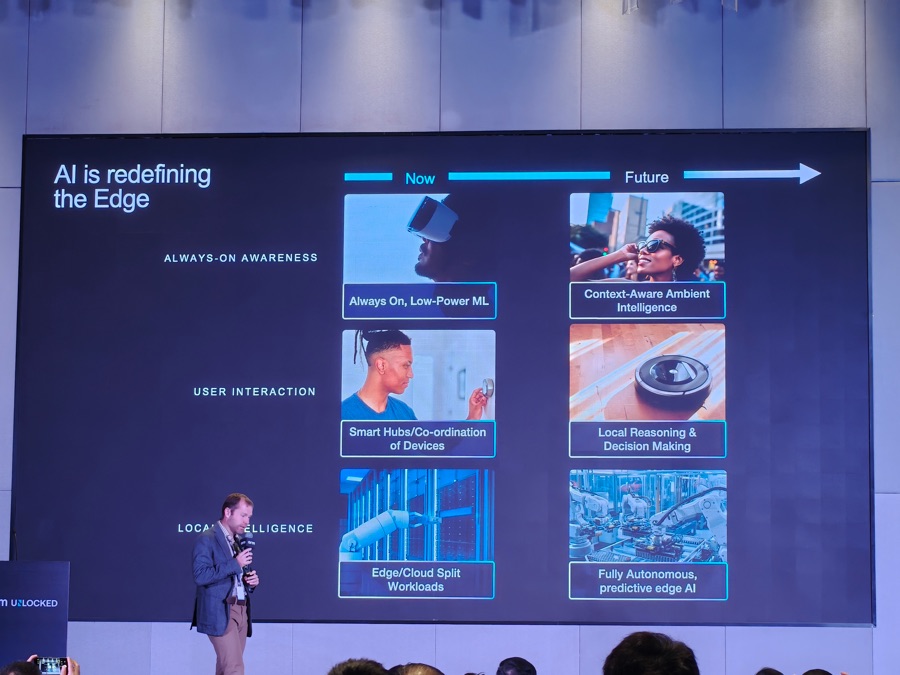
21世纪经济报道记者骆轶琪深圳报道 随着大模型技术持续推进应用落地,一个明显变化正在发生:人工智能不再只是云端的事,正越来越多地出现在人们身边的设 备中——从智能音箱到工业机器人,从可穿戴设备到智能家居。这便是"边缘AI",它让设备在本地就能完成智能处理,不必把 所有数据都传到云端。 尤其在端侧模型小型化的趋势下,边缘AI应用及其相关芯片都在快速发展。 Arm Unlocked 2025 AI技术峰会深圳站期间,Arm物联网事业部硬件产品管理高级总监Lionel Belnet指出,Arm于今年初推出全球 首个基于Armv9架构的边缘AI计算平台,以Arm Cortex-A320 CPU和Arm Ethos-U85 NPU为核心,专为物联网应用优化,支持运 行超10亿参数的端侧AI模型。该平台也将陆续纳入Arm技术授权订阅模式中的Arm Flexible Access方案,其通常服务于初创企业 与OEM厂商,令这类厂商可以以更低成本进行产品开发。 受访时,Lionel Belnet谈到多个看好在中国市场的边缘AI落地案例。他认为,"AI的终点不在边缘,而是始于边缘,从边缘侧推 动着下一波智能计算的浪潮。" 边缘 ...