圆通速递

Search documents
平台算法和劳动规则协商取得积极进展
Jing Ji Ri Bao· 2025-09-12 00:43
Group 1 - The core viewpoint is that national trade unions are actively promoting algorithm negotiations among platform companies, with expected coverage of over 20 million new employment form workers [1][2] - As of now, 15 leading platform companies have been included in the initiative, with 7 companies, including T3 Travel and Didi, having signed special agreements on algorithms and labor rules [1] - The agreements stipulate that labor remuneration will not be lower than the local minimum wage, and measures such as the gradual elimination of "overtime deductions" are being implemented [1][2] Group 2 - The focus of the algorithm negotiations includes core worker rights such as labor remuneration, rest rights, labor safety, and algorithm transparency [2] - In the ride-hailing industry, agreements have been made to publicly disclose pricing rules and reduce commission rates, along with enhancements to fatigue prevention rules [2] - New features such as abnormal order interception and mandatory rest reminders have been introduced to improve worker safety and well-being [2]
【读财报】快递行业2025年中报:营收普遍增长 快递业务“量增价减”
Xin Hua Cai Jing· 2025-09-11 23:12
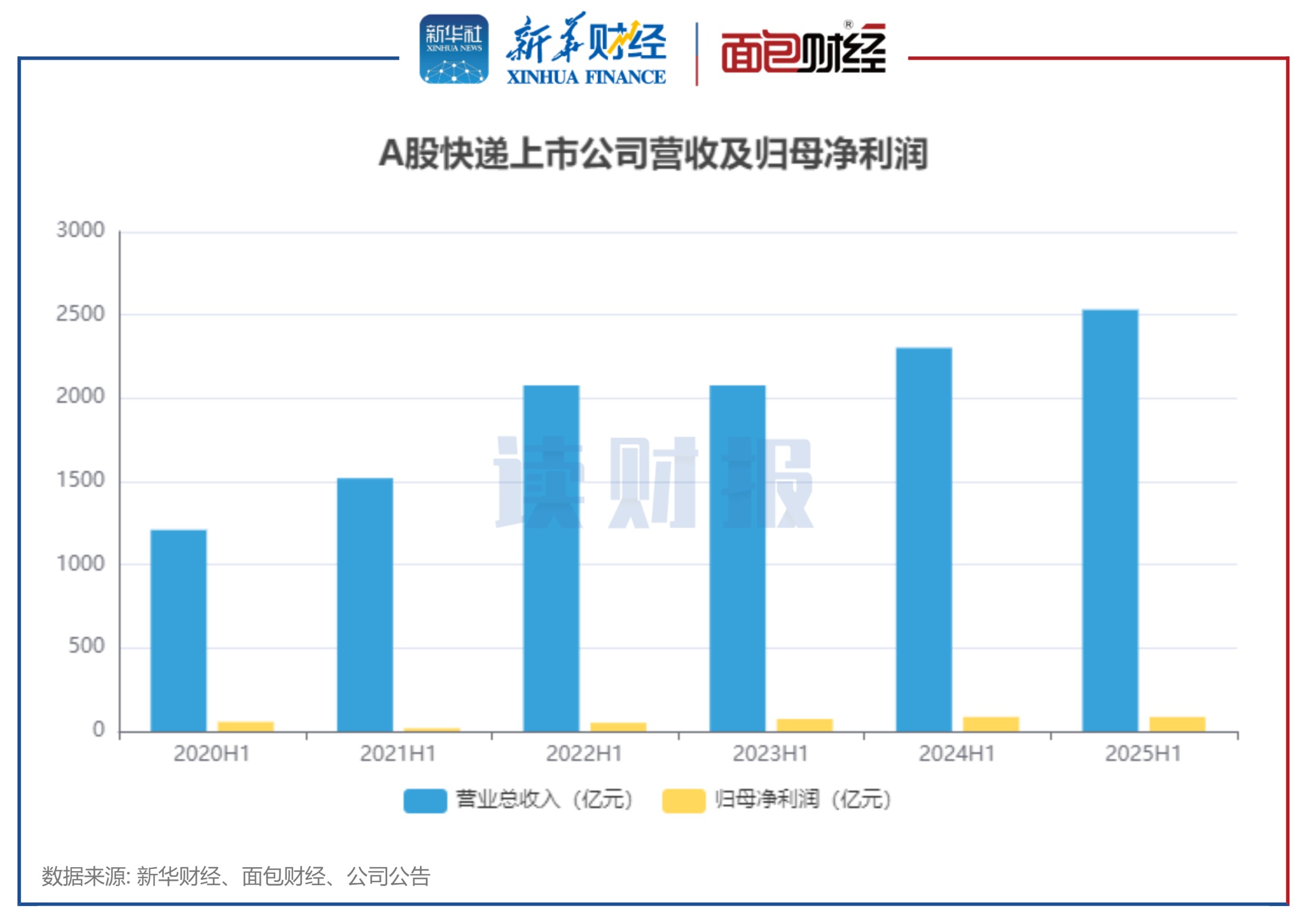
Core Insights - The express delivery sector in A-shares shows a mixed performance in revenue and net profit for the first half of 2025, with total revenue reaching 253.15 billion yuan, a year-on-year increase of 9.95%, while net profit slightly decreased by 0.03% to 8.60 billion yuan [1][2]. Revenue Performance - In H1 2025, SF Express led the revenue rankings with 146.86 billion yuan, followed by YTO Express with 35.88 billion yuan and Shentong Express with 25.03 billion yuan [5][6]. - Shentong Express exhibited the fastest revenue growth at 16.02% year-on-year, while Debon Express and YTO Express grew by 11.43% and 10.19%, respectively [5][12]. Net Profit Analysis - SF Express and YTO Express achieved net profits of 5.74 billion yuan and 1.83 billion yuan, respectively, while the other three companies reported net profits below 600 million yuan, with Debon Express experiencing a significant decline of 84.34% [8][9]. - SF Express and Shentong Express saw net profit increases of 19.37% and 3.73%, while YTO Express, Yunda Express, and Debon Express reported declines [8][9]. Market Trends - The express delivery industry is experiencing a "volume increase, price decrease" trend, with total express business volume reaching 95.64 billion pieces, a 19.3% increase year-on-year, but the average price per piece dropped by 8% to 7.5 yuan [9][12]. - In H1 2025, YTO Express led in business volume with 14.86 billion pieces, followed by Yunda Express and Shentong Express with 12.73 billion and 12.35 billion pieces, respectively [9][11]. Single Ticket Revenue - The single ticket revenue for major companies has shown a downward trend, with SF Express reporting a decline of 12.43% to 13.67 yuan in June compared to January, and YTO Express declining by 10.64% to 2.10 yuan [9][13].



快递进村 门口收件
Si Chuan Ri Bao· 2025-09-11 22:11
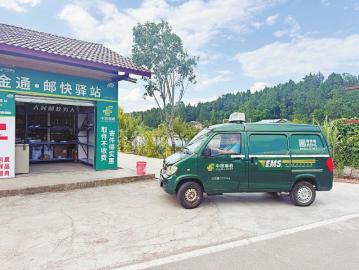
Core Viewpoint - The establishment of village-level logistics service stations by China Post in Nanchong, Sichuan, has significantly improved the delivery of packages to rural areas, facilitating cooperation with private express companies to enhance service efficiency and coverage [3]. Group 1: Logistics Service Stations - China Post has created the first batch of village-level logistics service stations in Nanchong, which has enabled unified delivery of packages from various express companies to rural areas [3]. - The Datan Village logistics service station has delivered nearly 10,000 packages in one year, covering over 10,000 people across three administrative villages and one construction site [3]. - As of August this year, 43 standardized logistics service stations have been established across 26 administrative towns in Yingshan County [3]. Group 2: Collaboration with Express Companies - China Post collaborates with private express companies to address the challenges of delivering packages to remote villages, leveraging its extensive delivery network [3]. - The partnership allows for the separate sorting of packages that are difficult to deliver, with China Post handling the final delivery to rural areas [3]. - The cooperation has led to a significant increase in package volume, with the number of packages received at the service station rising from less than 100 to 879 in one year [3]. Group 3: Cost Efficiency and Revenue Generation - The cost for villagers to receive packages through the service station is lower than traditional storage fees, eliminating the need for additional charges [3]. - The logistics service stations also provide a source of income for local businesses, with the owner of a small shop reporting earnings of 400 to 500 yuan per month from package services [3]. - To alleviate delivery pressure, China Post has coordinated with local passenger transport services to utilize excess capacity for package delivery [3].
平台算法和劳动规则协商取得积极进展 预计覆盖新就业形态劳动者逾2000万人
Jing Ji Ri Bao· 2025-09-11 21:59
Core Insights - The article highlights the proactive measures taken by labor unions in China to promote algorithm negotiations within platform companies, aiming to cover over 20 million new employment form workers this year [1][2] Group 1: Labor Negotiations - Labor unions have initiated a concentrated action for collective negotiations in 2025, focusing on algorithm negotiations with platform companies [1] - 15 leading platform companies have been included in this initiative, with 7 companies already signing specialized agreements regarding algorithms and labor rules [1] Group 2: Key Agreements - The agreements established by several platforms ensure that labor remuneration is not less than the local minimum wage and include provisions for bad weather subsidies while gradually eliminating "overtime deductions" [2] - In the ride-hailing industry, there are commitments to public pricing rules and reduced commission rates, along with enhanced fatigue prevention measures and features for intercepting abnormal orders and mandatory rest reminders [2] Group 3: Regional Collaboration - 15 provinces and cities, including Beijing, Hebei, Jilin, and Shanghai, are actively guiding local branches of platform companies to conduct regional negotiations, resulting in 33 regional negotiation or opinion consultation meetings [1]
烧钱越有钱,阿里巴巴现金为何不降反升?
36氪· 2025-09-11 13:35
Core Viewpoint - Alibaba's Q2 2025 financial report shows a lower-than-expected decline in operating profit, an increase in cloud business revenue growth, and a rebound in cash reserves after five consecutive quarters of decline, leading to a more than 20% rise in its stock price since the report's release [4][5][6]. Financial Performance - In Q2 2025, Alibaba's cash reserves reached approximately 183.1 billion yuan, an increase of 37.6 billion yuan from the previous quarter, marking the first rebound after five quarters of decline [6]. - The company reported a net cash outflow of 18.8 billion yuan in free cash flow for the quarter, the first negative figure in three years, prompting a need for increased liquidity [11][12]. Strategic Adjustments - Alibaba's strategy shifted in 2025, with a focus on a 380 billion yuan capital expenditure plan for AI and cloud services, alongside a commitment to instant retail, leading to increased cash requirements [11][20]. - The company reduced its stock buyback amount significantly from approximately 42.7 billion yuan in Q2 2024 to about 5.84 billion yuan in Q2 2025, indicating a strategic pivot towards maintaining liquidity [12][19]. Asset Management - Alibaba's short-term investments totaled 191.7 billion yuan in Q2 2025, a decrease of 37.1 billion yuan from the previous quarter, contributing to the increase in cash reserves [15]. - The company has been actively selling off non-core assets, including shares in various companies, to bolster cash reserves, with total cash generated from these sales estimated at 2 to 3 billion yuan [17][18]. Market Positioning - The increase in cash reserves is seen as a preparation for significant capital expenditures and a signal of Alibaba's commitment to expanding its cloud and AI capabilities [20][22]. - By streamlining its operations and focusing on core businesses, Alibaba aims to enhance its valuation, moving away from a "large and comprehensive" model to a "strong and precise" approach [24]. Valuation Outlook - Alibaba's strategic focus on AI and cloud services, coupled with a reduction in non-core investments, positions the company to potentially align its valuation with leading domestic and international peers in the cloud and AI sectors [25][27].


长三角首个新能源并网容量超2000万千瓦城市诞生
Xin Hua Wang· 2025-09-11 09:41
Core Insights - Jiangsu province has achieved a significant milestone by integrating over 20 million kilowatts of renewable energy into its grid, making Yancheng the first city in the Yangtze River Delta to surpass this capacity [1] - The renewable energy mix in Yancheng consists of 48% wind power and 51% solar power, with a total generation of 24.55 billion kilowatt-hours from January to August this year [1] - The State Grid Jiangsu Electric Power Company is enhancing its grid infrastructure to support the increased renewable energy capacity and facilitate the delivery of green electricity [2] Group 1 - Yancheng has become the first city in the Yangtze River Delta to exceed 20 million kilowatts of renewable energy capacity [1] - The renewable energy capacity in Yancheng includes 48% from wind and 51% from solar [1] - The total renewable energy generation in Yancheng from January to August reached 24.55 billion kilowatt-hours [1] Group 2 - The State Grid Jiangsu Electric Power Company has launched several major projects to improve the transmission capacity of renewable energy, including the 500 kV coastal second channel and the Gao Rong 500 kV substation project [2] - Jiangsu has established a total of 8 cross-river transmission channels with a combined transmission capacity of nearly 25 million kilowatts [2] - The maximum daily green electricity transmission capacity is expected to exceed 350 million kilowatt-hours by the summer of 2025 [2]
全国工会推动平台算法和劳动规则协商取得积极进展
Xin Hua She· 2025-09-11 09:07
Core Points - The article highlights the proactive measures taken by labor unions in China to promote algorithm negotiations with platform companies, aiming to cover over 20 million new employment form workers this year [1][2] - Several major platform companies have signed agreements that ensure labor compensation is not less than the local minimum wage, along with other benefits [1][2] Group 1 - Labor unions have initiated a "concentrated offer action" for collective negotiations in 2025, focusing on algorithm negotiations with platform companies [1] - As of now, 15 leading platform companies have been included in this initiative, with 7 companies successfully signing special agreements regarding algorithms and labor rules [1][2] - The agreements cover key labor rights such as compensation, rest rights, labor safety, and algorithm transparency, leading to improved clarity for workers regarding their rights [2] Group 2 - The agreements include provisions for minimum wage guarantees, bad weather subsidies, and the gradual elimination of "overtime deductions" [2] - In the ride-hailing industry, there are commitments to public pricing rules and reduced commission rates, along with enhanced fatigue prevention measures [2] - Many platforms are establishing regular negotiation systems with labor unions and workers, committing to hold algorithm negotiation meetings and provide advance notice of algorithm changes [2]
全国工会推进平台算法和劳动规则协商 预计将覆盖新就业形态劳动者逾2000万人
Zhong Guo Xin Wen Wang· 2025-09-11 07:17
Core Insights - The National Trade Union has initiated discussions on platform algorithms and labor rules, involving 15 major platform companies, with agreements already signed by 7 of them, impacting over 20 million new employment form workers [1] Group 1: Agreements and Coverage - Seven companies, including T3 Mobility, Jitu, UU Runner, Manbang, Didi, YTO Express, and Ele.me, have successfully signed special agreements on algorithms and labor rules [1] - All remaining companies are expected to complete negotiations and sign agreements by the end of September [1] Group 2: Focus Areas of Negotiation - The negotiations focus on core worker rights such as labor remuneration, rest rights, labor safety, and algorithm transparency [1] - Key algorithm rules discussed include order pricing, commission rates, dispatch methods, time estimation, and route planning [1] Group 3: Improvements and Commitments - Agreements stipulate that labor remuneration will not be lower than the local minimum wage, with provisions for adverse weather subsidies and the gradual elimination of "overtime deductions" [1] - In the ride-hailing industry, there are commitments to public pricing rules and reduced commission rates, alongside enhanced fatigue prevention measures [1] Group 4: Ongoing Collaboration - Several platforms have established regular negotiation systems with unions and workers, committing to periodic algorithm negotiation meetings and quick response channels for worker demands [1]
预计覆盖2000多万人 算法协商让劳动者核心权益“算得明白”
Yang Shi Xin Wen· 2025-09-11 05:10
Group 1 - The National Trade Union Council held a meeting in Shanghai to summarize the progress of algorithm negotiation and outline the next steps, focusing on platform enterprises [1] - As of now, 15 leading platform companies have been included in the negotiation process, with 7 companies successfully signing special agreements on algorithms and labor rules, expected to cover over 20 million new employment form workers [1][2] - Provinces such as Beijing, Hebei, Jilin, and Shanghai have actively guided local branches of platform companies to conduct regional negotiations, holding 33 regional negotiation or opinion consultation meetings [1] Group 2 - The algorithm negotiations focus on core labor rights such as remuneration, rest rights, labor safety, and algorithm transparency, leading to clearer understanding of labor rights for workers [2] - Several platform agreements stipulate that labor remuneration will not be lower than the local minimum wage, establish bad weather subsidies, and gradually eliminate "overtime deductions" [2] - Many platforms have established regular negotiation systems with trade unions and workers, committing to hold algorithm negotiation meetings regularly and provide advance notice of algorithm changes [2]
数智引擎驱动,产业跃迁新程——2025全球工业互联网大会观察
Xin Hua Wang· 2025-09-10 11:21
Group 1 - The 2025 Global Industrial Internet Conference held in Shenyang showcased the evolution of industrial internet from concept to value realization, emphasizing the integration of AI with manufacturing to enhance production logic and productivity [1][12] - The conference highlighted the shift from traditional platforms to "industrial large models + AI intelligent bodies," with examples such as Ansteel Group reducing production costs by 15% and wastewater discharge by 21% through intelligent model optimization [4][6] - The integration of AI in industrial processes is not just about optimizing production flow but also upgrading the quality of industrial value, with many traditional manufacturers recognizing digital transformation as essential for growth [6][7] Group 2 - China has established over 30,000 basic intelligent factories and more than 1,200 advanced intelligent factories, demonstrating the industrial internet's role in transforming data into productive forces [7][9] - The industrial internet's application has expanded to cover all 41 major industrial categories, with a projected core industry scale exceeding 1.5 trillion yuan by 2024, indicating a shift from production-focused applications to full supply chain integration [9] - The conference emphasized the need for multi-technology integration, including AI, drones, and edge computing, as a key driver for enhancing industrial internet efficiency [7][9] Group 3 - Local governments are encouraged to act as facilitators for digital transformation by promoting key technology innovation, improving digital infrastructure, and supporting intelligent manufacturing development [10] - The integration of AI with industry requires a pragmatic approach, focusing on gradual improvements and leveraging existing strengths to enhance digital and intelligent capabilities [10] - The conference served as a platform for global collaboration in industrial internet development, positioning AI as a catalyst for deeper integration between the digital and physical worlds [12]