华能国际

Search documents
四大发电央企上半年赚了214亿元,大唐发电净利润增长逾47%
Hua Xia Shi Bao· 2025-09-03 00:05
Core Viewpoint - The four major power generation companies in A-shares have shown a mixed performance in their financial results for the first half of 2025, with overall net profits exceeding 21.4 billion yuan, but individual results vary significantly among the companies [3][4]. Group 1: Financial Performance - Huaneng International reported a net profit of 9.262 billion yuan, a year-on-year increase of 24.26% [3][5]. - Datang Power achieved a net profit of 4.579 billion yuan, with a substantial year-on-year growth of 47.35% [3][4]. - Huadian International's net profit reached 3.904 billion yuan, reflecting a year-on-year increase of 13.15% [3][5]. - Guodian Power's net profit fell to 3.687 billion yuan, a significant decline of 45.11% year-on-year [3][9]. Group 2: Revenue and Cost Analysis - Datang Power's revenue for the first half of 2025 was 57.193 billion yuan, a slight decrease of 1.93% year-on-year, while its total profit reached 7.284 billion yuan, up 36.14% [4]. - Huadian International's revenue was approximately 59.953 billion yuan, down 8.98% year-on-year, with a total generation of 1,206.21 billion kWh, a decrease of about 6.41% [5]. - Huaneng International reported revenue of 112 billion yuan, a decline of 5.70% year-on-year, but its total profit increased by 31.93% [5]. - Guodian Power's revenue was 77.655 billion yuan, down 9.52% year-on-year, with a notable drop in net profit [9]. Group 3: Industry Trends and Challenges - The decline in coal prices has positively impacted the cost structure of thermal power companies, with coal costs accounting for 60%-70% of their total costs [11]. - The average spot price of thermal coal in the Bohai Rim fell by 22.94% year-on-year, significantly reducing fuel costs for power generation companies [11]. - The transition towards clean energy is becoming a key focus for the major power generation companies, with Datang Power increasing its clean energy capacity to 40.87% [11]. - Guodian Power faces challenges in developing new energy projects due to increasing competition and resource scarcity [12].






三升一降!四大发电央企上半年赚了214亿元,大唐发电净利润增长逾47%
Hua Xia Shi Bao· 2025-09-02 13:59
Core Insights - The four major power generation companies in A-shares reported mixed performance for the first half of 2025, with total net profits exceeding 21.4 billion yuan, reflecting a divergence in their financial results [1] - The overall improvement in the profitability environment for the power generation industry is attributed to falling coal prices, supportive electricity pricing policies, and growth in new energy installations [1][4] Group 1: Company Performance - Huaneng International reported a net profit of 9.262 billion yuan, a year-on-year increase of 24.26% [1][3] - Datang Power achieved a net profit of 4.579 billion yuan, a significant year-on-year growth of 47.35% [1][2] - Huadian International's net profit reached 3.904 billion yuan, reflecting a year-on-year increase of 13.15% [1][3] - Guodian Power's net profit fell to 3.687 billion yuan, a decline of 45.11% year-on-year [1][5] Group 2: Revenue and Cost Analysis - Datang Power's revenue for the first half of 2025 was 57.193 billion yuan, a decrease of 1.93% year-on-year, with a proposed cash dividend of 0.055 yuan per share [2] - Huadian International's revenue was approximately 59.953 billion yuan, down 8.98% year-on-year, with a total power generation of 1,206.21 billion kWh, a decrease of about 6.41% [3] - Huaneng International reported revenue of 112 billion yuan, a decline of 5.70% year-on-year, while its total profit reached 14.762 billion yuan, a year-on-year increase of 31.93% [3] - Guodian Power's revenue was 77.655 billion yuan, down 9.52% year-on-year, with a non-recurring profit of 3.410 billion yuan, an increase of 56.12% [5][6] Group 3: Industry Trends - The decline in coal prices has positively impacted fuel costs for thermal power companies, with coal costs accounting for 60%-70% of their cost structure [8] - The market for thermal coal has shown a supply-demand imbalance, leading to a significant drop in prices, which has improved short-term profits for power generation companies [8] - The transition towards clean energy is a key focus for the major power generation companies, with Datang Power increasing its clean energy capacity to 40.87% of its total installed capacity [8] Group 4: Challenges and Future Outlook - Guodian Power faces challenges due to its high coal power business proportion, which makes it more susceptible to coal price fluctuations and competitive pressures in certain regions [5][9] - The rapid increase in new energy installations presents challenges such as resource scarcity and regulatory hurdles, impacting project development [9] - Future profitability will depend on the progress of clean energy transitions and effective cost management, with leading companies likely to maintain their competitive edge through structural optimization [9]
三升一降!四大发电央企上半年赚了214亿元 大唐发电净利润增长逾47%
Hua Xia Shi Bao· 2025-09-02 13:47
Core Viewpoint - The four major power generation companies in A-shares reported mixed performance in the first half of 2025, with overall net profits exceeding 21.4 billion yuan, but showing significant divergence among the companies [1][2]. Group 1: Company Performance - Huaneng International reported a net profit of 9.262 billion yuan, a year-on-year increase of 24.26% [1][3]. - Datang Power achieved a net profit of 4.579 billion yuan, with a substantial year-on-year growth of 47.35% [1][2]. - Huadian International's net profit reached 3.904 billion yuan, reflecting a year-on-year increase of 13.15% [1][2]. - Guodian Power's net profit was 3.687 billion yuan, showing a significant year-on-year decline of 45.11% [1][6]. Group 2: Revenue and Profit Trends - Datang Power's revenue was 57.193 billion yuan, a slight decrease of 1.93%, while its net profit grew significantly [2]. - Huadian International's revenue was approximately 59.953 billion yuan, down 8.98%, but its net profit increased [2]. - Huaneng International's revenue was 112 billion yuan, a decrease of 5.70%, with a net profit of 12.307 billion yuan, up 34.41% [3]. - Guodian Power's revenue was 77.655 billion yuan, down 9.52%, but its non-recurring net profit increased by 56.12% [6]. Group 3: Industry Trends - The decline in coal prices positively impacted the cost control and profit margins of thermal power companies, with coal costs accounting for 60%-70% of their cost structure [8]. - The market for thermal coal showed a supply-demand imbalance, leading to a significant drop in prices, which benefited the profitability of power generation companies [8]. - The shift towards clean energy is becoming a key focus for the major power generation companies, with Datang Power increasing its clean energy capacity to 40.87% [8][9]. Group 4: Challenges and Future Outlook - Guodian Power faces challenges due to its high reliance on coal-fired power, which makes it more susceptible to coal price fluctuations and competitive pressures in certain regions [6][9]. - The development of new energy projects is becoming increasingly difficult due to resource scarcity, grid capacity issues, and environmental regulations [9]. - Future profitability will depend on the progress of clean energy transitions and effective cost management, with leading companies likely to maintain their competitive edge through structural optimization [9].
金工定期报告20250902:预期高股息组合跟踪
Soochow Securities· 2025-09-02 09:04
Quantitative Models and Construction Methods - **Model Name**: Expected High Dividend Portfolio **Model Construction Idea**: The model aims to construct a portfolio with high expected dividend yield by leveraging historical dividend data, fundamental indicators, and short-term factors like reversal and profitability[5][10][16] **Model Construction Process**: 1. **Dividend Yield Calculation**: - Phase 1: Calculate dividend yield based on annual report profit distribution announcements - Phase 2: Predict and calculate dividend yield using historical dividend data and fundamental indicators[5][10] 2. **Screening Process**: - Exclude suspended and limit-up stocks from the CSI 300 constituents[15] - Remove the top 20% of stocks with the highest short-term momentum (21-day cumulative return)[15] - Exclude stocks with declining profitability (quarterly net profit YoY growth < 0)[15] 3. **Final Selection**: - Rank the remaining stocks by expected dividend yield - Select the top 30 stocks with the highest expected dividend yield and construct an equally weighted portfolio[11] **Model Evaluation**: The model demonstrates strong historical performance with significant excess returns and controlled drawdowns, making it a robust strategy for high-dividend stock selection[13] Model Backtesting Results - **Expected High Dividend Portfolio**: - Cumulative Return: 358.90% - Cumulative Excess Return (vs CSI 300 Total Return Index): 107.44% - Annualized Excess Return: 8.87% - Maximum Rolling 1-Year Drawdown of Excess Return: 12.26% - Monthly Excess Win Rate: 60.19%[13] Quantitative Factors and Construction Methods - **Factor Name**: Expected Dividend Yield Factor **Factor Construction Idea**: Predict future dividend yield by combining historical dividend data, fundamental indicators, and short-term influencing factors[5][16] **Factor Construction Process**: 1. Calculate historical dividend yield based on profit distribution announcements[5][10] 2. Predict future dividend yield using fundamental indicators and historical dividend patterns[5][10] 3. Incorporate two short-term factors: - **Reversal Factor**: Accounts for short-term price reversals - **Profitability Factor**: Reflects the company's earnings performance[5][16] **Factor Evaluation**: The factor effectively identifies high-dividend stocks and serves as a reliable input for portfolio construction[16] - **Factor Name**: Red Dividend Timing Framework (Composite Signal) **Factor Construction Idea**: Combines multiple single-factor signals to assess the market's outlook on dividend stocks[25][28] **Factor Construction Process**: 1. Evaluate five single-factor signals: - **Inflation**: PPI YoY (High/Low) - **Liquidity**: M2 YoY (High/Low) - **M1-M2 Gap**: Scissors Difference (High/Low) - **Interest Rate**: US 10-Year Treasury Yield (High/Low) - **Market Sentiment**: Dividend Stock Turnover Ratio (Up/Down)[28] 2. Assign binary signals (1 for bullish, 0 for bearish) to each factor 3. Aggregate the signals into a composite indicator[28] **Factor Evaluation**: The framework provides a systematic approach to timing dividend stock investments, though the September 2025 signal suggests a cautious stance[25][28] Factor Backtesting Results - **Expected Dividend Yield Factor**: - August 2025 Portfolio Average Return: 5.69% - Excess Return (vs CSI 300 Index): -4.80% - Excess Return (vs CSI Dividend Index): +4.70%[5][16] - **Red Dividend Timing Framework (Composite Signal)**: - Latest Signal (September 2025): 0 (Neutral)[25][28]






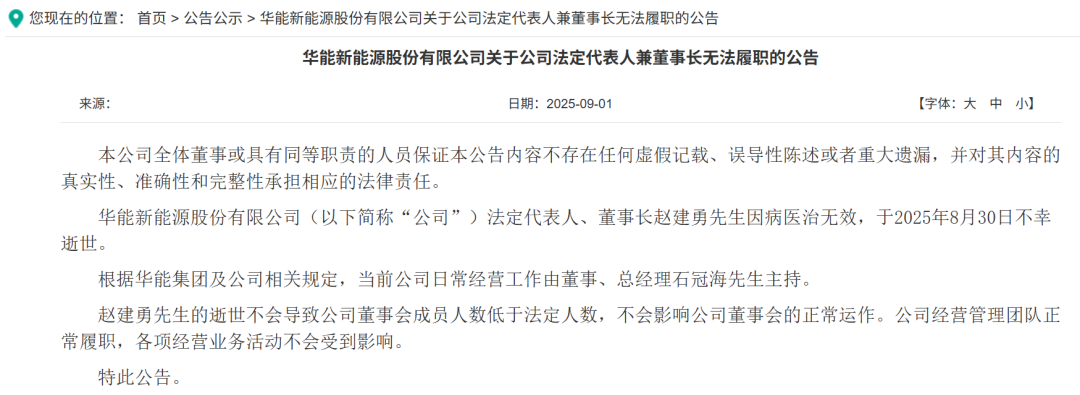
突发公告,赵建勇不幸逝世
Zhong Guo Ji Jin Bao· 2025-09-02 09:00
【导读】华能新能源法定代表人、董事长赵建勇逝世 9月1日,华能新能源股份有限公司(以下简称华能新能源)发布关于公司法定代表人兼董事长无法履职的公告。 能源圈传来不幸消息! | | | 公告显示,华能新能源法定代表人、董事长赵建勇先生因病医治无效,于2025年8月30日不幸逝世。根据华能集团及华能新能源相关规定,当前公司日常 经营工作由董事、总经理石冠海主持。 华能新能源表示,赵建勇的逝世不会导致公司董事会成员人数低于法定人数,不会影响公司董事会的正常运作。公司经营管理团队正常履职,各项经营业 务活动不会受到影响。 公开简历显示,赵建勇,52岁,于2021年2月加入华能新能源。赵建勇毕业于华北电力学院动力工程系电厂热能动力工程专业,获得工学学士学位,后获 北京大学光华管理学院工商管理硕士,正高级经济师。 赵建勇在中国华能集团系统内工作多年,曾任中国华能集团公司(华能国际(600011)电力股份有限公司)江西分公司副总经理、党组成员,中国华能集 团公司(华能国际电力股份有限公司)江西分公司副总经理、党委委员、工会主席,华能黑龙江发电有限公司总经理、党委副书记,中国华能集团有限公 司黑龙江分公司总经理、党委副书记, ...
电力行业2025年半年报综述:成本主导火电持续改善,清洁能源盈利有所承压
Changjiang Securities· 2025-09-02 08:43
Investment Rating - The report maintains a "Positive" investment rating for the power industry [12]. Core Insights - Since 2025, electricity demand has slowed, with a year-on-year growth of 3.73% in total electricity consumption in the first half of the year. The revenue of the power sector decreased by 3.61% year-on-year due to adjustments in annual long-term contract prices in several provinces. However, benefiting from a significant drop in coal prices and stable growth in the high-margin hydropower sector, the net profit attributable to shareholders in the power sector increased by 1.49% year-on-year. In the second quarter, net profit decreased by 2.16% year-on-year, with performance continuing to diverge among sub-sectors [2][21][36]. Summary by Sections Overall Industry Performance - In the first half of 2025, the power sector achieved a revenue of 844.48 billion yuan, a decrease of 3.61% year-on-year, while net profit attributable to shareholders was 102.01 billion yuan, an increase of 1.49% year-on-year [21][25]. Thermal Power - In the first half of 2025, thermal power generation decreased by 2.40% year-on-year, and revenue fell by 5.81% year-on-year to 608.77 billion yuan. However, net profit increased by 3.92% year-on-year to 48.91 billion yuan due to significant cost reductions, with the average coal price dropping by 199.21 yuan per ton [6][27][52]. Hydropower - Despite a decrease in water inflow, major hydropower companies maintained stable growth, with revenue increasing by 4.16% year-on-year to 62.21 billion yuan and net profit rising by 10.05% year-on-year to 22.44 billion yuan in the first half of 2025 [7][27]. Renewable Energy - The renewable energy sector faced challenges due to weak wind and solar conditions, with revenue growth of only 2.18% year-on-year to 156.40 billion yuan. Net profit decreased by 7.24% year-on-year to 29.65 billion yuan, impacted by rising costs and market price pressures [8][27]. Grid Sector - The grid sector's performance was affected by reduced water inflow and weak electricity demand, resulting in a net profit of 0.998 billion yuan, a decrease of 7.25% year-on-year [9][27]. Investment Recommendations - The report expresses optimism about the transformation of quality thermal power and the investment value of clean energy. It recommends leading companies in thermal power such as Huaneng International, Huadian International, and Guodian Power, as well as hydropower companies like Yangtze Power and Huaneng Hydropower. For renewable energy, it suggests companies like China Nuclear Power and Funiu Co., Ltd. [10][40].

公用事业ETF(560190)涨超1.4%,我国月度用电量首破万亿
Xin Lang Cai Jing· 2025-09-02 06:18
Group 1 - The China Securities Index for Public Utilities (000995) increased by 0.89% as of September 2, 2025, with notable gains from Shanghai Electric (600021) up 9.98%, Jilin Electric Power (000875) up 5.98%, and Huaneng Hydropower (600025) up 2.32% [1] - In July, the total electricity consumption in China reached 10,226 billion kilowatt-hours, marking an 8.6% year-on-year increase, with monthly consumption surpassing 1 trillion kilowatt-hours for the first time, indicating strong demand [1] - Dongguan Securities highlighted that the first and third industries, along with urban and rural residential electricity consumption, experienced rapid growth, while the average price of thermal coal decreased year-on-year, benefiting the profitability of thermal power companies [1] Group 2 - As of August 29, 2025, the top ten weighted stocks in the China Securities Index for Public Utilities (000995) include Yangtze Power (600900), China Nuclear Power (601985), and Three Gorges Energy (600905), collectively accounting for 56.01% of the index [2]



中泰国际每日晨讯-20250902
ZHONGTAI INTERNATIONAL SECURITIES· 2025-09-02 06:05
Market Overview - On September 1, the Hong Kong stock market opened strongly, with the Hang Seng Index rising by 539 points or 2.2% to close at 25,617 points, driven by Alibaba's (9988 HK) performance [1] - The Hang Seng Tech Index also increased by 2.2%, closing at 5,798 points, with total market turnover exceeding 380.2 billion HKD and net inflow from the Stock Connect reaching 11.94 billion HKD [1] - Despite the overall rise, market breadth showed adjustments, with funds concentrating on technology, biomedicine, and non-ferrous metal stocks [1] Sector Performance - Alibaba's stock surged by 18.5% in a single day, marking the strongest increase among blue-chip stocks, with a trading volume of 54.92 billion HKD, the highest since its listing [1] - Semiconductor stocks also performed well, with SMIC (981 HK) rising by 4.9% due to increased capital expenditure in AI [1] - Biomedicine and non-ferrous metal stocks continued their strong performance, with Zijin Mining (2899 HK), Zhaojin Mining (1818 HK), and Luoyang Molybdenum (3993 HK) rising between 6.7% and 8.9% [1] Economic Indicators - The overall sentiment in the Hong Kong stock market remains stable, with active trading focused on high-performing stocks, indicating a structural market trend [2] - In August, China's official manufacturing PMI showed a slight recovery but remained in contraction territory, highlighting weak internal and external demand [2] - The non-manufacturing PMI also saw a minor increase, but the internal structure showed divergence, with the construction sector weakening and the service sector rebounding [2] Real Estate Dynamics - New home transaction volumes in major cities showed a year-on-year increase of 3.6% to 1.8 million square meters for the week ending August 31, indicating a recovery compared to the previous week [3] - Performance varied across city tiers, with first-tier cities seeing a decline of 5.1%, while second-tier cities experienced a growth of 17.7% [3] Automotive Sector Insights - The automotive sector lagged behind technology stocks, with BYD (1211 HK) reporting a net profit of 6.4 billion RMB for Q2, down 30% year-on-year and 31% quarter-on-quarter, below expectations [4] - Intense price competition has compressed profit margins, with a gross margin of 16.3% in Q2, down 3.8 percentage points [4] - The market is focused on BYD's overseas expansion, with production capacity in Indonesia, Brazil, and Hungary expected to be completed ahead of schedule [4] Healthcare Sector Developments - The Hang Seng Healthcare Index surged by 4.9%, led by innovative drugs and the CXO sector [4] - Most leading innovative drug companies reported strong interim results, while traditional pharmaceutical and medical device sectors continue to be affected by centralized procurement policies [4] Renewable Energy and Utilities - Recent performance in the renewable energy and utilities sector was mixed, with nuclear, gas, and environmental sectors generally declining, while solar and thermal power sectors saw gains [5] - Xinyi Solar (968 HK), Flat Glass (6865 HK), and GCL-Poly Energy (3800 HK) saw increases of 0.9%, 1.3%, and 2.4% respectively [5] Company-Specific Analysis: Innovent Biologics (1801 HK) - Innovent Biologics reported a 50.6% year-on-year increase in revenue to 5.95 billion RMB for the first half of the year, with a gross profit increase of 56.3% to 5.12 billion RMB [6] - The company successfully turned a profit with a net income of 830 million RMB, compared to a loss of 390 million RMB in the same period last year [6] - The main product, the oncology drug Darbepoetin, saw a 16% increase in sales revenue to approximately 2.7 billion USD (about 19.6 billion RMB) [6] Future Projections for Innovent Biologics - Sales revenue is expected to grow rapidly from 2025 to 2027, driven by the anticipated approval of new indications for existing products and the launch of new drugs [7] - The company plans to increase R&D investment, projecting over 300 million USD for the year, with expectations for net profit to significantly exceed previous forecasts [7] - Long-term prospects for pipeline products IBI363 and IBI343 are promising, with ongoing clinical trials showing positive results [8] Target Price and Rating Adjustments for Innovent Biologics - The target price for Innovent Biologics has been raised to 113.75 HKD, with a rating upgrade to "Buy" based on revised revenue forecasts and profit expectations [9]
中泰国际:每日晨讯-20250902
ZHONGTAI INTERNATIONAL SECURITIES· 2025-09-02 05:09
Group 1: Market Overview - On September 1st, the Hong Kong stock market started well, with the Hang Seng Index rising 539 points or 2.2% to close at 25,617 points, and the Hang Seng Tech Index rising 2.2% to close at 5,798 points. The market turnover reached over HK$380.2 billion, and the Hong Kong Stock Connect had a net inflow of HK$11.94 billion [1] - The overall sentiment of the Hong Kong stock market remained stable, with active trading. The market presented a structural trend, mainly trading around high - performance stocks. The Hong Kong stock market is likely to continue to fluctuate at a high level. It is recommended to focus on technology leaders with high performance certainty, semiconductor, AI and computing infrastructure, and cyclical sectors such as non - ferrous metals [2] Group 2: Macro - dynamics - In the real estate sector, the volume of new home sales in 30 large and medium - sized cities reached 1.8 million square meters last week (as of August 31st), a year - on - year increase of 3.6%, better than the 9.2% year - on - year decline in the previous week, and a month - on - month increase of 11.6%, worse than the 26.2% month - on - month decline in the previous week. The year - on - year performance of different types of cities was divergent [3] Group 3: Industry Dynamics Automobile - In the automobile sector, BYD's second - quarter net profit was RMB 6.4 billion, a year - on - year decrease of 30% and a month - on - month decrease of 31%, lower than expected. The gross profit margin in the second quarter was 16.3%, a month - on - month decrease of 3.8 percentage points. The market has lowered its target price, and the stock price fell 5.2% on Monday to a three - month low. The market is focusing on the company's overseas expansion progress [4] Healthcare - The Hang Seng Healthcare Index rose 4.9% yesterday, led by the innovative drug and CXO sectors. The performance of innovative drug leading enterprises was mostly excellent, the CXO sector was recovering, while the traditional pharmaceutical and traditional medical device sectors were still affected by centralized procurement, and the performance of the medical service sector was still affected by medical insurance cost control [4] New Energy and Utilities - The performance of new energy and utility stocks in Hong Kong was divergent. The photovoltaic, thermal power, and Hong Kong utility sectors generally rose, while the nuclear power, gas, and environmental protection sectors generally fell [5] Group 4: Research Report on Xinda Bio - pharm (1801 HK) - In the first half of 2025, Xinda Bio - pharm's performance greatly exceeded expectations. The company's revenue in the first half of the year increased by 50.6% year - on - year to RMB 5.95 billion, and the gross profit increased by 56.3% year - on - year to RMB 5.12 billion, successfully turning losses into profits [6] - It is expected that the company's product sales revenue will grow rapidly from 2025 - 2027E. The profit in the second half of the year is expected to be significantly lower than that in the first half but still greatly exceed expectations. The net profit of shareholders from 2026 - 2027E is also expected to exceed expectations [7] - In the long run, in - research products such as IBI363 and IBI343 are expected to bring new highlights. As of the end of June, the company had 21 in - research products [8] - The target price is raised to HK$113.75, and the rating is upgraded to "Buy" [9] Group 5: Research Report on GUOQUAN FOOD (2517 HK) - GUOQUAN FOOD is China's dominant one - stop provider of at - home meal solutions. By the end of 2024, the number of its retail stores reached 10,150, leading the nearly RMB 400 billion market with a 3% share [10] - After the restructuring of the sales network, the number of stores has stabilized at over 10,000, and it is expected to have a net increase of 780 stores in 2025. The future strategy will prioritize lower - tier markets for expansion [11] - The company has built a strong supply chain moat, pioneering a 'single product, single factory' upstream supply chain cooperation model [12] - The report initiates coverage with a "Buy" rating and a target price of HK$5.17, forecasting a revenue CAGR of 22.2% from 2025 to 2027E [13]
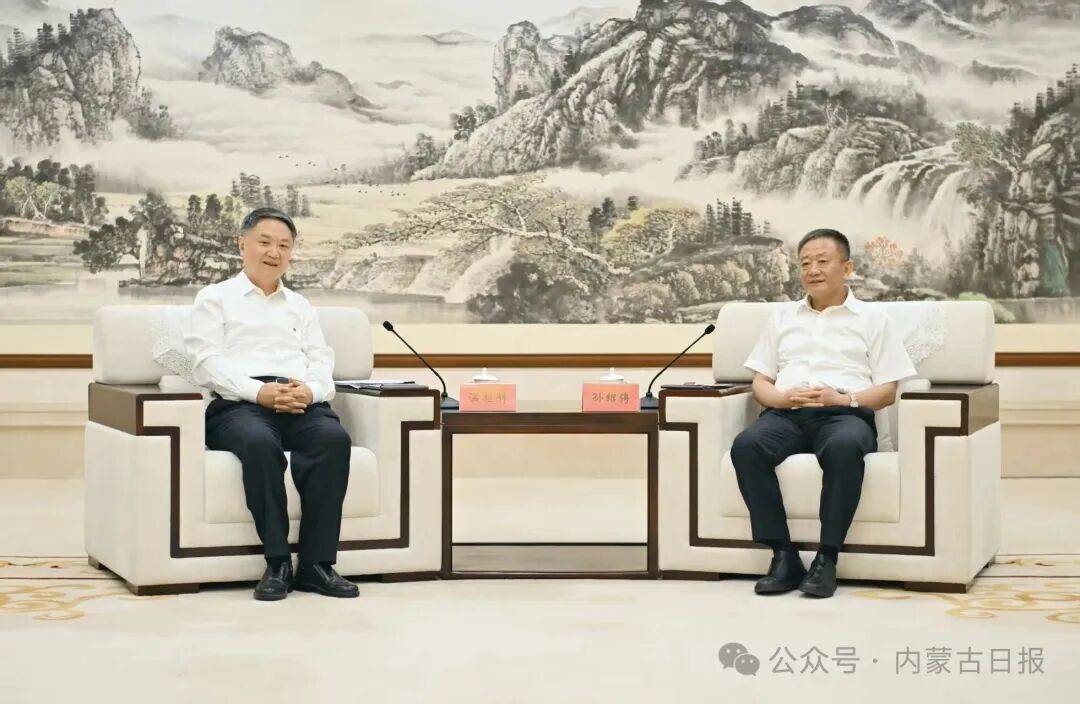
孙绍骋会见中国华能集团董事长温枢刚
Sou Hu Cai Jing· 2025-09-02 04:51
Core Viewpoint - The meeting between the Secretary of the Autonomous Region and the Chairman of China Huaneng Group emphasizes the importance of collaboration in developing renewable energy projects in Inner Mongolia, highlighting the region's strategic significance for the company [3][4]. Group 1: Investment and Development - The Secretary expressed gratitude for China Huaneng's contributions to the economic and social development of Inner Mongolia and encouraged the company to increase investments in energy projects such as energy storage, hydrogen energy, and nuclear energy [3][4]. - China Huaneng is recognized for its technological capabilities and is urged to align its projects with the region's development plans, focusing on renewable energy and new development areas [4]. Group 2: Strategic Importance - Inner Mongolia is identified as a key investment and development area for China Huaneng, which plans to enhance its investment in energy supply security, warmth projects, and the construction of large-scale renewable energy bases [4]. - The company aims to deepen cooperation with local authorities to contribute to the high-quality economic and social development of the region [4].