
吉利汽车

Search documents
EV战略转向,欧美车企巨亏后靠拢中国
日经中文网· 2026-02-12 07:51
Core Viewpoint - Major American automakers, including Ford, General Motors, and Stellantis, have reported a total loss exceeding 8 trillion yen related to electric vehicles (EVs), indicating significant challenges in the EV sector due to shifting policies in the US and Europe [2][6]. Group 1: Financial Performance and Losses - Ford reported a final loss of $11.1 billion for the fourth quarter of 2022, primarily due to adjustments in its EV development plans [4]. - The total EV-related losses for Ford, GM, and Stellantis have reached 8.1 trillion yen, reflecting the adverse impact of policy reversals on EV support in the US and Europe [6]. - Ford's total loss for 2025 is projected to reach $8.2 billion, marking the highest level since the 2008 financial crisis [6]. Group 2: Policy Changes and Strategic Adjustments - The Biden administration initially implemented various support policies for EVs, such as tax credits for purchasing EVs assembled in North America, aimed at boosting domestic EV production [6]. - The Trump administration reversed tax credit policies and modified emissions regulations, allowing major automakers to prioritize investments in gasoline and hybrid vehicles over EVs [8]. - The EU has also postponed its target to ban the sale of new gasoline vehicles after 2035, indicating a broader retreat from aggressive EV policies [10]. Group 3: Collaborations and Market Strategies - Ford is seeking partnerships with Chinese companies like Geely and Xiaomi to develop low-cost EVs, despite opposition from US hardliners [10][11]. - CEO Jim Farley emphasized the need to adapt to changing regulatory environments by leveraging partnerships and expanding market share outside the US, while also focusing on more competitively priced EVs domestically [10]. - The collaboration with Chinese firms may serve as a gateway for Chinese companies to enter the US market, as they look to expand amid domestic demand challenges [11].



汽车和汽车零部件行业周报20260208:地补出台+需求见底,建议关注汽车板块
Guolian Minsheng Securities· 2026-02-12 07:45
Investment Rating - The report maintains a "Buy" rating for the automotive sector [3] Core Insights - The automotive sector is expected to stabilize and recover due to the introduction of local subsidies for vehicle replacement and the upcoming launch of new models after the Spring Festival [2][12] - The report highlights key investment opportunities in various segments, including passenger vehicles, automotive parts, and motorcycles, with specific company recommendations [2][19][34] Summary by Sections 1. Passenger Vehicles - The introduction of the 2026 vehicle replacement subsidy is expected to stimulate domestic demand positively [14] - The subsidy structure will improve the model mix, with new energy vehicles receiving 12% of the vehicle price as a subsidy (up to 20,000 yuan) and fuel vehicles receiving 10% (up to 15,000 yuan) [15][16] - Recommended companies include Geely, Xpeng, and BYD, with a focus on the left side of the demand bottom [2][19] 2. Automotive Parts - The report emphasizes the growth potential in the automotive parts sector, particularly in intelligent driving and new energy vehicle supply chains [19][23] - Recommended companies include Bertel, Horizon Robotics, and Top Group, focusing on the H and T chains [2][19] 3. Motorcycles - The report suggests a focus on mid-to-large displacement motorcycle manufacturers, with companies like Chunfeng Power and Longxin General recommended [31][34] - The market for mid-to-large displacement motorcycles is expected to expand, driven by supply and export efforts from leading manufacturers [34] 4. Commercial Vehicles - The heavy truck market is projected to recover due to the continuation of the vehicle replacement subsidy policy, with recommendations for Weichai Power and China National Heavy Duty Truck [35][36] 5. Tires - The tire industry is expected to benefit from ongoing globalization and the optimization of production structures, with recommendations for Sailun Tire and Senqilin [37][39]




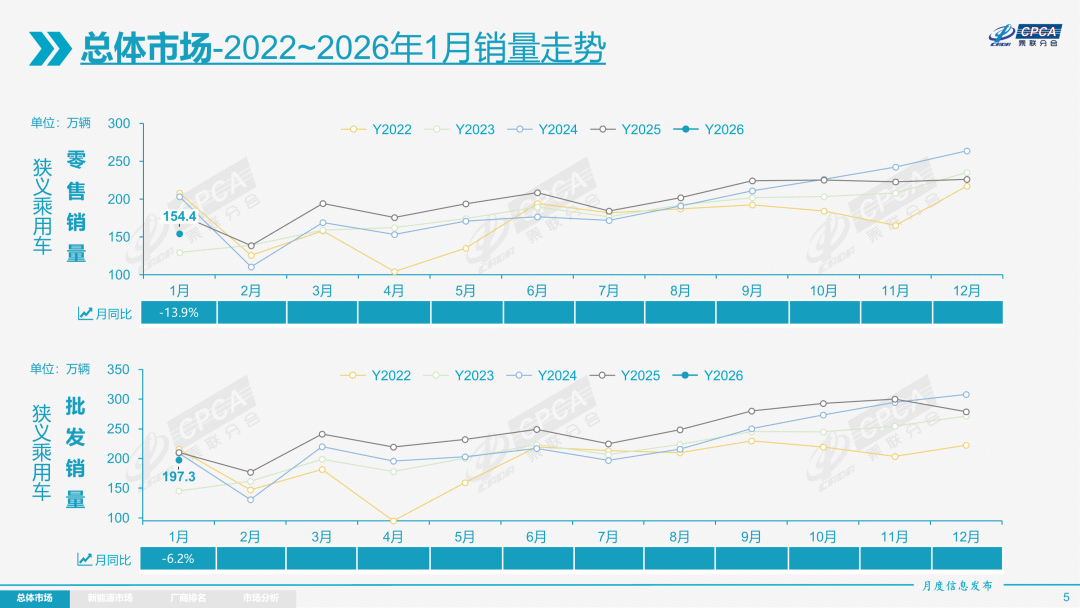
乘联分会:1 月全国乘用车市场零售 154.4 万辆,同比下降 13.9%
Xin Lang Cai Jing· 2026-02-12 07:27
Core Viewpoint - In January, the retail sales of passenger cars in China reached 1.544 million units, representing a year-on-year decline of 13.9% [1][7]. Group 1: Market Performance - The January retail sales decline is part of a historical trend where January sales have shown significant fluctuations, with previous years experiencing similar declines [3][9]. - The penetration rate of new energy vehicles (NEVs) in the overall passenger car market was 38.6%, down 3 percentage points from the previous year [3][9]. - Among domestic retail sales, the penetration rate of NEVs for independent brands was 61.7%, while luxury brands had a penetration rate of 16.1%, and mainstream joint venture brands only reached 4.3% [3][9]. Group 2: New Energy Vehicle Sales - In January, the retail share of NEVs for independent brands was 60.1%, a decrease of 12 percentage points year-on-year, while the share for mainstream joint venture brands increased to 3.9%, up 2 percentage points [3][9]. - The new forces in the market, including brands like Xpeng, Leap Motor, and Xiaomi, saw their share increase by 10 percentage points year-on-year, reaching 31.2% [3][9]. - Tesla's market share fell to 3.1%, a decrease of 1.5 percentage points compared to the previous year [3][9]. Group 3: Export Performance - In January, NEV exports reached 286,000 units, marking a year-on-year increase of 103.6%, accounting for 49.6% of total passenger car exports, up 12.5 percentage points from the previous year [4][10]. - Pure electric vehicles constituted 65% of NEV exports, while A00 and A0 class pure electric vehicles made up 50% of pure electric exports [4][10]. - The growth of NEV exports is attributed to the increasing recognition of Chinese brands in international markets, despite some external challenges [4][10]. Group 4: Manufacturer Performance - Leading manufacturers in NEV exports for January included BYD (96,859 units), Tesla China (50,644 units), and Geely (32,117 units) [5][11]. - The overall performance of NEV manufacturers remained strong, with 16 companies achieving monthly wholesale sales exceeding 10,000 units, accounting for 90.3% of total NEV sales [6][12]. - BYD led the market with 205,518 units sold, followed by Geely (124,252 units) and Tesla China (69,129 units) [6][12]. Group 5: Market Outlook - The outlook for February indicates a potential decline in sales due to the shorter effective production and sales time caused by the extended Spring Festival holiday [7][13]. - The rising costs of raw materials, driven by increased demand for electric power storage, are putting pressure on manufacturers [7][13]. - The anticipated decrease in promotional capabilities for NEV manufacturers may lead to a cautious consumer sentiment, potentially suppressing normal car purchase demand in the short term [7][13].

汽车和汽车零部件行业周报20260208:地补出台+需求见底,建议关注汽车板块-20260212
Guolian Minsheng Securities· 2026-02-12 07:06
Investment Rating - The report maintains a "Buy" rating for the automotive sector [3] Core Insights - The automotive sector is expected to stabilize and recover due to the introduction of local subsidies for vehicle replacement and the upcoming launch of new models after the Spring Festival [2][12] - The report highlights potential investment opportunities in various segments, including passenger vehicles, automotive parts, and motorcycles, with specific company recommendations [2][19][34] Summary by Sections 1. Passenger Vehicles - The introduction of the 2026 vehicle replacement subsidy is anticipated to stimulate domestic demand, with subsidies based on vehicle price [14][15] - January sales data shows mixed results, with BYD's sales down 30% year-on-year, while Geely's sales increased by 1% [13][18] - Recommended companies include Geely, Xpeng, and BYD, with a focus on the left side of the demand bottom [2][19] 2. Automotive Parts - The report emphasizes the growth potential in the automotive parts sector, particularly in smart driving and new energy vehicles [19][23] - Recommended companies include Bertel, Horizon Robotics, and Top Group, focusing on the H and T chains [2][19] 3. Motorcycles - The motorcycle market is experiencing growth, particularly in the mid-to-large displacement segment, with recommendations for Chuanfeng Power and Longxin General [31][34] - Sales data indicates a strong performance in the 500cc+ category, with a significant year-on-year increase [32] 4. Commercial Vehicles - The heavy truck market is expected to recover due to the continuation of the vehicle replacement subsidy policy, with recommendations for Weichai Power and China National Heavy Duty Truck [35][36] - The report notes a 26% year-on-year increase in heavy truck sales for 2025 [35] 5. Tires - The tire industry is projected to benefit from ongoing globalization and demand, with recommendations for Sailun Tire and Senqilin [37][39] - The report highlights a high operating rate for PCR tires and a gradual recovery in TBR demand [39]
Smart开年遇冷,1000辆限量车至今未能售罄
Xin Lang Cai Jing· 2026-02-12 06:57
Core Insights - Smart's sales have been declining for two consecutive years, with a projected 2024 sales volume of 33,400 units, representing a nearly 20% decrease from 2023 [4] - The launch of the "Year of the Horse" edition of the EQ fortwo did not generate the expected consumer interest, with significant inventory remaining unsold [5][12] - Smart's strategy to expand its model lineup has not resonated with the market, as evidenced by the low sales figures for its new models [8][9] Sales Performance - Smart's sales volume for 2024 is expected to drop to 33,400 units, with a further decline to 30,800 units in 2025 [4] - The EQ fortwo "Year of the Horse" edition saw only 20 units sold in January at a specific dealership, with 1,000 units still in inventory as of February 11 [5] - The EQ fortwo accounted for 67.7% of Smart's total sales in 2025, with projected sales of 20,800 units [4] Market Position and Strategy - Smart, a joint venture between Mercedes-Benz and Geely, has struggled to maintain its unique brand identity in the high-end small car market [9] - The brand's transition from fuel vehicles to electric models has not provided a competitive edge, as its technology is based on Geely's architecture [9] - Smart plans to launch two new models, the EQ fortwo and EQ6, in 2026 to better balance mainstream market presence and brand identity [12][13] Competitive Landscape - The electric vehicle market is becoming increasingly competitive, with brands like NIO's Firefly achieving significant sales success [11][12] - Firefly's pricing strategy and brand trust have contributed to its rapid growth, contrasting with Smart's struggles [12] - The overall market for electric vehicles saw a decline in sales, with January 2023 figures showing a drop of 18.9% year-on-year [13]
乘联分会:1月全国乘用车市场零售154.4万辆 新能源车渗透率为38.6%
智通财经网· 2026-02-12 06:41
Core Insights - The overall retail sales of passenger cars in January decreased by 13.9% year-on-year, with a total of 1.544 million units sold. The retail sales of new energy vehicles (NEVs) reached 596,000 units, representing a penetration rate of 38.6%, down 3 percentage points from the previous year [1][11]. Retail Market Overview - In January, the retail sales of self-owned fuel passenger cars were 250,000 units, up 17% year-on-year, while self-owned NEVs sold 226,000 units, marking a significant increase of 115%. NEVs accounted for 47.5% of self-owned exports, indicating growing international influence [2]. - The retail sales of self-owned brands totaled 890,000 units, down 18% year-on-year, with a domestic market share of 57.5%, a decrease of 3.5 percentage points [2]. - Mainstream joint venture brands sold 470,000 units, down 4% year-on-year, with German brands increasing their market share to 19.8%, up 1.4 percentage points [2]. Production and Wholesale Analysis - In January, the production of passenger cars was 2.003 million units, down 4.4% year-on-year. The wholesale volume was 1.973 million units, a decrease of 6.2% year-on-year [4]. - The wholesale of self-owned brands was 1.326 million units, down 8%, while luxury car wholesale increased by 4% to 228,000 units [4]. - The overall wholesale landscape is changing, with some mid-tier companies showing strong performance, such as SAIC-GM-Wuling and NIO [4]. New Energy Vehicle Insights - The production of NEVs reached 938,000 units, a slight decrease of 0.6% year-on-year, while wholesale sales were 864,000 units, down 3.3% [5][6]. - NEV retail sales were 596,000 units, down 20% year-on-year, with conventional fuel vehicles selling 948,000 units, down 10% [7]. - NEV exports reached 286,000 units, a remarkable increase of 103.6%, accounting for 49.6% of total passenger car exports [11][12]. Market Trends and Future Outlook - The new energy vehicle market is expected to face challenges in February due to the impact of the Spring Festival, which may lead to lower sales volumes [16]. - The transition from merely selling cars to exporting entire industrial chains is anticipated, indicating a shift towards quality growth in the automotive export sector [17].



乘联分会:1月新能源乘用车出口28.6万辆,同比增长103.6%
Xin Lang Cai Jing· 2026-02-12 06:19
Core Insights - In January, China's new energy passenger car exports reached 286,000 units, marking a year-on-year increase of 103.6% [1] - New energy vehicles accounted for 49.6% of total passenger car exports, an increase of 12.5 percentage points compared to the same period last year [1] - Pure electric vehicles made up 65% of new energy exports, slightly down from 67% last year, with A00 and A0 class pure electric cars representing 50% of pure electric exports, up from 41% last year [1] - Plug-in hybrids constituted 33% of new energy exports, a slight increase from 32% last year, with strong growth in developing countries despite some external challenges [1] Company Performance - Leading companies in new energy vehicle exports for January include: - BYD Auto: 96,859 units - Tesla China: 50,644 units - Geely Auto: 32,117 units - Chery Auto: 27,033 units - Leap Motor: 14,523 units - SAIC Passenger Cars: 13,071 units - SAIC-GM-Wuling: 11,097 units - Dongfeng Motor: 6,745 units - Great Wall Motors: 6,102 units - Changan Auto: 4,952 units - Other companies also showed significant export volumes [2]
【月度分析】2026年1月份全国乘用车市场分析
乘联分会· 2026-02-12 06:06
Overall Market - In January 2026, the retail sales of passenger cars reached 1.544 million units, a year-on-year decrease of 13.9% [14] - The decline in retail sales is attributed to complex market factors and a historical pattern of fluctuating sales in January [14] - The end of the new energy vehicle purchase tax exemption in December 2025 has led to a recovery period for the new energy vehicle market, with some consumers having made purchases in December to take advantage of the policy [14] - January 2026 saw a significant increase in exports, with passenger car exports reaching 576,000 units, a year-on-year increase of 52.0% [16] - The production of passenger cars in January 2026 was 2.003 million units, a year-on-year decrease of 4.4% [16] - The wholesale volume for January 2026 was 1.973 million units, a year-on-year decrease of 6.2% [17] New Energy Market - In January 2026, retail sales of new energy vehicles (NEVs) totaled 596,000 units, down 20.0% year-on-year [18] - The penetration rate of NEVs in the domestic market was 38.6%, while the export penetration rate was 49.6% [15] - The production of NEVs reached 938,000 units, a slight decrease of 0.6% year-on-year [18] - The wholesale volume of NEVs was 864,000 units, down 3.3% year-on-year [18] - The export of NEVs reached 286,000 units, a significant increase of 103.6% year-on-year, accounting for 49.6% of total passenger car exports [22] Company Performance - BYD, Geely, and Chery are leading in the new energy vehicle market, with BYD's sales reaching 205,518 units in January 2026 [24] - The market share of domestic brands in the new energy sector is increasing, with a notable rise in the export of new energy vehicles to Europe and Southeast Asia [15][22] - The new energy vehicle market is characterized by a shift towards higher quality products, with an increase in the proportion of high-end NEVs [15] Market Outlook - February 2026 is expected to see lower sales due to the shorter working days caused by the extended Spring Festival holiday [27] - The market is anticipated to stabilize post-holiday, with potential recovery in the entry-level electric vehicle segment [28] - The overall sentiment in the consumer market remains cautious, influenced by high costs and economic factors [28]



今年首月汽车市场总体运行平稳 出口延续高增长态势
Zheng Quan Ri Bao Wang· 2026-02-12 04:30
Core Viewpoint - In January 2026, China's automotive industry experienced a stable overall operation, with a slight increase in production but a decline in sales, influenced by policy changes and consumer demand shifts [1][2][3]. Group 1: Production and Sales Data - In January, China's automotive production reached 2.45 million units, a year-on-year increase of 0.01%, while sales totaled 2.346 million units, reflecting a year-on-year decrease of 3.2% [1]. - Domestic sales of automobiles were 1.665 million units in January, down 14.8% year-on-year and 33.9% month-on-month [2]. - Passenger car sales were 1.988 million units, a year-on-year decline of 6.8% and a month-on-month decline of 30.2% [2]. Group 2: Market Segmentation - The passenger car market saw a decrease in sales, with Chinese brand passenger cars selling 1.329 million units, down 8.9% year-on-year [2]. - Commercial vehicles showed positive growth, with sales of 359,000 units in January, a year-on-year increase of 23.5% [2]. - New energy vehicle (NEV) sales remained stable, with 945,000 units sold, a slight year-on-year increase of 0.1% [3]. Group 3: Export Performance - In January, automobile exports reached 681,000 units, a year-on-year increase of 44.9%, with passenger car exports at 589,000 units, up 48.9% [4]. - NEV exports were particularly strong, with 302,000 units exported, reflecting a year-on-year growth of 100.5% [4]. - The top ten exporting companies showed positive growth, with Chery and Geely leading in export volumes [4][5]. Group 4: Future Outlook - The automotive industry is expected to stabilize as new policies are implemented, enhancing market vitality [5]. - The transition to high-quality development during the 14th Five-Year Plan period is crucial for the automotive sector [3].
平安证券(香港)港股晨报-20260212
Ping An Securities Hongkong· 2026-02-12 04:03
Market Overview - The Hong Kong stock market experienced fluctuations, with the Hang Seng Index closing at 23,831 points, down 145 points or 0.61% [1] - The market saw a further decrease in trading volume, with total turnover dropping to 82.799 billion [1] - The net inflow of funds through the Hong Kong Stock Connect was 484 million, with 283 million from the Shanghai Stock Connect and 201 million from the Shenzhen Stock Connect [1] Sector Performance - The local real estate, software, and 5G concept sectors faced significant declines, while gold stocks performed well against the market trend [1] - Notable performers included Chifeng Jilong Gold, which rose nearly 6%, and China National Building Material, which increased by over 11% [1] - The market showed a structural divergence, with resource/building materials strong and financial sectors weak, particularly in light communication and CPO [1] US Market Insights - The US stock market saw slight declines, with the Dow Jones down 0.13% and the Nasdaq down 0.16% [2] - Major tech stocks like IBM and Salesforce led the declines, with IBM dropping over 6% [2] - The Nasdaq Golden Dragon China Index fell by 0.65%, indicating challenges for Chinese tech firms in the US market [2] Future Market Outlook - The report emphasizes the importance of technology self-reliance and AI applications as core themes for future performance in the Hong Kong stock market [3] - The Ministry of Industry and Information Technology's recent policies on national computing power are expected to boost domestic computing and communication sectors [3] - Investment opportunities are highlighted in sectors supported by policies for "technology self-reliance," including AI, semiconductors, and industrial software [3] Key Company Performances - The report notes significant stock performance variations among major companies, with Tencent and Alibaba showing declines of 0.5% and 0.2% respectively [12] - BYD's stock increased by 3.5%, while XPeng Motors saw a rise of 1.9% [12] - In the pharmaceutical sector, companies like WuXi Biologics and CSPC Pharmaceutical reported positive stock movements, with WuXi Biologics up 3.4% [12]