
罗氏

Search documents
HOLX vs. DGX: Which Women's Health-Focused Stock Is the Better Pick?
ZACKS· 2025-05-27 13:25
Core Insights - The women's health diagnostics market is projected to grow at a compound annual growth rate (CAGR) of 9.25% through 2030, driven by technological advancements and increased healthcare expenditures [1] - Hologic and Quest Diagnostics are key players in the women's health sector, each with distinct specializations and market strategies [2][3] Hologic Overview - Hologic, with a market cap of $12.10 billion, focuses on advanced diagnostics, medical imaging, and surgical products, benefiting from multiple growth drivers across its global franchises [2][4] - Key products include Aptima and Panther Fusion assays, which are experiencing strong double-digit growth due to rising awareness and reimbursement in the U.S. vaginitis market [4] - The Genius Digital Diagnostics System, the first FDA-cleared digital cytology system for cervical cancer screening, is gaining traction, although international sales were impacted by external factors [5] - Hologic's mammography products maintain leading market shares, with recurring service revenues increasing by 12% year-over-year [6] - The Surgical business is performing well, but macroeconomic challenges, including tariffs, are expected to impact manufacturing costs significantly [7] Quest Diagnostics Overview - Quest Diagnostics, with a market cap of $19.12 billion, is experiencing strong growth in Women's and Reproductive Health, driven by prenatal and hereditary genetic testing [2][8] - The company launched a new self-collection solution for HPV cervical cancer screening, enhancing its diagnostic offerings [8] - Other clinical areas, including cardiometabolic and oncology, also reported double-digit growth, contributing to a 12% year-over-year revenue increase [9][10] - Quest completed eight acquisitions in 2024, positively impacting sales and adjusted operating income, with a notable growth in adjusted EPS of 8.3% [11] - The company is leveraging automation and AI to improve productivity, while maintaining its revenue and EPS guidance despite rising debt levels [12] Financial Estimates and Performance - Hologic's fiscal 2025 sales and EPS estimates suggest a year-over-year improvement of 1.2% and 3.2%, respectively, with mixed movements in bottom-line estimates [13] - Quest Diagnostics' 2025 sales and EPS estimates indicate a year-over-year improvement of 9.2% and 8.6%, respectively, with analysts showing increased optimism [13] - Hologic's shares have decreased by 31.6% over the past six months, while Quest Diagnostics has gained 4.9% [14] Valuation Comparison - Hologic is trading at a forward price-to-sales (P/S) multiple of 2.87X, while Quest Diagnostics is at 1.75X, both below their respective industry averages [16] - Both companies have a Value score of B, indicating potential for long-term stability [16] Investment Outlook - Hologic's diversified revenue model and international prospects suggest potential for long-term stability despite near-term challenges [17] - Quest Diagnostics shows strong growth opportunities in women's health, with favorable stock performance and upward analyst revisions making it a compelling investment [18]



特朗普关税大棒挥向欧盟时 哪些行业风雨飘摇?
智通财经网· 2025-05-26 13:35
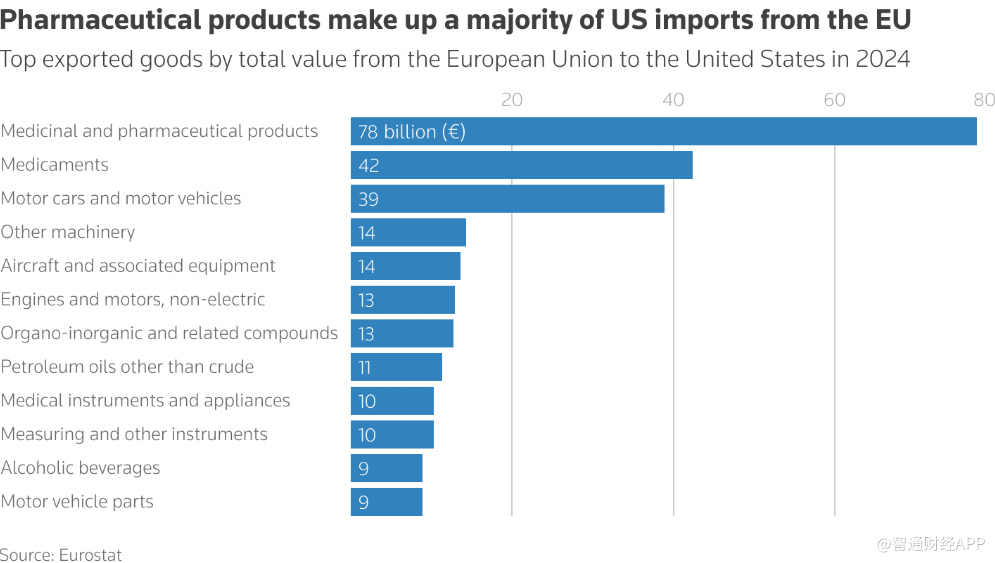
Core Viewpoint - President Donald Trump has abandoned the threat of imposing a 50% tariff on EU imports, allowing more time for negotiations between Washington and the 27 EU countries [1] Group 1: EU Exports to the US - In 2024, the US is the largest export partner for the EU, accounting for 20.6% of EU exports [1] - The top three countries exporting from the EU to the US are Germany (€161 billion, approximately $182.6 billion), Ireland (€72 billion), and Italy (€65 billion) [3] - The main products exported from the EU to the US include pharmaceuticals (€120 billion), automobiles (€40 billion), and aircraft and related equipment [3][4] Group 2: Pharmaceuticals - In 2024, the EU exported approximately €120 billion worth of pharmaceutical products to the US [3] - Major pharmaceutical companies in the EU include Novo Nordisk, Bayer, Roche, and Novartis [3] Group 3: Automobiles - The EU exports about 750,000 cars to the US annually, valued at approximately €40 billion, representing 14% of the EU's total automotive production [4] - Major car manufacturers affected by US trade policies include Mercedes-Benz, Stellantis, and Volvo [4] - Volkswagen is significantly impacted by tariffs due to its high-end Audi brand not being produced in the US, but plans to announce production of some best-selling models in the US [4] Group 4: Aircraft and Equipment - Airbus is the second-largest exporter in France, with about 12% of its aircraft sold to the US, some of which are assembled locally [5] - CFM International, a major supplier for Airbus and Boeing, is co-owned by Safran and GE Aviation [5] Group 5: Alcohol and Beverages - In 2024, the EU exported approximately €9 billion worth of alcoholic beverages to the US, with European spirits valued at €2.9 billion [9] - Major European beverage producers include Heineken, Diageo, and Carlsberg [9] Group 6: Cosmetics - The EU exported cosmetics, perfumes, and personal care products worth approximately $10.47 billion to the US in 2024 [10] - French company L'Oréal exports about €2.5 billion worth of cosmetics to the US annually [11] Group 7: Luxury Goods - About one-quarter of products from major luxury goods groups are aimed at US consumers, with smaller brands having varying market shares [12] - The French luxury goods industry is the largest globally, employing over 600,000 people [13] - The luxury goods sector is significantly affected by US tariffs, as companies have limited ability to shift production to the US [14]
全球生物医药产业格局生变,中国创新药如何赢得市场
Di Yi Cai Jing Zi Xun· 2025-05-24 01:50
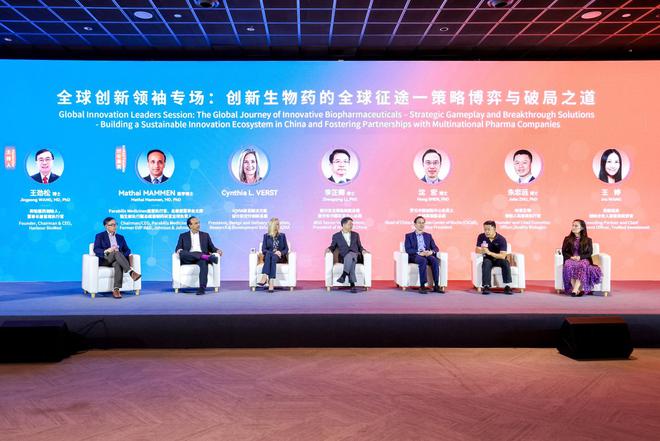
Core Insights - The Chinese biopharmaceutical industry is entering a new phase characterized by rapid R&D and clinical trial growth, shifting from traditional imports to independent innovation [1] - By the end of 2024, global clinical trials are expected to reach 5,300, with 30% originating from China, highlighting China's significant role in the global clinical trial landscape [1] - The market size for innovative drugs in China is projected to grow from $132.5 billion in 2019 to $159.2 billion in 2024, with expectations to exceed $300 billion by 2030 [1] Group 1: Clinical Trials and Market Position - China accounts for 30% of global in vitro diagnostic trials and 39% of tumor-related clinical trials [1] - In 2024, China's share of global drug pipelines is expected to rise to 26.7%, ranking second after the U.S. [2] - China ranks third in the number of new drug approvals annually, following the U.S. and Japan [2] Group 2: Innovation and Global Collaboration - Chinese pharmaceutical companies are increasingly engaging in international licensing agreements, with 94 transactions worth $51.9 billion in 2024, a 26% increase year-on-year [5] - The synchronization of R&D and regulatory processes in China with international standards has improved efficiency and reduced approval times significantly [6] - The introduction of ICH standards has reduced clinical trial application approval times to as low as 30 days in major cities [6] Group 3: Challenges and Future Directions - The Chinese biopharmaceutical industry faces challenges in establishing a broader clinical trial network and market access in the global landscape [7] - There is a need for better commercialization of research outcomes from Chinese universities to enhance the translation of scientific achievements into marketable products [7] - Investment in the biopharmaceutical sector requires a long-term perspective, with a focus on sustainable funding rather than immediate returns [8]
Regeneron Initial Data on Multiple Myeloma Drug Encouraging
ZACKS· 2025-05-23 21:11
Core Insights - Regeneron Pharmaceuticals, Inc. announced promising initial results from the early-stage study of oncology drug linvoseltamab, particularly in patients with relapsed/refractory multiple myeloma [1][2] Group 1: Study Results - The LINKER-MM2 trial showed linvoseltamab combined with carfilzomib or bortezomib yielded high response rates in earlier treatment lines for relapsed/refractory multiple myeloma [2] - Efficacy results indicated a 90% objective response rate (ORR) and a 76% complete response (CR) at a median follow-up of 15 months [6] - Among patients treated with linvoseltamab and bortezomib, an 85% ORR was observed with 50% achieving CR [7] Group 2: Patient Demographics - The study included patients who had progressed after at least two lines of therapy, with many being double-class refractory or triple-class exposed [4] - 48% of enrolled patients had baseline soft tissue plasmacytomas, and 39% were over 75 years old, indicating a high-risk patient population [5] Group 3: Regulatory Developments - The European Commission granted conditional marketing approval for linvoseltamab under the brand name Lynozyfic for adults with relapsed/refractory multiple myeloma [8] - The FDA has accepted the resubmission of the Biologics License Application (BLA) for linvoseltamab, with a target action date of July 10, 2025 [9] Group 4: Oncology Portfolio Expansion - Regeneron is focused on strengthening its oncology portfolio, which includes Libtayo for various cancers [10] - The approval of odronextamab for treating relapsed/refractory follicular lymphoma and diffuse large B-cell lymphoma has also contributed to the oncology franchise [11] Group 5: Market Competition - The decline in sales of Regeneron's lead drug Eylea is a concern, attributed to competition from Roche's Vabysmo, which has significantly impacted Eylea's market share [12][13]


巨头药企纷纷押注细胞治疗,阿斯利康豪掷72亿元收购这家公司
Guo Ji Jin Rong Bao· 2025-05-23 09:47
Group 1: Company Developments - AstraZeneca has made significant investments in the cell therapy sector, including a recent acquisition of EsoBiotec for 7.2 billion RMB, aimed at accelerating its cell therapy initiatives [1] - The acquisition of EsoBiotec, which specializes in in vivo CAR-T therapies, includes an upfront payment of 425 million USD and potential milestone payments of up to 575 million USD, expected to be completed by Q2 2025 [1][2] - EsoBiotec's core product, ESO-T01, is currently in clinical trials for treating relapsed/refractory multiple myeloma, showing promising early results [3] Group 2: Market Trends - The global cell and gene therapy market was valued at 5.8 billion USD in 2022 and is projected to grow to 23.33 billion USD by 2028, with a CAGR of 26.4% [2] - Major pharmaceutical companies, including Roche, Sanofi, and AstraZeneca, have collectively invested over 15 billion USD in the cell therapy sector within a short span of five months [6] - The market is anticipated to open up significantly, especially if immunotherapy proves effective in treating solid tumors, potentially reducing CAR-T production costs by 90% [6] Group 3: Competitive Landscape - Roche has announced plans to acquire Poseida Therapeutics for 1 billion USD, gaining access to a leading non-viral vector platform and multiple CAR-T pipelines [7] - Sanofi has finalized a 1.9 billion USD deal to acquire Dren Bio, enhancing its bispecific antibody technology platform [8] - AstraZeneca's strategic acquisitions, including a 1.2 billion USD purchase of Genzymed, reflect a broader trend of major players consolidating their positions in the cell therapy market [5][6]

速递|API管理Gravitee获6000万美元C轮融资,130人团队支撑同步+异步API双引擎
Z Potentials· 2025-05-23 03:33
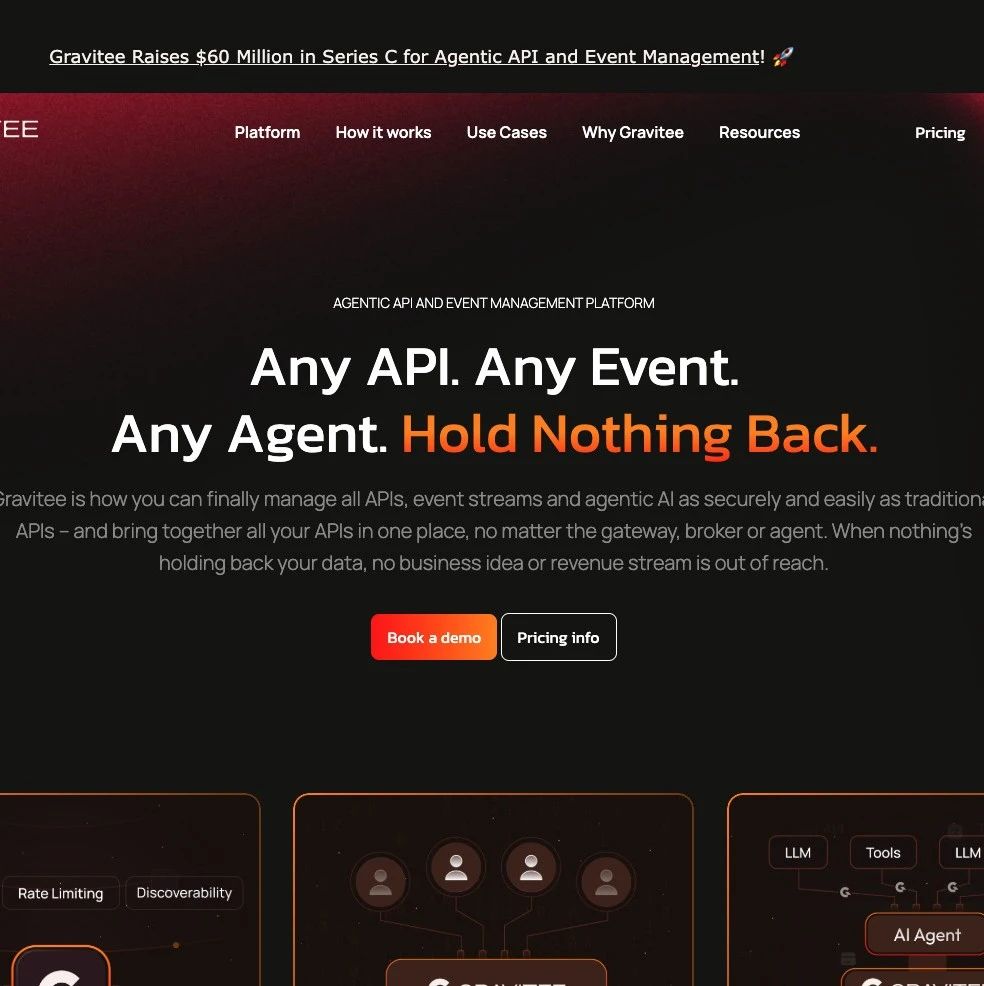
Core Insights - Gravitee is a platform designed to help businesses manage their APIs and other digital traffic pipelines, having raised $60 million in a Series C funding round led by Sixth Street Growth, with participation from Riverside Acceleration Capital and Albion VC. This new funding brings Gravitee's total funding to over $125 million, with plans to develop new product features and expand into new markets [1][2]. Group 1: Company Overview - Gravitee was co-founded in 2015 by Rory Blundell and a team of developers, initially as an open-source project that quickly transitioned into a commercial entity, now supporting its free software through paid services [1]. - The platform can be deployed in local environments, self-hosted, or as part of its Software as a Service (SaaS) offering, featuring API design tools, pre-deployment testing capabilities, and a dashboard for visualizing API deployment components [2]. Group 2: Market Position and Competition - Gravitee's competitors include Blobr, which offers enterprise-level API monetization software, and StepZen, known for its technology that connects and visualizes various APIs [2]. - The company's differentiation lies in its support for both asynchronous APIs (which return data with a delay) and synchronous APIs (which return data immediately), a feature not offered by some competitors [2]. Group 3: Financial Performance - Gravitee currently has hundreds of clients, including notable companies such as Blue Yonder, Michelin, Roche, and Tide, with an annual recurring revenue of $22 million for the fiscal year 2024 [2]. - The company has approximately 130 employees and plans to expand its workforce to around 200 by the end of the year [3].
Dianthus Therapeutics Appoints Simon Read, Ph.D., to Board of Directors
Globenewswire· 2025-05-22 20:10
Core Insights - Dianthus Therapeutics has appointed Simon Read, Ph.D., to its Board of Directors, bringing over 30 years of biopharmaceutical leadership and expertise [1][2] - The company is focused on advancing its mid- and late-stage clinical programs, particularly the DNTH103 therapy for severe autoimmune diseases [2][3] - Lonnie Moulder will transition from the Board, having played a significant role in the company's growth from a private entity to a publicly traded company with three ongoing clinical trials [2] Company Overview - Dianthus Therapeutics is a clinical-stage biotechnology company dedicated to developing next-generation antibody complement therapeutics aimed at treating severe autoimmune and inflammatory diseases [3] - The company is based in New York City and Waltham, Massachusetts, and is led by an experienced team of biotech and pharma executives [3] Leadership Background - Dr. Read previously served as CEO and founder of Mariana Oncology until its acquisition by Novartis in 2024 and as Chief Scientific Officer at Ra Pharma until its acquisition by UCB in 2020 [1][2] - He has held leadership roles in R&D at major pharmaceutical companies, including GlaxoSmithKline, AstraZeneca, and Roche/Genentech, contributing to the development of well-known immunology drugs [2] Clinical Development - The company is currently executing three clinical programs, with Phase 2 MaGic results for DNTH103 expected in September [3] - Dr. Read expressed confidence in the potential of DNTH103 as a best-in-class therapy for patients with severe neuromuscular conditions [3]


国信证券晨会纪要-20250522
Guoxin Securities· 2025-05-22 02:00
Macro and Strategy - April fiscal data shows tax revenue returning to positive growth at 1.9% YoY, while general expenditure growth accelerated to 12.9% YoY [8][9] - Key tax categories showed mixed results, with personal income tax growing significantly at 9% YoY, while corporate income tax declined to 4% YoY [8][9] Textile and Apparel Industry - Textile manufacturing continues to benefit from inventory optimization and order rebound, with revenue growth of 13.7% YoY in 2024, while apparel and home textiles saw a slowdown to 1.0% YoY [9][10] - In Q1 2025, textile manufacturing growth slowed to 8.2% YoY, while apparel and home textiles faced a 5.1% decline in revenue [9][10] - Major companies in manufacturing, such as Huayi and Shenzhou, reported strong orders and better profitability, while sports brands showed resilience compared to casual wear [9][10] Pharmaceutical Industry - Q1 2025 saw overall revenue growth slow for overseas pharmaceutical companies, with Eli Lilly and Novo Nordisk showing significant growth driven by GLP-1 drugs [15][16] - The U.S. drug pricing reform and macroeconomic uncertainties are impacting revenue forecasts for major pharmaceutical firms [15][16] Computer Industry - Major domestic companies like Alibaba and Tencent are significantly increasing capital expenditures, with Alibaba planning to invest over 380 billion RMB in cloud and AI infrastructure over the next three years [17][18] - There is a growing demand for computing power rental services, with several companies announcing related orders [17][18] Automotive Industry - April 2025 saw a total vehicle production and sales of 2.619 million and 2.590 million units respectively, with a year-on-year increase of 8.9% and 9.8% [19][20] - New energy vehicles accounted for 47.3% of total new vehicle sales, with production and sales growth of 43.8% and 44.2% YoY [19][20] - The market is witnessing a shift towards autonomous driving technologies, with Robotaxi commercial deployment accelerating [20][21] Building Materials Industry - The recent government policy is expected to accelerate urban renewal projects, benefiting local construction and decorative renovation companies [22][23] - Cement prices have seen a slight decline, while demand remains weak, indicating a cautious market outlook [23][24] Smart IoT Industry - The company focuses on IoT solutions and is expanding into AI infrastructure, with significant revenue contributions from its various business segments [26][27] - The global AI server market is projected to grow rapidly, driven by increasing demand for AI training and inference [28] Travel Industry - The company reported a 16.2% increase in revenue for Q1 2025, with strong growth in domestic hotel bookings and international travel [29][30] - The international platform is experiencing rapid growth, benefiting from favorable policies and increased travel demand [30][31] Gaming and E-commerce Industry - The company achieved a 30% revenue growth in Q1 2025, driven by strong performance in e-commerce and digital financial services [33][34] - The gaming segment also saw significant growth, with a notable increase in user engagement and revenue from popular titles [36][37]
罗氏(RHHBY.US)宣布肝癌III期临床研究TALENTACE达到主要研究终点
智通财经网· 2025-05-21 06:26
Core Insights - Roche's TALENTACE study achieved its primary endpoint, demonstrating significant improvement in TACE-PFS for patients with unresectable HCC who had not received prior systemic therapy [1] - The study innovatively combined immune checkpoint inhibitor atezolizumab with anti-angiogenic therapy bevacizumab and on-demand TACE, showing potential for a new treatment paradigm in HCC [1] Group 1 - The TALENTACE study showed statistically and clinically significant improvement in TACE-PFS, with the overall survival data still immature at the time of the interim analysis [1] - The study's design included TACE-PFS as the primary endpoint, providing high-level evidence for the combined treatment approach in HCC patients with intermediate to high tumor burden [1] - Safety profiles of atezolizumab and bevacizumab were consistent with previous data and underlying conditions [1] Group 2 - Roche's Vice President of Medical Affairs in China expressed excitement over the TALENTACE study results and emphasized the company's commitment to addressing local clinical needs in liver cancer treatment [2] - The company aims to enhance global research collaboration and accelerate the accessibility of innovative therapies, contributing to China's cancer prevention and control goals for 2030 [2]


海外制药企业2025Q1业绩回顾:美国药品价格改革叠加不确定的宏观环境
Guoxin Securities· 2025-05-21 05:58
Investment Rating - The investment rating for the pharmaceutical industry is "Outperform" [2] Core Insights - Overall revenue growth for pharmaceutical companies has slowed down, with Eli Lilly and Novo Nordisk showing significant increases of 45% and 18% respectively in Q1 2025, while other companies like GSK and Merck faced low single-digit growth or declines [3][5] - The U.S. drug price reform and uncertain macroeconomic environment are impacting the industry, with the Trump administration's executive order promoting "Most Favored Nation" pricing potentially reducing the pricing power of large pharmaceutical companies [3][7] - The next five years will see several blockbuster drugs facing patent expirations, prompting pharmaceutical companies to pursue business development (BD) transactions to enhance revenue and fill pipeline gaps [3][13] Summary by Sections 01 Overview of Q1 2025 Performance - The top 15 pharmaceutical companies had a combined R&D expenditure of $31.8 billion in Q1 2025, reflecting a year-on-year increase of 0.6% [8] 02 Revenue and Guidance - Eli Lilly reported Q1 2025 revenue of $12.7 billion, a 45% increase year-on-year, with a full-year guidance of $58.0 billion to $61.0 billion [5] - Pfizer's revenue decreased by 6% to $13.7 billion in Q1 2025, with a full-year guidance of $61.0 billion to $64.0 billion [6] 03 Drug Price Reform and Macro Environment - The Trump administration's executive order aims to provide U.S. patients with "Most Favored Nation" pricing, which could pressure drug prices downward [7] - A proposed budget plan by the Republican party includes significant cuts to Medicaid, potentially impacting pharmaceutical revenues [7] 04 Upcoming Patent Expirations - Several key products are approaching patent expiration, including Eli Lilly's Tirzepatide and JNJ's Invega Sustenna, which could lead to increased competition and revenue challenges [13][14] 05 Recent Business Development Projects - Notable recent BD transactions include JNJ's acquisition of IntraCellular for $14.6 billion to enhance its pipeline in mental health treatments [15][16]


