龙芯中科

Search documents
龙芯中科技术股份有限公司关于近期关税相关政策对公司影响的自愿性披露公告
Shang Hai Zheng Quan Bao· 2025-04-09 19:22
登录新浪财经APP 搜索【信披】查看更多考评等级 证券代码:688047 证券简称:龙芯中科 公告编号:2025-004 龙芯中科技术股份有限公司 关于近期关税相关政策对公司影响的自愿性披露公告 本公司董事会及全体董事保证本公告内容不存在任何虚假记载、误导性陈述或者重大遗漏,并对其内容 的真实性、准确性和完整性依法承担法律责任。 近日,美国政府宣布实施"对等关税"政策,对全球贸易伙伴加征关税,引发市场高度关注。龙芯中科技 术股份有限公司(以下简称"公司")持续关注全球贸易政策,经公司初步评估,本次美国加征关税,对 公司无负面影响。 目前公司各项业务稳步推进,经营及财务情况正常,基于2022-2024年三年转型的成果,新一代产品性 价比竞争力提升,公司正在进入新一轮的可持续增长周期。 公司将持续关注和跟进后续事件的发展情况,进一步分析和评估对公司的潜在影响,并持续与各相关方 进行沟通,做好各项应对工作。同时,公司将严格遵守相关规则,及时履行信息披露义务,敬请广大投 资者注意投资风险。 特此公告。 龙芯中科技术股份有限公司董事会 2025年4月10日 一、公司坚持基于自主指令系统构建独立于X86体系和ARM体系的 ...

提振A股进行时:增持、回购、业绩亮眼,北京逾百家上市公司发声
Xin Jing Bao· 2025-04-09 15:03
公告发布后,4月8日,中国石化集团便通过上海证券交易所交易系统以集中竞价方式增持了中国石化 17843500股A股股份。 4月7日至9日期间,按地域划分,属于北京市的A股上市公司中有超过100家企业发布了公告,内容包括 去年业绩稳增的年报、今年一季度业绩预增的快报、股东增持计划、公司股份回购计划等。 记者注意到,多家上市公司的董事长提议回购公司股份,增强投资者信心。另外,披露增持计划或回购 计划的股东、公司也不在少数,更有公司的控股股东在发布增持计划当日便"火速"出手。 北京上市公司密集公告 大股东频频出手增持 4月7日,在股价震荡之际,青矩技术的重要股东已出手。其持股5%以上的股东谭宪才基于对公司未来 发展的信心以及对公司投资价值的充分肯定,以自有资金通过北京证券交易所证券交易系统增持青矩技 术股票10万股,他的增持均价为30元/股。增持完成后,谭宪才对青矩技术的持股比例上升至7.44%。 4月8日和9日,青矩技术的股价持续上涨,截至4月9日收盘,其股价为35.53元/股,单日涨幅为 13.99%。 此外,中国石化(600028)、中煤能源(601898)、中国石油、北辰实业(601588)、三峡能源、光大 ...






龙芯中科:公司不依赖国外技术授权 从芯片研发、生产到软件生态三个环节提高自主可控度
news flash· 2025-04-09 11:06
龙芯中科:公司不依赖国外技术授权 从芯片研发、生产到软件生态三个环节提高自主可控度 《科创板日报》9日讯,龙芯中科(688047.SH)公告称,公司持续关注全球贸易政策,初步评估美国加征 关税对公司无负面影响。公司坚持自主指令系统LoongArch,不依赖国外技术授权,从芯片研发、生产 到软件生态三个环节提高自主可控度。目前公司无来自美国的收入,各项业务稳步推进,经营及财务情 况正常。公司将持续关注事件发展,分析潜在影响,并及时履行信息披露义务。 ...
自主可控概念狂飙,中芯国际大涨!咬定“科技”主线不放松, 震荡期逢低布局战略性资产
Mei Ri Jing Ji Xin Wen· 2025-04-09 02:57
Group 1 - The Hong Kong stock market opened lower, with the Hang Seng Tech Index dropping by 4.26%, but later saw a narrowing of losses, with notable gains in stocks like SMIC and Xiaomi [1] - Southbound capital net purchases of Hong Kong stocks exceeded 13 billion HKD during the trading session, indicating strong investor interest [1] - A-shares in sectors like electronics and computers showed strong upward movement, with the ChiNext 50 ETF rising over 3% [1] Group 2 - The institution believes that the trend of increased investment in Hong Kong stocks by both domestic and foreign capital will continue despite short-term fluctuations, driven by the fundamentals of the stock market [2] - Southbound capital has seen a net inflow of nearly 540 billion HKD this year, highlighting the attractiveness of Hong Kong tech leaders [2] - The Hang Seng Tech Index ETF includes 30 leading tech stocks in Hong Kong, focusing on the AI industry chain, with companies like Alibaba, Tencent, and SMIC positioned as key players in China's tech sector [2]

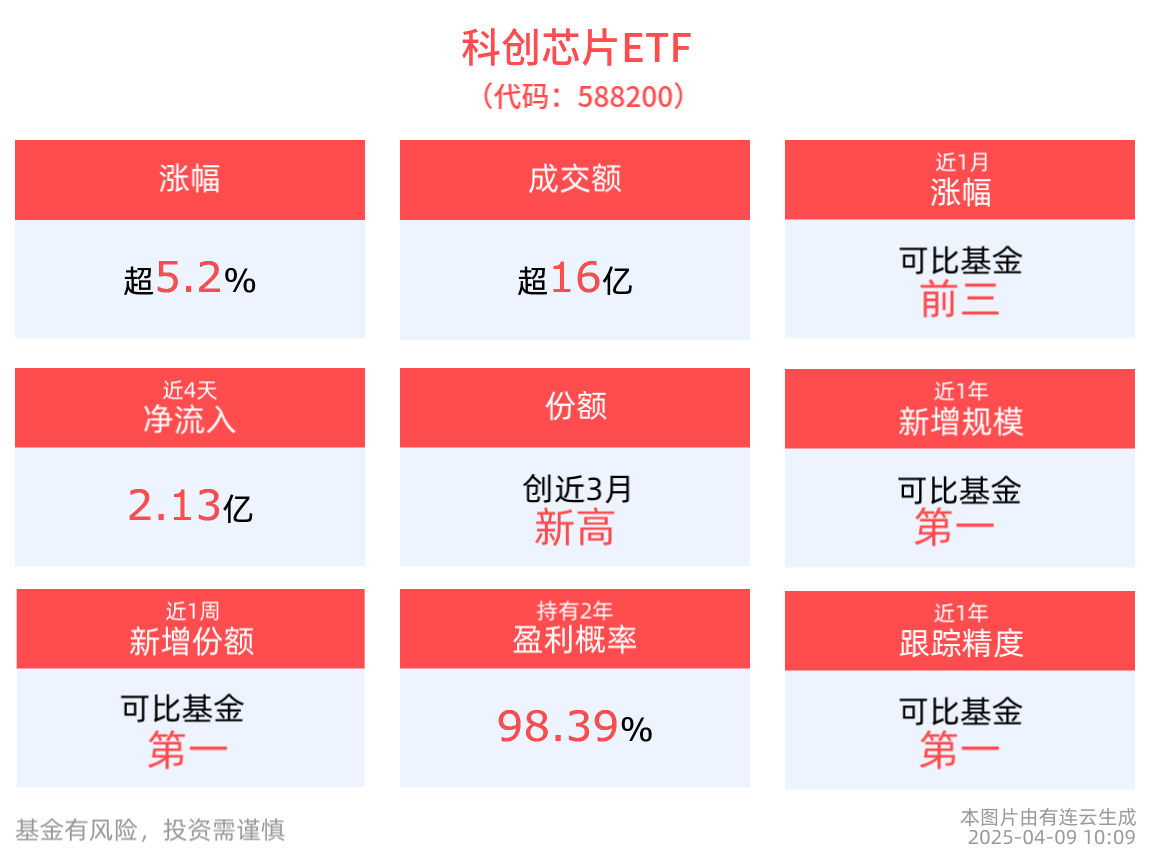
科创芯片ETF(588200)盘中上涨5.23%,最新份额创近3月新高!
Sou Hu Cai Jing· 2025-04-09 02:45
Group 1 - The core viewpoint highlights significant growth in the Sci-Tech Chip ETF, with a trading volume of 1.647 billion yuan and a turnover rate of 7.41% [3] - The Sci-Tech Chip ETF has seen a substantial increase in scale, growing by 17.349 billion yuan over the past year [3] - The latest share count for the Sci-Tech Chip ETF reached 15.571 billion, marking a three-month high [3] Group 2 - Recent net inflow of funds into the Sci-Tech Chip ETF amounted to 75.432 million yuan, with three out of the last four trading days showing net inflows totaling 213 million yuan [3] - Leverage funds are actively investing, with the latest margin buying amounting to 169 million yuan and a margin balance of 1.533 billion yuan [3] - According to CITIC Securities, the rapid development of AI applications is expected to drive sustained growth in upstream material demand, with a focus on semiconductor new materials related to AI investment themes [3] Group 3 - As of March 31, 2025, the top ten weighted stocks in the Shanghai Stock Exchange Sci-Tech Chip Index include SMIC, Haiguang Information, and Cambricon, collectively accounting for 57.96% of the index [3] - Investors without stock accounts can access investment opportunities in domestic chips through the Sci-Tech Chip ETF linked fund (017470) [3]

芯片股快速反弹 芯动联科涨超10%
news flash· 2025-04-09 01:56
芯动联科、 华岭股份涨超10%, 圣邦股份、 龙芯中科、 紫光国微、 寒武纪涨超5%, 北方华创、 华海 清科、 芯原股份、 沪硅产业等跟涨。 ...



中美互加关税带来的电子行业投资机遇解读
2025-04-07 05:59
Summary of Conference Call on US-China Tariff Impact on the Electronics Industry Industry Overview - The conference call discusses the impact of US-China tariffs on the electronics industry, highlighting both challenges and opportunities for domestic companies in China [2][4][6]. Key Points and Arguments 1. **Impact of Tariffs**: The tariffs create a dual game affecting both Chinese exports to the US and US exports to China, increasing uncertainty in the supply chain and end markets [2][3]. 2. **Opportunities for Domestic Companies**: Domestic companies can enhance competitiveness through domestic substitution, particularly in sectors dominated by US competitors, such as semiconductors [2][4]. 3. **Beneficial Sectors**: - **Semiconductor Equipment and Chip Design**: Companies like 科磊 and 英伟达 face decreased competitiveness due to tariffs, providing opportunities for domestic firms [2][5]. - **Silicon Carbide**: Domestic companies like 三安光电 may benefit if US tariffs are imposed, despite high-end markets still relying on foreign products [2][15]. 4. **Specific Companies to Watch**: - **Analog Chips**: Companies like 盛邦微电子 and 纳芯微电子 could see improved competitiveness if tariffs are applied to Texas Instruments [2][8][9]. - **CPU Sector**: 海光信息 and 龙芯中科 are highlighted as companies to watch due to enhanced domestic substitution capabilities [2][10]. - **FPD Sector**: 安路科技 and 东方同创 are positioned to benefit from domestic substitution trends [2][11]. - **Communication Chips**: 盛科通信 may replace overseas competitors like 思科 if prices rise [2][12]. - **EDA Tools**: Companies like 华大九天 are less affected by sanctions, focusing on the domestic market [2][13]. 5. **Market Dynamics**: The analog chip sector has low export rates and has not penetrated major supply chains like Apple and Tesla, presenting a potential growth area if tariffs are enacted [2][8]. 6. **Investment Opportunities**: Investors should focus on semiconductor equipment, chip design, and silicon carbide technology, as these areas may see growth due to import restrictions [2][6]. 7. **Supply Chain Adjustments**: Domestic companies are establishing factories in Southeast Asia to avoid tariffs, but face risks from potential policy changes [2][17]. 8. **Long-term Trends**: The uncertainty from tariffs may impact demand, necessitating close monitoring of domestic substitution progress [2][15][19]. 9. **External Environment**: The changing external environment, including potential increases in US tariffs, complicates industry development and requires companies to adapt strategies continuously [2][19]. Additional Important Content - **Emerging Trends**: The call emphasizes the acceleration of domestic substitution in various sectors, including automotive chips and data centers, driven by the need for supply chain stability [2][18][20]. - **Market Performance**: The performance of different chip sectors varies, with analog chips showing growth while SOCs may face declines due to high overseas revenue dependence [2][7]. This summary encapsulates the critical insights from the conference call regarding the implications of US-China tariffs on the electronics industry, highlighting both challenges and potential investment opportunities.
信创行业点评报告:自主可控为盾,AI自强为茅
ZHESHANG SECURITIES· 2025-04-06 13:42
Investment Rating - The industry investment rating is "Positive" (maintained) [5] Core Insights - The ongoing trade war has led to increased tariffs, with the U.S. imposing a total of 20% tariffs on Chinese goods as of February and March 2025, followed by an additional 34% tariff announced in April 2025 [1][2] - In response, China has implemented a 34% tariff on all U.S. imports and has taken measures against 16 U.S. entities, indicating an escalation in the trade conflict [2] - The heightened tensions between the U.S. and China have underscored the importance of self-reliance in technology and the need for China to enhance its technological capabilities [3] - The software sector is expected to focus on domestic demand, with significant potential for market growth and technological substitution [3] - 2025 is anticipated to be a pivotal year for government and party-related technology initiatives, with a focus on PC-based technology updates and strong performance from key companies in Q1 and throughout the year [3] - Domestic AI models, such as those from Alibaba and DeepSeek, are now among the global leaders, driving the development of AI applications tailored to local needs [4] - The report recommends several companies for investment, including those with high market share in foundational software, AI applications, and hardware sectors [5] Summary by Sections - **Tariff Impact**: The U.S. has increased tariffs on Chinese goods, leading to a total of 20% and then 34% tariffs, prompting China to retaliate with similar measures [1][2] - **Technological Self-Reliance**: The report emphasizes the need for China to focus on self-reliance in technology amidst rising tensions, particularly in the software sector [3] - **AI Development**: Chinese AI models are gaining global recognition, with a focus on applications that meet domestic enterprise needs [4] - **Investment Recommendations**: Key companies recommended for investment include Dameng Data, China Software, and others in the AI and hardware sectors [5]
微核芯的RISC-V哲学:打造无限可能的“万能积木”
半导体芯闻· 2025-04-01 10:14
Core Viewpoint - The article discusses the development and potential of the domestic open-source high-performance RISC-V processor core, "Xiangshan," highlighting its significance in the computing industry and its future applications in commercial sectors like servers and edge computing [1][2][4]. Group 1: Development of Xiangshan - The Xiangshan processor core, developed by the Institute of Computing Technology of the Chinese Academy of Sciences and Beijing Microkernel Technology Co., Ltd., is the world's first high-performance open-source RISC-V processor project [1]. - The first version, "Yanshihu," was launched in July 2021, followed by the second version, "Nanhu Architecture," in November 2023, with the third version, "Kunming Lake," currently under development [1]. - The project has attracted collaboration from domestic and international developers, enterprises, and universities, laying a foundation for future commercial applications despite its initial positioning as a research project [1]. Group 2: Microkernel's Background and Strategy - The Microkernel team has over 20 years of experience in CPU development, having participated in the R&D of the "Loongson CPU" and various high-performance processors [2]. - The decision to pursue the RISC-V architecture represents a strategic shift towards a more open and customizable computing solution, addressing the limitations of traditional architectures like X86 and ARM [4][6]. - The team aims to integrate high-performance CPU technology with industry applications, promoting an open and flexible innovation model [4]. Group 3: Market Positioning and Competitive Advantage - Microkernel's strategy focuses on high-performance computing, particularly in server and AI computing markets, as a means to establish RISC-V's foothold [6][7]. - The company has formed strategic partnerships with major internet companies and data processing enterprises, concentrating on storage servers and DPU fields to build a robust ecosystem [7]. - Customization and cost-effectiveness are highlighted as core competitive advantages, allowing RISC-V to achieve significant performance improvements through hardware acceleration [7][8]. Group 4: Customization and Commercial Value - The article emphasizes that open-source is just the starting point, with the real commercial value lying in deep customization to meet specific industry needs [9][10]. - Microkernel offers tailored services across hardware, software, and system levels, enabling precise alignment with various application requirements [10][12]. - The company adopts a "technical translation" approach, converting abstract customer needs into concrete technical blueprints, exemplified by their collaboration on a phased array radar chip [12]. Group 5: Future Prospects - The high-performance processor platform developed by Microkernel is designed to be adaptable across multiple fields, including robotics, edge servers, industrial control, and automotive electronics [14]. - RISC-V is viewed as a versatile technology platform with immense potential, capable of driving innovation when integrated with specific applications [14][15]. - With backing from top-tier investors, Microkernel is positioned for high-quality development and aims to redefine the technology ecosystem, believing RISC-V will play a crucial role in the future of technology [15].
专家访谈汇总:市场寻求“风格轮动”,消费板块将复苏?
阿尔法工场研究院· 2025-04-01 03:07
Group 1: AI Industry and Ecosystem - The AI industry chain covers multiple levels, including infrastructure, model, platform, application, and service layers, with key areas such as chips, computing, storage, networking, and software [1] - DeepSeek has achieved significant performance improvements in model training and inference through innovative training methods and architectures, resulting in lower training costs compared to industry averages [1] - OpenAI's GPT series, including GPT-4, has driven the development of the AI industry, particularly in utilizing pre-training principles like Scaling Law [1] - The rapid growth in AI computing power demand will benefit related industries such as semiconductors, storage, servers, optical modules, PCBs, and power supplies [1] Group 2: Home Appliance Sector Investment Opportunities - The home appliance sector, particularly the three major white goods (air conditioners, refrigerators, washing machines), is characterized by low valuations, high dividends, and stable growth, making it an attractive investment area [2] - The second-hand housing market has shown a rapid recovery, with a 92.2% week-on-week increase in transaction area in key cities from February 8 to 14, indicating strong market resilience [2] - Air conditioner domestic sales growth reached 11.4%, reflecting positive effects from seasonal stocking and national subsidy policies [2] - The kitchen appliance sector is expected to benefit from the recovery in the second-hand housing market, suggesting a focus on undervalued kitchen appliance stocks [2] Group 3: Economic Policies and Inflation - The effectiveness of "capacity reduction" and "consumption promotion" policies is debated, with a greater emphasis on expanding consumer demand to stimulate economic recovery [3] - Service prices have reached historical lows, and a significant increase in service prices could positively impact the GDP deflator index [3] - A dual approach of "capacity reduction" and "consumption promotion" is necessary, but prioritizing consumption promotion is deemed more effective [3] Group 4: Commercial Aerospace Development - The number of global commercial space launches has doubled in the past three years, surpassing non-commercial launches, with commercial launches accounting for 56% of the total [4] - The construction of commercial space launch facilities and satellite manufacturing capabilities in Hainan is accelerating, with expectations of significant increases in launch capacity by 2026 [4] - The market potential for China's commercial aerospace upstream satellite manufacturing is estimated to be between 368.8 billion to 463.7 billion yuan from 2024 to 2030 [4] Group 5: AI and Consumer Trends - Technology is driving consumption upgrades, with the consumer sector expected to become a new growth driver for the economy as macroeconomic conditions stabilize [5] - AI technology is anticipated to revolutionize the home appliance industry, particularly in products like robotic vacuum cleaners, which have substantial market potential [6] - The application of AI in education (2C AI) presents significant market opportunities, especially in scenarios with large user bases and essential needs [7] - Emerging e-commerce brands have rapidly developed by leveraging online platforms, contributing to the consumer stock market boom post-2016 [8]