奥林巴斯

Search documents
Flickr公布2025年度相机使用排行榜
Xin Lang Cai Jing· 2026-02-20 04:11
知名图片分享社区Flickr近日发布2025年用户最常用相机TOP10,佳能EOS R6 Mark II登顶榜首,2018年 发布的索尼α7III仍居第二。以下为完整榜单: 佳能 EOS R6 Mark II 索尼 α7 III 苹果 iPhone 16 Pro 尼康 Z 6II 三星 Galaxy S23 Ultra 谷歌 Pixel 8 Pro 富士 X-T5 奥林巴斯 E-M1 Mark II OM SYSTEM OM-1 松下 DC-G9 (11362450) ...




明智科技:垂直整合背后的利润奇迹与现金流隐忧
Zhi Tong Cai Jing· 2026-02-11 05:55
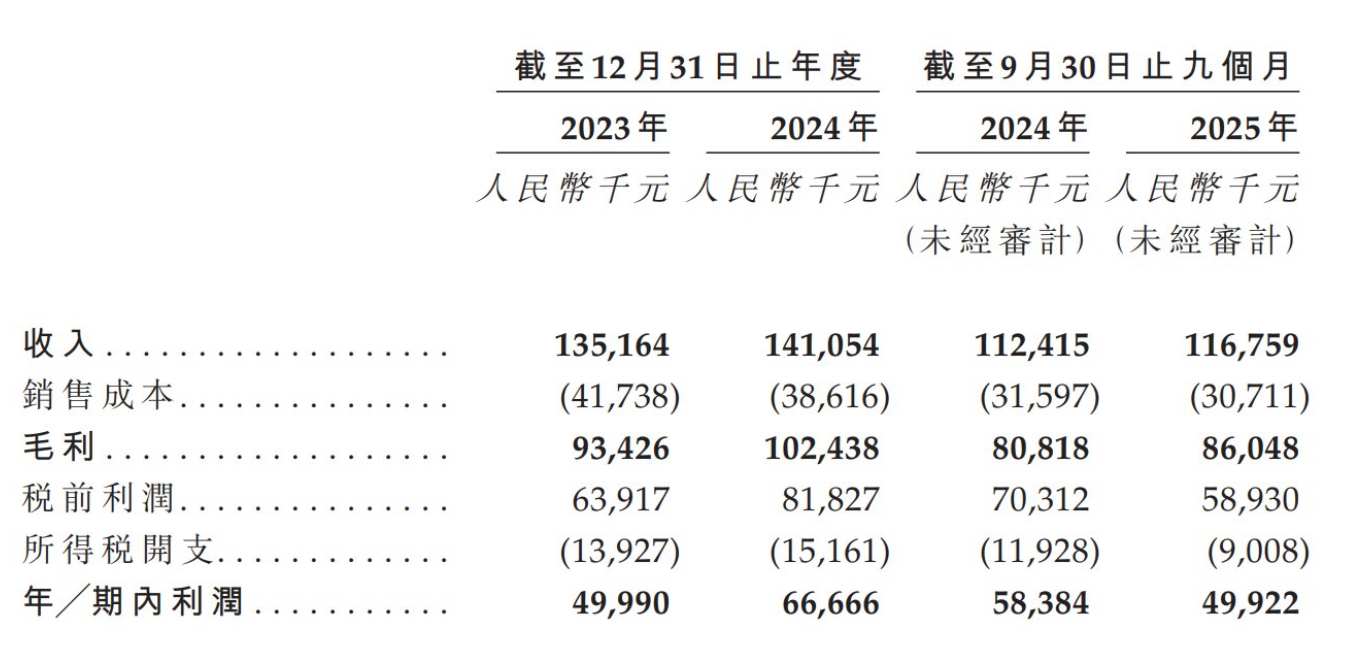
Core Viewpoint - Mingzhi Technology Co., Ltd. has submitted its listing application to the Hong Kong Stock Exchange, attracting attention due to its impressive financial metrics and leading position in the disposable endoscope market, while also facing challenges such as high customer concentration, declining cash flow, and increasing market competition [1][3]. Financial Performance - The company reported a gross margin of 72.62% and a net margin of 47.26% for 2024, with a significant increase in gross margin from 69.1% in 2023 to 73.7% in the first nine months of 2025, indicating strong profitability driven by vertical integration [2][4]. - Revenue for 2024 is projected at 1.41 billion RMB, a 4.4% increase from 1.35 billion RMB in 2023, while revenue growth slowed to 3.86% in the first nine months of 2025 compared to the same period in 2024 [3][4]. - Taxable profit reached 81.83 million RMB in 2024, a 28.0% increase from 63.92 million RMB in 2023, but fell by 16.2% to 58.93 million RMB in the first nine months of 2025 [4][6]. Market Position - Mingzhi Technology ranks among the top three brands in the disposable ureteroscope market in the U.S., Europe, and Japan, showcasing its international competitiveness in a highly regulated environment [3][9]. - The disposable endoscope market is expected to grow from approximately 2 billion USD in 2023 to over 6 billion USD by 2030, with a compound annual growth rate exceeding 17% [8][9]. Competitive Landscape - The market is dominated by major players such as Ambu, Boston Scientific, and Olympus, which collectively hold over 40% of the global market share, presenting significant competitive challenges for Mingzhi Technology [9][10]. - The company faces increasing pressure from local competitors in China, such as Kaili Medical, which has entered the disposable ureteroscope segment, intensifying competition [9][10]. Operational Challenges - Customer concentration remains high, with the top five customers accounting for 62.6% to 69.9% of sales from 2023 to the first nine months of 2025, indicating a dependency risk [10][11]. - The company relies heavily on distributors for revenue, with 92.8% of income coming from this channel in 2024, which may limit direct customer engagement and profit margins [10][11]. - Cash flow has deteriorated, with operating cash flow declining by 19.45% in the first nine months of 2025, attributed to increased inventory and extended accounts receivable collection periods [11][12]. Strategic Outlook - Mingzhi Technology's financial and operational indicators suggest it is at a critical juncture, needing to balance high profitability with sustainable growth strategies amid intensifying competition [7][11]. - The ability to manage operational and financial risks while leveraging technological innovation and maintaining supply chain efficiency will be crucial for the company's long-term value creation [12].
新股前瞻|明智科技:垂直整合背后的利润奇迹与现金流隐忧
智通财经网· 2026-02-11 05:49
Group 1: Company Overview - Mingzhi Technology Co., Ltd. has submitted its listing application to the Hong Kong Stock Exchange, with CCB International as the sole sponsor [1] - The company specializes in disposable endoscopes and has gained significant attention in the capital market due to its impressive financial metrics, including a gross margin of 72.62% and a net margin of 47.26% for 2024 [1] - Despite its high profitability, the company faces challenges such as high customer concentration, declining cash flow, and increasing market competition [1] Group 2: Business Model and Competitive Advantage - Mingzhi Technology positions itself as a "platform medical device company" with a unique vertical integration model, controlling the entire supply chain from core optical components to system assembly [2] - This vertical integration has resulted in significant cost advantages and technical control, with gross margins increasing from 69.1% in 2023 to 73.7% in the first nine months of 2025 [2][4] - The company has developed competitive products, including some of the thinnest disposable ureteroscopes and cystoscopes, which are crucial for minimally invasive surgeries [2] Group 3: Market Position and Financial Performance - By 2024, Mingzhi Technology ranks among the top three brands in the disposable ureteroscope market in the U.S., Europe, and Japan, reflecting its international competitiveness [3] - The company's revenue for 2024 is projected to be 141.05 million RMB, a 4.4% increase from 2023, but growth has shown signs of slowing down, with only a 3.86% increase in the first nine months of 2025 [3][4] - The gross profit margin has shown a consistent upward trend, but net profit has declined by 14.5% in the first nine months of 2025 compared to the same period in 2024, indicating emerging challenges in profitability [4][11] Group 4: Industry Dynamics and Challenges - The disposable endoscope market is experiencing rapid growth, with projections indicating an expansion from approximately $2 billion in 2023 to over $6 billion by 2030, reflecting a compound annual growth rate of over 17% [8][9] - However, the market is dominated by major players like Ambu, Boston Scientific, and Olympus, which collectively hold over 40% of the global market share, creating significant competitive barriers [9] - Mingzhi Technology's revenue is heavily reliant on overseas markets, exposing it to risks from geopolitical issues, currency fluctuations, and changes in international trade policies [10] Group 5: Operational Risks and Financial Health - The company has a high customer concentration, with the top five customers accounting for 62.6% to 69.9% of sales from 2023 to the first nine months of 2025, indicating a dependency risk [10] - The sales channel structure is heavily reliant on distributors, with 92.8% of revenue coming from this channel in 2024, which may limit direct customer engagement and profit margins [10] - Operational efficiency is under pressure, as evidenced by a 19.45% decline in operating cash flow in the first nine months of 2025, attributed to increased inventory and extended accounts receivable collection periods [11]
国产创新器械两倍增长,为何仍难迎“创新药时刻”?
3 6 Ke· 2026-02-11 02:46
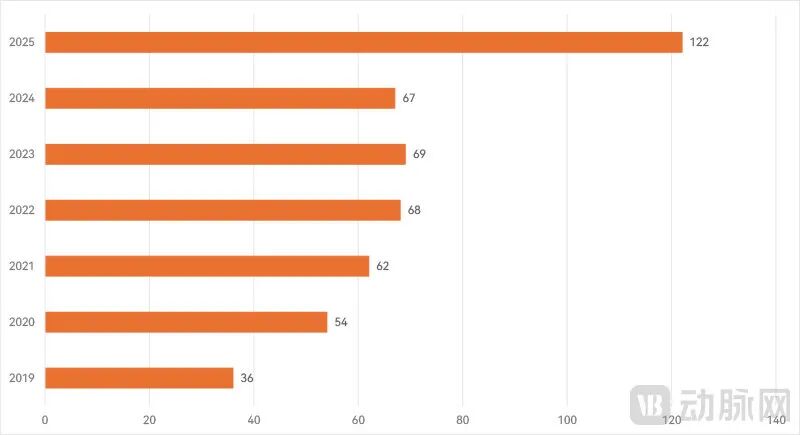
如同最初的创新药一般,近两年来,中国创新医疗器械BD也正逐渐起势。 日前,国家药监局宣布多款创新医疗器械获批上市,其中,一次性使用外周血管血栓旋切导管为国内首创,并达 到国际先进水平。与此同时,又有十多款产品公告进入创新医疗器械特别审批程序。公开数据显示,2025年国家 药监局已公告122款产品进入创新医疗器械特别审批程序,较2024年近乎翻倍。 中国创新医疗器械,即将迎来自己的"创新药"时刻? 01 国内创新医疗器械BD也疯狂 回顾中国创新药的崛起,从2024年开始,中国创新药得到全球关注并被MNC大肆买进成为了一个标志。彼时正是 在美国生物技术生态普遍低迷之际,中国创新药反而逆势而上,成为"卖方市场"的主角。 2025年,这种趋势更是势不可挡。据医药魔方NextPharma数据库显示,2025年中国创新药共完成157起BD出海授 权交易,交易总额为1356.55亿美元,其中首付款70亿美元,这三项关键数据均创下历史新高。 此外,在超高额BD交易中,2025年全球医药License-out交易总额Top10有8项来自中国,另外总交易额超过百亿美 元4起中,中国独占3起。这些高额交易使得中国创新药2025年B ...
迈瑞公布,手术机器人最新进展
Xin Lang Cai Jing· 2026-02-09 10:20
Group 1 - Mindray is actively developing its surgical robot business, integrating technologies from endoscopy, energy platforms, and surgical instruments [1][7][10] - The company has established a strong foundation in minimally invasive surgery, with a projected growth rate of over 25% for this segment by Q3 2025 [2][9] - Mindray's market share for its hard endoscope systems has surpassed 10%, positioning it just behind two major imported brands [2][9] Group 2 - The surgical robot industry is highly competitive, with major players like Medtronic and Intuitive Surgical making significant advancements [3][4] - Medtronic's Hugo™ robotic system has received FDA approval, marking its entry into the U.S. market [3] - Intuitive Surgical's da Vinci 5 system has been approved for specific cardiac surgeries, expanding its application range [4] Group 3 - The endoscopic surgical robot sector is gaining attention, with Olympus investing in Swan EndoSurgical to advance this technology [11] - Johnson & Johnson's MONARCH robot has been approved in China, allowing for natural orifice procedures without incisions [12] - Domestic companies are rapidly advancing in the surgical robot field, with several achieving initial commercialization in various specialties [12] Group 4 - The National Healthcare Security Administration has introduced guidelines for pricing surgical robots based on their participation and precision in surgeries [13][14] - The evolving regulatory framework is expected to facilitate the growth of the domestic surgical robot industry [14]


日企想在消费电子赛道继续挣扎,但意义不大了
3 6 Ke· 2026-01-28 09:06
Group 1 - Sony's collaboration with TCL has sparked discussions, marking a shift as the company plans to establish a joint venture while divesting its television business [2] - Sony has a history of divesting consumer electronics, having sold its VAIO business in 2014 and subsequently exiting the computer market, with its mobile division also facing layoffs [2][3] - By FY2024, Sony's entertainment segments—film, music, and gaming—account for over 60% of the group's revenue, indicating a strategic shift away from its identity as a consumer electronics giant [3] Group 2 - The global television market is projected to see a slight decline in shipments, with Sony's television sales significantly lagging behind competitors like TCL, which shipped 20.8 million units compared to Sony's 2.6 million in the first three quarters of 2025 [5][6] - Sony's display business revenue, including TVs and projectors, is expected to decline by approximately 10% year-on-year, reflecting ongoing challenges in profitability within the television sector [5][6] - The company aims to focus on high-value areas such as gaming, music, and film, which have proven to be more profitable, as evidenced by an increase in profit margins from 2.78% in FY2010 to 10.9% in FY2024 [6] Group 3 - Sony's partnership with TCL may leverage the latter's supply chain and cost efficiency to enhance global competitiveness in the consumer electronics market, with projections suggesting a combined market share of 16.7% by 2027 [7] - The global consumer electronics market is expected to grow, with a projected sales figure of $1.3 trillion in 2025, indicating a potential opportunity for companies like Sony to adapt and thrive [6][7] - Sony's venture into the electric vehicle market, with plans to launch its Afeela brand, reflects its ambition to diversify beyond traditional consumer electronics [8][9] Group 4 - The Japanese consumer electronics industry, including Sony, faces challenges as it struggles to maintain its position in a rapidly evolving global market, with many companies experiencing declines in market share [11][12] - The shift in focus from hardware to software and services is becoming increasingly important, with predictions that over 65% of future value in consumer electronics will come from software and subscription services [20][21] - Japanese companies, including Sony, are recognizing the need for innovation and adaptation in response to competitive pressures from global players, particularly in the areas of AI and smart technology [21][25]


奥林巴斯任命中国区新总裁
仪器信息网· 2026-01-28 08:10
特别提示 微信机制调整,点击顶部"仪器信息网" → 右上方"…" → 设为 ★ 星标,否则很可能无法看到我们的推送。 1月28日,奥林巴斯官方宣布一项重要人事任命: 自 2026 年 3 月 2 日 起 , 陈 小 穗 ( Rosa Chen ) 女 士 将 加 入 公 司 , 出 任 奥 林 巴 斯 中 国 区 总 裁 , 直 接 向 奥 林 巴 斯 全 球 总 裁、首席执行官兼董事Robert White汇报。 陈小穗女士, 2021年9月加入丹纳赫。2023年底晋升为丹纳赫中国医学诊断平台总裁,成为丹纳赫中国领导团队核 心成员。 此前,丹纳赫集团于1月13日宣布宣布原美敦力副总裁、中国骨科与神外业务总经理于婧将加入丹纳赫,接替陈小穗 (Rosa)任中国诊断平台总裁一职。 相关阅读: 新总裁将上任,丹纳赫中国诊断平台官宣 ↓ ↓ 加入行业讨论群 ↓ ↓ | 版 权 : 本 文 部 分 素 材 源 自 网 络 , 版 权 归 原 作 者 所 有 , 观 点 代 表 作 者 本 人 , 不 代 表 本 号立 场 | 转 载 : 须 本 号 授 权 , 请 联 系 主 编 | 来 源 : 仪 器 信 息 网 | ...


日美成为金融市场动荡的震源
日经中文网· 2026-01-22 02:59
Group 1 - Japan's long-term interest rates have risen sharply, causing turmoil in the bond market and creating spillover effects globally, with U.S. long-term rates reaching a high not seen in about five months [2][5] - The newly issued 30-year government bond yield in Japan was 3.71%, down 0.165% from the previous day, while the 40-year bond yield was 4.04%, also down 0.165%, indicating a market correction after a historic surge [4] - The Japanese bond market turmoil has led to increased scrutiny from overseas investors, with concerns about fiscal irresponsibility and a lack of clarity regarding funding sources for proposed consumption tax cuts [7] Group 2 - The Nikkei average fell by 216 points (0.4%) on January 21, marking a decline of over 1500 points over five consecutive trading days, reflecting market apprehension towards rising interest rates [7][8] - Financial stocks, including Mitsubishi UFJ Financial Group, experienced significant sell-offs, with shares dropping over 3%, indicating a shift in market sentiment [9] - The rising interest rates, while potentially improving bank loan spreads, could also suppress economic growth and force financial institutions to write down their bond holdings, contributing to market volatility [10] Group 3 - The ongoing geopolitical tensions between the U.S. and Europe, particularly regarding Greenland, have further dampened investor confidence, leading to a 2% drop in the Dow Jones Industrial Average [10][11] - Speculation about Europe potentially selling U.S. Treasury holdings as a countermeasure has added to market chaos, although U.S. Treasury Secretary has downplayed such discussions [10] - The chief investment officer of a Danish pension fund indicated plans to reduce U.S. Treasury holdings to near zero, reflecting growing pessimism and the potential for prolonged market adjustments [11]

中国医疗-中国医院调研:2026年保持谨慎乐观
2026-01-22 02:44
Summary of China Healthcare Industry Conference Call Industry Overview - **Industry**: China Healthcare Industry - **Report Date**: January 21, 2026 - **Sentiment**: Cautiously optimistic outlook for 2026 regarding hospital capital expenditures and market dynamics [1][2] Key Insights Capital Expenditure Trends - **Stable to Moderate Growth**: Hospital capital expenditures are expected to remain stable with moderate growth in 2026 [2] - **Survey Results**: 59% of surveyed hospital managers anticipate capital expenditure growth in 2026, up from 43% in late 2024, but still below 85% in late 2023 [3] - **Projected Growth Rate**: Expected capital expenditure growth of 4.7% in 2026, compared to 3.0% growth anticipated for 2025 [3] - **Actual Growth Expectations**: Respondents expect actual capital expenditure growth of 5.8% for 2025, indicating limited visibility on actual demand [3] Key Drivers of Expenditure - **Primary Drivers**: 1. Hospital Surplus (69%) 2. Patient Demand (50%) 3. Local Fiscal Budgets (44%) [3] - **Service Volume Constraints**: Factors such as Diagnosis-Related Group (DRG) payment limits and medical insurance settlements are seen as major constraints on service volume [3] Equipment and Technology Focus - **Investment Priorities**: Hospitals are prioritizing investments in AI, endoscopy, and imaging equipment, with a focus on surgical and flexible endoscopes, followed by CT and ultrasound [3] - **Weak Demand**: In vitro diagnostics are expected to remain weak [3] Company-Specific Insights Beneficiaries of Capital Expenditure Growth - **Mindray Medical (300760.SZ)**: Expected to benefit from a stable capital expenditure environment, with anticipated single-digit revenue growth in 2026. The company is expected to maintain a 16% share of planned capital expenditures [4][10] - **United Imaging (688271.SS)**: Anticipated to benefit from strong demand in high-end imaging, with projected revenue growth of approximately 21% in 2026 [4][11] - **New Industries (300832.SZ)**: Expected to face continued pricing pressure in in vitro diagnostics but may achieve above-industry growth due to healthy demand for chemical luminescence analyzers [4][12] - **Huatai Medical (688617.SS)**: Positioned to capitalize on the growing adoption of pulse field ablation technology, with projected revenue growth of 30% in 2026 [4][13] - **Guichuang Tongqiao (2190.HK)**: Expected to see revenue growth of around 30% driven by increased demand for neurointerventional and peripheral interventional procedures [4][15] Challenges for Global Players - **GE Healthcare**: Faces mixed impacts from increased capital expenditure and growing preference for local brands, which may offset some growth [4][16] - **Siemens Healthineers (SHL)**: Cautious outlook due to slow recovery in utilization rates and increased pricing pressure from procurement policies [4][17] - **Philips (PHIA)**: Similar cautious outlook with potential declines in market share for CT and ultrasound equipment [4][18] - **Olympus (7733.T)**: Expected to face challenges in maintaining market share in the digestive endoscopy market [4][19] - **Hologic (6869.T)**: Anticipated slowdown in clinical testing volumes and potential market share decline in hematology [4][20] Additional Observations - **Market Dynamics**: The report highlights a complex landscape for global medical technology companies in China, with both opportunities and pressures from local competition and procurement policies [4][16][17][18][19][20] - **Emerging Trends**: The shift towards local brands and the impact of procurement policies are significant trends that may reshape the competitive landscape in the healthcare sector [4][16][17][18][19][20]




生死局:AI正将仪器厂商逼向“产业链上游”的角落
仪器信息网· 2026-01-21 09:02
Core Viewpoint - The scientific instrument industry is undergoing a structural transformation driven by artificial intelligence (AI), leading to a reallocation of value within the industry. Traditional manufacturers face the risk of becoming marginalized unless they evolve into intelligent experimental solution providers [3][4]. Group 1: Paradigm Shift - The industry is transitioning from "tool intelligence" to "system intelligence," where AI enhances decision-making and optimizes processes across instruments rather than just improving individual hardware performance. This shift emphasizes the integration of hardware, data, algorithms, and services [4]. Group 2: Value Chain Erosion - New solution providers, exemplified by companies like Megatech and Huixiang Technology, are benefiting from this value transfer by offering integrated and value-added services. Their business models focus on automation solutions that command higher profit margins compared to traditional hardware sales, indicating a trend where hardware profits are diminishing [6][7]. Group 3: Dual Situation for Domestic Instruments - The transformation presents a dual opportunity for domestic instrument manufacturers. While AI creates a chance for "leapfrog" development in specific verticals, there is a risk of being relegated to mere hardware suppliers if they fail to build interoperable intelligent ecosystems [7][8]. Group 4: Key to Breaking the Deadlock - Traditional manufacturers must undergo a strategic transformation to avoid marginalization. This includes restructuring capabilities to integrate software, algorithms, and domain knowledge, shifting business models to subscription or solution contracts, and actively participating in industry ecosystem development [9][10]. Group 5: Policy and Market Context - The Beijing "High-end Scientific Instrument Innovation Development Action Plan" emphasizes the need for AI-enabled innovation in instruments, highlighting the importance of positioning as a core component in the intelligent ecosystem rather than a standard hardware supplier [11]. Group 6: Comparative Analysis of Solution Providers - A comparison of domestic and international solution providers reveals various core positions and technological features, indicating a competitive landscape where companies are leveraging AI to enhance their offerings across different application areas [12][14].