Inditex

Search documents
Technip Energies' polyester recycler Reju to build plant in France
Reuters· 2026-02-13 06:03
Core Insights - Reju, a textile recycling firm owned by Technip Energies, plans to build a polyester recycling plant in southwest France to address fast fashion's waste problem [1] - The new plant aims to convert used textiles into new polyester fibers, with similar projects planned in the Netherlands and the United States [1] - The textile recycling industry is still in its early stages, facing high costs and challenges in scaling operations [1] Company Developments - Reju's new plant in Lacq is expected to target around 50,000 metric tons per year of recycled polyester, with investments estimated between 300 million and 400 million euros ($355-475 million) per site [1] - CEO Patrik Frisk emphasized the mission to transform textile waste into valuable resources, highlighting the need for sustainable practices in the industry [1] - Several brands are reportedly lined up to sign purchase agreements with Reju, indicating potential demand for recycled materials [1] Industry Context - The production of polyester, primarily derived from petrochemicals, has surged in recent years, driven by its low cost and durability [1] - Fast fashion retailers like H&M and Inditex are investing in textile-to-textile recycling startups to enhance sustainability and comply with stricter regulations [1] - Currently, 98% of recycled polyester is sourced from plastic bottles, which has drawn criticism for diverting materials from established recycling loops [1]



Industria de Diseno Textil (IDEXY) Surges 5.5%: Is This an Indication of Further Gains?
ZACKS· 2026-02-05 16:16
Group 1 - Industria de Diseno Textil SA (IDEXY) shares increased by 5.5% to $17, following a trading session with higher-than-average volume, contrasting with a 3.3% loss over the past four weeks [1] - The company is expected to report quarterly earnings of $0.29 per share, reflecting a year-over-year increase of 141.7%, with revenues projected at $13.72 billion, up 14.7% from the previous year [2] - The consensus EPS estimate for IDEXY has remained unchanged over the last 30 days, indicating that stock price movements may not sustain without trends in earnings estimate revisions [3] Group 2 - Industria de Diseno Textil is part of the Zacks Retail - Apparel and Shoes industry, where Designer Brands (DBI) also operates, having seen a 10.2% increase to $7.44 in the last trading session, despite a -11.8% return over the past month [3] - Designer Brands has a consensus EPS estimate of -$0.48 for the upcoming report, which is a 9.1% decrease from the previous year, and currently holds a Zacks Rank of 1 (Strong Buy) [4]


2月全球十大富豪
Sou Hu Cai Jing· 2026-02-04 10:19
Core Insights - The global billionaire rankings have seen significant changes at the start of the year, with half of the top ten billionaires experiencing shifts in their positions, while Elon Musk remains the wealthiest individual with an estimated net worth of $775 billion as of February 1, 2026 [2][5]. Group 1: Wealth Increases - Elon Musk's net worth increased by $48 billion over the past month, driven by the success of xAI Holdings and the rising valuations of SpaceX and Tesla [2][3]. - Larry Page's wealth rose by $20 billion due to an 8% increase in Alphabet's stock price, making him the second-largest gainer this month [3][7]. - Sergey Brin's net worth increased by $18 billion, reaching $255 billion, as he also benefited from Alphabet's stock performance [3][9]. - Jeff Bezos saw an increase of $8 billion in his wealth, bringing his total to $250 billion [3][11]. - Mark Zuckerberg's net worth rose by $19 billion to approximately $246 billion, aided by an 8% rise in Meta's stock price [3][13]. Group 2: Wealth Decreases - Larry Ellison experienced the largest decline, with a $34 billion drop in his net worth to $211 billion, following a 17% decrease in Oracle's stock price [4][15]. - Bernard Arnault's wealth decreased by $26 billion to $169 billion, as LVMH's stock fell by 14% [4][17]. - Amancio Ortega's wealth decreased by $1 billion to approximately $145 billion, despite returning to the top ten [4][21]. - Warren Buffett's net worth fell by $7 billion to $142 billion, reflecting a decrease in Berkshire Hathaway's stock value [4][23]. Group 3: Billionaire Rankings - The total wealth of the top ten billionaires remains stable at $2.6 trillion, with all individuals having a net worth of at least $147 billion [5][25]. - The top ten billionaires include eight Americans, with Bernard Arnault from France and Amancio Ortega from Spain being the only non-Americans [5][25]. - As of February 1, 2026, the wealthiest individuals are predominantly male, with the highest net worth being $775 billion for Elon Musk [5][25].

Bitcoin falls out of global top 10 assets by market capitalization, below Elon Musk's Tesla
Yahoo Finance· 2026-01-31 18:14
Bitcoin’s market capitalization is now around $1.57 trillion, making it the 13th-largest asset by this metric, behind Saudi Aramco and Tesla stock. The move came after its price dropped sharply from around $90,000 to $78,500, a loss of more than 11% over the last 7-day period. The recent price decline comes amid geopolitical tension, a breakdown in the precious metals rally, the nomination of a "Hawkish" next Federal Reserve chair and a partial government shutdown. Bitcoin falling out of the top 10 asse ...
行业聚焦:全球纺织业螯合剂行业头部生产商市场份额及排名调查(附龙头企业介绍)
QYResearch· 2026-01-27 02:43
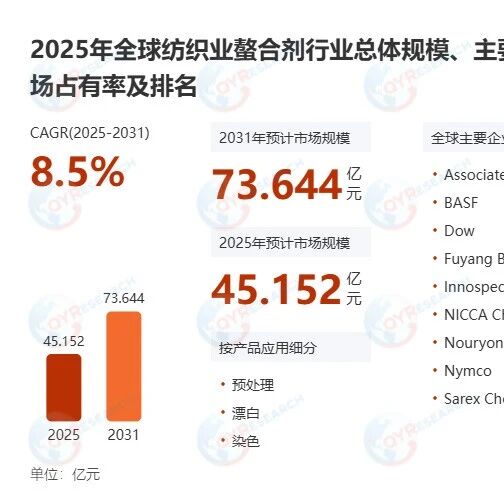
Core Viewpoint - The textile industry chelating agents are essential for improving product quality and sustainability by preventing metal ion reactions that can damage fibers and equipment, thus enhancing the efficiency and environmental compliance of textile production processes [2][3]. Product Range - The product range of textile chelating agents has evolved from traditional inorganic salts to a diverse family of fine chemicals, including: - Traditional inorganic chelating agents (e.g., polyphosphates) are widely used for general water treatment due to their low cost and high stability. - Organic carboxylic acid chelating agents (e.g., EDTA, NTA) dominate high-end dyeing processes but face environmental concerns. - Bio-based and green chelating agents (e.g., gluconates, chitosan derivatives) are rapidly emerging in response to sustainable textile policies. - Multifunctional composite chelating agents integrate dispersion, buffering, and anti-redeposition capabilities to meet integrated dyeing and finishing process needs [2]. Application Scope - Textile chelating agents serve as an "invisible engine" throughout the textile production process: - In the pre-treatment stage, they integrate calcium and magnesium ions to prevent hard water precipitation, enhancing desizing and refining efficiency. - During bleaching and dyeing, they stabilize oxidants and dye activity, ensuring color uniformity and reproducibility. - In post-treatment and water treatment, they inhibit metal ion catalysis that leads to fiber damage and reduce heavy metal loads in wastewater [3]. Market Overview - According to QYResearch, the global textile chelating agents market is projected to reach USD 1.16 billion by 2032, with a compound annual growth rate (CAGR) of 8.4% over the coming years [4]. Market Structure - Major manufacturers in the global textile chelating agents market include BASF, Dow, Nouryon, Innospec, and NICCA Chemical, with the top five companies holding approximately 59.0% market share by 2025 [6]. - The top three chemical giants (BASF, Dow, Nouryon) collectively account for over 40% of the market share, leveraging their global supply chains, R&D capabilities, and brand influence to dominate the high-end market [8]. Competitive Landscape - The competitive landscape shows that specialized manufacturers like Innospec and NICCA Chemical maintain stable shares in niche markets through application technology services and regional channels. - Asian companies (e.g., Fuyang Biotech, Taihe Chem, Yuanlian Chemical) leverage cost advantages and localized services to compete effectively in the mid-to-low-end market [8]. Industry Trends - The textile chelating agents market is transitioning from traditional functional additives to green, high-performance, and systematic solutions. The focus is shifting towards developing new molecular structures that are biodegradable, low-toxicity, and multifunctional to meet stringent environmental regulations [18]. - The application scenarios are deepening, with products extending beyond core processes to include textile recycling, wastewater treatment, and functional finishing, thus elevating their value from mere process aids to strategic materials that ensure supply chain compliance and resource efficiency [18]. Development Opportunities - The market faces structural constraints, primarily the challenge of balancing the technology and economics of green alternatives. The development and production costs of biodegradable or low-toxicity chelating agents are significantly higher than traditional products, which poses a challenge for cost-sensitive textile manufacturers [19]. - Additionally, the lack of unified industry standards and certification systems complicates product development and market entry, as different regions have varying definitions and compliance requirements for "environmentally friendly" and "biodegradable" [19]. Development Barriers - The market's growth is hindered by the cost-performance balance challenge in the green transition. The raw material costs and synthesis complexity of eco-friendly chelating agents are significantly higher than traditional products, leading to slow penetration of green products in cost-sensitive markets [20]. - Furthermore, traditional chelating agents (e.g., EDTA, phosphates) have established market inertia due to their stable performance and mature technology, making it difficult for new products to gain traction [20].

非凡领越(00933):点评报告:Clarks线上线下齐发力,新CEO上任大有可为
ZHESHANG SECURITIES· 2026-01-21 11:47
Investment Rating - The report maintains a "Buy" rating for the company [7] Core Insights - The company is recognized as an excellent international brand operator with a promising future, having a diverse portfolio that includes Clarks, Bossini, and Testoni, among others. In the first half of 2025, the company reported a revenue of HK$48.1 billion, a year-on-year decrease of 5.7%, while the net profit attributable to shareholders increased by 60.9% to HK$1.8 billion [1][4] - Clarks, a well-known global footwear brand, holds a market share of 14.6% in the UK and 1.8% in the US. The brand's revenue for the first half of 2025 was HK$41.5 billion, down 5.3% year-on-year, with a gross margin of 48.7% [2] - The new co-CEO, Victor Herrero, has extensive management experience and has successfully led the company to profitability, with a significant increase in net profit in the first half of 2025 [4] Revenue and Profit Forecast - The company is expected to achieve net profits of HK$2.1 billion, HK$5.1 billion, and HK$5.7 billion for the years 2025, 2026, and 2027, respectively, indicating a recovery and growth trajectory [6] - The projected revenue for 2025 is HK$10.47 billion, with a slight increase expected in subsequent years [11] Online and Offline Expansion - Clarks is actively expanding its online sales network, with a projected online revenue increase of 9.7% to HK$630 million in the first half of 2025, accounting for 15.2% of total revenue [3] - The company plans to open new concept stores globally, including three independent Cloudstepper™ stores in Malaysia and the US by 2025, and a larger Canvas retail concept store in London's Tottenham Court Road [2][3] Strategic Initiatives - The company is enhancing its outdoor brand presence by establishing a joint venture to operate the Haglöfs brand in Greater China, with plans to open over 20 stores by 2025 [5] - The company is also leveraging social media platforms for targeted marketing to boost brand recognition [5]
ClearBridge Dividend Strategy Q4 2025 Commentary (Mutual Fund:SOPAX)
Seeking Alpha· 2026-01-08 11:00
Market Overview - The S&P 500 Index rose 17.9% in 2025, while the equal-weighted S&P 500 Index gained 11.4% [2] - The Magnificent Seven stocks increased by 24.9% in 2025 [2] - Since the launch of ChatGPT, the cap-weighted S&P 500 has nearly doubled the gains of its equal-weighted counterpart, with the Magnificent Seven surging 332% [3] Performance Analysis - The cap-weighted S&P 500 delivered an annualized total return of 23.0% from December 31, 2022, to December 31, 2025, compared to 12.7% for the equal-weighted S&P 500 [4] - The market is characterized by significant concentration, making it the most concentrated equity market in American history [4] Investment Strategy - The ClearBridge Dividend Strategy has seen healthy gains due to investments in AI-related companies like Alphabet, Broadcom, Meta, Microsoft, and Oracle, although it has not matched the cap-weighted S&P 500's performance [10] - The strategy limits individual holdings to 3%-5% of the portfolio and caps sector exposures at 15%-20%, while the IT sector currently represents 34% of the market [11] AI Market Dynamics - AI is expected to radically change various sectors, but not all AI stocks are considered good investments due to high valuations relative to current revenues [13] - Key questions remain regarding the future of large language models and the competitive landscape, particularly between U.S. and Chinese companies [14] Company-Specific Insights - Oracle's shift to a capital-intensive AI data center business raises concerns about its balance sheet and investment-grade credit rating, leading to a reduction in its position [19] - Broadcom's position as a leading ASICS chip provider allows it to compete effectively in the AI market, with a strategy that aligns with its core competencies [20] Future Outlook - The ClearBridge Dividend Strategy anticipates continued focus on AI in 2026 but aims to find opportunities in overlooked market segments [26] - The strategy continues to trade at a significant discount to the broader market, with an average holding growing its dividend by 10% over the last 12 months [27]




物流脱碳机遇可观 龙头引领亟待扩展
Zhong Guo Fa Zhan Wang· 2025-12-31 08:03
Core Insights - The report highlights that leading cargo companies are leveraging China's advancements in renewable energy technology and infrastructure to implement logistics carbon accounting, switch to electric trucks, and adopt multimodal transport models [1][2] Group 1: Green Logistics Initiatives - 63% of evaluated companies have adopted new energy vehicles for logistics, while 41% are experimenting with clean fuels in shipping or air transport [2] - 77% of companies are focused on improving transportation efficiency, with firms like Decathlon and Geely increasing the application and range of new energy trucks [2] - Over half of the companies are also paying attention to emissions reduction in warehousing [2] Group 2: Emission Data Disclosure - More than 90% of cargo companies disclose their logistics-related carbon emissions, with 35% of companies like VF and Inditex using ISO14083 or GLEC frameworks for more accurate carbon accounting [2] - 41% of companies collect data on logistics suppliers' activities or emissions, with firms such as Puma and Lenovo encouraging suppliers to disclose climate information [2] Group 3: Recommendations for Scaling Decarbonization Efforts - The report suggests creating a supportive external environment to help leading companies scale their decarbonization pilot projects [3] - It recommends sharing best practices from leading companies to encourage more firms to adopt similar strategies [3] - Companies are advised to establish quantifiable decarbonization targets for logistics activities and incorporate carbon intensity metrics into supplier evaluations and procurement decisions [3]






2025年亿万富翁“大赢家”:身家飙升2.3万亿元,手握全球第一大独角兽
Sou Hu Cai Jing· 2025-12-27 13:13
Group 1 - The global billionaire count is projected to increase by over 340 individuals by 2025, representing a 50% growth compared to the average of the past five years [1] - The total wealth of over 3100 billionaires is expected to reach $18.7 trillion, with a record increase of $3.6 trillion since the beginning of the year [1] - The top ten wealth gainers in the past year saw their fortunes rise by a total of $729.2 billion, with American billionaires contributing over 85% of this growth [1] Group 2 - Copper is anticipated to be the standout commodity in 2025, with prices having surged over 35% this year, potentially marking the largest annual increase since 2009 [3] - Grupo México, the fourth-largest copper producer globally, reported a copper output of 789,400 metric tons from January to September 2025 [3] - Germán Larrea Mota Velasco and family own approximately 60% of Grupo México, which has expanded into infrastructure and rail transport under his leadership since 1994 [3] Group 3 - The wealth of top American tech billionaires has surged due to investor enthusiasm for leading AI companies, with six individuals collectively gaining $625.2 billion this year [5] - Alphabet, Google's parent company, reported third-quarter revenues of $102.346 billion, a 16% year-over-year increase, marking the first time quarterly revenues surpassed $100 billion [5] - Alphabet plans to invest over $10 billion in building a 1 GW data center in southern India and announced a $4.75 billion cash acquisition of Intersect, a data center and energy infrastructure company [5] Group 4 - Elon Musk emerged as the biggest winner in 2025, with a wealth increase of $333.2 billion, surpassing the wealth growth of the second-richest individual, Larry Page, by $78.5 billion [7] - Musk's wealth surge is attributed to the rising valuations of Tesla, SpaceX, and xAI Holdings, with SpaceX's valuation doubling to $800 billion [7] - Over the past five years, Musk has achieved several wealth milestones, including becoming the first person to surpass $400 billion and reaching $754.4 billion in 2025 [7] Group 5 - The top ten billionaires with the highest wealth growth in 2025 include Elon Musk, Larry Page, Sergey Brin, Jensen Huang, Larry Ellison, Amancio Ortega, Germán Larrea Mota Velasco, Masayoshi Son, Mark Zuckerberg, and Carlos Slim Helú [8] - Elon Musk leads the list with a net worth of $754.4 billion, followed by Larry Page at $254.7 billion and Sergey Brin at $235.1 billion [8]



优衣库日本起薪将涨至约1.66万人民币
日经中文网· 2025-12-27 00:32
Core Viewpoint - Fast Retailing, the operator of Uniqlo, will raise the starting salary for new graduates joining in March 2026 to 370,000 yen (approximately 16,600 RMB), marking the fourth increase since 2020. Despite this increase, Chairman and CEO Tadashi Yanai expressed that the salary is still low compared to global standards and indicated a willingness to continue raising wages [2][5]. Group 1: Salary Increases - The starting salary for new graduates will increase by 40,000 yen from the previous year, with an expected annual income of approximately 5.9 million yen (around 265,700 RMB) for 480 new hires in 2026 [4]. - The salary for formal employees in regions without relocation will rise from 255,000 yen to 280,000 yen (approximately 12,600 RMB) [4]. - Over the past six years, the starting salary has been raised a total of 160,000 yen, from 210,000 yen in 2020 to 370,000 yen in 2026 [4]. Group 2: Comparison with Other Industries - In comparison to other major Japanese companies, starting salaries are as follows: Mitsubishi Corporation at 340,000 yen, Itochu Corporation at 360,000 yen, and major banks like Mitsubishi UFJ at 300,000 yen [4]. - In the advertising sector, CyberAgent offers a starting salary of 420,000 yen, while software company Cybozu offers 400,000 yen [4]. Group 3: Strategic Intent and Market Position - The salary increase aims to attract talent amid concerns of a talent drain to countries with higher wage levels, particularly the U.S., where the median annual salary for full-time employees aged 20-24 is $41,000 [5]. - Fast Retailing seeks to transform into an "information manufacturing retail" company, moving away from traditional retail models, and plans to utilize AI to analyze customer demand and optimize production [5]. - The company aims to enhance its brand image and competitiveness by being a leader in wage increases within the retail sector, where the average annual salary is significantly lower than other industries [5]. Group 4: Financial Performance and Growth Projections - Fast Retailing expects a consolidated net profit of 435 billion yen for the fiscal year ending August 2026, marking a record profit for six consecutive years, with North America and Europe identified as key growth drivers [7]. - Sales revenue in North America for the fiscal year 2025 is projected to reach 271.1 billion yen, a 25% increase year-on-year, with ambitions to achieve 1 trillion yen in sales in the future [7]. - The company plans to invest heavily in flagship stores, with 1.2 trillion yen allocated for overseas store development, aiming to enhance brand recognition and compete with major players like Inditex and H&M [8].