中小盘股

Search documents
中小盘持续强势!中证1000增强ETF招商(159680)、中证2000增强ETF招商(159552)连续吸金,5日合计近亿元
Sou Hu Cai Jing· 2026-02-10 02:06
Core Viewpoint - The recent rally in small-cap stocks is driven by multiple factors, including improved market risk appetite, technical rebound demands, and positive policy expectations for small enterprises [3]. Group 1: Market Performance - On February 10, small-cap stocks showed positive performance, with the CSI 1000 Enhanced ETF (159680) and CSI 2000 Enhanced ETF (159552) rising by 0.12% and 0.09% respectively, and a total net inflow of nearly 100 million yuan over five days [2]. Group 2: Factors Driving Small-Cap Rally - The marginal improvement in market risk appetite is attributed to the stabilization of the broader market and a rebound in previously underperforming technology stocks, leading to reduced risk aversion [3]. - A strong technical rebound demand has emerged as small-cap stocks, having undergone significant declines, are now at historically low valuation levels, creating strong technical rebound momentum [3]. - There is a long-term confidence boost from anticipated policies supporting the development of small and specialized enterprises, which is expected to encourage investment in small-cap stocks [3]. Group 3: Future Outlook - Enhanced tools like the CSI 1000 Enhanced ETF (159680) and CSI 2000 Enhanced ETF (159552) aim to achieve returns exceeding benchmarks through quantitative strategies, providing investors with efficient options for participating in the small-cap market [4]. - The sustainability of the small-cap stock rally is highly dependent on overall market liquidity and risk appetite, with higher volatility compared to large-cap stocks, suggesting a more cautious approach to investment [4]. - The strong performance of the dual ETFs may indicate a shift towards a more balanced and diversified market style [4].

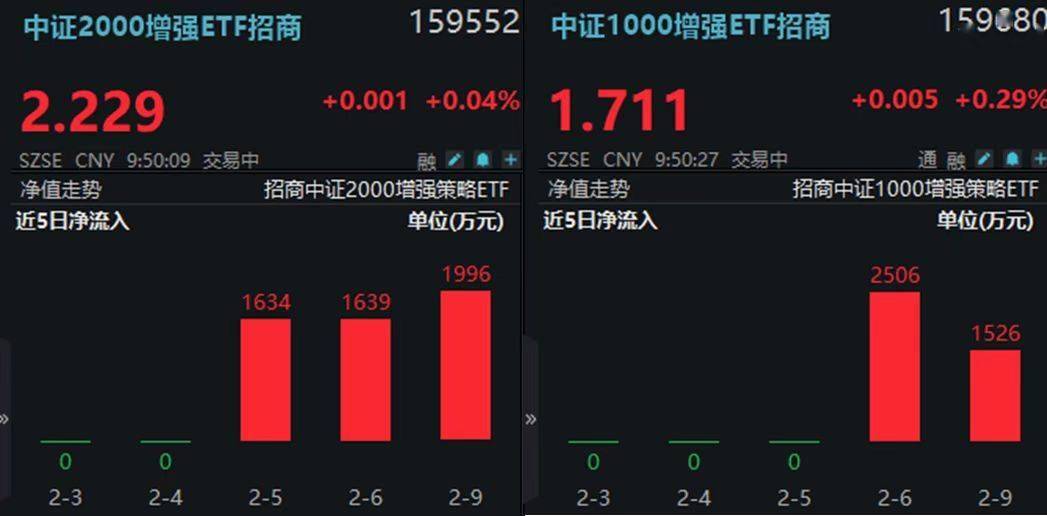
中小盘持续占优!资金连续加码!中证1000增强ETF(159680)、中证2000增强ETF(159552)盘中再迎净申购
Sou Hu Cai Jing· 2026-02-09 05:48
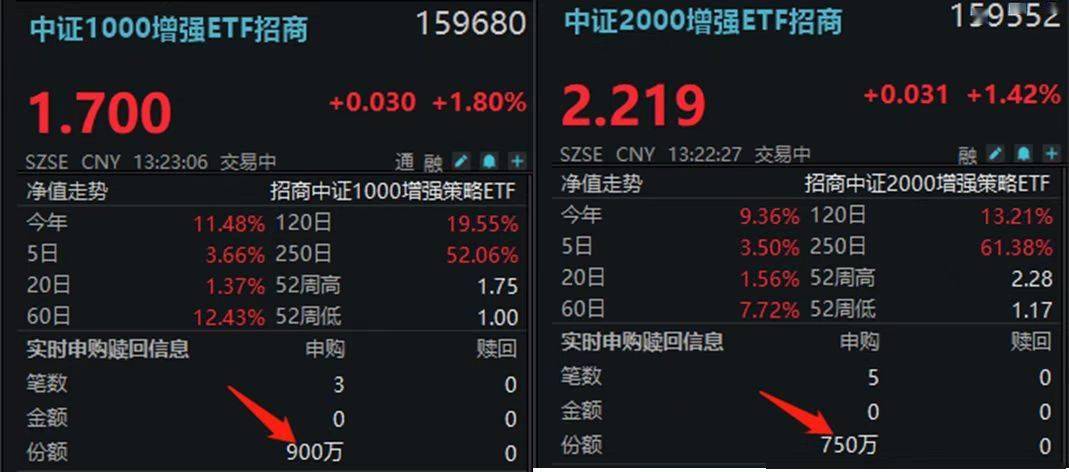
Core Viewpoint - The A-share small and mid-cap stocks are currently outperforming, driven by multiple factors including improved market risk appetite and strong technical demand for oversold stocks [1][3]. Group 1: Market Performance - As of February 9, the CSI 1000 Enhanced ETF (159680) and CSI 2000 Enhanced ETF (159552) have increased by 1.86% and 1.55% respectively, attracting significant net inflows [1]. - The CSI 1000 Enhanced ETF has a 120-day return of 11.48% and a 250-day return of 52.06%, while the CSI 2000 Enhanced ETF has a 120-day return of 19.55% and a 250-day return of 61.38% [2]. Group 2: Market Drivers - The collective strength of small and mid-cap stocks is attributed to a marginal improvement in market risk appetite, as the overall market stabilizes and previously underperforming technology stocks rebound [3]. - There is a strong technical demand for oversold small-cap stocks, which have reached historically low valuation levels, creating significant potential for technical rebounds [3]. - Expectations for supportive policies aimed at small and medium-sized enterprises, particularly those classified as "specialized and innovative," provide confidence for long-term investment [3]. Group 3: Future Outlook - The enhanced tools represented by the CSI 1000 and CSI 2000 ETFs offer efficient and diversified options for investors looking to capitalize on the small-cap market trend [3]. - The sustainability of the small-cap rally is highly dependent on overall market liquidity, with noted volatility being higher than that of large-cap stocks, suggesting a cautious approach to investment [3].
市场选择了阻力最小的方向!两大主线王者归来?
Mei Ri Jing Ji Xin Wen· 2026-01-25 09:42
Group 1 - The mysterious funds continue to control the market rhythm and sentiment, while small-cap stocks have attracted significant capital, with the Micro-cap and CSI 500 indices rising over 4% this week, and the National 2000 and CSI 1000 indices increasing by around 3% [1][17] - The market liquidity is abundant, leading to a search for opportunities, particularly in small-cap stocks, as large-cap stocks face pressure from mysterious funds [1][18] - The speculative sentiment in the market has been significantly suppressed, particularly in the commercial aerospace and AI application sectors, which have returned to normal levels [3][19] Group 2 - The mysterious funds' control over the market rhythm is expected to gradually diminish, as their selling of broad-based ETFs has lasted for 8 trading days, indicating that the intensity of control may not remain as strong [2][18] - Historical patterns suggest that the intervention of mysterious funds does not last long, with previous instances showing a maximum of 16 trading days of influence [3][19] - The CSI 500, CSI 1000, and National 2000 indices have all reached new highs, indicating a favorable environment for small-cap stocks, which supports the notion that a "spring" for small-cap stocks is likely [6][22] Group 3 - The commercial aerospace and AI application sectors are identified as the two main investment themes, with the commercial aerospace index showing signs of a potential second wave of growth [9][25] - The AI hardware supply chain has shown positive signals, with leading companies exceeding market expectations in their performance, and several sub-sectors experiencing stock price increases [11][27] - Recent reports indicate that Samsung Electronics plans to raise NAND flash supply prices by over 100% in Q1, significantly exceeding market expectations, highlighting price increases across various segments in the electronics industry [29]
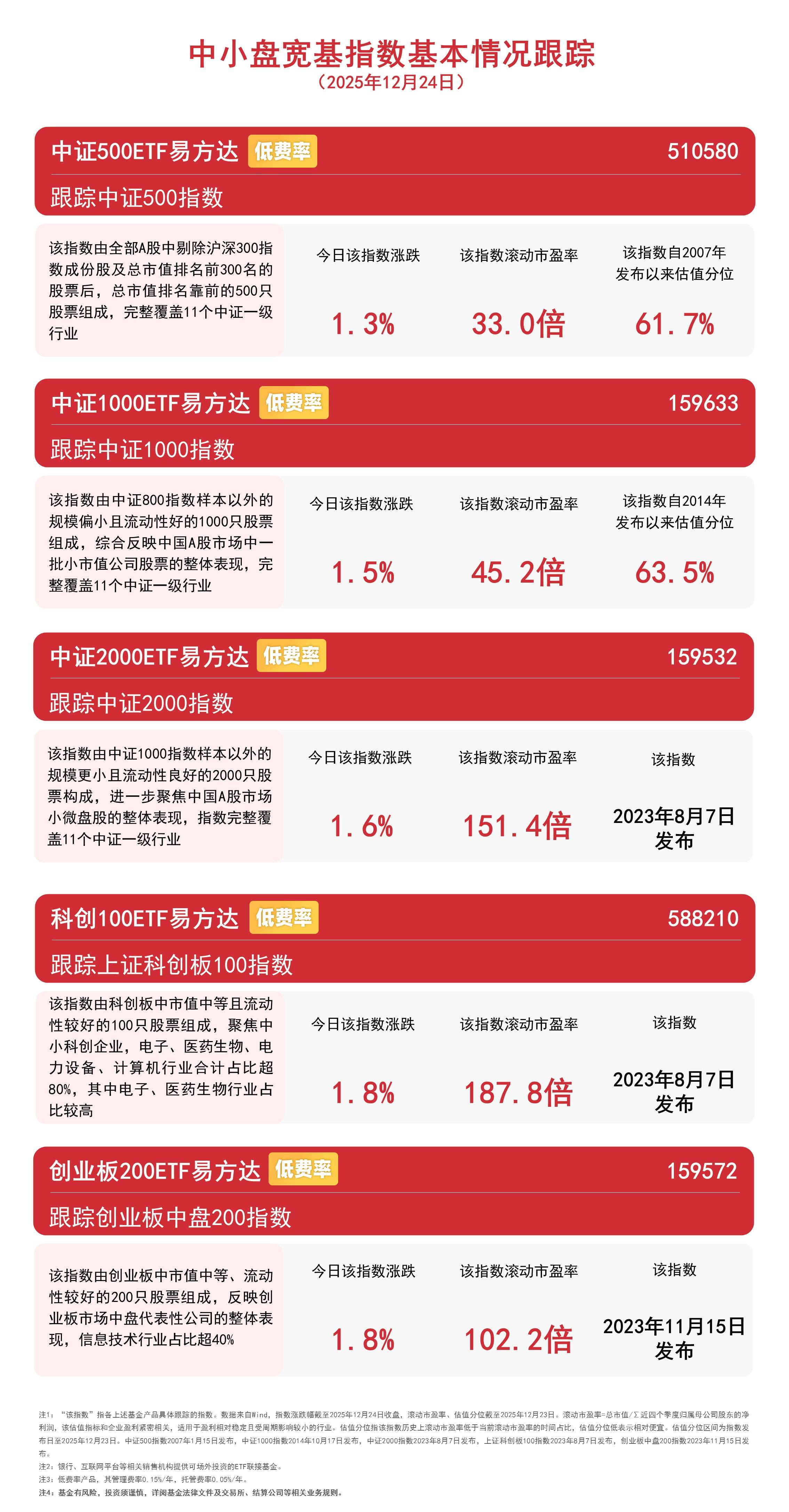
小盘股领涨,中小盘宽基指数集体涨超1%,中证2000ETF易方达(159532)助力一键打包优质成长型企业
Sou Hu Cai Jing· 2025-12-24 11:22
Group 1 - The article discusses the performance of small-cap stocks in the Chinese A-share market, highlighting the comprehensive coverage of 11 first-level industries by the CSI 2000 ETF [4] - The CSI 2000 ETF, managed by E Fund, tracks the CSI 2000 Index, which consists of 2000 smaller, liquid stocks outside the CSI 1000 Index, focusing on the overall performance of small and micro-cap stocks in China [4] - The article also mentions the Sci-Tech 100 ETF, which tracks the Shanghai Stock Exchange Sci-Tech Innovation Board 100 Index, comprising 100 medium-sized, liquid stocks from the Sci-Tech Board, with over 80% of the index concentrated in the electronics, biopharmaceuticals, and electrical equipment sectors [4]
周末重点速递丨券商热议提前布局“春季行情”,关注商业航天、液冷技术等配置机会
Mei Ri Jing Ji Xin Wen· 2025-12-14 02:17
Group 1: Economic Policies and Market Outlook - The Chinese government has implemented a series of policies since the Central Political Bureau meeting on September 26, 2024, and will introduce incremental policies in response to changing circumstances in 2025 [1] - The market has experienced adjustments recently, but there is a positive outlook for growth styles, particularly in technology and cyclical sectors, as historical data shows that style continuity is more likely than style switching after significant pullbacks [2] - The current liquidity environment is favorable for small and mid-cap stocks, which historically outperform during periods of loose liquidity and large stimulus policies [2] Group 2: Commercial Aerospace Industry - The commercial aerospace sector is characterized by market-driven activities where enterprises invest, operate, and assume risks, covering the entire industry chain from technology development to application [3] - There is a global surge in satellite constellation construction due to the scarcity of satellite frequency and orbital resources, with countries competing for these critical assets [3] - New regulations from the International Telecommunication Union (ITU) require countries to deploy satellites within seven years of application, emphasizing the urgency for companies to act [3] Group 3: Investment Opportunities in Aerospace - Investment opportunities in the commercial aerospace sector include advancements in modular design and automated testing for satellite manufacturing, as well as the evolution of rocket launches towards reusable and cost-effective solutions [4] - Key companies to watch include those involved in rocket manufacturing (e.g.,航天动力, 斯瑞新材, 超捷股份) and satellite production (e.g., 上海瀚讯, 上海沪工, 高华科技) [4] Group 4: Optical Circuit Switch (OCS) Technology - OCS technology is emerging as a solution for AI computing clusters due to its high bandwidth and low latency, making it ideal for modern communication needs [5] - The OCS market is segmented into upstream core devices, midstream equipment integration, and downstream applications, with high technical barriers and significant value concentration in core components [6] Group 5: Liquid Cooling Technology - Liquid cooling technology is becoming essential for data centers to manage increasing heat from high-density chips, with the cold plate method currently dominating and immersion cooling expected to grow in the future [7] - The market for liquid cooling systems is projected to reach significant scales by 2026, with specific estimates of 35.3 billion yuan for ASIC systems and 69.7 billion yuan for NVIDIA systems [7] - Companies such as 英维克, 申菱环境, 高澜股份, and 宏盛股份 are positioned to benefit from the rising demand for efficient cooling solutions in data centers [7]
投资策略周报:提前布局春季躁动-20251130
KAIYUAN SECURITIES· 2025-11-30 12:44
Group 1 - The market adjustment has temporarily concluded, and December is an important macroeconomic window, suggesting early positioning for the spring rally [2][10][14] - The core driving force of the current bull market remains unchanged, with liquidity still in a loose state and the fundamentals undergoing mild recovery [10][18][23] - The recent market adjustment was primarily caused by the inability to form strong macro expectations, geopolitical tensions, and the transmission of overseas liquidity risks [10][12][14] Group 2 - The growth style is expected to continue, with historical data indicating a higher probability of style continuation rather than switching during market adjustments [3][25][26] - The current market environment is conducive to small-cap stocks, which tend to outperform in a loose liquidity context [4][28][30] - Small-cap stocks are likely to lead the next phase of the recovery due to their characteristics and the current macroeconomic conditions [4][28][34] Group 3 - Investment strategies should focus on a dual-driven approach of technology and cyclical sectors, with opportunities emerging in underperforming growth industries [5][39] - Specific sectors to consider include military, media (gaming), AI applications, and core AI hardware, alongside cyclical beneficiaries from PPI improvements [5][39] - The overall investment strategy emphasizes a balanced allocation between technology and cyclical sectors to capture potential market movements [5][39]
多只基金连创新高,板块轮动剧烈,这类指数却高位徘徊
Zheng Quan Shi Bao· 2025-11-13 10:36
Core Viewpoint - The performance of small and micro-cap stocks remains strong amid market fluctuations, driven by liquidity and value recovery, with several funds achieving historical net asset value highs [1][2][4]. Group 1: Market Performance - The CSI 2000 and National 2000 indices, representing small-cap stocks, have been hovering at high levels, with the CSI 2000 index closing at 3141 points as of November 12, nearing a ten-year high [2]. - Funds focusing on small and micro-cap stocks, such as Nuon Fund and CITIC Prudential, have shown strong performance in Q4, with respective gains of 9.34%, 6.24%, and 8.99% [2]. - The average market capitalization of the top holdings in these funds is typically in the tens of millions, significantly lower than large-cap stocks [2]. Group 2: Liquidity and Investment Strategy - The current market liquidity is considered a fundamental reason for the strong performance of small and micro-cap stocks, as these stocks are more sensitive to capital flows [4]. - Fund managers suggest that investors are increasingly favoring high-elasticity stocks, with small micro-cap stocks often exhibiting greater price volatility [3][5]. - The liquidity environment is expected to remain supportive for small-cap styles, with a decrease in market leverage levels contributing to a more stable risk profile [4]. Group 3: Risks and Considerations - Despite the strong performance, there are concerns regarding the liquidity of small and micro-cap stocks, which can lead to difficulties in trading and price volatility [6][7]. - Fund managers caution that the crowded nature of small-cap stocks may lead to wider bid-ask spreads and challenges in liquidating positions during market corrections [6][7]. - The low trading activity and insufficient depth in buy-sell orders for micro-cap stocks necessitate careful liquidity management during trading [7].
多只基金连创新高!板块轮动剧烈,这类指数却高位徘徊
证券时报· 2025-11-13 09:37
Core Viewpoint - The article highlights the strong performance of small and micro-cap stocks in the current market, driven by liquidity easing and value recovery of certain stocks, while also noting the risks associated with trading liquidity and market adjustments [1][3][4]. Group 1: Market Performance - The CSI 2000 and Guozheng 2000 indices, representing small-cap stocks, have remained at high levels, with the CSI 2000 index closing at 3141 points as of November 12, nearing a ten-year high [3]. - Several funds focusing on small and micro-cap stocks, such as Nuon Fund and CITIC Prudential, have seen their net values reach historical highs, with quarterly gains of 9.34%, 6.24%, 1.41%, and 8.99% respectively [3]. Group 2: Liquidity Factors - The article emphasizes that the current strong performance of micro-cap stocks is primarily due to abundant liquidity, which allows for greater price volatility in these stocks [6][7]. - The easing liquidity environment not only attracts funds to micro-cap stocks but also alleviates financing constraints for small enterprises, improving profit expectations [7]. Group 3: Investment Strategies - Investors are increasingly favoring high-elasticity stocks, with micro-cap stocks often showing stronger potential for price recovery after market adjustments [4][9]. - The article suggests that in a market where large-cap stocks are over-traded, funds may shift towards undervalued micro-cap stocks, seeking opportunities for marginal improvements [9]. Group 4: Risks and Cautions - Despite the positive outlook, there are concerns regarding the trading activity and liquidity of micro-cap stocks, which may lead to difficulties in executing trades and widening bid-ask spreads during market corrections [1][10]. - The low liquidity characteristic of micro-cap stocks poses challenges for large-scale operations and necessitates careful liquidity management during trading [10].

多只基金连创新高!板块轮动剧烈,这类指数却高位徘徊
券商中国· 2025-11-13 03:41
Core Viewpoint - The article highlights the strong performance of small and micro-cap stocks in the current market, driven by liquidity easing and value recovery of certain stocks, with indices like the CSI 2000 and National 2000 remaining at high levels [2][3]. Group 1: Market Performance - The CSI 2000 index was reported at 3141 points as of November 12, nearing a ten-year high, indicating robust performance in the small-cap sector [3]. - Several funds focusing on small and micro-cap stocks, such as Nuon Fund and CITIC Prudential, have seen significant net value increases, with quarterly gains of 9.34%, 6.24%, 1.41%, and 8.99% respectively [3]. - The average market capitalization of the top holdings in these funds is around several hundred million, significantly lower than large-cap stocks, which are in the billion range [3]. Group 2: Investment Strategies - Investors are increasingly favoring high-elasticity stocks, with micro-cap stocks showing greater potential for price movement due to their smaller market size and higher free float [4][5]. - The current market environment is characterized by a shift in funding structure, with lower leverage levels compared to early 2024, making the market less prone to large fluctuations [6]. - Micro-cap strategies are seen as a way to capture excess returns due to the inefficiencies in pricing, as these stocks are often less covered by analysts and can be mispriced [6]. Group 3: Liquidity Factors - The article emphasizes that the current liquidity environment is favorable for small and micro-cap stocks, as increased social financing and M2 growth lead to more funds flowing into these stocks for higher returns [5][6]. - The low liquidity characteristic of micro-cap stocks poses challenges, such as difficulties in executing large trades and managing liquidity effectively [8]. - Despite the positive outlook, there are concerns about the stability of trading activity and the ability to execute trades without significant price impact, especially during market corrections [7][8].

侃股:大盘股更受青睐是大势所趋
Bei Jing Shang Bao· 2025-09-24 12:11
Group 1 - The trend of large-cap stocks becoming bull stocks is significantly influencing investors' stock selection strategies, shifting focus from speculative trading to performance and growth metrics [1][2] - The market preference is changing, with a growing emphasis on companies with strong industry barriers, stable cash flows, and robust risk resistance, which resonate with both institutional and retail investors [1][2] - The structure of market participants is evolving, with long-term funds like pensions and insurance capital entering the market, favoring predictable performance and solid value investment targets [1][2] Group 2 - Large-cap stocks are not a necessary condition for becoming bull stocks, but their probability of doing so has increased, indicating a shift in market dynamics [2] - Investors should not adopt a mindset of only buying large-cap stocks; quality companies with strong performance and growth potential should be prioritized regardless of market capitalization [2] - The valuation levels of large-cap stocks are generally higher than those of small-cap stocks, but small-cap stocks can still demonstrate significant growth potential if they maintain performance increases [2]