城镇化率

Search documents
浙江去年常住人口增加31万人
第一财经· 2026-03-03 13:13
根据第一财经记者梳理发现,当前已有8个省份公布了2025年的具体人口数据。其中,山东2025年 年末常住人口为10043万人,而2024年年末山东常住人口为10080.17万人。也就是说,2025年山 东常住人口比上一年减少37.17万人。此外,2025年末,青海常住人口592万人,比上年末减少1万 人;广西全区常住人口4989万人,比上年末减少24万人;贵州全省常住人口3857万人,比上年末 减少3万人;甘肃全省常住人口2443万人,比上年末减少15万人。 封图 | AI生成 目前,已有多个省份公布了去年的人口数据。从趋势上看人口继续向长三角、珠三角等发达地区和城 市集聚。 3月3日发布的2025年浙江省国民经济和社会发展统计公报显示,当年末全省常住人口6701万人, 比上年末增加31万人。其中城镇常住人口5117万人,乡村常住人口1584万人,城镇化率76.4%。 对一个省份来说,人口增长包括自然增长和机械增长(即"人口净流入")。去年浙江机械增长人口 即新增跨省净流入人口为38.9万人,再次凸显了浙江近年来的人口吸引力。 2026.03. 03 本文字数:1033,阅读时长大约2分钟 作者 | 第一财经 ...


多省份公布2025年人口数据
Di Yi Cai Jing Zi Xun· 2026-02-27 08:46
2026.02.27 本文字数:1042,阅读时长大约2分钟 作者 |第一财经 林靖 目前,已有多个省份公布了去年的人口数据。 根据海南省统计局公布的《2025年海南省国民经济和社会发展统计公报》,2025年末全省常住人口1055 万人,比上年末增加7万人。常住人口城镇化率64.08%,比上年提高1.00个百分点。 广东省统计局公布的数据显示,2025年末,广东全省常住人口12859万人,比上年末增加79万人。全年 出生人口100.3万人,人口出生率为7.82‰;死亡人口71.3万人,人口死亡率为5.56‰;人口自然增长29 万人,人口自然增长率为2.26‰。2025年城镇人口占常住人口比重(城镇化率)为76.58%,比上年末提 高0.67个百分点。 在出生人口方面,广东已连续6年成为全国唯一出生人口超百万的省份,连续8年蝉联"第一生育大省"。 一般而言,较高的人口出生率往往对应着较低的城镇化率。而第一经济大省广东是个例外。广东城镇化 率位居全国第四,出生率长期处于全国前列。这一定程度上受到了传统生育文化的影响,同时东莞、广 州、佛山等地的多个村社纷纷出台生育奖励政策,进一步鼓励生娃。 此外,广西、贵州和甘肃 ...

中央一号文件解读|再次聚焦农村,“适应人口变化趋势”有何深意?
Xin Lang Cai Jing· 2026-02-04 10:17
Group 1 - The core viewpoint of the article emphasizes the shift in China's rural policies from passive responses to proactive adaptations in light of demographic changes, particularly focusing on the integration of urbanization and rural revitalization strategies [1][4] - The 2026 Central Document No. 1 marks a significant change by making population dynamics a prerequisite for rural land use planning, indicating a move towards a more systematic approach to rural governance [2][4] - The document introduces a new path of "regional promotion of rural revitalization," replacing the previous "village classification construction" approach, reflecting a deeper understanding of the new characteristics of rural populations [2][3] Group 2 - As of the end of 2025, China's total population is approximately 1,404.89 million, showing a slight decrease of about 3.39 million from the previous year, with urban population reaching 953.80 million, an increase of about 10.30 million, while rural population decreased to 451.09 million, down by approximately 1.37 million [3] - The urbanization rate has risen to 67.89%, an increase of 0.89 percentage points year-on-year, indicating a steady upward trend in urbanization, which is a key structural indicator of China's modernization process [3][5] - The ongoing trend of rural population decline and aging, coupled with regional disparities, presents new challenges for rural development, necessitating a strategic response through the rural revitalization initiative [3][4] Group 3 - The 2026 Central Document No. 1 acknowledges the long-term trend of population movement to cities while attempting to maintain rural vitality to avoid widespread "hollowing" and disorder [4][5] - The document's focus on optimizing rural land use and determining construction priorities based on population trends signifies a proactive approach to rural planning, rather than assuming population stability or return [5] - The strategy suggests a rational choice for a transitional period, where resources will be allocated based on the viability of villages, with some areas receiving concentrated investment while others may gradually exit high-intensity construction sequences [5]
我国经济总量首次突破140万亿元 经济底盘更实抗风险能力更强
Zhong Guo Qing Nian Bao· 2026-01-20 00:57
Economic Overview - In 2025, China's GDP reached 140,187.9 billion yuan, marking a 5% increase from the previous year, showcasing a stable and resilient economic growth trajectory [1][2] - The "14th Five-Year Plan" period saw China's economy achieve significant milestones, with GDP surpassing 110 trillion, 120 trillion, 130 trillion, and finally 140 trillion yuan [1] Economic Stability and Growth - The year 2025 is characterized by stability in economic metrics such as total GDP, employment, and foreign trade, with a notable increase in goods trade and foreign exchange reserves exceeding 3.3 trillion USD [2][3] - High-tech manufacturing's value added accounted for 17.1% of industrial output, and final consumption contributed over 50% to economic growth, indicating a shift towards a more optimized economic structure [2] Trade and Innovation - China's exports of high-tech products grew by 13.2% in 2025, with total goods imports and exports increasing by 3.8%, and exports alone rising by 6.1% [3] - Research and development expenditure reached 2.8% of GDP, surpassing the OECD average for the first time, and China's innovation index entered the global top ten [3] Social Welfare and Employment - The average disposable income per capita for residents was 43,377 yuan, reflecting a 5% real growth, with rural incomes growing even faster at 6% [5] - The urban unemployment rate remained stable at an average of 5.2%, with the total number of migrant workers reaching 30.115 million, an increase of 0.5% from the previous year [4][5] Urbanization and Education - By the end of 2025, the urbanization rate in China reached 67.89%, with the average education level for the population aged 16-59 increasing to 11.3 years [6] Future Outlook - Despite external challenges, the foundation for China's economic growth remains strong, with expectations for continued stability and opportunities in 2026 [6][7]
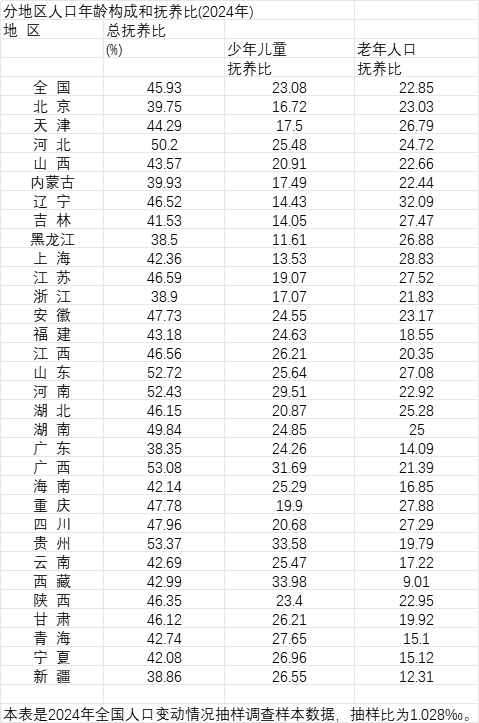
31省份人口抚养比数据公布
Di Yi Cai Jing Zi Xun· 2025-11-11 09:38
Core Insights - The article discusses the dependency ratio in China, highlighting that in 2024, 15 provinces will have a total dependency ratio higher than the national average, with five provinces exceeding 50% [2][3]. Regional Population Age Structure and Dependency Ratio (2024) - The national total dependency ratio is 45.93%, with a child dependency ratio of 23.08% and an elderly dependency ratio of 22.85% [3]. - Provinces with total dependency ratios exceeding 50% include: - Guizhou: 53.37% - Guangxi: 53.08% - Shandong: 52.72% - Henan: 52.43% - Hebei: 50.2% [3][4]. - High total dependency ratios are linked to labor outflow and high proportions of children or elderly populations [3]. Future Population Dividend - Provinces like Guizhou and Guangxi have child dependency ratios above 30%, indicating potential for urbanization [4]. - 18 provinces have a child population ratio exceeding the national average of 15.81%, with 13 provinces above 17%, predominantly in the western region [4]. Guangdong Province Insights - Guangdong has a permanent urban population of 97.01 million, with an urbanization rate of 75.91%, ranking fourth nationally [5]. - The province's birth rate is 8.89‰, with 113,000 births in 2024, maintaining its status as the largest birth province for seven consecutive years [5]. - The influx of young, marriage-age individuals contributes to the province's high birth rates despite declining fertility intentions in some areas [5]. Labor Age Population Proportion - 12 provinces have a labor age population ratio exceeding 70%, including Guangdong (72.28%), which has the highest influx of labor-age individuals [6]. - The Northeast region has a low child population ratio, resulting in a lower total dependency ratio despite a relatively high labor age population [6]. Elderly Dependency Ratio - 11 provinces have an elderly dependency ratio of 25% or higher, primarily located in Northeast, Yangtze River Delta, and Bohai Rim regions [6].

31省份人口抚养比数据公布
第一财经· 2025-11-11 09:16
Core Viewpoint - The article discusses the dependency ratio in China, highlighting the challenges and opportunities presented by the demographic structure across different provinces in 2024, with a focus on the implications for urbanization and economic growth [3][5]. Summary by Sections Dependency Ratio Overview - The dependency ratio, or support ratio, measures the ratio of non-working-age population to working-age population (ages 15-64). In 2024, 15 provinces had a total dependency ratio above the national average, with five provinces exceeding 50%: Guizhou, Guangxi, Shandong, Henan, and Hebei [3][5]. Provincial Analysis - The article provides a detailed breakdown of the dependency ratios across various provinces, indicating that high dependency ratios are often linked to population outflows, particularly of the working-age population, and high proportions of children or elderly individuals [5][6]. - For instance, Guizhou and Guangxi have child dependency ratios exceeding 30%, indicating potential future demographic advantages due to a larger base of young people [5]. Urbanization Potential - Provinces with high child populations and low urbanization rates, such as those in the western regions, show significant potential for urbanization. In contrast, provinces like Guangdong and Fujian, despite high urbanization rates, also maintain a substantial proportion of children in their populations [5][6]. Birth Rates and Population Trends - Guangdong has the highest urban population, with a rate of 75.91% and a birth rate of 8.89‰, leading the nation in births for seven consecutive years, with 1.13 million births in 2024 [5][6]. - The influx of young, working-age individuals into Guangdong contributes to its high labor force participation, with 72.28% of its population in the working-age group [6]. Regional Disparities - The article notes that while some provinces have high ratios of elderly dependents, such as those in Northeast China, they also have a relatively low birth rate, leading to a lower overall dependency ratio [6].

31省份人口抚养比数据公布,哪些地方抚养比高
Di Yi Cai Jing· 2025-11-11 08:40
Core Insights - The overall dependency ratio in five provinces exceeds 50%, indicating a significant proportion of non-working age population compared to the working-age population [1][3] - In 2024, 15 provinces have a total dependency ratio higher than the national average, with notable figures in Guizhou, Guangxi, Shandong, Henan, and Hebei [1][2] Dependency Ratios by Region - The national total dependency ratio is 45.93%, with a breakdown of 23.08% for children and 22.85% for the elderly [2] - Provinces with the highest total dependency ratios include: - Guizhou: 53.37% (children: 33.58%, elderly: 19.79%) - Guangxi: 53.08% (children: 31.69%, elderly: 21.39%) - Shandong: 52.72% (children: 25.64%, elderly: 27.08%) - Henan: 52.43% (children: 29.51%, elderly: 22.92%) - Hebei: 50.2% (children: 25.48%, elderly: 24.72%) [2][3] Population Composition and Urbanization Potential - High total dependency ratios are linked to both out-migration of the working-age population and high proportions of children or elderly in certain provinces [3] - Provinces like Guizhou and Guangxi, despite high dependency ratios, have significant potential for urbanization due to their high child dependency ratios (over 30%) [3] Child Population Statistics - Eighteen provinces have a child population ratio exceeding the national average of 15.81%, with 13 provinces above 17%, predominantly in the western region [4] - Guangdong, despite its high urbanization rate (75.91%), has a child population ratio exceeding 17% and continues to lead in birth rates, with 1.13 million births in 2024 [4] Working-Age Population Insights - Twelve provinces have a working-age population ratio above 70%, including Guangdong, Zhejiang, Beijing, and Shanghai, which are major destinations for labor migration [5] - Guangdong has the highest working-age population ratio at 72.28%, reflecting its status as the province with the most significant inflow of young labor [5]
10年4000亿,省委书记的“旅居经济账”
2 1 Shi Ji Jing Ji Bao Dao· 2025-10-14 12:57
Core Insights - The real estate market in Yunnan is experiencing a decline in new housing sales, with a 4.7% decrease in sales area and a 7.3% decrease in sales revenue from January to August 2025 compared to the previous year [1] - Despite the national trend, Yunnan's provincial leadership believes that real estate development is crucial for economic growth, particularly due to the province's low urbanization rate [1][3] - Yunnan's urbanization rate is currently at 54.11%, and if it can reach 65% by 2035, it could generate nearly 400 billion yuan in new investments and consumption [1] Real Estate Sales Trends - In 2025, external buyers purchased 43,000 housing units in Yunnan, accounting for 33.5% of total sales, marking a record high [2] - The proportion of external buyers has been increasing since 2022, with figures rising from 24.8% in 2022 to 31.7% in the first nine months of 2025 [2] - Certain cities, such as Xishuangbanna and Baoshan, have even higher proportions of external buyers, reaching 75% and 46.2% respectively [2] Factors Attracting External Buyers - Yunnan's ecological and resource advantages, including a pleasant climate and rich natural resources, are key factors attracting external buyers [3] - The province's urbanization rate is under pressure, with several regions below 60%, necessitating the transformation of agricultural populations into urban residents [3] - Tourism plays a significant role in job creation, with Yunnan receiving 700 million tourists in 2024, contributing to the local economy [3] Economic Impact of Tourism - The city of Pu'er has achieved an urbanization rate of 80% by leveraging local resources like tea and coffee to create jobs [4] - In 2024, Yunnan's tourism generated significant economic benefits, with an average tourist spending of 1,628.57 yuan [4] - The province is focusing on promoting "travel residency," with a notable increase in visitors from the Yangtze River Delta region [5] Future Development Strategies - Yunnan is prioritizing the development of public services and infrastructure to accommodate the influx of tourists and residents [6] - The provincial government has issued guidelines to enhance the quality of life for both locals and visitors [6] - The next 3 to 5 years are seen as a critical opportunity for urban development in Yunnan, with a call for proactive measures to boost city construction [6]
国家统计局:16-59岁年龄人口占比超六成,人口红利依然存在
Xin Jing Bao· 2025-09-28 11:52
Core Insights - The report from the National Bureau of Statistics indicates that in 2024, China's working-age population (ages 16-59) will be 857.98 million, accounting for 60.9% of the total population, highlighting the continued demographic advantage and population dividend [1] - By the end of 2024, China's urbanization rate is projected to reach 67%, reflecting a 3.11 percentage point increase from the end of 2020 [1] - The total population of China is expected to be 1,408.28 million by the end of 2024, maintaining its position among the highest globally [1] Population Distribution - The population is increasingly concentrated in urban areas and eastern regions, with the urban population reaching 943.50 million by the end of 2024 [1] - The permanent population in eastern regions will be 567.02 million, representing 40.32% of the national population, an increase of 0.30 percentage points since 2020 [1] Life Expectancy and Education - The average life expectancy in China is projected to reach 79 years in 2024, an increase of 1.07 years since 2020, which is 5 years higher than the global average [1] - The average years of education for the working-age population (ages 16-59) will be 11.21 years, an increase of 0.46 years since 2020 [1] - The proportion of citizens with scientific literacy is expected to reach 15.37%, an increase of 4.81 percentage points since 2020 [1]
闪辉:中国新增住房需求即将筑底
高盛GoldmanSachs· 2025-06-23 08:00
Core Viewpoint - The article discusses the changing dynamics of housing demand in urban China, highlighting a significant decline in new housing demand due to population decrease, urbanization slowdown, and shifts in family structure, with projections indicating a future annual demand of slightly below 5 million units [2][5][6]. Group 1: Population and Housing Demand - New housing demand in urban areas peaked around 2015, with projections indicating it may stabilize at just below 5 million units annually in the foreseeable future [2][6]. - Population growth has historically been a key driver of new housing demand, but projections show a negative contribution to housing demand from 2020 to 2029, averaging -500,000 units annually, and further declining to -1.4 million units annually from 2030 to 2039 [3][5]. Group 2: Urbanization Trends - Despite a declining population, urbanization rates continue to rise, contributing significantly to housing demand. However, the pace of urbanization is expected to slow as the government aims for a 70% urbanization rate by 2030, with only a 0.5 percentage point increase per year from 2024 to 2030 [4][5]. - The contribution of urbanization to new housing demand is projected to decrease from an average of 6.4 million units annually in 2010-2019 to 3.8 million units from 2020-2029, and further to 2.8 million units from 2030-2039 [4][5]. Group 3: Family Structure Changes - The trend of shrinking family sizes in urban areas is expected to continue, supporting new housing demand. The proportion of "one-generation households" has increased from 27% in 2000 to 50% in 2020, with projections indicating an increase in demand contribution from this factor [5][6]. - The average contribution of shrinking family sizes to new urban housing demand is expected to rise from 1.4 million units annually in 2010-2019 to 1.8 million units in 2020-2029, and further to 2.1 million units in 2030-2039 [5][6]. Group 4: Housing Investment Demand - Housing investment demand, which accounted for 24% of total urban housing demand from 2010-2019, peaked at 5.7 million units in 2021 but is expected to decline sharply due to falling property prices and negative future price expectations [7]. - Projections indicate that housing investment demand will average -180,000 units annually from 2025-2030 and -120,000 units from 2030-2039, with the release of vacant second-hand properties likely to further suppress new housing demand [7].