
大数据风控

Search documents
两年注销60家法人牌照、清退数千分支机构,保险中介加速洗牌
Xin Lang Cai Jing· 2026-02-28 02:00
智通财经记者 | 吕文琦 在强监管持续推进的背景下,保险中介行业迎来新一轮深度洗牌。 2月27日,金融监管总局披露,2024-2025年累计查处并注销60家保险专业中介法人牌照,同时清退保险专业中介分支机构3730家、保险兼业代理机构226 家。这是自2024年启动保险中介市场"清虚规范提质"行动以来的重要阶段性成果。 金融监管总局表示,下一步将围绕防风险、强监管、促高质量发展工作主线,扎实做好保险中介监管工作,完善保险中介监管制度,持续深入推进保险中介 清虚提质,优化保险中介市场结构,推动保险中介机构加强专业能力和信息化建设,深化保险兼业代理改革,推动保险中介高质量发展,助力提升金融服务 质效。 近年来,从地方性中介机构主动注销牌照,到区域性代理公司收缩业务,再到兼业代理渠道明显退场,行业主体数量持续下降。在费用压缩、佣金重塑与监 管穿透并行的背景下,保险中介"撤退潮"正在加速。 强监管信号进一步明确 北京大学应用经济学博士后、教授朱俊生在接受智通财经采访表示,此次集中出清释放出强监管、严监管成为行业新常态的明确信号。 "监管层对保险中介市场的治理决心是坚定且持续的。"朱俊生表示,监管思路正在从过去相对偏重 ...


省呗科普升级:揭秘“职业背债”骗术,全方位守护金融安全
Cai Fu Zai Xian· 2026-01-27 02:34
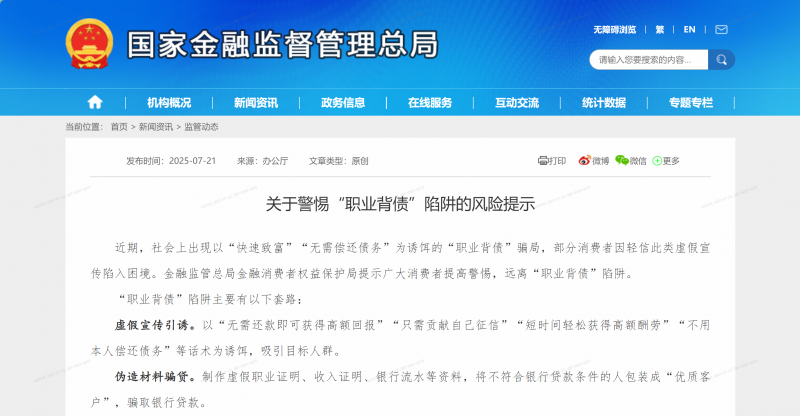
在数字化金融高速演进的当下,各类金融产品与服务持续涌现,便利性提升的同时,也给不法分子留下 可乘之机。一段时间以来,以"快速赚钱""不用本人偿还贷款"为噱头的 "职业背债"骗局再度卷土重来, 不少消费者因缺乏金融知识而深陷其中。作为长期扎根金融科技领域、始终秉持"用户至上"的省呗,认 为有必要为公众拆解骗局本质,帮助大家提升自我保护能力,避免落入非法陷阱。 成为"职业背债人"的严重风险 1. 巨额债务由自己承担 "职业背债"骗局的核心套路 1. 虚假宣传诱导上钩 不法分子往往通过社交平台大肆发布诸如 "不用承担债务,还能赚佣金""征信越差越赚钱""提供名下信 息即可获利" 等虚假口号,特别针对急于解决资金困境或对金融知识了解不足的群体。他们营造出一 种"轻松赚钱、毫无风险"的假象,让人觉得只要贡献身份信息或征信,就能获得高回报,实则为诈骗精 心布置的第一步陷阱。 2. 伪造材料骗取贷款 为了顺利骗取金融机构资金,不法分子通常会准备大量伪造材料,包括 虚假收入证明、假银行流水、 假工作信息等,将原本不符合贷款要求的人包装成"高质量申请人"。当贷款成功后,被诱导的"背债 人"却对这一过程毫不知情,所有风险也随之转 ...
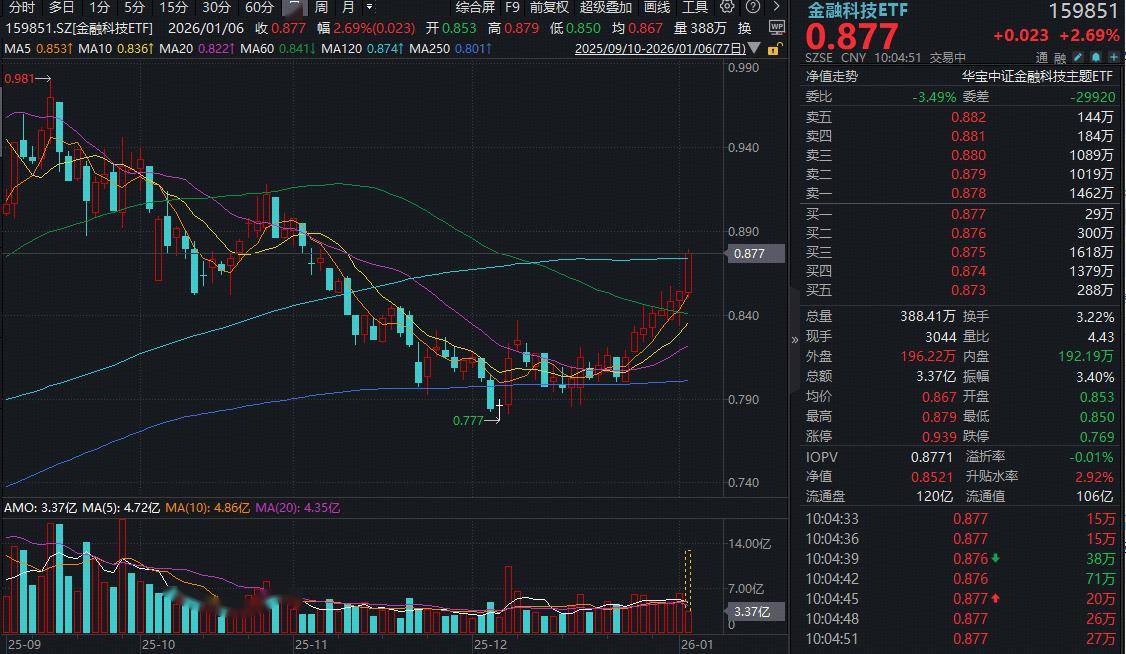
ETF盘中资讯|互联网券商异动,同花顺领涨超8%!金融科技ETF(159851)再涨超2%放量八连阳!
Sou Hu Cai Jing· 2026-01-06 02:39
Core Viewpoint - The financial technology sector is experiencing a significant upward trend, with the Shanghai Composite Index reaching a ten-year high, driven by strong performance in internet brokerage stocks and financial technology ETFs [1][3]. Group 1: Market Performance - On January 6, the Shanghai Composite Index surpassed 4050 points, marking a ten-year high, with the financial technology sector achieving an eight-day consecutive rise [1]. - Internet brokerage concepts saw substantial gains, with stocks like Tonghuashun rising over 8% and other companies like Zhinan Zhen and Wealth Trend increasing by more than 4% [1]. - The financial technology ETF (159851) also experienced a rise of over 2%, with trading volume exceeding 300 million yuan [1][2]. Group 2: Catalysts for Growth - A record high annual trading volume of 400 trillion yuan in A-shares for 2025 indicates a vibrant capital market, suggesting that internet brokerages will see performance releases in 2025 and the first half of 2026 [3]. - The integration of AI in financial IT is creating new growth opportunities, enhancing product value and customer loyalty through applications like smart investment advisory and big data risk control [3]. - The financial technology ETF (159851) and its associated funds are recommended for investment, as they cover a wide range of themes including internet brokerages, financial IT, cross-border payments, and AI applications [3].

全国首个“保险+租赁”具身机器人保单在上海落地
Xin Hua Cai Jing· 2026-01-04 12:42
Core Insights - The signing of the "embodied robot insurance cooperation" marks the launch of China's first "insurance + leasing" policy for embodied robots, providing innovative financial risk protection for the industry [1][2] Group 1: Industry Context - Embodied intelligent robots are rapidly integrating into various industries, with technology evolving from demonstrations to practical applications since 2025 [2] - The demand for risk protection is increasing as embodied robots are deployed in real-world scenarios, leading to incidents such as equipment damage and third-party property loss [2] Group 2: Challenges in Insurance - The insurance sector faces three main challenges in providing coverage for embodied robots: strong confidentiality of core technology data, the majority of robot manufacturers being startups, and difficulties in moral hazard prevention under single-device ownership models [2][3] Group 3: Innovative Insurance Solutions - The collaboration between Ping An Property & Casualty and Shanghai Electric leverages financing leasing to achieve bulk insurance, clarifying application scenarios and usage standards for robots [3] - Ping An Property & Casualty utilizes advancements in AI, IoT, and big data risk control to enhance risk assessment and management, offering proactive maintenance suggestions and safety operation guidelines [3] Group 4: Future Outlook - The successful launch of the first policy is seen as a starting point for ongoing financial innovation in the embodied intelligent robot sector, aiming to support the development and application of technology [4]


7000亿深圳民营银行,行长换人
2 1 Shi Ji Jing Ji Bao Dao· 2025-11-24 06:08
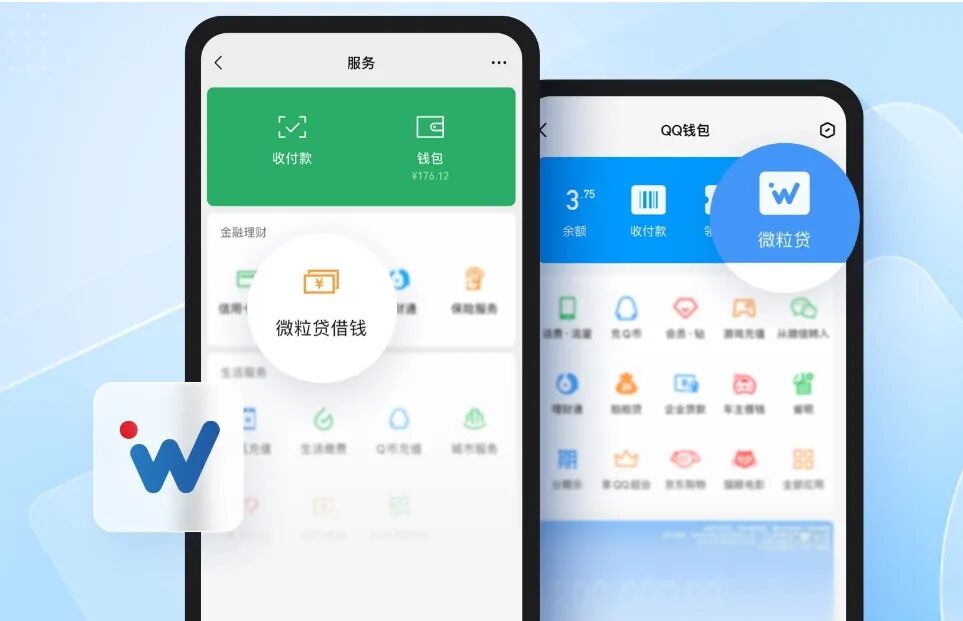
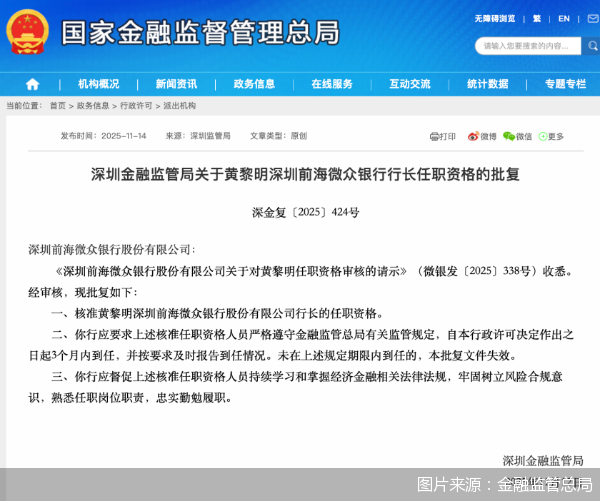
Core Viewpoint - The leadership transition at WeBank, with Huang Liming taking over from Li Nanqing, comes at a critical time as the bank aims to transform into an "AI-native bank" while facing challenges in the consumer loan market [2][4][5]. Group 1: Leadership Change - Li Nanqing is set to step down as the president of WeBank, with Huang Liming appointed as his successor, a move approved by regulatory authorities [2][3]. - Huang Liming has been with WeBank for 11 years, playing a key role in the development of its flagship product, "Weilidai" [3][8]. - The transition is seen as a normal adjustment in management, with expectations for Huang to lead the bank through its transformation phase [2][5]. Group 2: Financial Performance - WeBank's total assets exceeded 700 billion yuan by June 2025, reflecting significant growth since its inception [6]. - For the first half of 2025, WeBank reported a net profit of 5.57 billion yuan, averaging about 30 million yuan per day, although both revenue and net profit showed a decline compared to the previous year [13][14]. - The bank's net profit growth has slowed from nearly 40% in 2021 to just 0.8% in 2024, indicating a shift in its financial performance dynamics [14]. Group 3: Business Strategy and Transformation - WeBank is accelerating its transition to an "AI-native bank" by enhancing its infrastructure and developing diverse application models [4][20]. - The bank's strategy has shifted from prioritizing scale to focusing on risk management and profitability, with a new "New Decade" strategy launched in 2024 [19][20]. - Huang Liming's leadership will involve restructuring the bank's operations into four main business segments, emphasizing technology integration and international development [20][23]. Group 4: Market Challenges and Opportunities - The consumer loan market is facing increased competition, with a decline in the balance of consumer loans by 5.53% year-on-year, and the average loan amount for Weilidai has decreased to 7,200 yuan [14][17]. - Despite challenges, WeBank's asset management has shown stable growth, with a 26% year-on-year increase in managed assets, primarily driven by its agency business [17]. - WeBank is exploring new growth opportunities in cross-border business and AI technology, particularly in the Asia-Pacific region, leveraging its digital banking solutions [23].
建设银行青岛市分行:创造服务价值激活高质量发展新动能
Xin Lang Cai Jing· 2025-11-18 02:23
Core Viewpoint - The financial industry is tasked with a new historical mission to support high-quality development, focusing on enhancing financing accessibility and improving financial product services by 2027 [1] Group 1: Financial Industry Development - The State Council has issued guidelines for the financial sector to achieve significant results in five key areas by 2027, including improving financing accessibility and enhancing the inclusiveness of financial services [1] - Financial institutions are increasingly adopting a "value creation" approach to support high-quality development, integrating their growth with national strategic goals [2] Group 2: Inclusive Finance - The Qingdao branch of the Construction Bank emphasizes serving small and micro enterprises as a core aspect of inclusive finance, utilizing digital technology to enhance credit services [3] - The "Jianhang Huidongni" platform has been developed to provide a comprehensive digital inclusive finance model, streamlining the loan process and addressing the "first loan difficulty" for small businesses [3] - As of August this year, the inclusive finance loan balance at the Qingdao branch reached 35 billion yuan, with an increase of 3.05 billion yuan since the beginning of the year [4] Group 3: Pension Finance - The Qingdao branch is actively implementing national pension finance strategies, focusing on building a comprehensive pension service system to support the aging population [5] - The bank has introduced the "Anxiang" series of financial products designed for the elderly, emphasizing stability and low volatility to alleviate economic burdens [5][6] Group 4: Consumer Finance - The bank is responding to the trend of consumption upgrades by offering diverse and personalized consumer credit products to stimulate market potential [7] - In August, a new fiscal subsidy policy for personal consumer loans was launched, aimed at reducing financing costs for residents and enhancing consumption [8] - The bank has implemented a new online service for personal loans, providing 24/7 access and streamlining the application process for various consumer credit products [8] Group 5: Future Outlook - The Qingdao branch plans to continue its focus on inclusive finance, pension finance, and consumer finance, aiming to enhance service quality and contribute to the development of a modern socialist metropolis [9]

轻资本模式受冲击,互联网银行“一哥”微众银行新帅的新挑战
Bei Jing Shang Bao· 2025-11-16 14:01
Core Viewpoint - The appointment of Huang Liming as the new president of WeBank marks a significant leadership transition as the bank faces challenges in performance, asset quality, and structural transformation amid a tightening regulatory environment and shrinking consumer loans [1][2]. Leadership Transition - Huang Liming will be the third president of WeBank, following the tenure of Li Nanqing, who led the bank for ten years and significantly expanded its asset scale [2]. - Huang has been with WeBank since its inception and has a deep understanding of its operations, having previously served as the deputy president [2][3]. Business Performance - As of mid-2025, WeBank's total assets reached 714.72 billion yuan, maintaining its position as the leading internet bank, but it reported a decline in both operating income (189.63 billion yuan, down 3.44%) and net profit (55.66 billion yuan, down 11.86%) for the first time [4]. - The proportion of personal consumer loans has decreased, with total loans and advances amounting to 435.976 billion yuan, a year-on-year increase of 5.18%, while consumer loans fell by 5.53% [4]. Regulatory Environment - The new lending regulations have compressed the leverage space for joint loans, impacting WeBank's reliance on products like "Weilidai" that depend on external funding [5][6]. - The regulations require internet banks to assume more risk capital in joint loans and restrict outsourcing of core risk control functions, challenging WeBank's "light capital" operational model [6]. Strategic Adjustments - WeBank is undergoing a transformation focusing on cost reduction, structural optimization, and technology-driven growth, with an emphasis on corporate loans and wealth management as new growth areas [7][8]. - The bank has established partnerships with numerous financial institutions for wealth management and has developed a comprehensive AI infrastructure to enhance its digital banking capabilities [8][9]. Future Outlook - Analysts suggest that WeBank's strategic adjustments should focus on enhancing middle-income through high-value services, leveraging technologies like blockchain for risk control, and exploring new financial sectors [9]. - Huang Liming's leadership is expected to strengthen the integration of WeBank's consumer and business ecosystems, fostering innovation and compliance in product development [9].
监管新信号!多家银行被罚
Jing Ji Wang· 2025-10-22 02:21
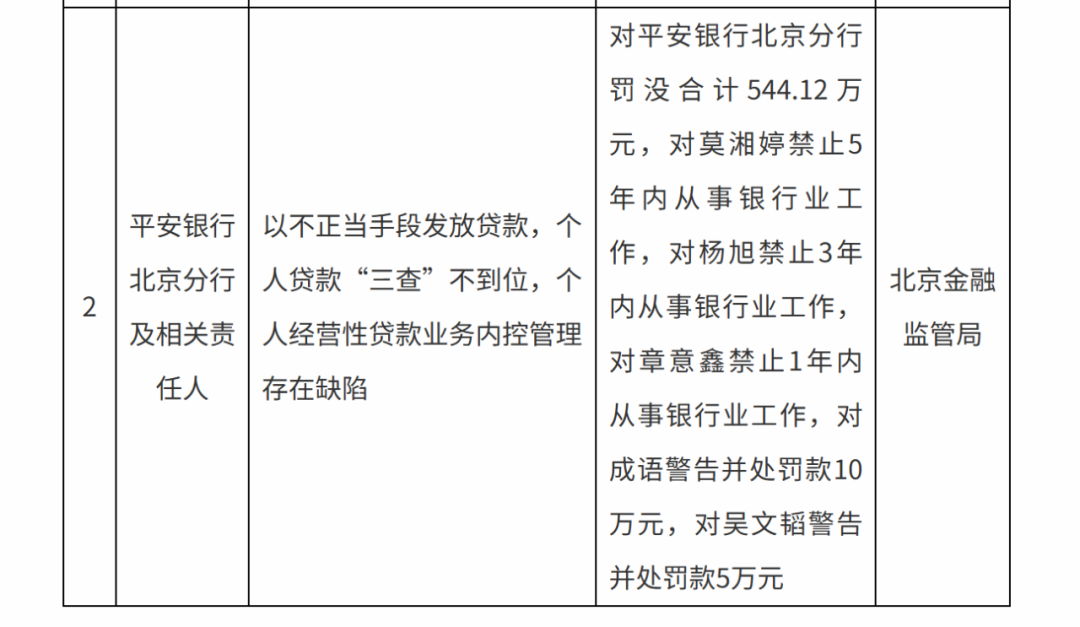
Core Viewpoint - Recent regulatory actions against multiple banks highlight a stringent regulatory environment, emphasizing the need for improved pre-loan audits and monitoring of fund flows to ensure compliance and promote standardized business practices [1][3]. Regulatory Actions - The Beijing Regulatory Bureau of the National Financial Supervision Administration disclosed penalties against Ping An Bank's Beijing branch for improper loan issuance and inadequate internal controls in personal loans, resulting in fines totaling 5.44 million yuan [2]. - Agricultural Bank of China’s Honghe branch was fined 300,000 yuan for ineffective control over loan fund flows, while its Beijing branch faced penalties for six violations related to loan monitoring and management [1][2]. - Zhejiang Zhuji United Village Bank was fined 550,000 yuan for imprudent management of personal business loans and misuse of loan funds [1]. Industry Implications - The penalties reflect a broader trend of regulatory bodies holding both institutions and individual responsible parties accountable, indicating a "double penalty" system becoming standard practice [2]. - Experts suggest that the observed credit irregularities point to deficiencies in risk control and compliance management within financial institutions, which could lead to funds being misallocated to restricted sectors like real estate [3]. - Recommendations for improvement include enhancing pre-loan audits, monitoring fund flows, and establishing a comprehensive penalty mechanism to foster compliance and mitigate financial risks [3].


688627,突然火了!138家机构调研!
Zheng Quan Shi Bao· 2025-09-28 00:42
Group 1 - A total of 234 listed companies disclosed institutional research records this week, with nearly 40% of them achieving positive stock returns [1] - The stock price of Jingzhida (688627) increased by 17.68% after receiving 138 institutional inquiries, focusing on its storage testing and semiconductor testing equipment [1][2] - Xintai's stock rose by 15.81% after hosting a roadshow with 77 institutional investors, with its core revenue source being over 80% from its formulation business [2] Group 2 - Mengke Pharmaceutical announced a stock issuance plan at a price of 6.3 yuan per share, raising up to 1.033 billion yuan, with Haiqing Pharmaceutical becoming the controlling shareholder [3] - Haiqing Pharmaceutical will leverage its experience in raw material drug development to enhance Mengke's product cost efficiency and profitability [3] - Gaowei Technology received attention from over 40 institutions due to its strategic partnership with Ant Group, focusing on AI and financial technology [4][5]


浙商银行合肥分行:借助资金流信息平台提升小微金融精准服务
Zhong Guo Jin Rong Xin Xi Wang· 2025-09-11 09:05
Core Insights - Zhejiang Merchants Bank Hefei Branch has actively implemented the People's Bank of China's requirements to promote the national small and micro enterprise fund flow credit information sharing platform, becoming one of the first banks in Anhui Province to support small and micro enterprises in addressing financing difficulties [1][2] Group 1: Implementation and Impact - As of August 2025, the bank has served 43 small and micro enterprises through the fund flow credit information sharing platform, with a total loan amount of 86.504 million yuan [1] - The fund flow information platform offers advantages such as nationwide networking, subject-driven, real-time online access, on-demand sharing, and broad application, which helps small and micro enterprises improve financing opportunities and reduce costs [1] Group 2: Case Study - A packaging board company faced challenges in obtaining bank financing due to a lack of traditional collateral. The bank intervened by guiding the client to use the "Digital Science Loan" product and leveraging big data models for risk control [2] - The bank conducted a comprehensive assessment of the company's operations, confirming its stability and sufficient orders, which led to the approval of a 2 million yuan credit loan within five working days, significantly alleviating the client's urgent financial needs [2] Group 3: Future Plans - The bank plans to strengthen organizational leadership, enhance system application, improve process supervision, and conduct promotional training to further promote the fund flow information platform and implement the "Credit Enhancement Flow Loan" project [3]
