大模型竞争

Search documents
内测输给Gemini,还套壳?!Meta千亿自研大模型遭延期
机器之心· 2026-03-14 06:33
Core Viewpoint - Meta's AI project, particularly the new foundational model Avocado, has faced delays due to performance issues, pushing its release to at least May [2][3]. Group 1: Model Performance and Competition - Avocado's performance in reasoning, code generation, and writing still lags behind competitors' latest models, indicating that while Meta has made significant progress, rivals are advancing even faster [4][5]. - The gap in foundational models affects ecosystem attractiveness, developer resources, and talent recruitment, as foundational models are crucial for AI platforms [6]. - Internal discussions at Meta considered temporarily licensing Google's Gemini model to support its AI products, highlighting the critical state of Meta's AI strategy [7]. Group 2: Investment and Future Plans - Meta's investment in AI is among the most aggressive in the internet sector, with projected AI-related spending of $72 billion in 2025 and up to $135 billion in 2026, alongside a long-term data center investment of around $600 billion [8][9]. - The goal is to establish a pathway to superintelligent AI, with Avocado being developed by the elite TBD Lab, which is also working on another model named Mango [10][11]. Group 3: Strategic Shifts and Industry Signals - Meta's AI strategy may shift from open-source to closed-source models, as indicated by internal discussions, due to high costs and competitive pressures [14][15]. - The delay of Avocado signals a broader industry trend where the competition has shifted from merely creating models to the speed of iteration and improvement [16][17]. - Meta is already planning the next generation of models, continuing the fruit-themed naming convention with Mango and Watermelon, which will be larger in scale [18].



一只龙虾,成了MiniMax、月暗、智谱的财神爷
投中网· 2026-03-04 06:46
Core Insights - The article discusses the rapid rise of AI model companies like MiniMax, Zhipu, and Moonlight, which have significantly benefited from their integration with the OpenClaw ecosystem, leading to substantial increases in their market valuations and API usage [6][20]. Group 1: Market Dynamics - In February, MiniMax and Moonlight dominated the API usage rankings on OpenRouter, with MiniMax's M2.5 model leading in usage for three consecutive weeks [6]. - Both MiniMax and Zhipu AI have surpassed a market capitalization of 300 billion HKD, while Moonlight's API revenue has exceeded its total for the entire year of 2025 within just 20 days of launching its K2.5 model [6]. - The OpenClaw platform has become a significant driver of token consumption, with Chinese models accounting for 61% of the total token usage on the platform [8]. Group 2: Competitive Advantages - Chinese model companies are benefiting from their competitive pricing and performance, with Kimi K2.5 being used for 80% of daily inference tasks by a European studio, showcasing its cost-effectiveness compared to alternatives like Claude [7]. - The article highlights the importance of model adaptability and commercial efficiency as key competitive factors in the evolving AI landscape, moving beyond traditional metrics like model parameters [8]. Group 3: Financial Performance - MiniMax reported a sixfold increase in daily token consumption for its M2 series models in February 2026 compared to December 2025, indicating a strong growth trajectory [16]. - Moonlight's shift to a token-based pricing model has led to a significant increase in daily token consumption and user engagement [17]. Group 4: Challenges and Responses - Despite the success, companies like Zhipu have faced challenges with service stability due to surging demand, leading to service delays and a temporary drop in stock prices [18]. - The article emphasizes the need for model companies to ensure stable computing power and token services to maintain their competitive edge in the market [20]. Group 5: Future Outlook - Major tech firms like Alibaba, Tencent, and Baidu are entering the market with their own desktop agent tools, indicating a growing competitive landscape [22]. - The long-term success of AI model companies will depend on their ability to enhance model capabilities and user retention, as the market continues to evolve [23].

一只龙虾,成了MiniMax、月暗、智谱的财神爷
创业邦· 2026-03-03 10:09
Core Viewpoint - The article discusses the explosive growth and market impact of the AI model API aggregation platform OpenRouter, particularly highlighting the success of Chinese companies like MiniMax, Zhiyu, and Moonlight in the OpenClaw ecosystem, which has led to significant increases in their valuations and market presence [6][7][19]. Group 1: OpenClaw and Market Dynamics - OpenClaw has become a highly sought-after tool in the developer community, achieving nearly 250,000 stars on GitHub, making it the most popular open-source project ever [10]. - The platform has led to a dramatic increase in token consumption, with MiniMax's M2.5 model seeing a sixfold increase in daily token consumption from December 2025 to February 2026 [16]. - Chinese models dominate the token consumption landscape, accounting for 61% of the total token usage on OpenRouter, with MiniMax M2.5 leading at 24.5 trillion tokens consumed [9][15]. Group 2: Financial Performance and Valuation - MiniMax and Zhiyu have both surpassed a market capitalization of 300 billion HKD, with Moonlight's API revenue exceeding its total for 2025 within just 20 days of launching its K2.5 model [7]. - Moonlight completed two rounds of financing totaling over 1.2 billion USD, doubling its valuation to over 10 billion USD [7]. - The competitive pricing of Chinese models, such as MiniMax's M2.5 at 2.4 USD per million tokens, contrasts sharply with competitors like Anthropic's Claude Sonnet 4.6, which costs 15 USD per million tokens, highlighting the cost advantage of Chinese offerings [15]. Group 3: Challenges and Opportunities - The surge in usage has led to challenges for companies like Zhiyu, which faced service delays and user experience issues due to increased demand for its GLM-5 model [17]. - Major tech companies like Baidu, Tencent, and Alibaba are entering the market with their own desktop agent tools, indicating a competitive landscape that is rapidly evolving [19][20]. - The long-term success of these models will depend on their ability to maintain performance and stability, as well as the ongoing development of their capabilities to meet user needs [21].

速递 | DeepSeek V4突然“泄密”!别被爆料带偏,真正的大局藏在这里
未可知人工智能研究院· 2026-02-26 09:26
Group 1 - The core message of the article emphasizes the importance of being prepared and having a clear understanding of developments in the AI sector, particularly regarding the DeepSeek V4 model [1] - The article discusses three significant updates regarding DeepSeek V4, including the decision to grant early access to domestic suppliers like Huawei instead of traditional chip manufacturers like NVIDIA and AMD, indicating a strategic positioning in the ecosystem [4] - There is a notable enhancement in the product's capabilities, with reports of a new long-context model supporting up to 1 million tokens, which could significantly improve the model's memory and retrieval abilities [6][7] Group 2 - The article warns against confusing testing phases with official releases, highlighting that the current model identifiers still refer to DeepSeek V3.2, and the context length remains at 128K for API access [12][13] - It points out a shift in the competitive landscape of large models, moving from a focus on intelligence to efficiency in running on specific hardware, which could lead to better user experiences in terms of speed and cost [17] - The article identifies three immediate opportunities for monetization in the AI space, including preparing content for long-text applications, developing tools and services for industries that require dense documentation, and optimizing domestic hardware for better performance [20][21]
一切为了Agent:千问、阶跃、Gemini打响“3.5模型大战”,春节将成关键节点?
3 6 Ke· 2026-02-06 10:15
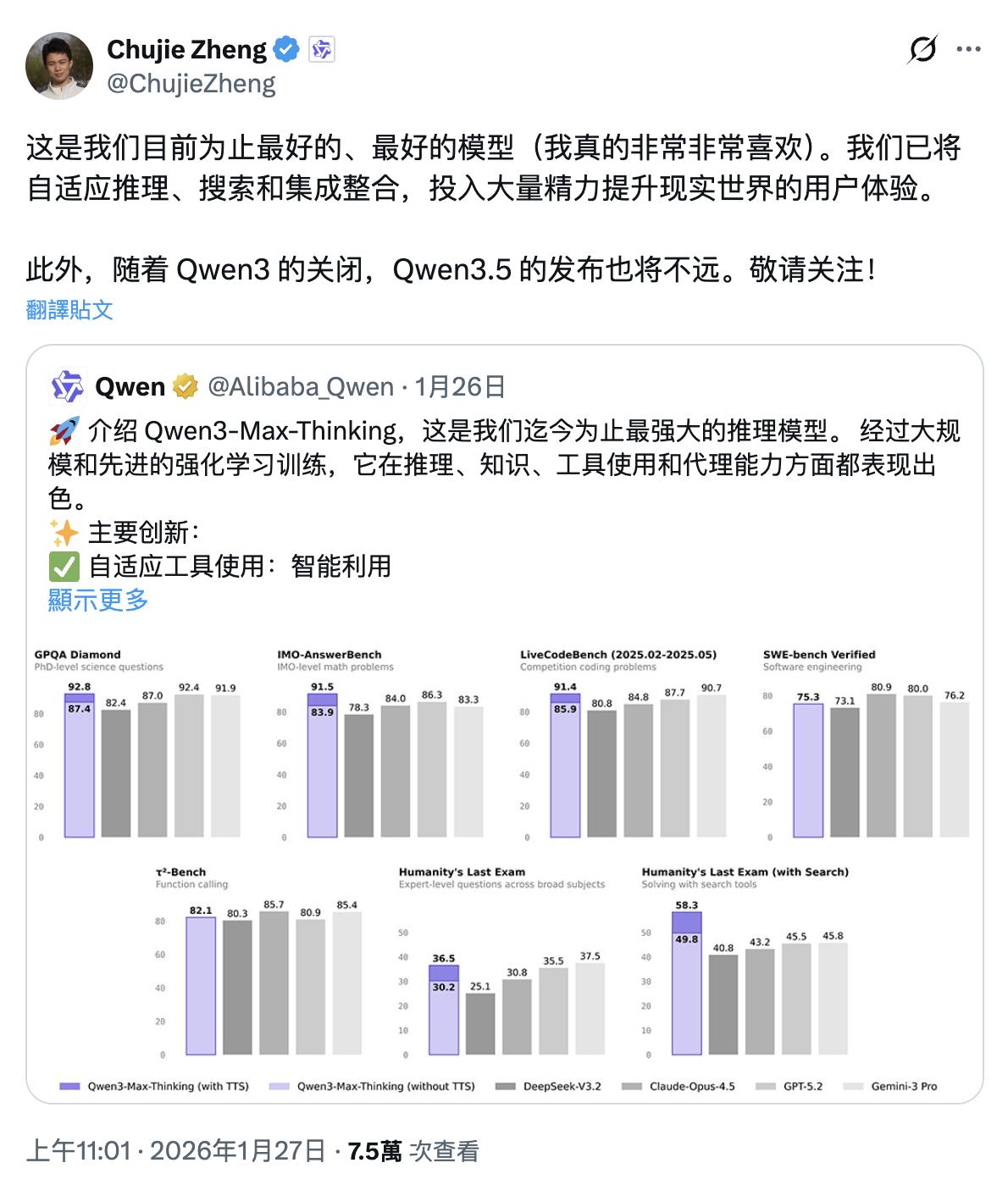
Core Insights - The AI model competition is heating up with multiple new releases expected around the Chinese New Year in early 2026, including significant updates from major players like OpenAI, Anthropic, and domestic companies such as Qwen and DeepSeek [1][2][20]. Group 1: Upcoming Model Releases - Major updates are anticipated from Qwen, with Qwen3-Max-Thinking being highlighted as the best model to date, and Qwen 3.5 expected soon [2][4]. - Other companies like ByteDance are also set to release new models, including Doubao 2.0 and Seedream 5.0, in March [5]. - The upcoming releases are not just limited to minor iterations but represent a broader trend of simultaneous major updates across the industry [7][21]. Group 2: Shift in Model Capabilities - The focus of the new generation of models is shifting from merely larger and stronger models to practical applications and enhanced reasoning capabilities [8][23]. - Reinforcement learning is being reintroduced, and reasoning is becoming a default capability rather than a unique selling point [9][10]. - Long context handling is emphasized as a core upgrade, with models like GLM-5 and Gemini 3.5 designed for real-world applications rather than just performance metrics [14][16]. Group 3: The Role of Agents - Agents are evolving from demonstration tools to central components of AI systems, with a focus on completing complex tasks with minimal human intervention [17][19]. - New models are being designed to enhance multi-agent collaboration and maintain context over long tasks, indicating a shift towards more integrated AI solutions [17][19]. - The success of these models will depend on their ability to be embedded into various systems, transforming them from simple assistants to essential engines of operation [19][25]. Group 4: Competitive Landscape and Market Dynamics - The timing of these releases is strategic, capitalizing on the heightened attention around the Chinese New Year, which previously saw significant developments in the AI sector [20][21]. - The upcoming model releases are expected to lead to rapid comparisons in real-world applications, with developers and users able to test capabilities almost immediately [22][23]. - The true measure of success will not be the initial release but rather the ability to integrate these models into everyday tools and systems, influencing the competitive landscape for the year ahead [25][26].
谁能接住马化腾的红包?
Sou Hu Cai Jing· 2026-01-27 06:08
Group 1 - The core viewpoint of the article is that the domestic AI industry in China is expected to undergo three major changes in 2026: significant technological investment, intense competition differentiation, and market segmentation [1][30]. - The competition among major internet companies is intensifying, with Tencent, Baidu, and ByteDance engaging in a "red envelope war" during the Spring Festival, reminiscent of past marketing battles [3][6][7]. - Tencent announced a cash giveaway of 1 billion yuan through its Yuanbao app, while Baidu and ByteDance also made significant marketing moves, indicating a shift from pure model competition to application and entry competition [7][21]. Group 2 - In 2025, major companies are heavily investing in AI, with ByteDance's capital expenditure expected to reach 300 billion yuan, while Alibaba plans to invest 380 billion yuan over three years, setting a record for domestic AI spending [14][15]. - The competitive landscape is characterized by a "Warring States" model, with major players like ByteDance, Alibaba, Tencent, and Baidu each having distinct strengths and strategies [17][20]. - The article highlights that the current competition is not just about AI models but also encompasses the entire ecosystem from cloud services to applications, with companies like Alibaba focusing on creating a comprehensive application ecosystem [21][24].




中泰期货晨会纪要-20260112
Zhong Tai Qi Huo· 2026-01-12 01:27
1. Report Industry Investment Rating No relevant content provided. 2. Core Viewpoints of the Report - A-share market showed a strong upward trend on Friday, with the Shanghai Composite Index achieving 16 consecutive positive days and breaking through the 4100-point mark. The market turnover exceeded 3.1 trillion yuan, indicating a high level of market activity. The overall economic climate in China is improving, with the CPI and PPI showing positive trends, and the PMI indices rising above the expansion range [15]. - Different commodity futures have various trends and investment suggestions. For example, in the black sector, it is expected to be in a short - term shock and medium - long - term bottom - building state; in the agricultural product sector, different products such as cotton, sugar, and eggs have their own supply - demand situations and price trends [18][32]. 3. Summary by Relevant Catalogs 3.1 Macro Information - The State Council's Anti - monopoly and Anti - unfair Competition Committee Office will investigate and evaluate the market competition in the food delivery platform service industry. Meituan, Taobao Flash Delivery, and JD Delivery will cooperate actively [8]. - China declared multiple satellite constellation plans to the ITU in the last week of 2025, with a total scale of over 200,000 satellites [8]. - The Fed's interest rate cut expectation in January 2026 is completely dashed. The US non - farm payrolls data in December 2025 was lower than expected, but the unemployment rate decreased, reducing the possibility of an interest rate cut [8]. - The State Council executive meeting deployed a package of fiscal and financial policies to promote domestic demand, including loan discount policies and risk - sharing mechanisms [9]. - In December 2025, China's CPI and core CPI increased year - on - year, and the PPI decline narrowed. The CPI and PPI both increased month - on - month [9]. - The regulatory authorities have issued new policy guidance on real estate financing, allowing loans for projects on the "white list" to be extended for up to 5 years [9]. - China has made a major breakthrough in the extraction and separation technology of salt lake lithium resources, improving the lithium ion recovery rate and reducing costs and energy consumption [9]. - DeepSeek plans to launch a new flagship AI model V4 around the Chinese New Year in mid - February, which shows better performance in code generation than existing mainstream models [10]. - The AGI - Next Frontier Summit believes that the competition in large models has shifted from the "Chat" to the "Agent" stage [10]. - Fund companies and sales institutions have received a notice on the implementation of regulations on the sales fees of publicly offered securities investment funds, with three key points attracting attention [10]. - The price of storage chips has skyrocketed, and tech giants are competing for DRAM supplies. The price of 8GB DDR4 memory has increased by more than 5 times in a year [11]. - The US Supreme Court has not made a ruling on Trump's tariffs, and the next announcement is on January 14. The government is prepared to re - implement tariffs if necessary [11]. - Trump has cancelled the second wave of military strikes against Venezuela, maintained the deployment of US ships, and plans to buy $200 billion in mortgage - backed securities to lower mortgage rates [11]. - Trump has called for setting a 10% cap on credit card interest rates for one year starting from January 20, but the feasibility is uncertain [12]. - Trump discussed with oil company executives how to rebuild Venezuela's oil industry and announced that the US will start refining and selling up to 50 million barrels of Venezuelan oil [12]. 3.2 Macro Finance 3.2.1 Stock Index Futures - The strategy is to consider following the trend, but be cautious about chasing highs due to the recent large short - term gains. The A - share market has been rising strongly, and the economic climate is improving, with the stock index breaking through the previous shock platform [14][15]. 3.2.2 Treasury Bond Futures - The strategy is to flatten the yield curve. The money market is balanced, and the bond market sentiment has declined. The central bank's monetary policy shows a retreat trend, and fiscal subsidy policies for consumption have been announced [16]. 3.3 Black Sector 3.3.1 Spiral Steel Rebar and Iron Ore - From a policy perspective, there is no new demand - side policy, and the supply - side policy interference for the steel industry is low, which is relatively negative for finished products and steel mill profits. - Fundamentally, the steel demand is under seasonal pressure, and the supply is relatively stable with low profits. The inventory has started to accumulate, and in the short - term, it is expected to fluctuate and be in a medium - long - term bottom - building state [18]. 3.3.2 Coking Coal and Coke - The prices of coking coal and coke may fluctuate and rise in the short term. The supply side of coal has disturbances, and the downstream demand support has declined. The potential negative feedback risk still restricts the price increase, and the rebound space may be limited [20]. 3.3.3 Ferroalloys - The fundamentals of ferrosilicon and silicomanganese are still bearish, but the cost side may have a phased positive impact. It is recommended to control positions, hold short positions in silicomanganese at high levels, and temporarily observe ferrosilicon [21]. 3.3.4 Soda Ash and Glass - For soda ash, it is advisable to wait and see. The supply is at a high level, and attention should be paid to new production capacity and cost - side expectations. - For glass, a long - holding strategy or partial profit - taking at high prices can be considered. The market sentiment has been boosted, and attention should be paid to cold repair and downstream purchasing sentiment [22]. 3.4 Non - ferrous Metals and New Materials 3.4.1 Shanghai Zinc - Domestic zinc inventories are increasing, and the supply is expected to increase slightly in January. The demand is still resilient but is expected to weaken compared to December. It is recommended to wait and see, and aggressive investors can short at high prices [24][25]. 3.4.2 Shanghai Lead - The fundamentals of lead are weak, with low downstream demand. Although the lead price may rebound before delivery, there is still a risk of inventory accumulation dragging down the price. It is recommended to hold previous short positions [26]. 3.4.3 Lithium Carbonate - The short - term fundamentals show signs of weakening, but the production resumption expectation is reduced due to mine disruptions. The long - term demand is positive, and it is expected to fluctuate at a high level in the short term [27]. 3.4.4 Industrial Silicon - The downstream demand has phased policy - driven support for export rush. The previous oversupply expectation needs time to verify the turn, and the disk is expected to fluctuate strongly but is still under upward pressure [28]. 3.4.5 Polysilicon - It is possible to try to buy at low prices with cautious positions. The market is worried about changes in the industrial pattern after the regulatory meeting, and the export tax - rebate cancellation policy may drive an export rush in the first quarter [28][29]. 3.5 Agricultural Products 3.5.1 Cotton - The short - term supply is loose, but the long - term supply is expected to shrink. The contradiction between pre - festival restocking and declining开工 leads to a short - term downward trend. Attention should be paid to the USDA report and the next target price subsidy policy [32][33]. 3.5.2 Sugar - The domestic sugar market is in a season of both strong supply and demand. The price is under pressure but also supported, and it is recommended to conduct short - term trading in the low - price range. The global sugar market still faces an oversupply situation [34][35]. 3.5.3 Eggs - The 02 - 03 contracts of eggs are currently at a discount to the spot price and are driven by the short - term strength of the spot market. However, as the inventory of laying hens is still high and the post - holiday demand may decline, the upside space is limited. The futures contracts are in a near - strong and far - weak contango pattern [36]. 3.5.4 Apples - The supply side has the characteristics of "less quantity and poor quality" and low inventory, while the demand side is weak. The price is expected to fluctuate within a range, and high - quality products may remain stable. The market may show a strong trend if the demand decline is controlled during the Spring Festival [37]. 3.5.5 Corn - The short - term price is expected to fluctuate strongly. The key to the price trend lies in the change of farmers' selling sentiment. Although there are some negative factors, the probability of a "panic selling" before the Spring Festival is low. Attention should be paid to the selling situation in March [38]. 3.5.6 Red Dates - The current market is in an oversupply situation, and the price lacks upward momentum. It is expected to fluctuate in the short term, and attention should be paid to the sales situation during the consumption peak season [39]. 3.5.7 Live Pigs - The consumption in the first half of January lacks significant improvement. It is expected that large - scale enterprises will resume slaughter in the middle of the month, and the spot price may decline. The main futures contract should be shorted at high prices [39][40]. 3.6 Energy and Chemicals 3.6.1 Crude Oil - Venezuela is expected to resume oil exports, but the geopolitical situation in Iran has heated up again, bringing support to oil prices. Although the fundamentals show an oversupply situation, the geopolitical premium still exists [43]. 3.6.2 Fuel Oil - The price of fuel oil is mainly driven by geopolitical and macro factors and will follow the trend of crude oil prices. The supply - demand relationship has improved marginally, and the focus is on the Iranian situation and the potential substitution role of fuel oil [44]. 3.6.3 Plastics - The supply pressure of polyolefins is large, and the downstream demand is weak. Although the upstream production enterprises are suffering losses, which may provide some support, there is no strong upward - driving force. It is recommended to adopt a shock - trading strategy and beware of回调 risks [44][45]. 3.6.4 Rubber - The short - term international macro environment and trading system may increase capital participation, but the lack of obvious supply - demand contradictions may limit the upward space. It is expected to fluctuate, and short - long opportunities during回调 can be considered [45]. 3.6.5 Synthetic Rubber - The short - term sentiment fluctuates significantly. It is advisable to wait and see if there are no positions. The price is under pressure due to the decline of downstream products and poor high - price transactions [46][47]. 3.6.6 Methanol - The current supply - demand situation of methanol has improved slightly, but the inventory is still relatively high, and there is a possibility of further accumulation at the end of the month. In the long term, the fundamentals are improving, and long positions in far - month contracts can be gradually considered [48]. 3.6.7 Caustic Soda - The caustic soda market follows the general trend of the commodity futures market and has weak fundamentals. The cost has decreased, and the futures price should be treated with a wide - range shock strategy [49]. 3.6.8 Asphalt - The short - term price fluctuation of asphalt may increase due to raw material factors. The future focus is on the price bottom after the winter storage game. The price of asphalt has stabilized after the increase [49][50]. 3.6.9 Polyester Industry Chain - In the short term, the price will fluctuate with the cost. PX and PTA 5 - 9 inter - month positive spreads can be considered. The supply - demand relationship of each product in the polyester chain shows different trends, and the overall rebound height is restricted by the terminal negative feedback [51]. 3.6.10 Liquefied Petroleum Gas (LPG) - Affected by the Iranian geopolitical conflict, the price of LPG has increased. The import cost provides support, and the demand is in the peak season. It still has some rebound momentum, but it is recommended to wait and see and not chase the rise [52][53]. 3.6.11 Pulp - The spot market trading sentiment is weakening, and the disk faces hedging pressure. However, the fundamentals are stable, and the external market price is strong, providing support for the domestic price. It is recommended to wait and see [54]. 3.6.12 Logs - The fundamentals are weakly bearish, and the spot price has temporarily stabilized. The market is expected to maintain a weak supply - demand balance, and the disk is expected to fluctuate [55]. 3.6.13 Urea - The coal price has increased, and the spot market trading of urea has weakened. After the price reduction, the trading of some factories is acceptable. The futures price maintains a shock trend [56].
OpenAI发布GPT-5.2系列:从“问答”迈向“交付”,生产力工具的全面进化
Haitong Securities International· 2025-12-12 15:02
Investment Rating - The report does not explicitly state an investment rating for the industry or specific companies involved. Core Insights - The launch of the GPT-5.2 series by OpenAI marks a significant enhancement in its deliverable capabilities, which is expected to increase AI penetration in knowledge-based roles. The model achieved a 70.9% win or tie rate in the GDPval benchmark, with a notable improvement of 9.3 percentage points in spreadsheet modeling tasks for junior investment banking analysts [2][13]. - The transition of model capabilities from merely providing answers to completing end-to-end tasks is highlighted, with a 98.7% completion rate in the Tau2-bench Telecom task and a 55.6% score in SWE-Bench Pro evaluations, indicating enhanced reliability in complex workflows [3][14]. - OpenAI's pricing strategy for the GPT-5.2 series emphasizes efficiency improvements through scenario segmentation, with a steeper pricing gradient for different model capabilities, aiming to increase Average Revenue Per User (ARPU) without significantly lowering service thresholds [4][15]. - The competitive landscape is evolving, with OpenAI's release of GPT-5.2 seen as a direct response to Google Gemini 3, indicating a shift in competition towards distribution channel control and enterprise system integration capabilities [5][16]. Summary by Sections Event Overview - OpenAI officially launched the GPT-5.2 model series on December 11, 2025, targeting professional knowledge work and long-horizon tasks, with significant performance enhancements in various applications [1][12]. Product Enhancements - The GPT-5.2 upgrade focuses on improving the quality of deliverables, particularly in financial modeling and presentation generation, which are critical for enterprise productivity scenarios [2][13]. Commercial Strategy - The pricing model for GPT-5.2 is designed to encourage precise model selection based on task complexity, thereby optimizing user engagement and revenue generation [4][15]. Competitive Dynamics - The introduction of GPT-5.2 is part of an ongoing "iteration speed war" among leading AI firms, with a focus on transforming model capabilities into scalable productivity solutions [5][16].
OpenAI用“大蒜”反击“可能倒闭”
阿尔法工场研究院· 2025-12-09 00:06
Core Viewpoint - The competition between OpenAI and Google in the AI sector has intensified, with OpenAI acknowledging its lag in pre-training capabilities and user engagement, leading to a strategic shift towards enhancing ChatGPT's performance and user experience [4][5][9]. Group 1: OpenAI's Response to Competition - OpenAI's CEO Sam Altman issued a "red alert" internally, indicating that ChatGPT is at a critical juncture due to competitive pressures from Google's Gemini3, which has significantly impacted ChatGPT's user traffic [4][9]. - Following the launch of Gemini3, ChatGPT's daily average visits dropped by approximately 6%, from 203 million to 191 million, highlighting the urgency for OpenAI to refocus its resources on core product enhancements [7][10]. - OpenAI is developing a new model, codenamed "Garlic," aimed at addressing pre-training issues and improving performance in programming and reasoning tasks, with expectations for a release in early 2024 [5][7]. Group 2: Strategic Focus Areas for ChatGPT - OpenAI plans to enhance user personalization, allowing around 800 million active users to customize AI responses more flexibly [11]. - The company aims to accelerate improvements in image generation capabilities to compete with Google's recently released models, particularly in high-demand applications like interior design [12]. - OpenAI is also focusing on improving public perception and user satisfaction, ensuring its models consistently outperform competitors on evaluation platforms [12]. Group 3: Ecosystem Competition - The competition has evolved beyond technical specifications to a deeper battle over ecosystem integration, with Google leveraging its extensive digital ecosystem to provide seamless user experiences [15][16]. - Google's Gemini benefits from a rich array of data sources and services, allowing it to deliver more contextually relevant interactions, while OpenAI's products often require users to actively engage with the AI, leading to a fragmented experience [16][18]. - The lack of localized data and cultural context in OpenAI's offerings has resulted in a disadvantage in markets like China, where Google has established a stronger foothold [17]. Group 4: Future Outlook - The future of AI competition will hinge on the ability to integrate AI into everyday user interactions, with Google positioned to embed AI as a foundational element of its services [19]. - OpenAI's potential to regain its competitive edge will depend on successfully launching new models like "Garlic" and forming partnerships with consumer platforms to create a more cohesive user experience [19].


深度讨论 Gemini 3 :Google 王者回归,LLM 新一轮排位赛猜想|Best Ideas
海外独角兽· 2025-11-26 10:41
Core Insights - Gemini 3 represents Google's significant return to leadership in the AI space, marking the beginning of a new competitive landscape among major players like OpenAI and Anthropic [4][14]. Group 1: Model Strength and Capabilities - Gemini 3's training FLOPs reached 6 × 10^25, indicating a substantial investment in pre-training compute power, allowing Google to catch up with OpenAI [5][6]. - The model's data volume is speculated to have doubled compared to Gemini 2.5, providing a significant advantage in pre-training and creating a strong intellectual barrier [7]. - Gemini 3 employs a Sparse Mixture-of-Experts (MoE) architecture, achieving over 50% sparsity, which allows for efficient computation while maintaining a vast parameter space [10][11]. Group 2: Competitive Landscape - The competitive landscape is evolving into a dynamic structure where Google, Anthropic, and OpenAI alternate in leadership positions, reflecting their differing technological and commercial strategies [14][15]. - Google has a cost advantage in inference due to its proprietary TPU cluster, while its coding capabilities are on par with OpenAI and Anthropic [15][17]. Group 3: Benchmark Performance - Gemini 3 outperformed its competitors in various benchmarks, achieving 91.9% in scientific knowledge tests and 95.0% in mathematics without tools, showcasing its superior reasoning capabilities [16]. - In terms of speed, Gemini 3 processes tasks approximately three times faster than GPT-5.1, completing complex tasks at a significantly lower cost [22]. Group 4: Organizational and Developmental Insights - The successful integration of DeepMind and Google Brain has led to improved model iteration speeds, overcoming previous internal challenges [13]. - Google has developed a unique "product manager-style programming" approach, enhancing user interaction and project management during coding tasks [12]. Group 5: Commercialization and User Engagement - Google is prioritizing user experience over immediate monetization, focusing on long-term user retention and ecosystem health [61][68]. - The introduction of tools like Antigravity and the integration of Gemini into Chrome are strategies to enhance user engagement and capture valuable feedback for model improvement [62][64]. Group 6: Future Prospects and Market Dynamics - The shift towards multi-modal capabilities in AI, as demonstrated by Gemini 3, positions Google favorably in the evolving landscape of AI applications, particularly in video generation [25][45]. - Google's TPU technology is projected to significantly reduce model training and inference costs, potentially disrupting Nvidia's dominance in the market [46][49].