
央企估值重塑

Search documents
华安基金:险资加大权益配置,持续增配港股红利
Xin Lang Ji Jin· 2025-11-25 09:52
Market Overview and Key Insights - The Hong Kong dividend sector experienced a decline last week, but with a smaller drop compared to the overall market: the Hang Seng Hong Kong Stock Connect China Central State-Owned Enterprises Dividend Total Return Index fell by 4.07%, while the Hang Seng Index dropped by 5.09% and the Hang Seng Tech Index decreased by 7.18% [1] - In Q3 2025, insurance capital continued to increase its allocation to equity assets, with the proportion of equity investments rising significantly to 15.5%, nearing the historical high of 16.1% recorded in mid-2015 [1] - The increase in equity allocation by insurance capital reflects the policy requirement for "long money, long investment," with an optimized assessment mechanism encouraging better alignment of asset-liability structures [1] Insurance Capital Trends - Insurance capital's funding characteristics align well with the low volatility and high dividend nature of the dividend sector, making it a primary focus for increased allocation [1] - In Q3 2025, insurance capital's net purchases in the banking sector amounted to approximately 57.35 billion [1] - The pace of insurance capital's stake acquisitions in listed companies has accelerated, with 30 instances this year, surpassing the total for 2020 and 2024, and 25 of these being in Hong Kong stocks [1] Future Outlook - Insurance capital is expected to be a significant source of incremental funds in the stock market, particularly favoring the dividend sector due to the low interest rate environment and weak economic recovery [2] - The dividend yield of the Hang Seng Hong Kong Stock Connect China Central State-Owned Enterprises Dividend Index stands at 5.81%, compared to 4.32% for the CSI Dividend Index, with a price-to-book ratio of 0.64 and a price-to-earnings ratio of 7.23 [2] - The total return index has achieved a cumulative return of 146% since early 2021, outperforming the Hang Seng Total Return Index by 136% [2] ETF Overview - The Huaan Hong Kong Stock Connect China Central State-Owned Enterprises Dividend ETF (code: 513920) tracks the Hang Seng Hong Kong Stock Connect China Central State-Owned Enterprises Dividend Index, reflecting the performance of high-dividend securities listed in Hong Kong with state-owned enterprises as the largest shareholders [3] - This ETF is the first in the market to combine the attributes of Hong Kong stocks, state-owned enterprises, and dividends [3] Recent ETF Performance - The Huaan Hong Kong Stock Connect China Central State-Owned Enterprises Dividend ETF had a net asset value of 1.6320 billion and a scale of 5.51 billion, with a weekly trading volume of 1.462 billion [4] - The top ten weighted stocks in the index have shown varying performance, with notable declines in several stocks over the past week [5]


华安基金:央企或有估值抬升空间
Zheng Quan Shi Bao Wang· 2025-11-11 06:04
Core Viewpoint - The ongoing reform of state-owned enterprises (SOEs) is expected to lead to a revaluation, enhancing the core functions and competitiveness of these enterprises [1] Group 1: State-Owned Enterprise Reform - Continuous advancement in state-owned enterprise reform is anticipated to optimize the layout and structural adjustments of the state economy [1] - The assessment indicators for central SOEs have been refined, shifting from "two profits and four rates" to "one profit and five rates," which emphasizes efficiency and cash flow [1] Group 2: Investment Opportunities - Central SOEs have historically faced low valuations, with market valuations not aligning with their economic status [1] - With improved market management and profit quality, central SOEs are expected to present further investment opportunities [1]
华安基金:港股通央企红利逆势上涨,高切低下红利价值凸显
Xin Lang Ji Jin· 2025-11-04 09:26
Market Overview and Key Insights - The Hong Kong dividend sector continued to rise last week, with the Hang Seng China Enterprises Dividend Total Return Index increasing by 1.33%, the Hang Seng Index by 0.97%, and the Hang Seng Tech Index by 0.24% [1] - In the context of high previous gains in the tech growth sector, some funds may seek to lock in profits towards the end of the year, benefiting the dividend style [1] - The U.S. Federal Reserve's recent decision to cut interest rates by 25 basis points to a range of 3.75%-4.0% and to stop balance sheet reduction is expected to maintain global liquidity [1] Fund and Investment Strategy - The Hong Kong stock market is likely to see a return of overseas funds due to the Fed's rate cut cycle, as the performance of the Hang Seng Index is negatively correlated with the U.S. dollar index and U.S. Treasury yields [2] - The dividend yield of the Hang Seng China Enterprises Dividend Index is 5.83%, significantly higher than the 4.28% of the CSI Dividend Index, with a price-to-book ratio of 0.63 and a price-to-earnings ratio of 7.16 [2] - The low interest rate environment and weak economic recovery in China are favorable for dividend strategies, with state-owned enterprises showing strong willingness and ability to distribute dividends [2] ETF Overview - The Huaan Hong Kong Stock Connect Central State-Owned Enterprises Dividend ETF (code: 513920) tracks the Hang Seng China Enterprises Dividend Index, reflecting the performance of high-dividend securities listed in Hong Kong with state-owned enterprises as major shareholders [3] - This ETF is the first in the market to combine the attributes of Hong Kong stocks, state-owned enterprises, and dividends [3] Top Holdings Performance - The top ten weighted stocks in the ETF include China Nonferrous Mining (4.9% weight, -5.2% weekly change), COSCO Shipping Energy (4.6% weight, +0.5% weekly change), and China Petroleum & Chemical Corporation (3.1% weight, +3.4% weekly change) [4]

华安基金:港股红利上周逆势上涨,配置价值仍较高
Xin Lang Ji Jin· 2025-10-28 06:09
Market Overview and Key Insights - The Hong Kong dividend sector saw a counter-trend increase last week, with the Hang Seng Hong Kong Stock Connect China Central Enterprises Dividend Total Return Index rising by 1.11%, while the Hang Seng Index fell by 3.96% and the Hang Seng Technology Index dropped by 7.98% [1] - The utility sector led the gains among Hang Seng's primary industries, while the information technology sector experienced the largest decline [1] Investment Perspective - The previous fluctuations in the dividend style may have reached a sufficient correction, making the current investment value more attractive, with capital likely to shift towards Hong Kong dividend stocks [1] - The ongoing U.S.-China tensions may cause short-term market disturbances, and the growth sector has accumulated significant gains, leading to potential profit-taking and capital reallocation [1] - Compared to the growth sector, Hong Kong dividends have shown notable stagnation and even some decline over the past two months, highlighting a more favorable valuation [1] Policy Perspective - Policy support has enhanced the attractiveness of dividend assets, with A-share companies increasing their dividend payouts significantly in 2024, injecting long-term valuation reformation momentum into dividend assets [1] - New regulations on bond value-added tax may indirectly benefit dividend-type assets [1] Funding Perspective - The demand for long-term capital allocation, particularly from insurance funds, is expected to continue, providing stable inflows into dividend assets despite potential shifts in trading capital towards growth sectors [1] Dividend Yield and Valuation - The Hang Seng Hong Kong Stock Connect China Central Enterprises Dividend Index boasts a dividend yield of 6.02% compared to 4.42% for the CSI Dividend Index, with a price-to-book (PB) ratio of 0.61 and a price-to-earnings (PE) ratio of 6.81 [2] - Since the beginning of 2021, the total return index has achieved a cumulative return of 138%, outperforming the Hang Seng Total Return Index by 128% [2] ETF Overview - The Huaan Hong Kong Stock Connect Central Enterprises Dividend ETF (code: 513920) tracks the Hang Seng Hong Kong Stock Connect China Central Enterprises Dividend Index, reflecting the performance of high-dividend securities listed in Hong Kong with state-owned enterprises as the largest shareholders [3] - This ETF is the first in the market to combine the attributes of Hong Kong stocks, central enterprises, and dividends, providing investors with opportunities to capitalize on the valuation reformation of central enterprises [3] Recent Performance of ETF - The performance of the Huaan Hong Kong Stock Connect Central Enterprises Dividend ETF (513920) was noted last week [4] Top Holdings Performance - The top ten weighted stocks in the Hang Seng Hong Kong Stock Connect Central Enterprises Dividend Index showed varied performance, with notable dividend yields and weekly price changes [6]

华安基金:港股红利前期回调较充分,外部扰动下或迎风格切换
Xin Lang Ji Jin· 2025-10-14 09:15
Market Overview and Key Insights - The Hong Kong dividend sector saw a counter-trend increase last week, with the Hang Seng Hong Kong Stock Connect China Central State-Owned Enterprises Dividend Total Return Index rising by 1.08%, while the Hang Seng Index fell by 3.11% and the Hang Seng Tech Index dropped by 5.48% [1] - The utility and energy sectors led the gains, while consumer discretionary and healthcare sectors lagged [1] - The previous volatility in the dividend style may have been sufficiently corrected, making current valuations attractive for investment [1] Policy Support and Banking Sector Outlook - Under supportive monetary policy, the banking sector in Hong Kong is expected to see fundamental improvements, with a stabilization in interest margin decline leading to better net interest income growth [2] - Policies aimed at local debt management, stabilizing real estate, and reducing internal competition have significantly alleviated extreme risks in bank loans, which is beneficial for reducing non-performing asset pressure [2] Dividend Yield and Valuation of Central State-Owned Enterprises - The dividend yield of the Hang Seng Hong Kong Stock Connect China Central State-Owned Enterprises Dividend Index is 6.10%, compared to 4.62% for the CSI Dividend Index, with a price-to-book (PB) ratio of 0.59 and a price-to-earnings (PE) ratio of 6.67 [2] - Since the beginning of 2021, the total return index has accumulated a return of 136%, outperforming the Hang Seng Total Return Index by 121% [2] Future Market Outlook - The low interest rate environment during the domestic interest rate cut cycle and the weak economic recovery are favorable for dividend strategies [2] - The willingness and ability of central state-owned enterprises to distribute dividends are strong, enhancing the investment value of the Hong Kong Stock Connect central state-owned enterprise dividends [2] ETF Overview - The Huaan Hong Kong Stock Connect Central State-Owned Enterprises Dividend ETF (code: 513920) tracks the Hang Seng Hong Kong Stock Connect China Central State-Owned Enterprises Dividend Index, reflecting the performance of high-dividend securities listed in Hong Kong with central state-owned enterprises as the largest shareholders [3] - This ETF is the first in the market to combine the attributes of Hong Kong stocks, central state-owned enterprises, and dividends [3] Recent Performance of the ETF - The top ten weighted stocks in the Hang Seng Hong Kong Stock Connect Central State-Owned Enterprises Dividend Index have shown varied performance, with notable dividend yields and weekly price changes [6]

华安基金:险资再度密集举牌,红利资金面仍向好
Xin Lang Ji Jin· 2025-08-19 09:25
Market Overview and Key Insights - The Hong Kong stock market's dividend sector continued to rise last week, with the Hang Seng China Central State-Owned Enterprises Dividend Total Return Index increasing by 1.08%, the Hang Seng Index by 1.73%, and the Hang Seng Tech Index by 1.52% [1] - All sectors within the Hang Seng Index experienced gains, with healthcare leading and utilities lagging [1] - Foreign capital inflow into Hong Kong stocks remained strong, with a net inflow of HKD 38.1 billion from southbound funds last week [1] Dividend Strategy and Performance - The Hang Seng China Central State-Owned Enterprises Dividend Index offers a higher dividend yield of 5.83% compared to the CSI Dividend Index at 4.45%, with a price-to-book (PB) ratio of 0.64 and a price-to-earnings (PE) ratio of 6.99 [2] - Since the beginning of 2021, the total return index has accumulated a return of 134%, outperforming the Hang Seng Total Return Index by 124% [2] - The current low interest rate environment and weak economic recovery are favorable for dividend strategies, with strong dividend willingness and capability from central state-owned enterprises [2] ETF Overview - The Huaan Hong Kong Stock Connect Central State-Owned Enterprises Dividend ETF (code: 513920) tracks the Hang Seng China Central State-Owned Enterprises Dividend Index, reflecting the performance of high-dividend securities listed in Hong Kong with major shareholders being mainland central enterprises [3] - This ETF is the first in the market to combine the attributes of Hong Kong stocks, central enterprises, and dividends [3] ETF Performance - The Huaan Hong Kong Stock Connect Central State-Owned Enterprises Dividend ETF (513920) had a net asset value of 1.5848 billion and a trading volume of 7.81 billion last week [4] - The top ten weighted stocks in the index showed varied performance, with notable dividend yields and weekly price changes [4]

华安基金:雅江世纪工程开工,有望激励顺周期板块
Xin Lang Ji Jin· 2025-07-22 09:31
Market Overview and Key Insights - The Hong Kong stock market's dividend sector continued to rise last week, with the Hang Seng China Central Enterprises Dividend Total Return Index increasing by 0.31%, the Hang Seng Index rising by 2.84%, and the Hang Seng Tech Index climbing by 5.53% [1] - The pharmaceutical and consumer discretionary sectors led the gains, while the real estate and construction sectors lagged [1] - Southbound capital maintained a high net inflow, with foreign capital net inflow into Hong Kong stocks amounting to $0.98 million, compared to $10.23 million the previous week; southbound funds saw a net inflow of HK$215 billion [1] Infrastructure Development - The Yarlung Tsangpo River Century Project commenced on July 19, with a total investment of approximately ¥1.2 trillion, expected to have a significant impact on cyclical sectors [1] - This large-scale project, anticipated to last over 10 years, will drive substantial upgrades in related industries, including: - Civil engineering: Major tunneling and excavation work [1] - Machinery and high-end equipment: High demand for heavy construction machinery, large generator sets, and intelligent control systems [1] - Building materials: Significant consumption of bulk materials such as cement and steel [1] - Power grid construction: A robust transmission and distribution network is essential for power delivery [2] Investment Opportunities - The Hong Kong Central Enterprises Dividend ETF (513920) captures high-dividend central enterprises in Hong Kong, focusing on quality, high-dividend, and undervalued companies within cyclical sectors, presenting high allocation opportunities amid increased infrastructure investment and ongoing anti-involution efforts [2] - The dividend yield of the Hong Kong Central Enterprises Dividend Index is 5.81%, compared to 4.50% for the CSI Dividend Index, with a price-to-book ratio of 0.64 and a price-to-earnings ratio of 6.98; since early 2021, it has achieved a cumulative return of 124%, outperforming the Hang Seng Total Return Index by 116% [2] ETF Performance - The Hong Kong Central Enterprises Dividend ETF (513920) had a net asset value of ¥1.5198 billion, with a scale of ¥31.90 billion and a weekly trading volume of ¥8.32 billion [4] - The top ten weighted stocks in the index include: - COSCO Shipping Holdings (4.5% weight, 13.0% dividend yield, -0.3% weekly change) [5] - Orient Overseas International (4.4% weight, 11.3% dividend yield, 0.0% weekly change) [5] - New China Life Insurance (3.9% weight, 6.3% dividend yield, 1.0% weekly change) [5] - China National Offshore Oil Corporation (2.8% weight, 7.6% dividend yield, 1.1% weekly change) [5]

华安基金:美联储降息周期延续,险资青睐港股红利
Quan Jing Wang· 2025-06-24 06:58
Market Overview and Key Insights - The Hong Kong stock market experienced a decline last week, with the Hang Seng Index dropping by 1.43% and the Hang Seng Technology Index falling by 2.03%. The Hang Seng China Enterprises Dividend Index decreased by 0.70% [1] - The information technology sector led the gains among Hang Seng's primary industries, while healthcare and energy sectors saw the largest declines [1] - There was a significant increase in passive foreign capital inflows, with a net inflow of $1.64 billion into Chinese stocks from foreign investors, compared to a net inflow of $0.03 billion the previous week [1] - Southbound capital also remained strong, with a net inflow of HKD 16.3 billion [1] Dividend Strategy and Outlook - The dividend yield of the Hang Seng China Enterprises Dividend Index reached 7.90%, significantly higher than the 5.56% yield of the CSI Dividend Index. The price-to-book (PB) ratio is 0.62, and the price-to-earnings (PE) ratio is 6.79 [2] - Since the beginning of 2021, the total return of the full return index has been 114%, outperforming the Hang Seng full return index by 113% [2] - The low interest rate environment and weak economic recovery in China are favorable for dividend strategies, with state-owned enterprises showing strong willingness and capability for dividend distribution [2] ETF Performance - The Huaan Hong Kong Stock Connect Central State-Owned Enterprises Dividend ETF (code: 513920) tracks the Hang Seng China Enterprises Dividend Index and aims to reflect the performance of high-dividend securities listed in Hong Kong with major shareholders being mainland state-owned enterprises [3] - The ETF is the first in the market to combine attributes of Hong Kong stocks, state-owned enterprises, and dividends [3] - The ETF had a scale of CNY 1.4856 billion and a weekly trading volume of CNY 1.012 billion [4] Top Holdings in the Dividend Index - The top ten weighted stocks in the Hang Seng China Enterprises Dividend Index include: - China COSCO Shipping (4.7% weight, 12-month dividend yield of 13.0%) - Orient Overseas International (4.5% weight, 12-month dividend yield of 11.4%) - New China Life Insurance (3.6% weight, 12-month dividend yield of 3.9%) - China National Offshore Oil (2.8% weight, 12-month dividend yield of 7.8%) [5]

华安基金:港股红利延续上涨,年度调仓吐故纳新
Xin Lang Ji Jin· 2025-06-17 02:45
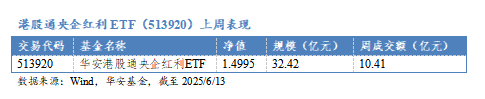
Market Overview and Key Insights - The Hong Kong stock market saw gains last week, with the Hang Seng China Enterprises Index rising by 4.43% and the Hang Seng Index increasing by 0.75% [1] - The healthcare and materials sectors led the gains, while consumer and information technology sectors lagged [1] - There was a shift in capital flow, with passive foreign capital turning into inflows, and significant net inflows from southbound trading [1] Central State-Owned Enterprises (SOEs) Buyback and Dividend Trends - As of June 12, 2023, 65 central state-owned enterprises (SOEs) implemented buybacks totaling 8.672 billion yuan, while 53 companies saw shareholder increases amounting to 7.39 billion yuan, leading to a combined total of 16.062 billion yuan [2] - The dividend yield for the Hang Seng China Enterprises Index stands at 8.17%, significantly higher than the 5.62% yield of the CSI Dividend Index, with a price-to-book (PB) ratio of 0.62 and a price-to-earnings (PE) ratio of 6.77 [2] - The total return of the Hang Seng China Enterprises Index has reached 116% since early 2021, outperforming the Hang Seng Total Return Index by 113% [2] Investment Opportunities in High Dividend Strategies - The current low interest rate environment and weak economic recovery favor dividend strategies, with strong dividend willingness and capability among central SOEs [2] - The Huaan Hong Kong Stock Connect Central SOE Dividend ETF tracks the Hang Seng China Enterprises Dividend Index, reflecting the performance of high-dividend securities listed in Hong Kong with central SOEs as major shareholders [2] ETF Performance and Characteristics - The Huaan Hong Kong Stock Connect Central SOE Dividend ETF (513920) is the first ETF in the market combining the attributes of Hong Kong stocks, central SOEs, and high dividends [3] - The fund has a net asset value of 1.4995 and a scale of 3.242 billion yuan, with a weekly trading volume of 1.041 billion yuan [4] Sector-Specific Dividend Yields - Notable companies with high dividend yields include: - COSCO Shipping Holdings (4.5% yield, industrial sector) [5] - Orient Overseas International (4.5% yield, industrial sector) [5] - New China Life Insurance (3.5% yield, financial sector) [5] - China National Petroleum (3.1% yield, energy sector) [5]
央企控股上市公司密集发声,多措并举加强市值管理
Di Yi Cai Jing· 2025-06-08 02:45
Core Viewpoint - The management of state-owned enterprises (SOEs) in China has shifted from policy advocacy to substantive implementation, with expectations for valuation restructuring and market confidence enhancement as assessment mechanisms and supporting policies improve [1][5]. Group 1: SOE Value Management - The State-owned Assets Supervision and Administration Commission (SASAC) has emphasized improving the quality of SOEs' listed companies and enhancing value management to stabilize market expectations [1][4]. - Several SOEs have held performance briefings and investor engagement activities, committing to increase dividend payouts and enhance shareholder returns while focusing on core business improvement and innovation [1][2]. - China National Nuclear Corporation (CNNC) reported a market value of approximately 260 billion yuan, with a year-on-year increase of over 30%, highlighting its commitment to shareholder value through strategic investments [1][2]. Group 2: Dividend Policies - China National Power has maintained a cash dividend payout ratio exceeding 35% for ten consecutive years, with the 2024 dividend ratio reaching a historical high of 41.92%, totaling over 24 billion yuan in cumulative dividends [2]. - China Nuclear Technology has consistently returned cash dividends for 18 years, with a 2024 payout ratio of 32.43% and an average payout ratio exceeding 30% from 2020 to 2024 [2]. - China Huaneng Group is focused on enhancing dividend frequency and amounts across its listed companies to stabilize market value [2]. Group 3: Innovation and Reform - Accelerating innovation and deepening reforms are crucial for SOEs to enhance value management and improve the quality of listed companies [3][4]. - The State Grid Corporation is implementing multiple measures to promote high-quality development of its listed companies, focusing on energy transition and new power system construction [3]. - China Aerospace Science and Technology Corporation aims to enhance innovation capabilities and integrate technology and industry innovation to improve value creation [3]. Group 4: Regulatory Framework - The SASAC has issued guidelines to improve the market value management of SOEs, emphasizing the importance of maintaining investor rights and promoting healthy capital market development [3][4]. - Recent analyses indicate that value management is essential for listed companies to enhance intrinsic value and market performance through various compliant methods [4][5]. - SOEs are increasingly formalizing their value management practices, including the establishment of value enhancement plans and regular communication with investors [5].


