改善性需求

Search documents
机构:2025年核心城市二手房成交量维持稳定规模
Feng Huang Wang· 2026-01-04 01:35
Core Insights - The overall real estate market in China is expected to continue its adjustment trend in 2025, with second-hand housing in core cities maintaining stable volumes through "price for volume" strategies, while improvement demand becomes the main support for the new housing market [1][6] - The report anticipates that policy optimizations in Beijing and tax reductions will be implemented by the end of 2025, with further policy efforts expected in 2026 to stabilize the real estate market [1][6] Second-hand Housing Market - In 2025, approximately 1.74 million second-hand residential units are expected to be sold in 30 key cities, showing a year-on-year stability [1] - The first quarter of 2025 saw a 25% year-on-year increase in second-hand housing transactions, while the second quarter experienced a slowdown [1] - Major cities like Shanghai and Shenzhen showed significant rebounds in transaction volumes, with year-on-year increases of 7% and 4% respectively [2][1] - The proportion of second-hand housing transactions in the total market is projected to rise to about 65% in 2025, up 4 percentage points from 2024 [2] New Housing Market - Improvement housing demand is identified as a key support for the new housing market, with larger units (120-144 square meters) seeing increased sales [3] - In 2025, 20 out of 30 representative cities reported an increase in the sales of larger units compared to the same period in 2024 [3] - The average clearing cycle for available inventory in 50 cities is reported to be 22.2 months, indicating a slow-moving market [3] Policy Changes - A significant policy optimization was announced in Beijing on December 24, 2025, aimed at stimulating the market through various measures, including lowering social security requirements for non-local buyers and supporting multi-child families [4] - Following the new policies, there was an increase in the average daily signing of new and second-hand homes in Beijing, indicating a positive market response [4] - The Ministry of Finance and the State Administration of Taxation announced a new tax policy effective January 1, 2026, which will impact the sale of homes purchased for less than two years [5] Future Outlook - The report suggests that policies aimed at stabilizing the real estate market will continue to be implemented in 2026, focusing on demand stimulation and supply optimization [6] - The overall market is still in a "de-inventory" phase, with limited new housing supply in most cities, which may pose challenges for market recovery [6]
机构:2025年核心城市二手房成交量维持稳定规模,改善需求成新房市场核心支撑
Xin Lang Cai Jing· 2026-01-03 10:00
Core Viewpoint - The real estate market in China is expected to continue its adjustment trend in 2025, with second-hand housing in core cities maintaining stability through "price for volume" strategies, while improvement demand becomes the main support for the new housing market [1] Group 1: Second-hand Housing Market - In 2025, the transaction volume of second-hand residential properties in 30 key cities is estimated to be around 1.74 million units, remaining stable year-on-year [1] - The first quarter of 2025 saw a 25% year-on-year increase in second-hand housing transactions, while the second quarter experienced a slowdown, with a 13% year-on-year growth in September [1] - The proportion of second-hand housing transactions in the total market reached approximately 65% in 2025, an increase of 4 percentage points from 2024 [2] Group 2: New Housing Market - Improvement housing demand is a significant support for the new housing market, with larger units (120-144 square meters) seeing an increase in transaction share across 30 representative cities [3] - The average clearing cycle for available inventory in 50 cities is 22.2 months, indicating a slow-moving market [3] - New housing prices in 100 cities have increased by 2.58% due to the entry of improvement-type properties, while second-hand housing prices have decreased by 8.36% cumulatively [3] Group 3: Policy Impact - A policy optimization announced in December 2025 in Beijing aims to stimulate the market by lowering purchase requirements for non-local families and supporting multi-child families [4] - Following the new policy, the average daily signing volume for new and second-hand homes in Beijing increased by 72.8% and 37.4% respectively compared to the previous period [4] - The Ministry of Finance and the State Administration of Taxation announced a new tax policy effective January 1, 2026, which will impact the sale of homes purchased less than two years ago [5] Group 4: Future Outlook - The report anticipates that policies will continue to be implemented in 2026 to stabilize the real estate market, focusing on demand stimulation and supply optimization [6] - The overall market is still in a "de-stocking" phase, with limited new housing supply in most cities, while core cities maintain a certain level of new supply [6]
2025年12月百城新房价格同比小涨 二手房价下跌
Zhong Guo Xin Wen Wang· 2026-01-01 10:54
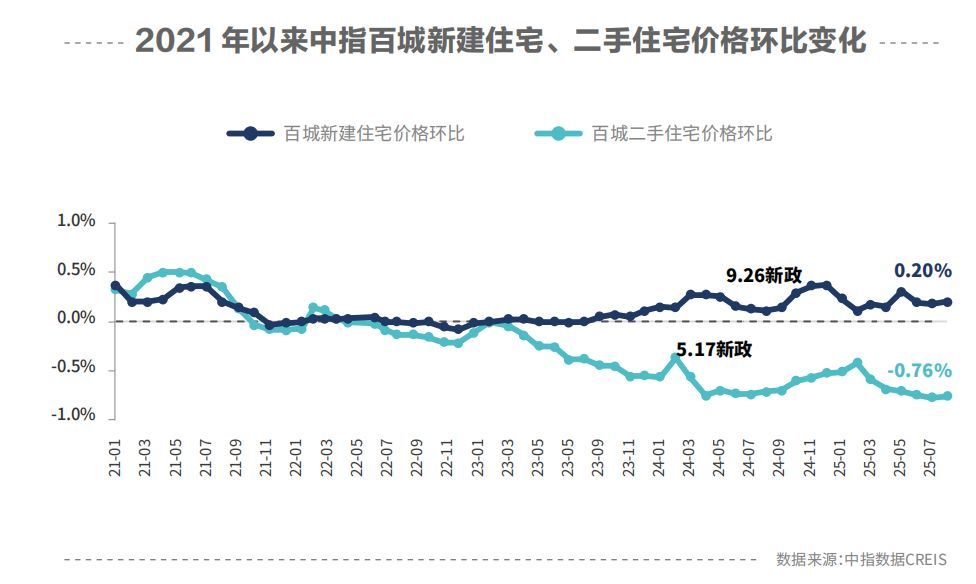
Group 1 - The core viewpoint indicates that the price divergence between new and second-hand housing in major Chinese cities will continue until the end of 2025 [1] - In December 2025, the average price of newly built residential properties in 100 cities is projected to be 17,084 yuan per square meter, with a month-on-month increase of 0.28% and a year-on-year increase of 2.58% [1] - The average price of second-hand residential properties in the same cities is expected to be 13,016 yuan per square meter, showing a month-on-month decrease of 0.97% and a year-on-year decrease of 8.36% [1] Group 2 - The Central Economic Work Conference in December 2025 emphasized the importance of stabilizing the real estate market, leading to the introduction of several related policies [1] - A new tax policy was announced on December 30, reducing the value-added tax on personal sales of housing purchased for less than two years from 5% to 3%, while properties held for over two years remain exempt from VAT [1] - The analysis from the China Index Academy suggests that 2026 will be a crucial year for stabilizing the real estate market, with potential policy optimizations in core cities like Beijing, Shanghai, and Shenzhen [2]
房地产:未来5年需求约49.8亿平,中后期或走出低迷
Sou Hu Cai Jing· 2025-12-18 12:16
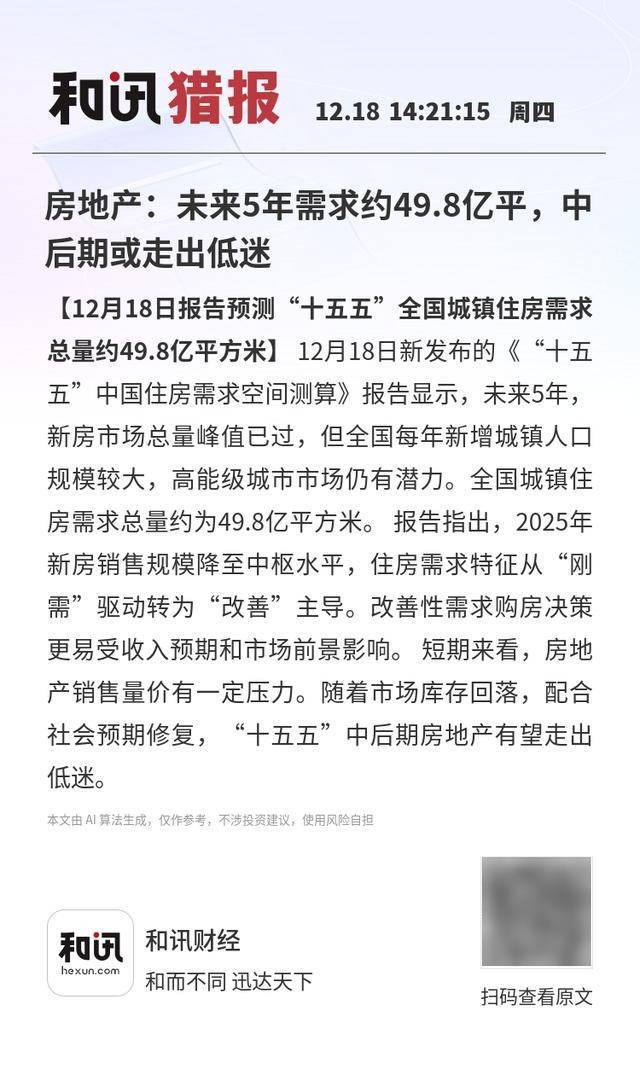
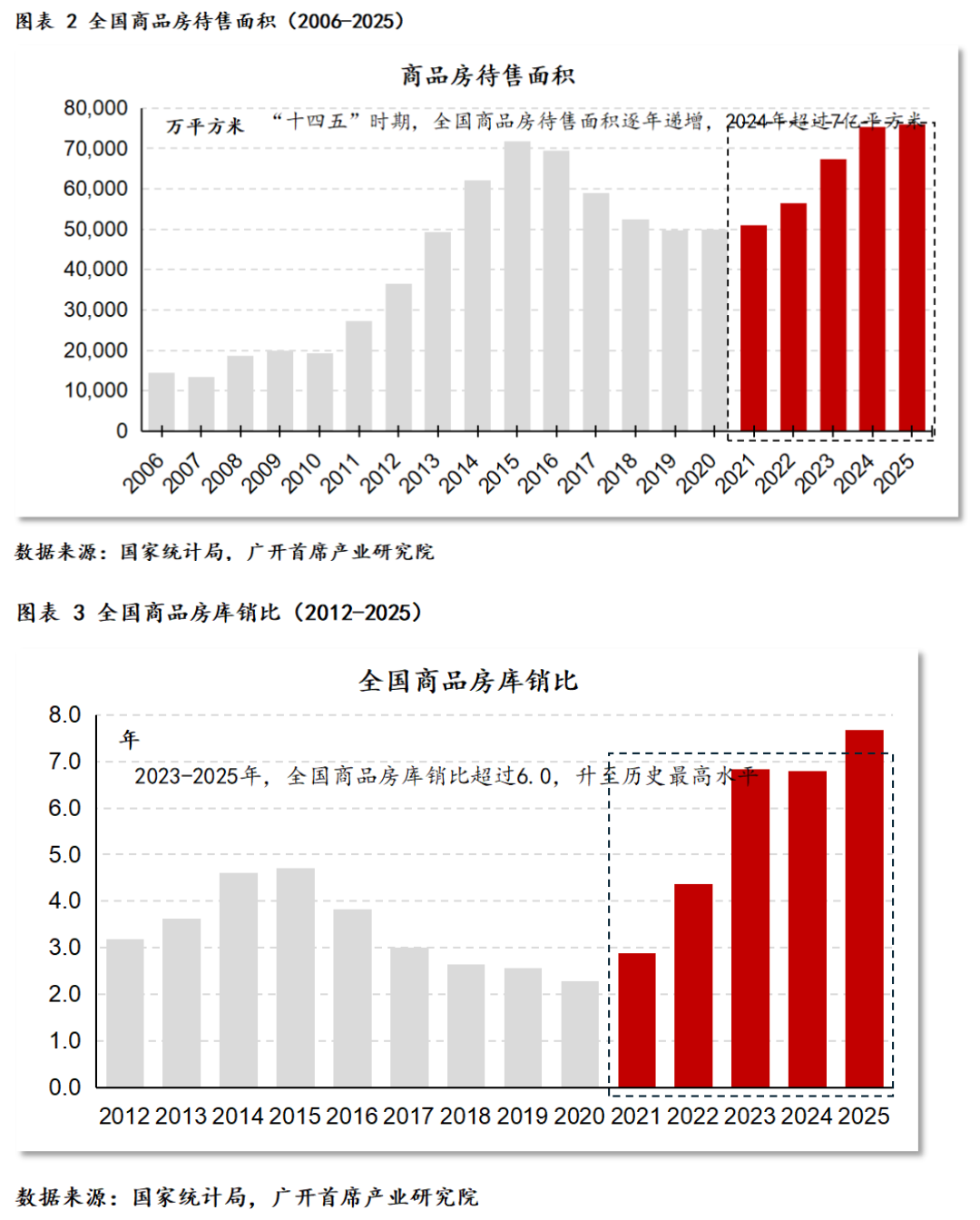
Core Insights - The report predicts that the total urban housing demand in China during the "14th Five-Year Plan" period will be approximately 4.98 billion square meters [1] - The new housing market has peaked, but there remains potential in high-tier cities due to significant annual urban population growth [1] - By 2025, new home sales are expected to stabilize at a mid-level, shifting housing demand characteristics from "first-time buyers" to "improvement-driven" [1] - Improvement-driven purchasing decisions are more influenced by income expectations and market outlook [1] - In the short term, there will be pressure on both sales volume and prices in the real estate market [1] - As market inventory decreases and social expectations recover, the real estate sector is anticipated to emerge from its downturn in the latter half of the "14th Five-Year Plan" [1]

近3年,是咬牙买房,还是果断卖房?内行人:不要选错
Sou Hu Cai Jing· 2025-11-25 01:39
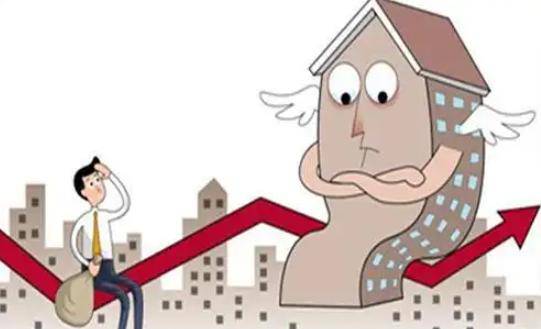
Core Insights - The current real estate market is experiencing a significant adjustment, with a notable decline in both new and second-hand housing prices across many cities in China [3][6][9] - The buyer's market is characterized by increased choice and negotiation power for buyers, while sellers face longer selling cycles and challenges in closing deals [6][8][11] - The demographic trends indicate a continued population decline in smaller cities, while larger cities maintain relative stability in property values [9][10] Market Conditions - As of December 2024, 48 out of 70 major cities reported a month-on-month decline in new residential prices, while 55 cities saw a drop in second-hand housing prices [3] - The average selling cycle for second-hand homes has increased to 75 days, indicating a shift towards a buyer's market [8] - The national urban housing vacancy rate rose to 21.4% in 2024, highlighting a significant number of idle properties [8] Buyer Sentiment - A survey by the China Real Estate Association revealed that 65% of current buyers are driven by rigid demand, with only 7% motivated by investment [3] - The average mortgage interest rate has dropped to 3.71%, providing financial relief for potential buyers [8] Selling Dynamics - Many sellers are motivated by financial needs or property upgrades, but face longer selling times and price reductions [8][11] - The average selling cycle for second-hand homes has increased by 18 days compared to the previous year, reflecting market challenges [8] Regional Disparities - First-tier and strong second-tier cities show more stable property values, while third and fourth-tier cities experience significant price declines [9] - Population trends indicate a negative growth rate of -1.27‰ nationally, with ongoing migration towards larger cities [9] Future Outlook - The real estate market is expected to enter a period of stable adjustment, with prices fluctuating within a reasonable range rather than experiencing drastic changes [10] - Buyers with genuine housing needs are encouraged to consider purchasing now, while investors should be cautious due to low rental yields and high holding costs [10][11]
供需结构发生变化,二手房成新晋“顶流”!业内人士解析→
Sou Hu Cai Jing· 2025-11-16 13:37
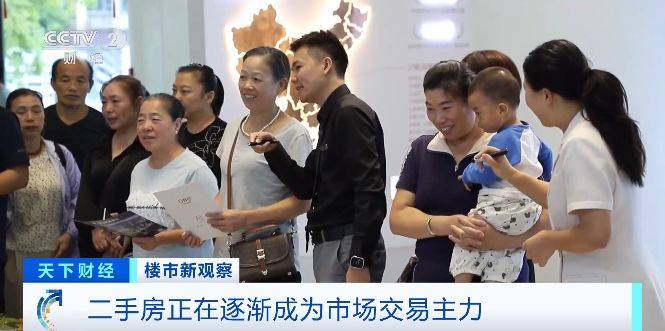
Core Insights - The trading structure of new and second-hand houses has changed, with second-hand houses increasingly replacing new houses as the market enters a stock era [1] - From January to October, the total transaction volume of new and second-hand houses nationwide decreased by 1.9% year-on-year, indicating stable overall market demand despite a high base from the previous year [3] - Various policies aimed at stabilizing the market are gradually showing positive effects, contributing to a stable total transaction volume compared to last year [5] Group 1 - The transaction area of second-hand houses increased by 4.7% year-on-year, with second-hand houses accounting for 45% of the total transaction volume [7] - In several cities, including Shanghai, Shenzhen, and Chongqing, the transaction area of second-hand houses has seen a year-on-year growth of over 10% [7] - There is a continuous release of housing demand, particularly for improvement needs, supported by policies such as increased housing provident fund loan limits and purchase subsidies [9]
连平:“十五五”房地产市场怎么走
Di Yi Cai Jing· 2025-11-06 03:46
Core Insights - The real estate market is expected to enter a destocking phase during the "15th Five-Year Plan" period, with overall housing prices declining and investment demand significantly weakening [1][21]. Macro Factors Impacting Housing Demand and Market Structure - Both total housing demand and supply are likely to contract further, driven by long-term population decline and slower urbanization [2][3]. - The supply side may contract more than the demand side due to high risks for real estate companies and limited investment capacity, leading to a more balanced supply-demand relationship [1][2]. - Structural market characteristics will become more pronounced, with urbanization focusing on key city clusters, enhancing competitiveness in high-tier cities [1][4]. Changes in Population and Housing Demand - China is entering a population reduction cycle, with a projected decrease of approximately 4.8 million people by 2030 [2]. - The number of eligible homebuyers is expected to decline by 21 million, with the proportion of this group in the total population dropping from 39.2% to 38% [2]. - However, the structural change in the homebuyer population will support stable growth in improvement demand, particularly in coastal megacities [2][3]. Regional Differentiation in Demand - Demand will increasingly concentrate in key city clusters, with sales in these areas expected to account for 80% of the national total, up from 75% [4]. - Urbanization is projected to increase the urban population to 983 million by 2030, with per capita residential area rising to 44.6 square meters [3][4]. Real Estate Supply and Demand Dynamics - The housing inventory is at a historical high, indicating a serious oversupply situation that will take time to digest [5][10]. - The leverage ratio of households is expected to decline from around 61% to 54% by the end of the "15th Five-Year Plan" [5][10]. Policy Responses to Market Conditions - The overall housing policy will focus on releasing demand and guiding the market towards a balanced supply-demand relationship [13][16]. - Policies will include accelerating the destocking of commercial housing and maintaining a supportive environment for personal home purchases [14][15]. Market Outlook for the "15th Five-Year Plan" - The total demand for urban residential building area is projected to be around 3 billion square meters, with an average annual new housing demand of about 600 million square meters [16][21]. - Housing prices are expected to decline at a slower rate, with new home prices projected to drop by 1% annually and second-hand home prices by 2% [17][21]. - The inventory of unsold commercial housing is expected to decrease by about 40% by the end of the "15th Five-Year Plan" [17][21]. Recommendations for Targeted Policies - Suggestions include significantly lowering home purchase costs, implementing regional housing policies for major cities, and preventing housing financial risks [22][23][24]. - Establishing a real estate stability fund to effectively manage risks and improve market confidence is also recommended [24][25].
改善性需求不减,10月这些城市新房价格还在涨
Mei Ri Jing Ji Xin Wen· 2025-11-04 00:56
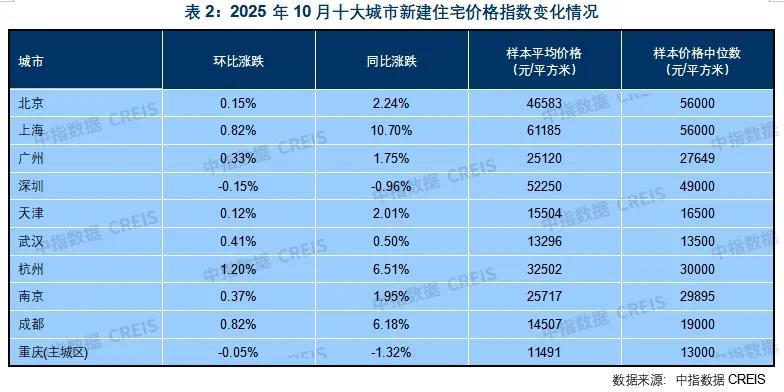
Core Insights - The real estate market in major cities, particularly Shanghai, continues to show positive price trends, with Shanghai's new home prices increasing by over 10% year-on-year in October [1][4] - Eight out of ten major cities reported both month-on-month and year-on-year increases in new home prices for October [2] Price Trends - Shanghai's new home prices rose by 10.7% year-on-year, while other cities like Beijing, Guangzhou, and Shenzhen saw more modest increases ranging from 1% to 3% [3][4] - The average price per square meter in Shanghai reached 61,185 yuan, with a median price of 56,000 yuan [3] Sales Performance - Despite the price increases, new home transaction volumes in Shanghai decreased significantly in October, with a 24% month-on-month drop and a 35% year-on-year decline [5] - The only notable project in October was "Shangyuan" in the Minhang district, which sold 44 units at an average price of approximately 61,601 yuan per square meter [5] Market Dynamics - The market is characterized by a healthy inventory level in Shanghai, with a de-stocking cycle of 7 to 8 months [6] - Improvement in market sentiment is attributed to the performance of quality projects in cities like Shanghai, Hangzhou, and Chengdu, which are seen as benchmarks for positive development in the real estate sector [4] Regional Comparisons - Hangzhou's new home prices increased by 6.51% year-on-year, with significant sales in high-priced projects, while Chengdu's prices rose by 6.18% year-on-year [7][9] - Chengdu's new home transaction volume reached 85,000 square meters in October, maintaining stability despite a year-on-year decline in sales [9] Future Outlook - The end of the year is expected to see increased supply from real estate companies, which may support new home sales in core cities [9]
上海“10万+”新盘有所降温
Mei Ri Jing Ji Xin Wen· 2025-11-03 12:07
Core Insights - The real estate market in major cities, particularly Shanghai, continues to show positive price trends, with new home prices in Shanghai increasing by 10.7% year-on-year in October [2][6] - Eight out of ten major cities reported both month-on-month and year-on-year increases in new home prices for October [3] - Despite the price increases, the transaction volume in Shanghai decreased significantly in October, with a 24% month-on-month drop and a 35% year-on-year decline [7] Price Trends - Shanghai's new home prices have risen for 83 consecutive months, with monthly year-on-year increases exceeding 5% since October 2024 [6] - Specific cities showed notable year-on-year price increases: Shanghai (10.7%), Hangzhou (6.51%), and Chengdu (6.18%), while Beijing, Tianjin, Nanjing, and Guangzhou saw increases between 1.0% and 3.0% [6][11] - The average price per square meter in Shanghai reached 61,185 yuan, with a median price of 56,000 yuan [4] Transaction Volume - In October, Shanghai's new home transaction volume was 740,000 square meters, marking a significant decrease due to high September figures and less appealing product offerings in October [7] - The top-selling projects in Shanghai included high-priced developments, with one project exceeding 214,000 yuan per square meter [9] Market Dynamics - The market in Shanghai is characterized by a relatively low short-term inventory and a healthy absorption cycle of 7-8 months [10] - Improvement in housing demand remains strong, particularly for quality projects in cities like Hangzhou and Chengdu, which have also seen significant sales in high-end segments [11][14] - The overall market is expected to face pressure towards the end of the year, with noticeable declines in sales volume for both new and second-hand homes in key cities [15]
楼市进入筑底关键期:改善性需求成为新房市场支撑
Mei Ri Jing Ji Xin Wen· 2025-10-25 00:42
Core Insights - The Chinese real estate market is entering a critical bottoming phase due to intensive policy measures since the second half of 2021, with a projected cumulative sale of approximately 5 billion square meters of new residential properties during the "14th Five-Year Plan" period [1][2]. Policy Signals - The real estate market has been in a continuous adjustment phase since the second half of 2021, with a decline in new residential property sales. Policies aimed at stabilizing the market have been implemented, including a focus on stopping the decline and promoting recovery [3][6]. Market Performance - From January to September 2025, the sales area of new residential properties was 6.58 million square meters, a year-on-year decrease of 5.5%, but the decline has narrowed by 11.6 percentage points compared to the previous year. The sales revenue was 6.3 trillion yuan, down 7.9% year-on-year, indicating a clear improvement trend despite remaining in negative territory [6][10]. Secondary Market Resilience - The secondary housing market has shown greater resilience, with a 10% year-on-year increase in transaction volume in 30 key cities from January to July 2025. By July, the proportion of secondary housing transactions reached 68%, a record high [6][10]. Market Segmentation - A clear "stronger stronger" market segmentation is emerging, with first-tier cities experiencing price increases in new homes, while second and third-tier cities face price declines. For instance, new home prices in first-tier cities rose by 6.87% year-on-year in September 2025, marking 27 consecutive months of increases [11][13]. Investment Focus - Real estate companies are increasingly focusing their investments on core cities, with significant land acquisition activity in cities like Shanghai, Beijing, and Chengdu, leading to record land prices. For example, a land parcel in Shanghai was sold for 34.135 billion yuan, setting a new record for total land price in the country [13][15]. Demand Shift - The demand structure in the new housing market is shifting towards improvement needs, with larger units (120-144 square meters) accounting for 30% of transactions in key cities from January to July 2025. In Beijing, units over 120 square meters made up 42% of sales [16][20]. High-End Market Dynamics - The high-end market is performing well, with significant sales in luxury properties. For instance, over 25 "sunshine plates" (properties sold out on the first day) were recorded in Shanghai, most priced above 100,000 yuan per square meter. However, this segment may face demand exhaustion due to limited overall transaction volume [19][20]. Upcoming Report - The "Prospects for the 15th Five-Year Plan" report will be officially released on October 30, 2025, providing further insights into the real estate industry [21].