新出口订单指数

Search documents
1月制造业PMI回落至49.3%,超3成企业反映利润下降
第一财经· 2026-01-31 10:46
Core Viewpoint - The manufacturing PMI in January fell below the growth line, indicating a decline in economic activity and a need for stronger foundational support for economic recovery [3][5]. Manufacturing Sector - The manufacturing PMI for January is reported at 49.3%, a decrease of 0.8 percentage points from the previous month, indicating fluctuations in manufacturing operations [5]. - The new orders index dropped to 49.2%, down 1.6 percentage points, reflecting a tightening of market demand [5]. - Seasonal factors and changes in the export environment are contributing to the slowdown in market demand, with the new export orders index at 47.8%, a decline of 1.2 percentage points [5][7]. - The production index remains in the expansion zone at 50.6%, despite a decrease of 1.1 percentage points, suggesting continued overall expansion in manufacturing [7]. - The prices of major raw materials and factory output have increased, with the purchasing price index at 56.1% and the factory price index at 50.6%, indicating an improvement in overall price levels in the manufacturing market [7]. Non-Manufacturing Sector - The non-manufacturing business activity index is at 49.4%, down 0.8 percentage points, primarily due to a decline in the construction sector [10]. - The service sector remains relatively stable, with the business activity index slightly decreasing by 0.2 percentage points, maintaining around 49.5% [10][11]. - The service industry anticipates a boost from the upcoming Spring Festival, with a business activity expectation index of 57.1%, indicating optimism for consumer-related services [10][11]. Economic Outlook - The overall economic climate is expected to be influenced by changes in export growth, the domestic real estate market, and the timing and intensity of growth-stimulating policies [8]. - There is potential for monetary policy easing in the second quarter, with fiscal policies aimed at boosting consumption and investment expected to gain momentum [8].

2025年12月制造业采购经理指数升至扩张区间
Ren Min Ri Bao· 2026-01-02 22:09
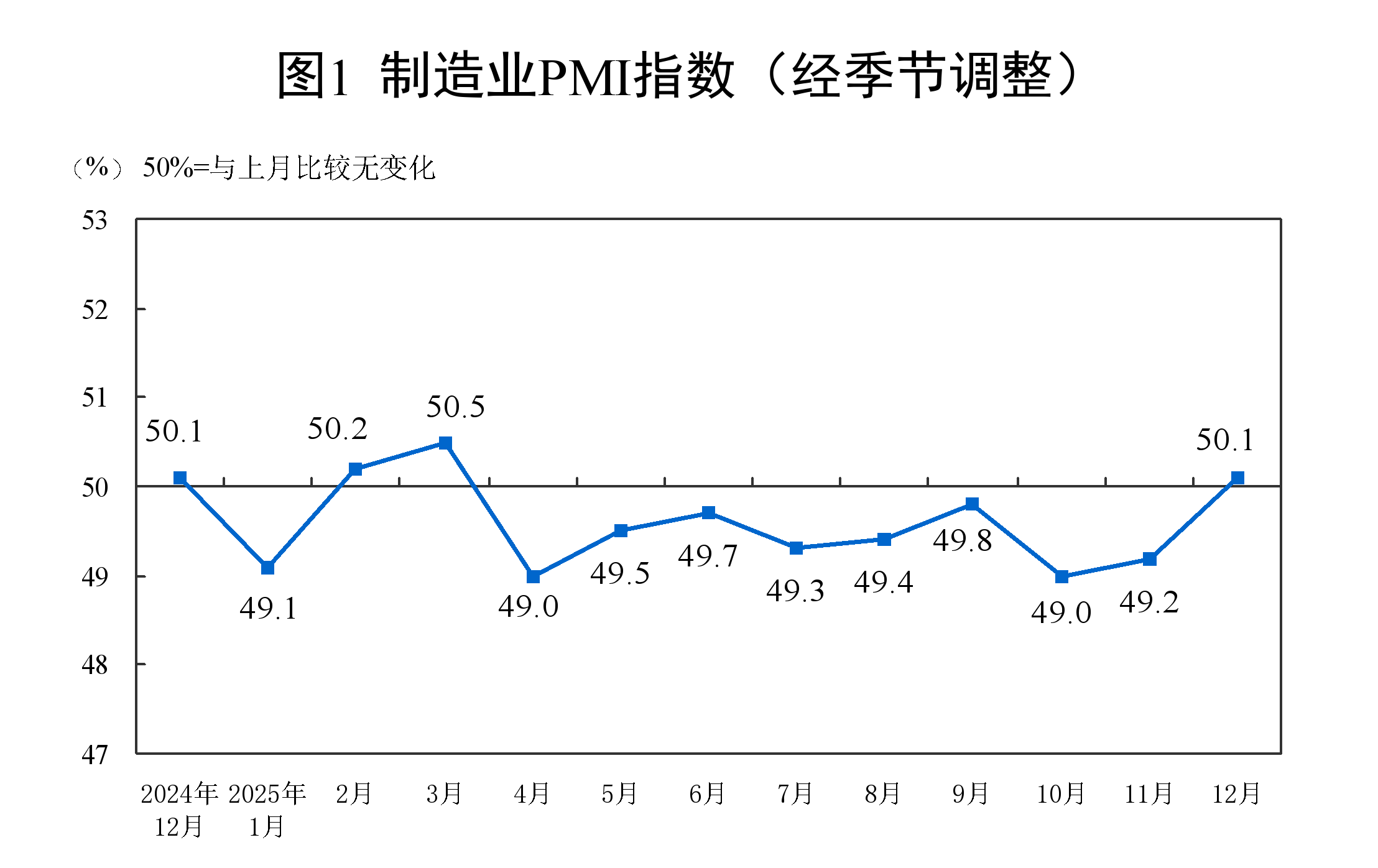
Group 1 - The manufacturing Purchasing Managers' Index (PMI) for December 2025 is reported at 50.1%, an increase of 0.9 percentage points from the previous month, marking a return to the expansion zone after eight consecutive months below 50% [1] - The production and business activity expectation index for December is at 55.5%, up 2.4 percentage points, the highest since April 2024 [1] - The new orders index for December is at 50.8%, rising 1.6 percentage points, indicating a return to the expansion zone after five months below 50% [1] Group 2 - The new export orders index for December is at 49%, an increase of 1.4 percentage points, indicating stable development in manufacturing exports [1] - The production index for December is at 51.7%, up 1.7 percentage points, showing significant growth in manufacturing activity [1] - The high-tech manufacturing PMI is reported at 52.5%, an increase of 2.4 percentage points, indicating a notable acceleration in expansion [1] Group 3 - The consumer goods industry PMI is at 50.4%, up 1 percentage point, with the production index exceeding 52% and the new orders index exceeding 51%, reflecting good expansion in the consumer goods manufacturing market [1] - The non-manufacturing business activity index for December is at 50.2%, an increase of 0.7 percentage points from the previous month [2] - The composite PMI output index for December is at 50.7%, up 1 percentage point from the previous month [2]
PMI为何重回扩张?——12月PMI数据解读
陈兴宏观研究· 2025-12-31 11:07
Group 1 - The national manufacturing PMI significantly rebounded to 50.1% in December, marking the first time since April that it entered the expansion zone, with a 0.9 percentage point increase from the previous month [3][4] - Key contributing factors to the PMI increase include rising new orders and production indices, while the employment index declined and the supplier delivery time index increased [3][4] - The recovery in production and demand is synchronized, with domestic demand strengthening relative to external demand, leading to an accumulation of inventory on the demand side and a recovery in downstream profits [2][4] Group 2 - The new export orders index rose significantly after the US-China trade talks in late October, with a cumulative increase of over 3.1 percentage points in November and December, indicating a recovery in external demand [4] - The manufacturing production index reached 51.7% in December, up 1.7 percentage points from the previous month, driven by improved external demand [4] - The manufacturing purchase price index fell to 53.1%, while the factory price index rose to 48.9%, indicating a potential improvement in profit distribution for downstream businesses [8] Group 3 - The non-manufacturing business activity index rose to 50.2%, with the construction sector showing a notable recovery, while the service sector remained slightly below the expansion threshold at 49.7% [7][10] - The construction business activity index increased by 3.2 percentage points to 52.8%, reversing a four-month decline, with new orders in construction reaching a year-high [7] - The service industry business activity expectation index rose to 56.4%, reflecting positive market expectations despite current low activity levels in retail and dining sectors [10]

关键指标现积极信号!50.1%重返扩张区,12月PMI暖了
2 1 Shi Ji Jing Ji Bao Dao· 2025-12-31 06:56
Core Viewpoint - The manufacturing Purchasing Managers' Index (PMI) in China rose to 50.1% in December 2025, marking the first expansion since April 2025, indicating a recovery in both production and demand [1][5]. Group 1: Manufacturing PMI Overview - The manufacturing PMI increased by 0.9 percentage points from the previous month, reaching the expansion zone [5]. - The production index and new orders index were reported at 51.7% and 50.8%, respectively, both showing significant month-on-month increases [6][7]. - In 2025, the monthly manufacturing PMI figures were 49.1%, 50.2%, 50.5%, 49%, 49.5%, 49.7%, 49.3%, 49.4%, 49.8%, 49.0%, 49.2%, and 50.1% [5]. Group 2: Sector Performance - Among the 21 surveyed industries, 16 showed an increase in PMI compared to the previous month, indicating improved business conditions [2][8]. - High-tech manufacturing, equipment manufacturing, and consumer goods sectors reported PMIs of 52.5%, 50.4%, and 50.4%, respectively, all above the expansion threshold [2][8]. - The new export orders index rose to 49.0%, up 1.4 percentage points, although it remains below the expansion threshold [7][9]. Group 3: Economic Indicators - The production activity expectation index reached 55.5%, indicating increased confidence among manufacturing enterprises regarding market development [10]. - The supplier delivery time index was reported at 50.2%, suggesting that the delivery times for raw materials are improving [9]. - The inventory indices for finished products and raw materials showed signs of recovery, with finished product inventory rising to 48.2% and raw materials inventory at 47.8% [9].
制造业采购经理指数为49.2%
Ren Min Ri Bao· 2025-11-30 22:20
Core Insights - The manufacturing Purchasing Managers' Index (PMI) in China for November is reported at 49.2%, reflecting a 0.2 percentage point increase from the previous month, indicating an improvement in economic conditions [1] Group 1: Manufacturing Sector Performance - The new export orders index stands at 47.6%, which is a 1.7 percentage point increase from last month, showing a significant rise in demand [1] - The high-tech manufacturing sector's new export orders index increased by over 3 percentage points compared to last month, while the consumer goods manufacturing sector's new export orders index rose by over 2 percentage points [1] - Overall, the new orders index for manufacturing is at 49.2%, up by 0.4 percentage points from the previous month, suggesting a recovery in market demand [1] Group 2: Business Confidence - The production and business activity expectation index is at 53.1%, which is a 0.3 percentage point increase from last month, indicating enhanced confidence among manufacturing enterprises regarding recent market developments [1]
11月制造业采购经理指数为49.2%
Ren Min Ri Bao· 2025-11-30 22:14
Core Viewpoint - The manufacturing Purchasing Managers' Index (PMI) in China for November is reported at 49.2%, indicating a slight improvement in the manufacturing sector's performance compared to the previous month [1] Summary by Categories Manufacturing PMI - The manufacturing PMI increased by 0.2 percentage points from the previous month, reflecting an overall improvement in the sector's economic conditions [1] Sub-indices Performance - The new export orders index stands at 47.6%, up by 1.7 percentage points from last month, showing a significant rise [1] - The high-tech manufacturing sector's new export orders index increased by over 3 percentage points compared to the previous month [1] - The consumer goods manufacturing sector's new export orders index rose by more than 2 percentage points from last month [1] Market Demand and Confidence - The overall market demand in the manufacturing sector is recovering, with the new orders index at 49.2%, an increase of 0.4 percentage points from the previous month [1] - The production and business activity expectations index is at 53.1%, which is an increase of 0.3 percentage points, indicating enhanced confidence among manufacturing enterprises regarding recent market developments [1]
制造业景气水平改善 新出口订单指数升幅明显
Zheng Quan Shi Bao· 2025-11-30 18:17
Core Insights - The manufacturing Purchasing Managers' Index (PMI) for November increased to 49.2%, reflecting a slight improvement in economic conditions compared to the previous month [1] - The new export orders index rose significantly by 1.7 percentage points, indicating a positive shift in the external trade environment, particularly benefiting small enterprises [1][2] - Most of the 13 sub-indices for manufacturing showed an upward trend, with production, new orders, and purchasing volume indices all improving [1][2] Manufacturing PMI Details - The manufacturing PMI for November stands at 49.2%, up by 0.2 percentage points from the previous month, indicating a recovery in manufacturing activity [1] - The new orders index increased by 0.4 percentage points to 49.2%, while the production index returned to the neutral level of 50% after a brief contraction [2] - The equipment manufacturing, high-tech manufacturing, and consumer goods manufacturing sectors all maintained production indices in the expansion zone [2] Price Trends - The purchasing price index for manufacturing rose to 53.6%, up by 1.1 percentage points, indicating a general increase in raw material prices across major manufacturing sectors [2] - The decline in finished product prices has slowed, influenced by rising raw material costs and stable market demand [2] Future Outlook - Analysts suggest that the manufacturing market demand may continue to stabilize and recover in December, driven by year-end activities, policy implementation, and expected demand increases from the upcoming "15th Five-Year Plan" [2] - Despite the improvements, the manufacturing PMI remains at historically low levels, indicating a growing necessity for macroeconomic policy support [3]
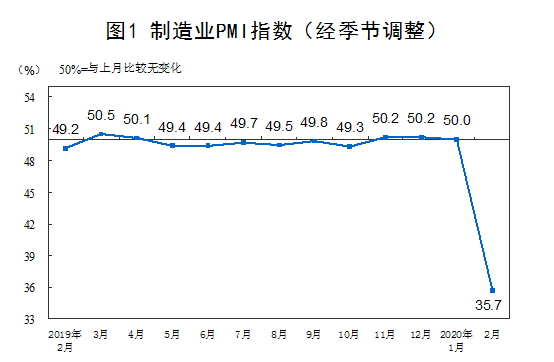
35.7%!2月制造业PMI创新低,3月能否反弹?出口、投资和消费谁先回暖?
Mei Ri Jing Ji Xin Wen· 2025-11-24 08:06
Core Viewpoint - The COVID-19 pandemic has significantly impacted China's manufacturing and non-manufacturing sectors, leading to a sharp decline in the Purchasing Managers' Index (PMI) for February 2020, with manufacturing PMI dropping to 35.7%, a decrease of 14.3 percentage points from the previous month [1][3]. Manufacturing Sector - The manufacturing PMI for February 2020 is reported at 35.7%, with large, medium, and small enterprises showing PMIs of 36.3%, 35.5%, and 34.1% respectively, all experiencing declines of over 14 percentage points [1][3]. - All five sub-indices that constitute the manufacturing PMI are below the critical threshold, indicating widespread contraction [3]. - The production index fell to 27.8%, a drop of 23.5 percentage points, while the new orders index decreased to 29.3%, down 22.1 percentage points [3]. Non-Manufacturing Sector - The non-manufacturing PMI dropped to 29.6%, a decline of 24.5 percentage points, indicating a significant overall contraction in the non-manufacturing economy [3]. - Only the monetary financial services and capital market services maintained an expansionary index, while the construction sector's index fell to 26.6%, down 33.1 percentage points [3]. Export and Import Orders - The new export orders index plummeted to 28.7%, a decrease of 20 percentage points, attributed to the pandemic's impact on domestic production and overseas demand [5][6]. - The import index also fell to 31.9%, down 17.1 percentage points, reflecting a temporary decline in demand for raw materials due to halted production [6]. Economic Recovery Outlook - Analysts predict a potential rebound in the PMI for March, with expectations that the recovery rate for large and medium enterprises will rise to 90.8% by the end of March [7]. - Various government policies aimed at tax reductions, financial support, and employment stabilization are expected to alleviate the difficulties faced by businesses and boost confidence [7]. - The recovery in external demand is anticipated to be gradual, with a focus on nurturing internal market dynamics to restore foreign investor confidence [7][8]. Industry-Specific Insights - The recovery of industries such as real estate and infrastructure is crucial, as their slow resumption has led to inventory accumulation in upstream sectors [8]. - The service sector, particularly leisure services like dining and tourism, continues to face challenges, with low operational rates and ongoing demand suppression expected to persist [9].
制造业PMI为何超季节性回落?:——2025年10月PMI点评
EBSCN· 2025-10-31 12:32
Manufacturing Sector - The manufacturing PMI for October 2025 is reported at 49.0%, a significant decrease of 0.8 percentage points from the previous month, which is notably higher than the seasonal average decline of 0.4 percentage points observed from 2020 to 2024[2][5] - The production index fell by 2.2 percentage points to 49.7%, while the new orders index decreased by 0.9 percentage points to 48.8%[5][15] - The new export orders index dropped to 45.9%, down 1.9 percentage points, marking the second-lowest level since the introduction of high tariffs in April 2025[5][20] - Small enterprises experienced a notable decline in PMI, falling 1.1 percentage points to 47.1%, while large enterprises' PMI decreased to 49.9%[6] Non-Manufacturing Sector - The non-manufacturing PMI for October 2025 is at 50.1%, slightly up from 50.0% in the previous month, driven by holiday consumption[2][28] - The service sector showed improvement, with indices for transportation, retail, and entertainment exceeding 60%, indicating strong performance in consumer-related services[28] - The construction PMI fell to 49.1%, but new orders and business activity expectations increased, suggesting a potential recovery in infrastructure activities[34] Economic Outlook - The report highlights that the construction sector may benefit from the introduction of 500 billion yuan in new policy financial tools and an additional 200 billion yuan in special bond issuance, which could support infrastructure investment[4][34] - The overall economic environment remains cautious due to external trade uncertainties and domestic demand stability, particularly in high-energy-consuming industries[16][20]
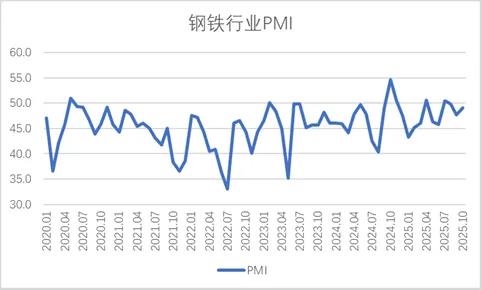
2025年10月钢铁PMI显示:钢铁行业有所恢复 供需两端回稳运行
Xin Hua Cai Jing· 2025-10-31 02:26
Core Viewpoint - The steel industry is showing signs of recovery in October 2025, with the PMI rising to 49.2%, ending a two-month decline, although challenges such as high raw material prices and inventory pressures remain [1][2]. Demand Recovery - October saw a recovery in steel demand due to the resumption of outdoor construction post-holidays and a lack of adverse weather in northern regions, but the real estate sector remains in deep adjustment, limiting overall market demand [2][3]. - The new orders index increased to 47.6%, up 2.4 percentage points, indicating some improvement in demand, but still within a contraction zone [3]. - Export orders showed significant improvement, with the new export orders index rising to 54.3%, the highest in nearly 20 months, driven by price differentials and overseas demand [3]. Production Trends - Steel production stabilized in October, with the production index rising to 49.8%, up 4.1 percentage points, indicating a recovery in production activities [5]. - Despite improvements in both supply and demand, the recovery in demand is weaker than the increase in supply, leading to continued inventory pressures for steel mills [5]. Raw Material Prices - Raw material prices remain high, with the purchasing price index exceeding 70%, indicating increased cost pressures for steel manufacturers [8]. - Prices for different raw materials are showing divergence, with iron ore prices stabilizing, scrap steel prices declining, and coke prices rising due to supply constraints [8]. Price and Profitability - Steel prices have shown a downward trend, with the Shanghai rebar price index dropping from 3176 CNY/ton to 3122 CNY/ton during October, leading to further compression of profit margins for steel mills [11]. - The overall cost pressure on steel manufacturers has increased compared to September, despite some recovery in demand [11]. Future Outlook - In November, steel demand is expected to show a "first rise then fall" trend, supported by construction activities and export resilience, but constrained by ongoing weakness in the real estate sector and seasonal factors [12]. - Steel production is anticipated to contract due to environmental restrictions in northern regions and a shift from peak to off-peak demand [15].