流动性净投放

Search documents
视频丨央行今日开展6000亿元中期借贷便利操作
Yang Shi Xin Wen Ke Hu Duan· 2026-02-25 05:13
Group 1 - The People's Bank of China (PBOC) conducted a 600 billion yuan medium-term lending facility (MLF) operation to maintain liquidity in the banking system, with a one-year term, resulting in a net injection of 300 billion yuan for the month due to 300 billion yuan of MLF maturing, marking the 12th consecutive month of increased MLF operations [1] - The continuation of net liquidity injection indicates a supportive monetary policy stance, which is expected to enhance banks' credit issuance capabilities and support government bond issuance, thereby stabilizing market expectations [3] - The PBOC plans to issue 500 billion yuan in central bank bills in Hong Kong, aiming to enrich high-credit-quality RMB financial products and improve the RMB yield curve in Hong Kong [5][6]
每日债市速递 | 银行间市场资金面仍显紧平衡
Wind万得· 2026-01-25 22:43
Group 1: Open Market Operations - The central bank conducted a 7-day reverse repurchase operation of 125 billion yuan at a fixed rate of 1.40% on January 23, with a total bid and awarded amount of 125 billion yuan, resulting in a net injection of 38.3 billion yuan for the day after accounting for 86.7 billion yuan in reverse repos maturing [3] - For the week, the net injection reached 229.5 billion yuan, with 1.181 trillion yuan in reverse repos maturing from January 26 to 30, along with 200 billion yuan in MLF maturing on January 26 [3] Group 2: Funding Conditions - The interbank market remains tight due to lingering tax payment impacts, with the weighted average rate of DR001 decreasing by about 2 basis points to around 1.39% [5] - Overnight rates in the anonymous click (X-repo) system are around 1.42%, indicating unstable supply, while non-bank institutions' overnight borrowing rates for pledged certificates and credit bonds are between 1.52% and 1.55% [5] - The latest overnight financing rate in the U.S. is 3.63% [5] Group 3: Interbank Certificates of Deposit - The latest transaction rate for one-year interbank certificates of deposit among major banks is approximately 1.59%, down over 1 basis point from the previous day [6] Group 4: Government Bond Futures - The closing prices for government bond futures show a slight increase, with the 30-year main contract rising by 0.07%, the 10-year by 0.03%, the 5-year by 0.04%, and the 2-year by 0.01% [12] Group 5: Regulatory Developments - The China Securities Regulatory Commission (CSRC) is intensifying scrutiny of illegal fundraising and other violations in the private equity fund sector, with over 1,750 institutions undergoing self-assessment and problem rectification, and approximately 30 cases being investigated [13]


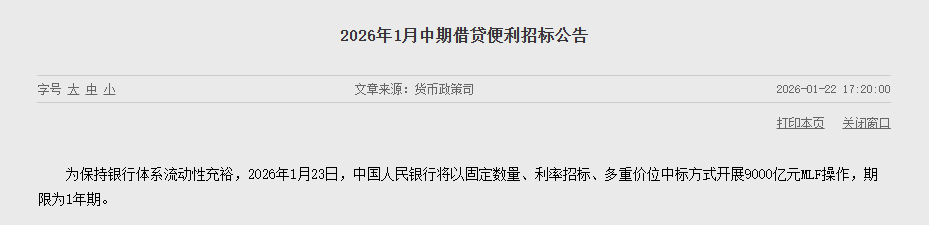
央行宣布!明天,9000亿元
Zhong Guo Zheng Quan Bao· 2026-01-22 12:26
Core Viewpoint - The People's Bank of China (PBOC) is implementing a significant liquidity injection of 700 billion yuan through a medium-term lending facility (MLF) operation to maintain ample liquidity in the banking system ahead of the upcoming Spring Festival [1][2]. Group 1: MLF Operation Details - On January 23, 2026, the PBOC will conduct an MLF operation of 900 billion yuan with a one-year term, using a fixed quantity, interest rate bidding, and multiple price bidding method [1]. - The MLF operation follows the maturity of 200 billion yuan in January, resulting in a net liquidity injection of 700 billion yuan [2]. Group 2: Market Impact and Analysis - The total liquidity injection for January, including 3-month and 6-month reverse repos, amounts to 1 trillion yuan, indicating a proactive approach to ensure market liquidity stability [2]. - Analysts suggest that the scale of net liquidity injection is equivalent to a reserve requirement ratio (RRR) cut of 0.25 to 0.5 percentage points, reflecting the PBOC's strategy to support economic growth and stabilize market expectations [2]. Group 3: Future Monetary Policy Outlook - The PBOC's Governor indicated that there is still room for further RRR cuts and interest rate reductions, emphasizing the flexible and efficient use of various monetary policy tools [2]. - Despite the large-scale net liquidity injection, the likelihood of an RRR cut before the Spring Festival has decreased, as such measures are seen as strong policy signals that can lower funding costs for financial institutions and boost market confidence [2][3]. - Looking ahead, the focus will be on the potential for coordinated fiscal measures alongside monetary policy tools, particularly during periods of concentrated government bond supply [3].
每日债市速递 | 2025年央行MLF净投放11610亿元
Wind万得· 2025-12-26 00:31
Group 1: Open Market Operations - The central bank conducted a 7-day reverse repurchase operation of 177.1 billion yuan on December 25, with a fixed rate of 1.40%, resulting in a net injection of 88.8 billion yuan for the day after accounting for 88.3 billion yuan in reverse repos maturing [1] - On December 24, the central bank announced a 400 billion yuan MLF operation for a one-year term, leading to a net injection of 100 billion yuan through MLF in December, marking the 10th consecutive month of increased MLF operations [1] Group 2: Market Liquidity - The interbank market liquidity remains stable and slightly loose, with the weighted average rate of DR001 dropping below 1.26%, while DR007 increased by over 10 basis points due to year-end factors [3] - The overnight financing rate in the U.S. is reported at 3.66% [3] Group 3: Interbank Certificates of Deposit - The latest transaction rate for one-year interbank certificates of deposit among major banks is around 1.64%, unchanged from the previous day [6] Group 4: Bond Market Overview - The yields on major interbank bonds show a mixed trend, with long-term bonds appearing weaker [8] - The closing prices for government bond futures showed declines across various maturities, with the 30-year contract down by 0.24% [10] Group 5: Economic Indicators - The People's Bank of China is expected to have a net injection of 11.61 trillion yuan in MLF for 2025, contrasting with a net withdrawal of 19.86 trillion yuan in 2024, indicating a shift in monetary policy tools [11] - The offshore yuan has surpassed the 7.0 mark against the U.S. dollar for the first time since September 2024, with the onshore yuan closing at 7.0066, reflecting a 95 basis point increase from the previous trading day [11] Group 6: Infrastructure Development - The National Development and Reform Commission emphasizes the need to accelerate the construction of a modern infrastructure system, including market-oriented adjustments in transportation pricing and reforms in the energy sector [11] Group 7: Climate Disclosure Standards - The newly released "Corporate Sustainability Disclosure Standards No. 1 - Climate (Trial)" outlines common requirements for climate-related information disclosure across various industries, with specific guidelines for sectors like electricity, steel, and cement under development [12] Group 8: Global Economic Insights - Japan's Prime Minister announced a preliminary budget of 122.3 trillion yen for the next fiscal year, with a debt dependency ratio of 24.2% [14] - The Bank of Japan's governor indicated a steady approach towards achieving a 2% stable inflation target, with low real interest rates suggesting potential for future rate increases [14]

中国人民银行:12月中期流动性净投放3000亿
Sou Hu Cai Jing· 2025-12-25 00:28
Core Viewpoint - The People's Bank of China (PBOC) conducted a 400 billion MLF operation in December, resulting in a net liquidity injection of 300 billion, indicating a continued commitment to maintaining a moderately loose liquidity stance despite a reduction in the scale of net injections compared to previous months [1] Group 1 - In December, the PBOC carried out a 400 billion yuan one-year MLF operation using a fixed quantity, interest rate bidding, and multiple price bidding methods [1] - A total of 300 billion yuan of MLF matured in December, leading to a net injection of 100 billion yuan, marking the tenth consecutive month of increased MLF operations [1] - The central bank also conducted a net injection of 200 billion yuan through reverse repos this month, bringing the total net liquidity injection for December to 300 billion yuan [1] Group 2 - The scale of net injections through reverse repos and MLF from August to November was consistently 600 billion yuan per month, which has now decreased by 300 billion yuan in December [1] - Analysts suggest that the reduction in net injection may be due to a decrease in the net financing scale of government bonds, with a possibility of a reserve requirement ratio (RRR) cut in the first quarter of 2026 to inject long-term liquidity [1] - Despite the reduction in net injection scale, the PBOC's approach to maintaining a moderately loose liquidity stance remains unchanged, considering the year-end funding pressures [1]
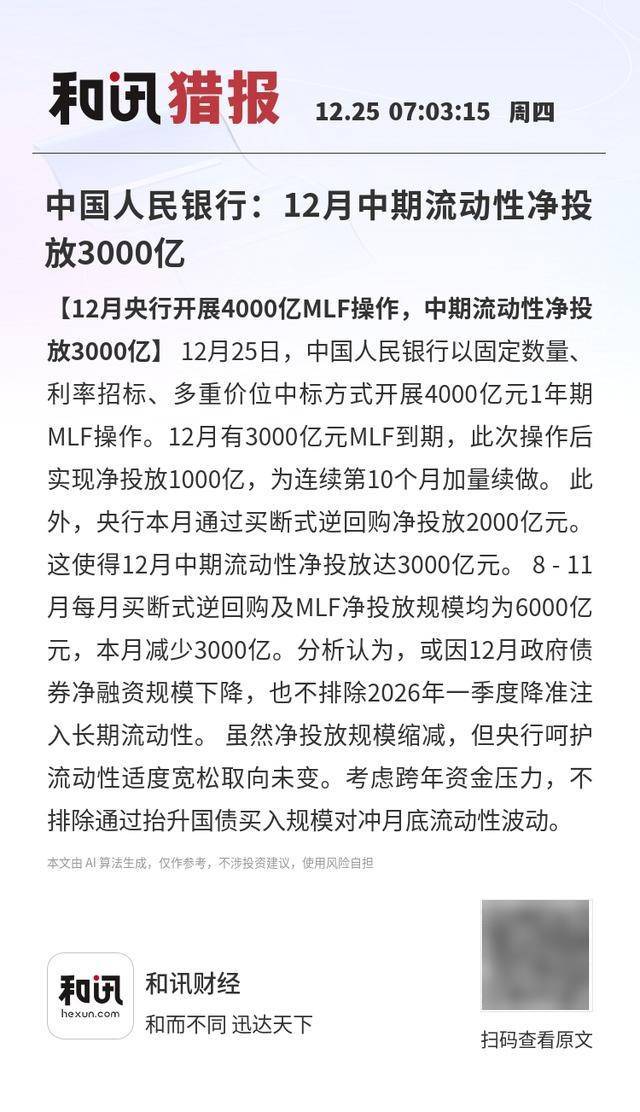
12月份MLF延续净投放,分析称不排除一季度实施降准的可能
Xin Lang Cai Jing· 2025-12-24 22:52
Core Viewpoint - The People's Bank of China (PBOC) is conducting a 400 billion MLF operation with a one-year term, resulting in a net liquidity injection of 100 billion, marking the tenth consecutive month of increased MLF operations [1] Group 1: MLF Operations - In December, the PBOC will conduct a 400 billion MLF operation, with 300 billion MLF maturing, leading to a net injection of 100 billion [1] - This operation represents the PBOC's continuous effort to maintain liquidity in the market, with a total of 300 billion net liquidity injection in December [1] Group 2: Market Analysis - The reduction in net liquidity injection from 600 billion in previous months to 300 billion in December may be attributed to a decrease in government bond net financing [1] - Analysts suggest that there is a possibility of the PBOC implementing a reserve requirement ratio (RRR) cut in Q1 2026 to inject larger amounts of long-term liquidity into the market [1] Group 3: Future Expectations - Despite the reduction in net liquidity injection, the PBOC's stance on maintaining a moderately loose liquidity environment remains unchanged [1] - There is a potential for the PBOC to increase the scale of government bond purchases to counter seasonal liquidity fluctuations at the end of the month [1]
如何理解央行最新中期借贷便利操作
Jin Rong Shi Bao· 2025-11-25 00:47
Core Viewpoint - The People's Bank of China (PBOC) is maintaining ample liquidity in the banking system through various monetary tools, including a 1 trillion yuan Medium-term Lending Facility (MLF) operation, which is expected to support economic stability and growth [1][2]. Group 1: MLF Operations - On November 25, the PBOC conducted a 1 trillion yuan MLF operation with a one-year term, marking a net injection of 100 billion yuan for November, continuing a trend of increased MLF operations for nine consecutive months [1]. - The total net liquidity injection for November reached 600 billion yuan, consistent with the previous month and representing a high level maintained for four months [1]. Group 2: Monetary Policy and Economic Support - The PBOC's actions, including MLF and reverse repos, are aimed at ensuring a stable and ample liquidity environment, which is crucial for encouraging financial institutions to increase credit supply [2]. - The central bank's supportive monetary policy is expected to contribute to stabilizing growth, expectations, and employment, while also enhancing the allocation of financial resources to key areas such as technological innovation and green development [2].
连续4个月净投放6000亿,央行双工具护航年末经济收官
第一财经· 2025-11-24 13:30
Core Viewpoint - The People's Bank of China (PBOC) announced a medium-term lending facility (MLF) operation of 1 trillion yuan on November 25, 2025, indicating a net liquidity injection of 1 trillion yuan for November, as 900 billion yuan of MLF is maturing [3][4]. Group 1: Liquidity Injection - In November, the total net liquidity injection reached 600 billion yuan, maintaining a high level for four consecutive months [3][4]. - The liquidity injection is primarily aimed at addressing three demands: the issuance of 500 billion yuan in local government bonds, the completion of 500 billion yuan in new policy financial tools, and the maturity of interbank certificates of deposit [3][4]. Group 2: Monetary Policy Outlook - The PBOC's approach to liquidity provision has become more fixed, with regular operations scheduled for different periods of the month [4]. - The report indicates that since the reserve requirement ratio cut in May, the market has seen sustained net liquidity injections, with a total of 1.5 trillion yuan injected through MLF and reverse repos in the third quarter [5]. - Future monetary policy is expected to focus on optimizing the structure rather than just increasing the scale, with an emphasis on directing financial resources towards key areas such as technological innovation and green development [5]. Group 3: Economic Stability Measures - Analysts predict that the PBOC will continue to use reverse repos and MLF to inject liquidity, but the scale may decrease from the current high level of 600 billion yuan per month [5]. - There is an expectation of new growth-stabilizing policies being introduced before the end of the year, focusing on fiscal support and monetary easing to stabilize the economy and achieve growth targets [5].
连续4个月净投放6000亿,央行双工具护航年末经济收官
Di Yi Cai Jing· 2025-11-24 12:28
Core Viewpoint - The central bank's liquidity injection in November remains at a high level of 600 billion yuan, with a net injection of 1 trillion yuan through medium-term lending facilities (MLF) and 5 trillion yuan through reverse repos, indicating ongoing support for market liquidity [1][2]. Group 1: Liquidity Injection Details - In November, the central bank announced a 10 trillion yuan MLF operation, with 9 trillion yuan of MLF maturing, resulting in a net injection of 1 trillion yuan [1]. - The total net liquidity injection for November reached 600 billion yuan, consistent with the previous month, marking a sustained high level over four months [1]. - The central bank's liquidity support is primarily driven by three factors: local government debt issuance, completion of new policy financial tools, and an increase in bank interbank certificates of deposit maturing [1]. Group 2: Future Policy Directions - The central bank is expected to maintain a moderately accommodative monetary policy, focusing on optimizing the structure rather than merely increasing the scale of liquidity [3]. - Future monetary policy will emphasize directing financial resources towards key areas such as technological innovation, consumption stimulation, and green initiatives, enhancing policy precision [3]. - There is a prediction that the central bank will continue to use reverse repos and MLF to inject liquidity, but the scale may decrease from the previous high of 600 billion yuan per month as year-end policies are introduced [3].
央行今日开展9000亿元MLF操作,为连续第8个月加量续做|快讯
Sou Hu Cai Jing· 2025-10-27 02:40
Core Viewpoint - The People's Bank of China (PBOC) is implementing a series of monetary policy measures to maintain liquidity in the banking system, including a 900 billion yuan MLF operation and a net liquidity injection of 600 billion yuan in October [2][3]. Group 1: Monetary Policy Actions - On October 27, the PBOC will conduct a 900 billion yuan MLF operation with a one-year term to ensure ample liquidity in the banking system [2]. - With 700 billion yuan of MLF maturing in October, the net MLF injection for the month will reach 200 billion yuan, marking the eighth consecutive month of increased MLF operations [2]. - The total net liquidity injection for October, including 400 billion yuan of reverse repos, amounts to 600 billion yuan, maintaining a high level of net injection compared to the previous month [2]. Group 2: Economic Outlook and Future Measures - Analysts suggest that the PBOC's continued liquidity support signals a sustained accommodative monetary policy stance, especially in light of increasing external volatility and the impact of high tariffs on global trade [2]. - There is an expectation for further monetary policy tools to be employed in the fourth quarter, including potential reserve requirement ratio (RRR) cuts and the resumption of government bond transactions to stabilize economic growth and employment [2][3]. - The PBOC aims to enhance liquidity management through various tools like reverse repos and RRR cuts to meet the demands of government bond issuance and increased credit supply [3].