
电力市场化改革

Search documents
机制电价重塑核电
2026-03-24 01:27
Summary of Key Points from Conference Call Records Industry Overview - The conference call discusses the nuclear power industry in China, focusing on the recent changes in pricing mechanisms and their implications for companies like China General Nuclear Power Group (CGN) and the overall nuclear power sector. Core Insights and Arguments 1. **Pricing Mechanism Shift**: The nuclear power pricing mechanism is transitioning from a "fixed price similar to hydropower" to a "market entry + off-market compensation" model, with pilot programs in Liaoning and Guangxi expected to expand nationwide by 2026 [1][2][3]. 2. **Profit Impact**: The policy adjustment is projected to increase CGN's profits by approximately 1 billion yuan in 2026, revising the profit expectation from 9.5 billion yuan (down 5% year-on-year) to 10.5-10.6 billion yuan (up 5%-6% year-on-year) [1][8]. 3. **Long-term Growth**: With the doubling of installed capacity and the implementation of price guarantees, CGN's performance targets are expected to reach 13-14 billion yuan and 18 billion yuan by 2031 for the nuclear power sector [1][8]. 4. **Valuation Logic**: The price-to-book (PB) ratio for nuclear assets is anticipated to recover from current levels to previous highs of 2.4-2.5 times, driven by a clear profit floor established by policy [1][10]. 5. **Comparative Analysis**: The fundamentals of nuclear power are seen as more favorable than hydropower, with thermal power benefiting from capacity price increases and spot pricing authority, likely exceeding expectations in 2026 [1][11]. Additional Important Content 1. **Market Misconceptions**: In 2024, market perceptions of nuclear power as a stable, high-priced asset led to inflated valuations, ignoring the market-driven nature of nuclear pricing [2]. 2. **Compensation Mechanism**: A proposed compensation mechanism aims to ensure reasonable returns for nuclear power in market transactions, following a model similar to the "Document 136" for renewable energy [3]. 3. **Liaoning and Guangxi Policies**: The specific policies in Liaoning and Guangxi include time-segmented compensation for 80% of electricity, with the average settlement price around 0.3798 yuan/kWh, indicating a favorable pricing environment [4][5][6]. 4. **Future National Policy Trends**: The pilot policies in Liaoning and Guangxi are expected to serve as a blueprint for national nuclear pricing policies, providing a clear profit floor and stabilizing asset returns [7][10]. 5. **Performance Projections**: The new pricing mechanisms in Liaoning and Guangxi are expected to significantly enhance CGN's profits, with estimates indicating a total profit increase of around 1 billion yuan for 2026 [8][9]. Conclusion The nuclear power sector in China is undergoing significant changes in pricing mechanisms, which are expected to enhance profitability and stabilize valuations for companies like CGN. The transition to a market-driven pricing model, coupled with compensation mechanisms, aims to address the challenges posed by the increasing participation of renewable energy sources in the market.


公用事业行业周报(2026.03.16-2026.03.20):用电需求上行,火电由负转正-20260322
Orient Securities· 2026-03-22 13:31
Investment Rating - The report maintains a "Positive" investment rating for the utility sector in China [4] Core Insights - Electricity demand is on the rise, with a year-on-year increase of 6.1% in total electricity consumption for January and February 2026, compared to a 3.3 percentage point increase from December 2025 [8] - The growth in electricity consumption is attributed to a recovery in economic activity and a low base effect from the previous year [12] - Power generation growth has rebounded, with thermal power growth turning positive at 3.3% year-on-year for January and February 2026 [19] - The report highlights the potential for value reassessment of low-priced utility assets amid international order restructuring [8] - The report suggests that the utility sector remains a quality asset for investment, benefiting from the ongoing reforms in the electricity market [8] Summary by Sections Electricity Demand and Supply - Total electricity consumption increased by 6.1% year-on-year in January and February 2026, with significant growth in primary (7.4%), secondary (6.3%), and tertiary industries (8.3%) [8][12] - Power generation from large-scale power plants rose by 4.1% year-on-year, with thermal power showing a recovery [19] Investment Recommendations - The report recommends investing in the utility sector, particularly in thermal power companies such as: - Jiantou Energy (000600, Buy) - Huadian International (600027, Buy) - Guodian Power (600795, Buy) - Huaneng International (600011, Buy) - Anhui Energy (000543, Buy) [8] - For gas, companies like Shouhua Gas (300483, Not Rated) and Xintian Gas (603393, Not Rated) are highlighted as potential beneficiaries of rising natural gas prices [8] - In hydropower, quality assets in favorable basins are recommended for investment [8] Market Dynamics - The report notes a decline in the Shenyang spot electricity price by 14.2% year-on-year, while Shanxi's price increased by 26.3% year-on-year [31][33] - Coal prices have risen, with Qinhuangdao's Q5500 coal price at 735 RMB/ton, reflecting a 9.2% increase year-on-year [35] - Natural gas prices have surged, with the Dutch TTF gas price increasing by 18.2% week-on-week [48]





1-2月全社会用电量同比增长6.1%,规上工业天然气产量同比增长2.9%
Xinda Securities· 2026-03-21 08:51
Investment Rating - The investment rating for the utility sector is "Positive" [2] Core Insights - The total electricity consumption in the first two months increased by 6.1% year-on-year, with industrial natural gas production rising by 2.9% [4] - The utility sector outperformed the broader market, with a decline of 2.4% compared to the Shanghai Composite Index's 2.2% drop [3][11] - The report highlights a potential improvement in profitability and value reassessment for the electricity sector due to ongoing supply-demand tensions and market reforms [4] Summary by Sections Market Performance - As of March 20, the utility sector declined by 2.4%, while the electricity sector fell by 2.45% and the gas sector by 1.42% [3][11] - Key companies in the electricity sector showed varied performance, with some gaining significantly while others faced declines [16] Electricity Industry Data Tracking - The price of Qinhuangdao port thermal coal (Q5500) remained stable at 731 CNY/ton as of March 20 [3][21] - Coal inventory at Qinhuangdao port increased by 580,000 tons week-on-week, totaling 7.18 million tons [27] - Daily coal consumption in inland provinces decreased by 2.79% week-on-week, with a total of 3.026 million tons [29] Natural Gas Industry Data Tracking - Domestic natural gas production in January-February reached 44.64 billion cubic meters, a year-on-year increase of 3.1% [4] - The average LNG ex-factory price in Shanghai was 4,868 CNY/ton, reflecting a year-on-year increase of 6.61% [55] - The European TTF spot price rose by 51.3% year-on-year, while the US HH spot price decreased by 22.8% [58] Key Industry News - The report notes significant growth in electricity consumption across various sectors, with the first industry seeing a 7.4% increase and the third industry 8.3% [4] - The report emphasizes the importance of ongoing reforms in the electricity market, which are expected to lead to a gradual increase in electricity prices [4] Investment Recommendations - The report suggests focusing on leading coal-fired power companies and regional leaders in electricity supply, as well as water power operators and equipment manufacturers benefiting from the new coal power cycle [4] - In the natural gas sector, companies with low-cost long-term gas sources and receiving station assets are expected to benefit from market conditions [4]
中国电力市场化改革新纪元:实时定价、AI赋能与储能爆发,开启万亿智慧能源新蓝海
Sou Hu Cai Jing· 2026-03-19 12:24
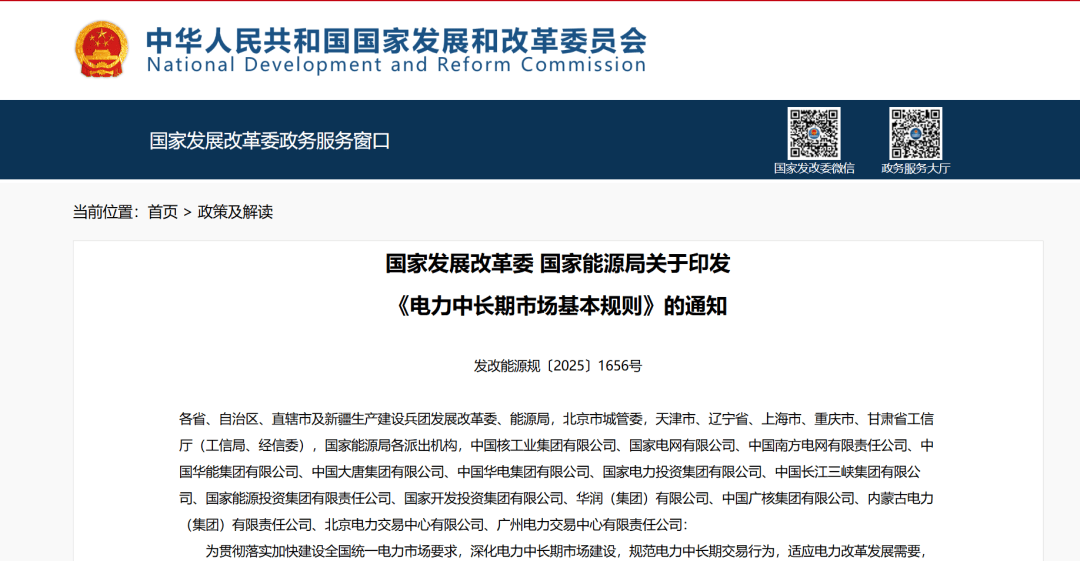
Core Insights - The implementation of the "Basic Rules for Long-term Electricity Market" marks a historic shift in China's electricity market, transitioning from a "planned pricing" era to a new phase characterized by "precise scheduling, flexible pricing, and dynamic competition" [1][3] Group 1: Reform Transition - The new rules signify a fundamental restructuring of China's electricity market across three dimensions: pricing mechanisms, trading models, and stakeholder responsibilities [3] - Fixed time-based electricity pricing has been completely eliminated, with over 27 provinces completing system upgrades and achieving a trading volume of 3.2 trillion kilowatt-hours, representing over 60% of total electricity consumption [3] Group 2: Market Transformation - The introduction of real-time pricing addresses key challenges in the new electricity system, enhancing efficiency across the entire supply chain, including the grid, users, and generation [4] - The essence of this transformation is to restore the commodity nature of electricity, optimizing resource allocation to support carbon neutrality goals and energy security [4] Group 3: AI Integration in Trading - The frequency of trading has increased to every 15 minutes, necessitating rapid data processing and decision-making, making AI an essential component of electricity trading [5] - Real-time pricing is now standard, with electricity prices determined by renewable output, grid load, and user demand, improving scheduling precision from daily to minute-level accuracy, enhancing market liquidity and price discovery [5][6] - The share of market-based trading for renewable energy is projected to exceed 85% post-regulation, moving away from guaranteed pricing and subsidies, thus driving technological upgrades and business model innovations [5] Group 4: International Players Entering the Market - UK-based Octopus Energy has entered the Chinese market by forming a joint venture with China’s Bicheng Energy, focusing on AI-driven electricity trading and virtual power plant operations [7] - Octopus's competitive edge lies in its proprietary Kraken AI platform, which manages 70 million energy accounts globally, setting a benchmark for real-time electricity trading [7] Group 5: Storage Market Expansion - The new pricing rules are expected to catalyze a trillion-yuan market for energy storage, which is essential for managing price volatility and securing stable returns [8] - By the end of 2025, China's new energy storage capacity reached 136 million kilowatts, accounting for over 40% of global installations, with real-time pricing elevating storage from a supporting role to a core market asset [8] Group 6: Future Outlook - The recent rule implementation is just the beginning of China's electricity market reform, with three clear trends emerging: the expansion of real-time pricing, deep integration of AI and storage, and the formation of a comprehensive industry ecosystem [9] - The market for real-time pricing is the largest incremental market globally, with AI trading penetration below 10%, indicating significant growth potential [9] - The projected increase in new energy storage installations to over 50 GW in 2026, doubling from 2025, is expected to drive over 250 billion yuan in industry investments [9]


公用事业行业周报(2026.03.09-2026.03.13):十五五目标明确,强调电力市场改革
Orient Securities· 2026-03-15 07:45
Investment Rating - The report maintains a "Positive" outlook on the utility sector, indicating it is a worthwhile asset for investment [6][3]. Core Insights - The "14th Five-Year Plan" emphasizes specific targets for the energy sector, including a 17% reduction in carbon emissions and a 25% share of non-fossil energy consumption by the end of the plan [6][3]. - The report highlights the ongoing reform of the electricity market, aiming for a unified national electricity market by 2030 and a multi-dimensional pricing system that reflects various values of electricity [6][3]. - The utility sector has shown a recovery post-Chinese New Year, with the Shenwan Utility Index rising by 3.1%, outperforming the CSI 300 Index by 2.9 percentage points [6][3]. Summary by Sections Investment Recommendations and Targets - The report suggests a positive outlook for the utility sector, driven by the restructuring of international order and the need for further market reforms to accommodate high proportions of renewable energy [6][3]. - Specific recommendations include: - Thermal Power: Expected improvement in dividend capacity and willingness, with recommended stocks including Jiantou Energy, Huadian International, Guodian Power, Huaneng International, and Waneng Power [6][3]. - Gas: Beneficiaries of high global gas prices include Shouhua Gas and Xintian Gas [6][3]. - Hydropower: Recommendations for high-quality hydropower stocks such as Yangtze Power and Guotou Power [6][3]. - Nuclear Power: Strong long-term growth potential with recommended stock China General Nuclear Power [6][3]. - Wind and Solar: Focus on leading companies with high wind power ratios, awaiting profitability recovery [6][3]. Industry Dynamics Tracking - Electricity prices in Guangdong and Shanxi have seen significant year-on-year declines, with Guangdong's average price down by 13.8% and Shanxi's by 25.0% [9][10]. - Domestic coal prices have decreased, with the Qinhuangdao Q5500 coal price at 729 RMB/ton, down 1.9% week-on-week [13][14]. - International gas prices remain high, with the Dutch TTF gas price at 50.1 EUR/MWh, down 6.1% week-on-week but up 19.1% year-on-year [25][26]. - The Three Gorges Reservoir's outflow has increased, with a weekly average outflow of 8793 cubic meters/second, up 4.0% week-on-week [30][31]. Market Performance - The utility sector outperformed the broader market, with a 3.1% increase in the Shenwan Utility Index compared to a 0.2% increase in the CSI 300 Index [38][39]. - Sub-sector performance showed wind power leading with an 8.5% increase, followed by solar power at 5.3% [40][41].
公用事业行业周报(2026.03.09-2026.03.13):十五五目标明确,强调电力市场改革-20260315
Orient Securities· 2026-03-15 07:11
Investment Rating - The report maintains a "Positive" outlook on the utility sector, indicating it is a worthwhile asset for investment [6][3]. Core Insights - The "14th Five-Year Plan" emphasizes specific targets for the energy sector, including a 17% reduction in carbon emissions and a 25% share of non-fossil energy consumption by the end of the plan [6][3]. - The report highlights the ongoing reform of the electricity market, aiming for a unified national electricity market by 2030 and a market-based pricing mechanism for various energy sources [6][3]. - The utility sector has shown a recovery, with the Shenwan Utility Index rising by 3.1%, outperforming the CSI 300 Index by 2.9 percentage points [6][3]. Summary by Sections Investment Recommendations and Targets - The report suggests a positive outlook for the utility sector, driven by the restructuring of international order and the need for further market reforms to accommodate high proportions of renewable energy [6][3]. - Specific recommendations include: - Thermal Power: Expected improvement in dividend capacity and willingness, with suggested stocks including Jiantou Energy, Huadian International, Guodian Power, Huaneng International, and Waneng Power [6][3]. - Gas: Beneficiaries of high global gas prices include upstream gas assets, with related stocks being Shouhua Gas and Xintian Gas [6][3]. - Hydropower: Recommended to invest in quality hydropower assets, with stocks like Yangtze Power and Guotou Power [6][3]. - Nuclear Power: Strong long-term growth potential, with China General Nuclear Power as a related stock [6][3]. - Wind and Solar: Anticipated growth under carbon neutrality expectations, with a focus on leading companies in the sector [6][3]. Industry Dynamics - Electricity prices in Guangdong and Shanxi have seen significant year-on-year declines, with Guangdong's average price down by 13.8% and Shanxi's by 25.0% [9][10]. - Domestic coal prices have decreased, while port inventories have increased, indicating a shift in supply dynamics [13][22]. - International gas prices remain high, influenced by geopolitical tensions, with LNG prices in China rising significantly [25][27]. Market Performance - The utility sector has outperformed the broader market indices, with notable weekly gains across various sub-sectors, particularly wind and solar [38][40]. - Individual stock performances show significant increases for companies like Huadian Energy and Xiexin Energy, while some companies faced declines [44].
公用事业行业周报:再度强调价格改革,算电协同助发展
Orient Securities· 2026-03-08 10:24
Investment Rating - The report maintains a "Positive" outlook for the utility sector [8] Core Insights - The report emphasizes the need for price reform in public utilities and highlights the synergy between computing power and electricity to support the development of the AI industry [8] - The government work report reiterates the importance of advancing the construction of a unified national market and gradually promoting price reforms in public utilities and public services [8] - The utility sector is expected to benefit from the revaluation of physical assets amid macroeconomic changes, with the Shenyuan Utility Index rising by 3.4% during the week, outperforming the CSI 300 Index by 4.5 percentage points [8][48] Summary by Sections Industry Overview - The report discusses the anticipated stable growth in electricity demand and the gradual increase in the installed capacity of renewable energy sources [8] - It notes that the price of natural gas has surged due to geopolitical tensions, which may lead to higher domestic gas prices than previously expected [8] Investment Recommendations - The report recommends investing in the utility sector, highlighting the following: - The trend of low interest rates and policy encouragement for long-term capital investment [8] - The necessity for further market-oriented price reforms to support the complex new power system construction [8] - Specific stock recommendations include: - Thermal Power: JianTou Energy, Huadian International, Guodian Power, Huaneng International, and WanNeng Power [8] - Gas: Shouhua Gas and Xinneng Gas [8] - Hydropower: Yangtze Power, Guotou Power, Guigang Power, and ChuanTou Energy [8] - Nuclear Power: China General Nuclear Power [8] - Wind and Solar: Longyuan Power [8] Market Dynamics - The report tracks recent trends in electricity prices, noting a decline in spot electricity prices in Guangdong and Shanxi [11][13] - It highlights the fluctuations in coal prices, with a slight decrease in port coal prices and an increase in port inventories [16][26] - The report also notes significant increases in natural gas prices, both domestically and internationally, due to supply chain disruptions [35][37]
移动储能车爆发前夜
高工锂电· 2026-03-07 05:44
Core Viewpoint - The article highlights the emerging market for mobile energy storage vehicles, which are gaining traction as a flexible and efficient solution in the energy sector, particularly in response to the growing demand for energy transition and decentralized energy systems [4][25]. Group 1: Industry Development - A niche market for mobile energy storage vehicles is quietly forming, with various players actively deploying these systems [4][5]. - Major state-owned enterprises like Southern Power Grid and State Grid have begun operating mobile energy storage vehicles in multiple provinces, showcasing their utility in high-traffic areas [6][14]. - Companies such as XINWANDA, Guoxuan High-Tech, and Yingke Shuneng are among those delivering mobile energy storage vehicles, indicating a diverse competitive landscape [7][10]. Group 2: Market Players - The market features a variety of players, including battery manufacturers, specialized integrators, and vehicle manufacturers, each leveraging their core strengths to enter the market [8][10]. - Key players include XINWANDA, Guoxuan High-Tech, and Yingke Shuneng, with products ranging from high-capacity vehicles to specialized solutions for specific industries [12][11]. Group 3: Product Characteristics - Mobile energy storage vehicles are categorized into several types based on capacity and application, including large capacity models (1 MWh to 2+ MWh) and modular designs [15][19]. - For instance, XINWANDA's 2 MWh mobile storage vehicle features advanced liquid cooling technology and can replace diesel generators, significantly reducing operational costs [17][19]. Group 4: Commercialization and Applications - Companies like Yingke Shuneng have successfully deployed mobile storage vehicles for commercial use, achieving over 60% savings in electricity costs compared to diesel generators [13]. - The Southern Power Grid has implemented zero-carbon mobile storage vehicles in Shenzhen, while State Grid has deployed several units for emergency charging in service areas [14]. Group 5: Trends and Future Outlook - The mobile energy storage vehicle market is evolving towards regular use and smart integration into energy systems, with four key trends identified: broadening application scenarios, technological advancements, integration into new power systems, and innovative business models [22][25]. - The market is transitioning from selling equipment to offering comprehensive services, including hardware, operations, and data management, exemplified by Guoxuan High-Tech's flexible leasing models [25].
独家 | 15家储能企业,给出2026年关键预判
行家说储能· 2026-03-03 04:40
Core Viewpoint - The article discusses the significant changes and trends in the energy storage industry as it approaches 2026, highlighting seven major changes and three core constants that will shape the future of the sector [3][7]. Group 1: Seven Major Changes in the Energy Storage Industry - The role of energy storage has evolved from being a passive supporting facility for renewable energy installations to an active necessity for grid operation, becoming a key node in the energy ecosystem [3][4]. - The driving factors for energy storage have shifted from a reliance on policy-driven fixed income to market-driven operational revenue, marking a transition from a focus on scale to system construction [3][4]. - The business model has transformed into a "storage+" approach, enhancing value through system collaboration, moving from short-term profit-taking to long-term and diversified revenue streams [3][4]. - Market focus has expanded into deeper niche areas, with new hotspots emerging in integrated solar-storage-charging systems, commercial and industrial applications, and innovative storage devices for distribution management [4]. - Technological pathways are diversifying, with a shift from lithium batteries to sodium-ion and flow batteries for long-duration storage applications in specific scenarios [4]. - Customer demand has evolved from a singular focus on price to a comprehensive evaluation of lifecycle value, emphasizing return on investment and operational efficiency [4]. - Competitive dynamics are shifting from scale to value, necessitating companies to possess a comprehensive understanding of technology, market, and trading [4]. Group 2: Three Core Constants in the Energy Storage Industry - The value of energy storage remains unchanged as a critical adjustment resource in the new power system, supporting renewable energy consumption and ensuring grid safety [7]. - The core market demand for energy storage, focusing on safety, stability, and sustainable value, has not altered despite changes in policy and market mechanisms [8]. - The long-term trend towards green and low-carbon energy remains a constant driving force in the industry, particularly as the dual carbon strategy progresses [8]. Group 3: Insights for 2026 - Key variables for 2026 include the full integration of the electricity spot market and the operationalization of virtual power plants, enhancing the role of energy storage in grid interaction [11][12]. - The focus on zero-carbon industrial parks and the retrofitting of existing power stations are expected to be significant growth areas, driven by the need for compliance with safety regulations and efficiency improvements [12][13]. - The industry is transitioning from a focus on large-scale construction to high-quality development, with an emphasis on integrated energy solutions and the optimization of lifecycle value [13][16]. Group 4: Commercial and Industrial Storage Innovations - The commercial energy storage sector is poised for breakthroughs in application scenarios, with new technologies such as cross-system scheduling control and large-capacity battery products being developed to meet market demands [20][22]. - The integration of energy storage with virtual power plants and trading operations is expected to deepen, creating new revenue opportunities and enhancing operational efficiency [31][32]. - Companies are focusing on long-duration discharge capabilities and multi-dimensional revenue models to adapt to the evolving market landscape [26][29].

外资入局中国电力市场,数据安全如何实现合规可控?
Xin Lang Cai Jing· 2026-03-02 08:23
Core Insights - The joint venture, Bitong Energy, established by Bicheng Energy and Octopus Energy, focuses on electricity trading and smart energy services, emphasizing data security solutions [1][2] - The collaboration took approximately seven months to finalize, driven by a strong alignment in strategy, resources, and vision between the two companies [1] - Bicheng Energy aims to localize technology solutions to meet the complex regulatory environment of the Chinese electricity market, rather than simply importing foreign platforms [1][2] Data Security Framework - Bitong Energy's core principle is that all data, systems, operations, and security frameworks for domestic business will operate within China [2] - The company will adhere to Chinese data security laws, implementing strict data classification and access control measures, while minimizing unnecessary cross-border data flow [2] - New research and intellectual property developed for the Chinese market will be managed locally, ensuring core capabilities remain within the domestic team [2] Technical Strategy - The company plans to adapt its technical strategies and models to the unique characteristics of different provincial electricity markets, allowing for dynamic adjustments [3] - Bitong Energy's development aligns with national policies promoting the integration of renewable energy into the electricity market [3][4] - The company intends to utilize virtual power plants to aggregate user-side adjustable loads and distributed energy resources, enhancing flexibility and market participation [4] Market Positioning - The innovative model aims to help commercial users reduce energy costs while providing support during peak demand periods, thereby enhancing grid resilience [4] - As the electricity market undergoes reform, the ability to drive innovation through technology is becoming a critical competitive factor for market participants [4]