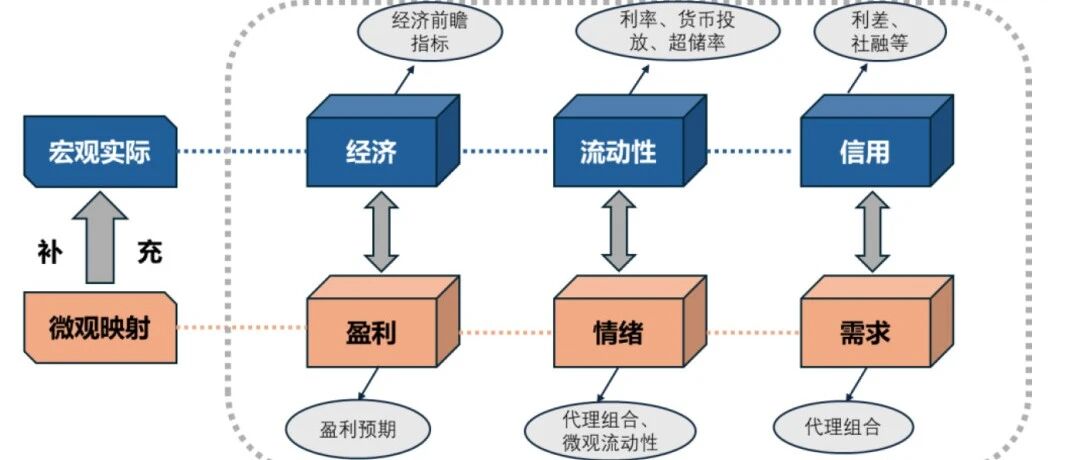
经济前瞻指标

Search documents
成长得分降低、整体风格偏均衡——量化资产配置月报202603
申万宏源金工· 2026-03-03 01:01
Group 1 - The overall growth score has decreased, indicating a balanced style with economic indicators showing weakness, liquidity slightly loose, and credit indicators weakening [1][6][21] - The asset allocation view suggests a slight decrease in gold positions, with bonds improving and U.S. stock positions increasing [1][23] - Economic leading indicators indicate that the downward cycle is nearing its end, with expectations of slight fluctuations in the next three months [11][14] Group 2 - Credit indicators show a stable price and structure, but the total credit volume has weakened significantly, leading to a further decline in comprehensive credit indicators [2][21] - The market focus remains on PPI, which has become the most watched variable, surpassing economic indicators in attention [2][24] - Industry selection remains consistent with previous periods, focusing on sectors that are insensitive to economic changes but sensitive to liquidity and credit [26][28] Group 3 - The liquidity environment is maintained at a slightly loose level, with short-term rates stable and long-term rates slightly declining [17][20] - The comprehensive credit indicators reflect a weak credit environment, with both credit volume and structure remaining low [21][22] - The asset allocation weights indicate a neutral stance on A-shares and a slight increase in bond positions, while gold positions have decreased [23]


量化资产配置月报202603:成长得分降低、整体风格偏均衡-20260301
Shenwan Hongyuan Securities· 2026-03-01 14:45
Group 1 - The growth score has decreased, and the overall style is balanced, indicating a weakening economy, slightly loose liquidity, and deteriorating credit indicators [3][6][9] - The asset allocation view suggests a slight decrease in gold positions, with an improvement in bond perspectives and an increase in US stock positions [3][27] - Economic leading indicators are entering the late stage of a downward cycle, with expectations of slight fluctuations in the next three months before entering another downward cycle in July [3][13] Group 2 - Liquidity is maintained at a slightly loose level, with short-term interest rates stable and long-term rates slightly retreating, indicating a loose monetary signal [3][22][23] - The comprehensive credit indicators have weakened significantly, with both credit volume and structure remaining low, leading to a further decline in the overall credit index [3][26] - The market focus remains highest on PPI, with inflation and liquidity being the most monitored variables, indicating a notable concern for future demand recovery [3][29][30] Group 3 - The industry selection from a macro perspective remains consistent with the previous period, focusing on sectors that are insensitive to economic fluctuations but sensitive to liquidity and credit [3][33] - The top-performing industries based on economic, liquidity, and credit sensitivity scores include electronics, computers, and retail, indicating a strategic focus on these sectors [3][32]
低波因子表现回归、形成共振——量化资产配置月报202602
申万宏源金工· 2026-02-04 01:03
Group 1 - The core viewpoint of the article indicates a return of low volatility factors, forming a resonance in the current economic environment, which is characterized by weakening economic indicators, slightly loose liquidity, and a contraction in credit [1][5][6] - The macroeconomic dimensions suggest a consistent direction of weak economy, loose liquidity, and credit contraction, aligning with previous assessments [5][6] - The article emphasizes the selection of factors that are insensitive to economic changes but sensitive to liquidity and credit, with a notable absence of clear preferences for growth or value factors [6][9] Group 2 - The asset allocation perspective suggests a slight allocation to US stocks, with a positive outlook on bonds despite low overall positions influenced by other assets [21][22] - The economic leading indicators maintain a downward judgment, with predictions indicating a continued decline into early 2026, supported by recent PMI data showing a decrease [9][12] - The liquidity environment is assessed as slightly loose, with short-term interest rates declining and monetary supply showing a neutral signal, while excess reserves continue to decrease [16][19] Group 3 - The article highlights that the market's focus remains on PPI, which has gained prominence over economic indicators, indicating heightened attention to future demand recovery [22][24] - Industry selection continues to favor sectors that are less sensitive to economic fluctuations, particularly TMT (Technology, Media, and Telecommunications) and consumer sectors [24][25] - The analysis of macroeconomic indicators suggests that industries such as electronics, retail, and computing are currently positioned favorably based on their sensitivity to liquidity and credit [25]

量化资产配置月报202601:经济指标出现转弱,PPI关注度维持最高-20260104
Shenwan Hongyuan Securities· 2026-01-04 14:44
Group 1 - The report indicates a shift towards a weaker economic outlook, with liquidity remaining slightly loose and credit indicators showing slight improvement. The macro dimensions suggest a continued trend of weak economy, loose liquidity, and credit contraction [2][8][14] - The asset allocation strategy emphasizes high dividend and low volatility configurations, focusing on factors that are insensitive to economic and credit conditions. The top scoring factors are centered around profitability and dividends, with significant improvements in dividend scores [5][9][30] - The report maintains a high allocation to gold, suggesting a 20% upper limit due to ongoing momentum, while bond views have improved but remain low due to other asset influences [2][27] Group 2 - Economic forward indicators are trending weak, entering the initial phase of a decline since December 2025, with expectations of continued downward movement. Key indicators such as PMI and retail sales are in a downward cycle [14][19] - Liquidity conditions have returned to a slightly loose state, with interest rates stabilizing and short-term rates slightly declining, indicating a shift back to a neutral signal [21][24] - Credit indicators show slight improvement in social financing year-on-year, although the structure of loans to households and enterprises has decreased, indicating a preference in credit indicators [25][26] Group 3 - The market focus remains on PPI, which has surpassed economic indicators in attention, highlighting market concerns regarding future demand recovery [28][29] - Industry selection is biased towards weak cyclical sectors, with top scoring industries including computer and food and beverage sectors, which are less sensitive to economic and credit fluctuations [30][31]
——量化资产配置月报202512:大股票池配置仍偏价值,PPI关注度升至最高-20251201
Shenwan Hongyuan Securities· 2025-12-01 06:38
Group 1 - The core view of the report indicates that the large stock pool allocation remains biased towards value, with a focus on economic recovery, slightly tight liquidity, and credit contraction [3][6][9] - The report emphasizes the selection of factors sensitive to the economy but insensitive to credit, with a preference for value and low volatility in macroeconomic selections [9][10][31] - The allocation viewpoint for major assets suggests an increase in gold allocation to 20%, while A-shares allocation decreases due to economic conditions [27][28] Group 2 - Economic leading indicators are maintained at an upward trend, with predictions indicating a potential downturn starting in the next period [15][19] - Liquidity indicators show a slight tightening, with monetary supply remaining above zero but overall liquidity pointing towards a slightly tight condition [22][25] - Credit indicators are weak, with a low level of credit volume and structure, although there are signs of improvement in the proportion of loans to households and enterprises [26][27] Group 3 - The market focus has shifted to PPI, which has become the most concerning variable, surpassing economic indicators in recent observations [30][29] - The report suggests industry selection should favor sectors sensitive to economic changes but less affected by credit conditions, maintaining a value bias [31][32]
量化资产配置月报202512:大股票池配置仍偏价值,PPI关注度升至最高-20251201
Shenwan Hongyuan Securities· 2025-12-01 05:43
Group 1 - The core view of the report indicates that the large stock pool allocation remains biased towards value, with economic recovery observed, liquidity slightly tight, and credit indicators showing slight improvement. The macro dimensions suggest a direction of economic improvement, weak liquidity, and credit contraction [3][9][15] - The report emphasizes that the allocation of major assets has shifted, with an increased proportion of gold allocation to 20% due to economic upturn, while A-shares allocation has decreased [3][28] - Economic leading indicators are maintained at an upward trend, with predictions indicating that December 2025 will be at the end of a rising cycle since September, although the strength of the indicators is not high [3][15][19] Group 2 - The liquidity environment is slightly tight, with monetary indicators showing a decline. The overall interest rates have remained stable, and the excess reserve ratio has dropped below historical levels [3][23][26] - Credit indicators are weak, with low levels of credit volume and structure. The report notes that the total social financing stock year-on-year remains weak, although there is some improvement in the structure of loans to households and enterprises [3][27][28] - The market focus has shifted to PPI, which has become the most concerning variable, surpassing economic indicators. This reflects the market's heightened attention to future demand recovery [3][30][31] Group 3 - The industry selection from a macro perspective favors sectors that are sensitive to economic changes but insensitive to credit fluctuations, maintaining a value bias [3][32] - The report identifies the highest scoring industries based on economic sensitivity and credit insensitivity, including utilities, coal, and construction decoration as top sectors [3][32]

信用指标修正,价值因子得分提高——量化资产配置月报202511
申万宏源金工· 2025-11-04 08:02
Core Insights - The article discusses the integration of macro quantification and factor momentum to identify resonant factors for investment strategies, emphasizing the importance of economic, liquidity, and credit indicators in shaping market expectations [1][3]. Group 1: Factor Scores and Market Indicators - The macroeconomic indicators show signs of recovery, with economic growth expected to improve, while liquidity is slightly weak and credit conditions are tightening [3][4]. - Value factors have seen a significant increase in scores, becoming resonant factors in the CSI 300 index, while growth factors have declined [4][6]. - The article presents a table of factor scores across different indices, indicating a preference for value and low volatility factors in the current market environment [4]. Group 2: Economic Outlook and Leading Indicators - The economic leading indicators model suggests that the economy is in a rising cycle since September 2025, with a slight upward trend expected in the coming months [6][9]. - Specific indicators such as PMI and fixed asset investment are analyzed, showing a mixed outlook with some indicators in a rising phase while others are nearing a peak [11][12]. - The article highlights the importance of monitoring leading indicators to anticipate future economic cycles and potential downturns [9][10]. Group 3: Liquidity and Credit Conditions - The liquidity environment is assessed as slightly loose despite some tightening in interest rates, with a focus on the net monetary supply and excess reserve rates [12][16]. - Credit indicators show a mixed picture, with overall credit volume and structure remaining low, but some signs of recovery are noted [17][18]. - The article suggests a cautious approach to credit-sensitive investments due to the ongoing tightening in credit conditions [17]. Group 4: Asset Allocation and Market Focus - The asset allocation strategy is adjusted to reflect a neutral to positive stance on A-shares, while reducing exposure to gold and bonds due to changing market dynamics [18]. - The focus on PPI and liquidity as key market drivers indicates a shift in investor sentiment towards these macroeconomic variables [19]. - The article emphasizes the importance of selecting industries that are sensitive to economic changes but less affected by credit conditions, with a preference for sectors like utilities and coal [21].
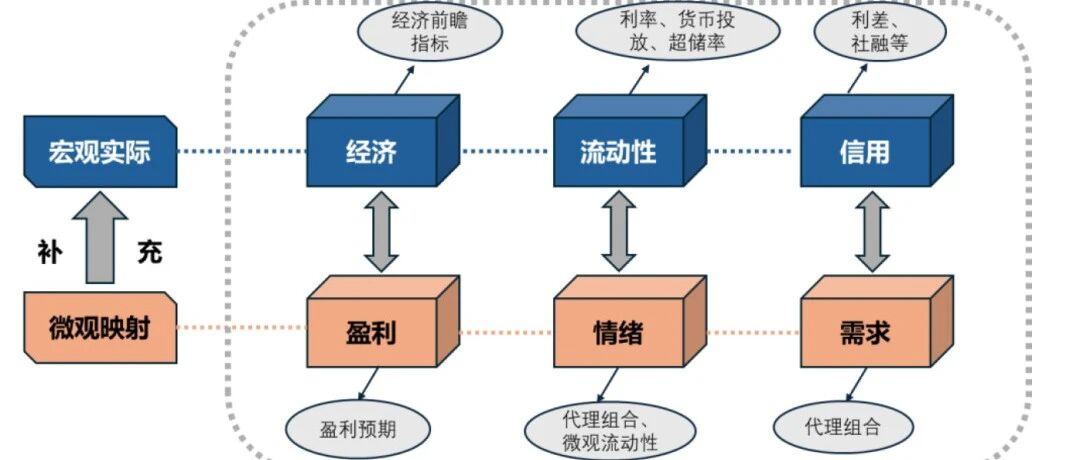
信用指标修正,价值因子得分提高:——量化资产配置月报202511-20251103
Shenwan Hongyuan Securities· 2025-11-03 11:42
Group 1 - The value factor score has improved, indicating a recovery in the economy, with liquidity slightly loose and credit indicators showing slight improvement. The macro direction is characterized by economic recovery, weak liquidity, and credit contraction [3][8][14] - The economic leading indicators are expected to maintain an upward trend, with predictions indicating a peak in March 2026 [14][15] - The liquidity environment is slightly loose overall, despite interest rates being above the average, with monetary supply remaining positive [21][24][22] Group 2 - The credit indicators are weak, with credit volume and structure maintaining low levels, although there has been a slight expansion in credit structure [25][26] - The allocation view for major asset classes indicates a decrease in gold allocation to 10%, while A-shares are favored [26][27] - Market focus has shifted towards economic indicators, with PPI attention rising above economic concerns recently [27][28] Group 3 - The industry selection is inclined towards sectors that are sensitive to economic changes but insensitive to credit fluctuations, with a general preference for value-oriented sectors [29][30] - The top-performing industries based on economic sensitivity include utilities, coal, and construction decoration, while the highest credit scores are seen in retail and banking [30]
量化资产配置月报:信用指标修正,价值因子得分提高-20251103
Shenwan Hongyuan Securities· 2025-11-03 09:46
Group 1 - The value factor score has improved, indicating a recovery in the economy, with liquidity slightly loose and credit indicators showing slight improvement. The macro direction suggests economic recovery, weak liquidity, and credit contraction [3][6][8] - The economic outlook indicator is maintained at an upward trend, with expectations of a slight increase over the next three months, reaching a peak in March 2026 [14][15] - The liquidity environment is characterized by interest rates above the average, but overall remains slightly loose, with monetary supply still positive [23][24][26] Group 2 - The credit indicators are weak, with credit volume and structure remaining low. The total credit indicators continue to decline, while the credit structure shows slight recovery [28] - The allocation view for major asset classes indicates a decrease in gold allocation to 10%, while A-shares allocation is increased [29] - Market focus has shifted towards economic indicators, with PPI attention rising above economic concerns recently [30] Group 3 - Industry selection is inclined towards sectors sensitive to economic changes but insensitive to credit fluctuations, with a general preference for value-oriented industries [32] - The top scoring industries based on economic sensitivity include utilities, coal, and construction decoration, while the highest credit scoring industries include retail and banking [33]
经济前瞻指标小幅回升,因子选择略偏向均衡——量化资产配置月报202510
申万宏源金工· 2025-10-13 08:01
Group 1 - The article emphasizes a balanced approach to factor selection, integrating macroeconomic quantitative insights with factor momentum to identify resonant factors while adjusting for discrepancies between macro and micro indicators [1] - Current macroeconomic indicators show signs of economic recovery, slightly loose liquidity, and improved credit metrics, leading to a revised outlook of economic improvement, weak liquidity, and loose credit [1] - The article presents a table summarizing the performance of various factors across different indices, indicating that growth factors remain strong in the CSI 300, while the CSI 500 shows a more balanced factor selection [2][3] Group 2 - Economic leading indicators are beginning to rise, with the PMI and new orders showing increases, suggesting a slight upward trend in economic activity expected to continue into early 2026 [5][9] - The liquidity environment is assessed as slightly loose despite rising interest rates, with a comprehensive liquidity signal indicating a mixed outlook [11][15] - Credit indicators are showing weakness, with a slight positive shift in overall credit metrics, indicating a complex credit environment [15][16] Group 3 - The article suggests a preference for asset allocation towards gold due to strong momentum, while equity allocations are slightly reduced, reflecting a cautious stance on A-shares [16] - The focus of market attention is shifting from liquidity to economic indicators, with recent trends indicating a growing concern for economic performance over liquidity conditions [17] - Industry selection is advised to favor sectors sensitive to economic changes but less affected by liquidity, with public utilities and coal being highlighted as top sectors based on their sensitivity scores [19]