
货币政策正常化

Search documents
日元疲软触痛政府神经!日本财务大臣释放强烈信号:正密切关注汇市 将与美国紧密沟通
智通财经网· 2026-02-27 06:44
Core Viewpoint - The Japanese government is closely monitoring the recent depreciation of the yen, expressing urgency regarding its impact on import costs and wage growth [1][2] Group 1: Currency Trends - The Japanese Finance Minister, Shunichi Suzuki, indicated a strong sense of urgency in monitoring the yen's depreciation trend [1] - The government is concerned that the yen's weakness could lead to increased import costs, affecting wage growth [1] Group 2: Political Landscape - Prime Minister Fumio Kishida, recently re-elected, is pushing for a shift in fiscal policy towards growth-oriented investment plans and tax cuts, raising concerns about Japan's already heavy debt burden [1] - The market is reacting to these fiscal measures with increased worries about the potential for higher yields on Japanese government bonds, which could further pressure the yen [1] Group 3: Monetary Policy - There is a cautious stance from the Kishida administration regarding further interest rate hikes, with the nomination of two perceived "dovish" scholars to the Bank of Japan's policy board [2] - Despite this dovish sentiment, there are internal calls within the Bank of Japan for vigilance against inflation risks and a gradual approach to interest rate increases [2] - The core CPI data presents mixed signals, with a slight increase in the "core-core" CPI, suggesting that inflation may not be slowing as quickly as anticipated [2]
15个月首次!日本东京CPI跌破2%目标,但央行加息路径未受动摇
Hua Er Jie Jian Wen· 2026-02-27 06:20
Core Viewpoint - Tokyo's inflation unexpectedly cooled, but analysts believe this slowdown will not hinder the Bank of Japan's (BOJ) path towards further tightening monetary policy [1][4] Group 1: Inflation Data - The consumer price index (CPI) in the Tokyo region, excluding fresh food, rose by 1.8% year-on-year in February, down from 2.0% in January, marking the first drop below the BOJ's 2% target since October 2024 [1] - The primary reason for this decline was the government's subsidy policy, which led to a 9.2% year-on-year drop in energy prices [2] - Core inflation, excluding fresh food and energy, increased from 2.5% in January to 2.5% in February, indicating persistent underlying price pressures [2][3] Group 2: Economic Indicators - Retail sales in January grew by 1.8% year-on-year, demonstrating sustained consumer momentum [5] - Industrial output rose by 2.2% month-on-month in January, a significant rebound from a 0.1% decline in December, partly due to pre-holiday stocking [5] - Despite short-term improvements, there are concerns that factory activity may weaken in the coming months, which could diminish the rationale for further rate hikes [5] Group 3: Monetary Policy Outlook - Economists and market participants agree that the BOJ's normalization process is not significantly impacted by the recent inflation slowdown [4] - The probability of a rate hike in April is close to 60%, according to market pricing [1] - The BOJ has maintained a cautious yet proactive stance on rate hikes since raising the policy rate to 0.75% in December [4]
日本通胀连续降温 央行加息步伐或暂缓
Xin Hua Cai Jing· 2026-02-27 05:54
Group 1 - The core CPI in Tokyo increased by 1.8% year-on-year in February, slightly above the market expectation of 1.7%, marking the lowest level since October 2024 and indicating a significant slowdown in inflation [1] - The decline in inflation is attributed to the effectiveness of utility cost subsidy policies implemented by the government, which have helped reduce household energy expenses, alongside a notable decrease in food price increases [1] - The Bank of Japan faces challenges in communicating its monetary policy stance as core inflation remains below 2%, which undermines the justification for further interest rate hikes, especially with the recent nomination of new board members leaning towards easing [1][2] Group 2 - Market expectations for a rate hike in April remain, with traders pricing in a 69% probability, driven by a weak yen and high hopes for the outcomes of the spring labor negotiations [1] - The Bank of Japan's Governor, Ueda, emphasized the importance of the spring labor negotiations as a key decision variable for upcoming policy meetings, indicating that stronger-than-expected wage negotiations could lead to an earlier achievement of inflation targets [2] - The central bank maintains a firm stance, asserting that the current inflation slowdown is temporary and that it is prepared to address the risks of overheating inflation, while also calling for fiscal discipline to ensure long-term market confidence in Japan's fiscal health [2]
高市早苗任命鸽派人士入央行董事会,释放维持宽松信号
Xin Lang Cai Jing· 2026-02-26 10:32
Core Viewpoint - The nomination of two dovish candidates by Prime Minister Sanna Takashi to the Bank of Japan's board signals her opposition to interest rate hikes and raises doubts about the central bank's future tightening capacity [1][6]. Group 1: Nomination Details - The two nominated candidates, scholars Toichiro Asada and Ayano Sato, are known for their pro-inflation stance and will replace current board members with similar views [3][9]. - The Ministry of Finance, which previously participated in the candidate selection process, was excluded from this nomination, indicating a shift in the nomination process [1][2]. Group 2: Market Reactions - Following the announcement of the nominations, the Japanese yen depreciated, reflecting market surprise at the choice of candidates [1][6]. - Analysts suggest that the strong intervention by Prime Minister Takashi in monetary policy could lead to further appointments of pro-inflation members in the future [1][11]. Group 3: Implications for Monetary Policy - The new appointees are not expected to influence short-term monetary policy directly, as they will not participate in the upcoming monetary policy meetings [4][10]. - Despite the dovish appointments, there is increasing pressure within the board for short-term interest rate hikes due to ongoing yen depreciation and high food inflation [5][10]. Group 4: Political Context - The nominations require approval from both houses of the Japanese Diet, with the ruling coalition holding a majority in the House of Representatives but a minority in the House of Councillors, necessitating support from opposition parties [2][7]. - Analysts believe that the political capital gained from recent elections may hinder the Bank of Japan's ability to implement aggressive rate hikes without government approval [11][12].
日本央行鹰派委员呼吁进一步加息 与高市早苗的宽松倾向唱反调
Xin Lang Cai Jing· 2026-02-26 03:51
Core Viewpoint - The divergence between the Japanese government and the Bank of Japan's policy committee is increasing, as Prime Minister Fumio Kishida expresses a desire to continue loose monetary policy while a hawkish member calls for interest rate hikes [1][2]. Group 1: Monetary Policy Stance - Prime Minister Fumio Kishida has indicated a preference for the continuation of loose monetary policy [1][2]. - Hawkish committee member Takeda Haruhiko has called for an adjustment in the policy direction, suggesting that the price stability target has been largely achieved [1][2]. - Takeda voted in favor of interest rate hikes for the second consecutive time during the last policy meeting, surprising observers [1][2]. Group 2: Committee Changes - Prime Minister Kishida nominated two known supporters of loose monetary policy, Aoyama Gakuin University professor Sato Ayano and Chuo University professor Asada Tohiro, to replace outgoing committee members Noguchi Akira and Nakagawa Junko [1][2]. - Noguchi's five-year term will end next month, while Nakagawa's term will conclude in June [1][2]. Group 3: Upcoming Policy Meeting - The Bank of Japan is scheduled to hold a policy meeting on March 18-19, where it is expected to maintain the current policy stance [3].
针锋相对?高市提名两大鸽派入局后 日本央行“鹰王”强硬表态:应继续加息!
Zhi Tong Cai Jing· 2026-02-26 03:41
Core Viewpoint - The divergence between the Japanese government and the Bank of Japan (BOJ) regarding monetary policy is becoming evident, particularly with the recent calls for interest rate hikes from BOJ's most hawkish committee member, Hajime Takata, despite Prime Minister Fumio Kishida's preference for maintaining an accommodative monetary policy [1] Group 1: Monetary Policy Stance - Hajime Takata advocates for further adjustments to the BOJ's policy, suggesting that the inflation stability target has been largely achieved [1] - Takata's recent public statements follow his unexpected proposal for consecutive interest rate hikes during last month's policy meeting, indicating a shift in the internal dynamics of the BOJ [1] - The upcoming BOJ policy meeting on March 18-19 is widely expected to result in no changes to the current monetary policy [1] Group 2: Government and BOJ Relationship - Prime Minister Fumio Kishida has nominated two prominent dovish figures, Toichiro Asada and Ayano Sato, to the BOJ's policy board, which may further highlight the differences in monetary policy perspectives between the government and the central bank [1] - The nominations come as current committee members Asahi Noguchi and Junko Nakagawa are set to complete their terms, with Noguchi's term ending next month and Nakagawa's in June [1]
日本央行鹰派委员呼吁进一步加息 与首相鸽派提名形成对比
Ge Long Hui· 2026-02-26 02:45
Core Viewpoint - The divergence between the Bank of Japan's hawkish policy committee member Takeda and Prime Minister Kishida regarding monetary policy is becoming increasingly evident, with calls for further interest rate hikes amidst a backdrop of ongoing accommodative policies [1] Group 1: Monetary Policy - Takeda, a prominent member of the Bank of Japan, has called for further interest rate hikes, indicating a shift towards policy normalization as the inflation target appears to be nearly achieved [1] - This call for rate increases comes after Takeda's unexpected proposal for consecutive hikes during a recent policy meeting, marking his first public comments since then [1] - The internal conflict within the Bank of Japan is highlighted by Takeda's stance, contrasting with the government's preference for maintaining loose monetary policies, as evidenced by Kishida's recent appointments of two well-known supporters of such policies to the central bank [1]
卸任行长的观察:黑田东彦称日本已摆脱通缩,货币与财政政策亟需转向
Zhi Tong Cai Jing· 2026-02-25 08:41
Core Viewpoint - The former Governor of the Bank of Japan, Haruhiko Kuroda, advocates for continued interest rate hikes and tighter fiscal policies due to Japan's healthy economic state, while warning that Prime Minister Fumio Kishida's large-scale spending plans may accelerate inflation [1][2]. Group 1: Economic Conditions and Predictions - Kuroda predicts that the Bank of Japan should implement approximately two interest rate hikes per year in 2026 and 2027, aiming to gradually raise the benchmark interest rate to a neutral level that neither stimulates nor suppresses the economy [1][2]. - Japan has reportedly moved past decades of deflation, making the normalization of monetary policy essential to support the yen and prevent economic overheating [1][2]. Group 2: Policy Divergence - There is a significant policy divergence between Kuroda and Kishida, with Kuroda expressing skepticism about the appropriateness of increased spending and tax cuts proposed by the current administration [1][3]. - Kishida's administration has increased spending and temporarily suspended an 8% consumption tax on food to alleviate rising living costs, which Kuroda warns could exacerbate inflation and raise bond yields [3]. Group 3: Currency and Inflation Concerns - Kuroda acknowledges that the yen is currently too weak, suggesting that interest rates could rise to between 1.5% and 1.75% in the coming years if economic growth continues [4][5]. - The depreciation of the yen is contributing to higher import costs, thereby intensifying overall inflationary pressures [4][5]. Group 4: Communication and Policy Implementation - Kuroda emphasizes that while monetary interventions can have short-term effects on the yen, they do not guarantee lasting impacts, advocating for a more subdued communication approach as the Bank of Japan seeks to normalize policies [5].
IC外汇平台:日本经济长期疲软 日元购买力降至53年最低
Sou Hu Cai Jing· 2026-02-24 03:46
Group 1: Currency and Economic Indicators - The actual effective exchange rate index of the yen fell to 67.73 in January, the lowest since 1973, indicating a significant decline in the yen's purchasing power for overseas goods [1] - Compared to the historical high of 193.95 in April 1995, the current purchasing power of the yen has shrunk to about one-third of that level [1] - Japan's potential economic growth rate has decreased from approximately 1% in 1995 to around 0% by the end of the second decade of the 21st century, contributing to long-term low inflation and interest rates [1] Group 2: Industry and Investment Climate - Traditional manufacturing sectors in Japan, such as automotive and electronics, are facing competitive pressure from emerging economies, while the digital economy is lagging, leading to a normalization of trade deficits [3] - Domestic investment sentiment is low due to poor returns on investment, despite the theoretical boost in export competitiveness from yen depreciation [3] - The Bank of Japan has raised interest rates from -0.1% to 0.75% over the past two years, with expectations of further increases to 1.5% to 1.75%, aimed at addressing inflation and exiting ultra-loose monetary policy [3] Group 3: Macroeconomic Impact on Society - The decline in yen purchasing power directly affects the cost of living in Japan, with rising prices for imported goods like energy and food, while wage growth has not kept pace with inflation [4] - In 2025, the average real wage in Japan is projected to decrease by 1.3%, marking four consecutive years of decline, which undermines consumer confidence [4] - The Bank of Japan's monetary policy normalization must balance inflation pressures with economic resilience, as the ability of households and businesses to withstand interest rate hikes is crucial for the future economic outlook [4]

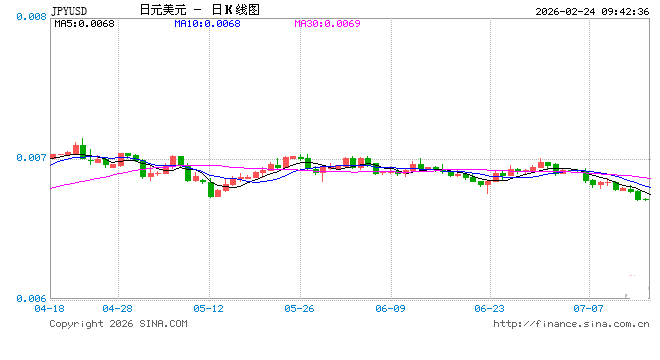
日元购买力跌至53年来最低
Sou Hu Cai Jing· 2026-02-24 01:10
Group 1 - The Japanese yen's real effective exchange rate index has reached a 53-year low, reflecting a significant decline in purchasing power against major currencies, down approximately two-thirds from its peak in 1995 [1][2] - As of January this year, the real effective exchange rate index stands at 67.73, the lowest level since 1973, indicating a persistent weakness in the yen's purchasing power for overseas goods [1] - Despite the Bank of Japan raising interest rates from -0.1% to 0.75% over the past two years, the yen remains weak, with projections suggesting it may approach a 38-year low by mid-2024 [1][2] Group 2 - One of the main factors contributing to the yen's decline is Japan's prolonged economic stagnation following the collapse of its bubble economy, with potential economic growth rates dropping from around 1% in 1995 to near 0% by the end of the 2010s [2] - The Bank of Japan is attempting to normalize monetary policy amid rising prices and wages, with plans to further increase the policy interest rate, currently at a 30-year high [2] - Analysts predict that if the policy rate is raised by 0.25 percentage points, households with debt could face an additional annual repayment burden of approximately 18,000 yen, while corporate profits (excluding financial and insurance sectors) could see an average decline of 0.9% [2]